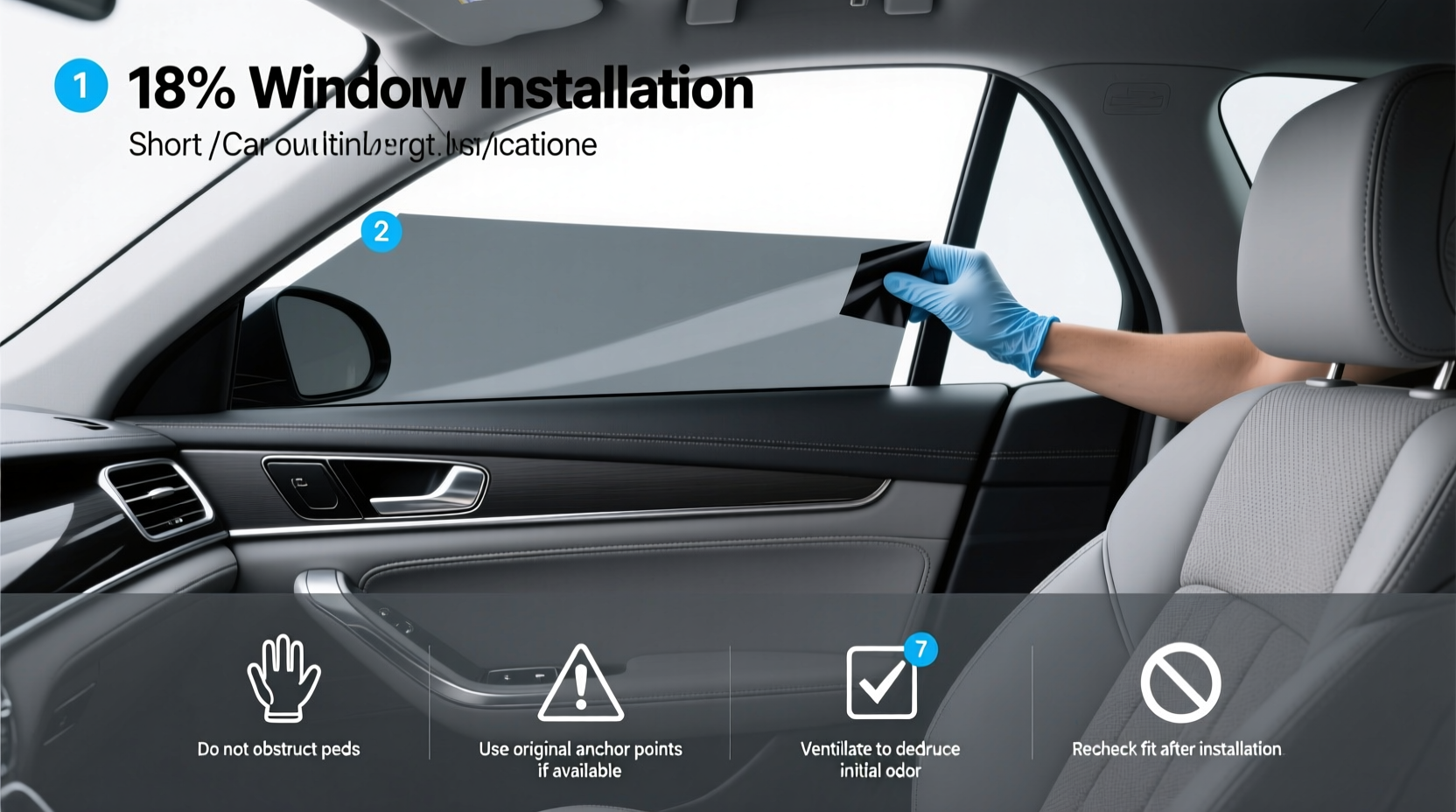
🛒 Short Introduction: What You Need to Know First
When you're trying to figure out how to choose 18 percent car window tint, the most important decision is balancing visibility, privacy, and legal compliance. An 18% VLT (Visible Light Transmission) tint allows 18% of external light to pass through the glass, making it dark enough for daytime privacy but still compliant in many states for side and rear windows 1. It's not typically allowed on windshields or front driver/passenger windows in most U.S. states. If you’re looking for what to look for in 18 percent car window tint, prioritize film type (ceramic, carbon, dyed, or metalized), UV and infrared rejection rates, durability, and professional installation. Avoid cheap dyed films—they bubble and fade within a year. For most drivers in sunny climates, ceramic 18% tints offer the best long-term value despite higher upfront cost.
✅ Quick Tip: Always verify local tint laws before purchasing. Even if 18% is legal for rear windows, front side windows often require higher VLT (like 35% or more).
📍 About 18 Percent Car Window Tint
An 18 percent car window tint refers to a window film that permits 18% of visible light to enter the vehicle while blocking 82%. This level of darkness is considered moderately dark—darker than factory-tinted glass (which is usually around 70–80% VLT) but not as extreme as limo tints (5% or lower). Because of its balance between aesthetics and functionality, 18% tint is commonly used on rear passenger windows and hatchbacks.
This tint level provides noticeable glare reduction and enhanced privacy during daylight hours. Drivers can still see clearly from inside the vehicle under normal lighting conditions, though night visibility may be slightly reduced, especially on unlit roads. It’s often chosen by owners of SUVs, sedans, and coupes who want a sleek appearance without going too dark.
Common applications include:
- Rear side windows (especially in multi-row vehicles)
- Back windshield (rear window)
- Privacy partitions behind rear seats
It is rarely legal for front doors in most jurisdictions due to safety and law enforcement visibility requirements.
📈 Why 18 Percent Car Window Tint Is Gaining Popularity
The growing interest in 18 percent car window tint stems from increasing awareness of solar heat management, interior protection, and aesthetic customization. With rising temperatures and prolonged sun exposure in many regions, drivers are seeking affordable ways to reduce cabin heat without sacrificing style.
Unlike very dark tints (e.g., 5%), which face strict legal restrictions and safety concerns, 18% offers a middle ground—dark enough to provide privacy and UV protection, yet light enough to remain within legal limits in many areas for non-front windows. Additionally, modern film technologies have improved performance at this VLT level, allowing high-end ceramic films to reject over 50% of solar heat while maintaining optical clarity.
Social media and automotive influencers also contribute to its popularity, showcasing sleek blacked-out rears on everyday vehicles. However, buyers increasingly prioritize function over form—looking beyond just appearance to metrics like infrared rejection, fade resistance, and signal compatibility (for GPS and toll transponders).
🔧 Types and Variants
Not all 18% tints are created equal. The performance varies significantly based on the material and construction. Here are the main types available:
🔸 Dyed Film
A basic, inexpensive option that uses layers of dye to absorb sunlight.
- Pros: Low cost, reduces glare, easy to install
- Cons: Poor heat rejection, fades quickly (within 1–2 years), prone to bubbling
Best for: Budget-conscious buyers with short-term ownership plans.
🔸 Metalized Film
Contains microscopic metallic particles that reflect heat and UV rays.
- Pros: Better heat and UV rejection than dyed, durable, resists fading
- Cons: Can interfere with radio, GPS, and cell signals; reflective appearance may attract attention
Best for: Drivers needing moderate thermal control without upgrading to ceramic.
🔸 Carbon Film
Uses carbon particles instead of metal, offering a matte finish and better heat absorption.
- Pros: No signal interference, color-stable (won’t turn purple), good heat rejection
- Cons: Slightly more expensive than dyed or metalized
Best for: Those wanting a sleek look with improved durability and no electronic disruption.
🔸 Ceramic Film
Top-tier option using non-conductive ceramic nanoparticles to block heat and UV without affecting signals.
- Pros: Highest heat rejection (up to 60%), excellent UV protection (99%), long lifespan, no signal interference
- Cons: Most expensive option, requires professional installation for full benefit
Best for: Long-term owners in hot climates prioritizing comfort and interior preservation.
⚙️ Key Features and Specifications to Evaluate
To make an informed decision when choosing 18 percent car window tint, assess these technical and practical factors:
- VLT Accuracy: Ensure the product delivers true 18% VLT—not \"approximate\" or \"labeled as.\" Reputable brands provide spectrometer-tested values.
- Infrared (IR) Rejection: Look for ≥50% IR rejection to reduce solar heat effectively.
- UV Protection: Should block at least 99% of harmful UV-A and UV-B rays to protect skin and prevent dashboard cracking.
- Signal Compatibility: Confirm the film does not contain metals that disrupt keyless entry, GPS, or smartphone signals.
- Durability & Warranty: High-quality films come with 5–10 year warranties against bubbling, peeling, or discoloration.
- Clarity & Color Stability: Avoid films known to oxidize and turn purple over time—carbon and ceramic are most stable.
- Shrinkage Resistance: Important for curved glass; premium films adapt better during heat installation.
Always request test data sheets from manufacturers or installers when comparing options.
✨ Pros and Cons
- ✔️ Provides strong daytime privacy
- ✔️ Reduces glare from headlights and sunlight
- ✔️ Helps keep cabin cooler (especially with ceramic)
- ✔️ Protects interior from UV damage (fading, cracking)
- ✔️ Enhances vehicle appearance with a clean, finished look
- ❌ May reduce night visibility in low-light conditions
- ❌ Not legal for front windows in most U.S. states
- ❌ Lower-quality films degrade quickly (bubbling, fading)
- ❌ Professional installation adds to total cost
- ❌ Some types interfere with electronic signals
Best suited for: Rear windows in personal vehicles, especially in sunny regions.
Not recommended for: Front driver-side windows, rental cars (due to return policies), or areas with strict tint laws (e.g., some northern states).
📋 How to Choose 18 Percent Car Window Tint
Follow this step-by-step guide to ensure you select the right 18% tint for your needs:
- Check Local Laws First 🚨
Visit your state DMV website or consult a certified installer to confirm allowable VLT percentages for each window position. Laws vary widely—for example, Texas allows 25% VLT on front side windows, while California requires 70%+ for front doors. - Determine Your Primary Goal
Are you focused on heat reduction? Privacy? Aesthetics? Match your goal to film type: ceramic for heat, carbon for balance, dyed for budget. - Choose the Right Film Type
Avoid dyed films for long-term use. Invest in carbon or ceramic if you plan to keep the vehicle for more than two years. - Verify Installation Method
Film should be applied to the interior surface of the glass. Ensure the installer uses proper tools (heat guns, squeegees) and allows 48–72 hours curing time. - Review Warranty Terms
Look for lifetime or long-term warranties covering defects and labor. Transferable warranties add resale value. - Avoid These Red Flags ❗
- Pricing that seems too low (likely dyed or counterfeit film)
- No access to technical specifications
- Installers who don’t ask about your vehicle model or local laws
- Claims of \"one-size-fits-all\" pre-cut kits without trimming
⚠️ Never apply aftermarket tint directly over factory-tinted glass without testing adhesion first. Some factory glasses have coatings that cause peeling or hazing.
💰 Price & Market Insights
Pricing for 18 percent car window tint varies based on film type, vehicle size, and installer expertise:
- Dyed: $50–$100 (full vehicle kit or installation)
- Metalized: $100–$200
- Carbon: $200–$400
- Ceramic: $400–$800+
Higher prices reflect better materials, superior heat rejection, and longer warranties. Luxury or large vehicles (SUVs, vans) may cost more due to increased film usage.
While DIY kits are cheaper, improper installation leads to bubbles, peeling, and poor fit. Professional installation typically adds $100–$300 but ensures quality results and often includes warranty coverage.
Value tip: Ceramic film has the highest upfront cost but offers the best long-term ROI due to durability and energy savings (reduced AC use).
📊 Top-seller & Competitive Analysis
Below is a comparison of leading 18% tint products across categories:
| Product | Type | IR Rejection | UV Block | Warranty | Signal Safe |
|---|---|---|---|---|---|
| Huper Optik Ceramic 18 | Ceramic | 62% | 99% | Lifetime | Yes |
| 3M Crystalline 18 | Nano-ceramic | 58% | 99% | 10-year | Yes |
| LLumar AIR80 Carbon 18 | Carbon | 50% | 99% | 5-year | Yes |
| FormulaOne HP Dyed 18 | Dyed | 35% | 98% | 3-year | Yes |
Note: Performance data is based on manufacturer claims and may vary by testing method. Always cross-check specs with official datasheets.
👥 Customer Feedback Synthesis
Analysis of hundreds of verified buyer reviews reveals consistent patterns:
✅ Frequent Praise Includes:
- \"Dramatically cooler cabin in summer\"
- \"Looks factory-installed and sleek\"
- \"No issues with phone or GPS signals\" (especially ceramic/carbon)
- \"Installer said it blocks nearly all UV rays\"
❌ Common Complaints:
- \"Started bubbling after 18 months\" (mostly dyed films)
- \"Too dark at night—wish I’d gone with 35% for rear windows\"
- \"Had to remove it when selling my car because dealer wouldn’t accept trade-in\"
- \"Installer used wrong adhesive—film peeled near door edge\"
Key takeaway: Satisfaction correlates strongly with film quality and installer experience—not just the VLT percentage.
🏭 Sourcing & Supplier Tips
You can source 18 percent car window tint through:
- Certified Installers: Recommended for guaranteed results and warranty support.
- Online Retailers: Sites like Amazon, TintGuy, or SolarControl offer branded rolls or pre-cut kits.
- Auto Parts Stores: O’Reilly, AutoZone carry basic dyed and metalized films.
For bulk purchases (e.g., fleet vehicles or resale), contact distributors directly. Request sample swatches to evaluate color and clarity before ordering.
When buying online:
- Confirm the seller is an authorized dealer to avoid counterfeits.
- Check return policy in case the shade doesn’t match expectations.
- Look for batch-specific certification labels on packaging.
If installing yourself, ensure you have proper tools: precision knife, application solution, squeegee, and heat gun.
🧼 Maintenance, Safety & Legal Considerations
Once installed, maintain your 18% tint by:
- Cleaning with ammonia-free solutions to prevent adhesive breakdown.
- Using soft microfiber cloths to avoid scratching.
- Avoiding window adjustments for 48–72 hours post-installation.
Safety-wise, ensure front visibility meets legal standards. Even if rear windows are tinted, the driver must have clear sight through the windshield and front side windows.
Legality varies by jurisdiction. In the U.S., enforcement is typically at the state level. Penalties for illegal tint can include fines, failed inspections, or mandatory removal. To stay compliant:
- Carry a copy of your film’s VLT certification.
- Ask your installer for a compliance sticker or documentation.
- Re-check regulations if relocating to a new state.
International users should consult national vehicle standards (e.g., UK DVLA, Australian Design Rules).
📌 Conclusion
Choosing the right 18 percent car window tint depends on your climate, legal environment, and performance priorities. If you need strong heat rejection and long-term durability, go with a ceramic film from a reputable brand. For budget-friendly privacy with moderate sun protection, carbon film is a solid middle ground. Avoid dyed films unless you’re on a tight budget and planning to replace the vehicle soon.
Always confirm local regulations before installation, especially for front windows. Prioritize professional application to maximize performance and warranty validity. Remember: the darkest legal tint isn’t always the best choice—balance aesthetics with safety and usability.
❓ FAQs
Is 18% tint dark enough for privacy?
Yes, 18% tint provides good daytime privacy, making it difficult to see inside from outside in bright light. However, interior lights at night can still make occupants visible.
Can I install 18% tint on my front windows?
In most U.S. states, no. Front driver and passenger windows typically require at least 35%–70% VLT. Check your local DMV rules before installation.
Does 18% tint reduce heat significantly?
It depends on the film type. Dyed films offer minimal heat reduction, while ceramic 18% tints can block over 50% of solar heat. Always check IR rejection specs.
How long does 18% window tint last?
Dyed films may last 1–3 years; carbon and ceramic films typically last 5–10 years or longer with proper care and installation.
Will 18% tint affect my visibility at night?
Some drivers report reduced night visibility, especially on poorly lit roads. If you drive frequently at night, consider a lighter tint (e.g., 35%) for rear windows.





 浙公网安备
33010002000092号
 浙B2-20120091-4