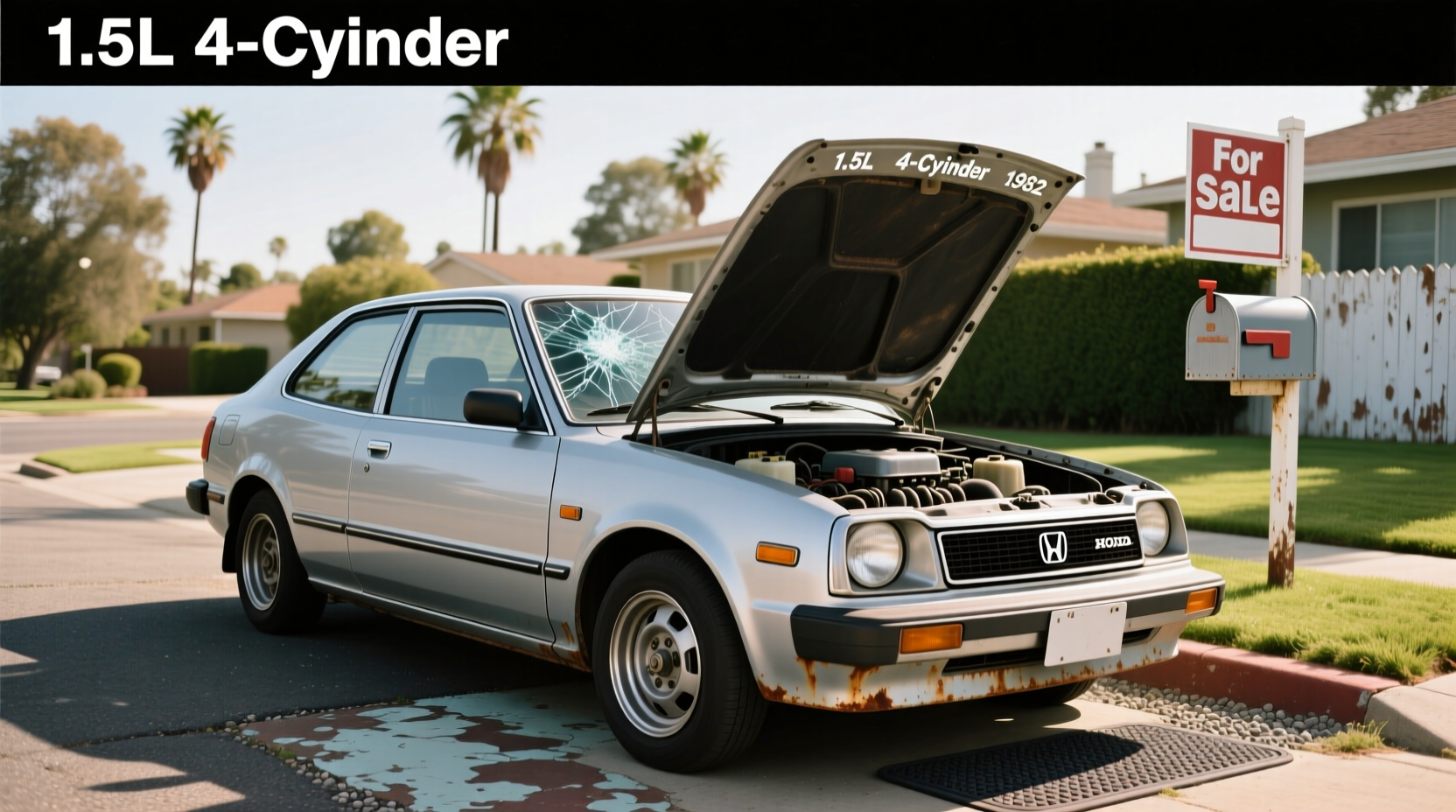
If you’re looking at a 1982 Honda Civic hatchback, here’s how to choose: focus on the 1.3L vs. 1.5L engine difference, trim level (DX, GL, or S), and transmission type. Most models came with a 1.3-liter inline-four (1335cc) CVCC engine—ideal for fuel efficiency and basic city driving. The 1.5L version (1488cc), found in higher trims like the GL, offers slightly better acceleration but may be harder to source parts for today. If you’re a typical user, you don’t need to overthink this: the 1.3L is simpler, more reliable, and easier to maintain. Avoid cars with mismatched VINs or unclear service history—these are red flags regardless of engine size.
About the 1982 Honda Civic Hatchback
The 1982 Honda Civic hatchback belongs to the second generation (1979–1983) of the Civic lineup, known for its compact footprint, lightweight design, and exceptional fuel economy. This model year sits near the end of the Mk2 run, benefiting from minor refinements in comfort and emissions control while retaining the mechanical simplicity that made early Civics iconic. Available as a three-door hatchback, it was marketed as an affordable, practical commuter car during a period when fuel efficiency was a top concern in many markets.
It featured a front-engine, front-wheel-drive layout and came in multiple trim levels—common ones include the DX, GL, and S—with variations in engine output, interior features, and exterior styling. Over the past year, interest in these vehicles has grown among urban collectors and minimalist drivers who value mechanical transparency and low ownership costs. This piece isn’t for keyword collectors. It’s for people who will actually use the product.
Why the 1982 Civic Hatchback Is Gaining Popularity
Lately, there's been a quiet resurgence in demand for small, analog cars like the 1982 Civic hatchback. This shift isn't driven by nostalgia alone. Drivers are reacting to rising insurance costs, complex electronics in modern vehicles, and the increasing weight and size of new compacts. The 1982 Civic stands out because it delivers predictable handling, minimal maintenance needs, and a sense of direct control often missing in today’s drive-by-wire systems.
Additionally, its compact dimensions make it ideal for tight city parking, and its mechanical simplicity means owners can perform many repairs themselves. While not powerful by modern standards, its lightweight chassis gives it a nimble feel on winding roads. If you’re a typical user, you don’t need to overthink this: if your goal is low-cost, dependable transportation with character, the '82 Civic remains a rational choice—even decades later.
Types and Variants
The 1982 Civic hatchback was offered in several trims, each targeting different priorities. Understanding these helps clarify what you're likely to encounter in today’s market.
DX (Standard Model)
- Engine: 1.3L (1335cc) inline-four, CVCC technology
- Transmission: 4-speed manual or 2-speed Hondamatic
- Features: Basic instrumentation, manual windows, vinyl seats
Pros: Highest fuel efficiency, simplest mechanics, easiest to repair.
Cons: Minimal sound insulation, fewer creature comforts, lower resale appeal to collectors.
GL (Higher Trim)
- Engine: 1.5L (1488cc) inline-four, CVCC
- Transmission: 5-speed manual or Hondamatic
- Features: Cloth upholstery, tachometer, upgraded trim, optional rear wiper
Pros: Better acceleration, improved interior quality, more desirable for preservation.
Cons: Slightly lower MPG, rarer in good condition, potential for rust in fenders and floor pans.
S Model (Sport-Inspired)
- Engine: 1.3L or 1.5L depending on market
- Transmission: 5-speed manual standard
- Features: Sport suspension, blacked-out trim, center console
Pros: Sharper handling, enthusiast-focused tuning.
Cons: Limited availability outside Japan and Europe, often modified—hard to find original examples.
Key Features and Specifications to Evaluate
When assessing a 1982 Civic hatchback, prioritize function over form. These core elements determine long-term usability.
Engine Type (1.3L vs. 1.5L)
When it’s worth caring about: If you plan daily driving or value smooth highway merging, the 1.5L provides noticeably better torque. It also tends to have a 5-speed manual, which improves drivability.
When you don’t need to overthink it: For short trips and city use, the 1.3L is perfectly adequate. If you’re a typical user, you don’t need to overthink this—the smaller engine is more common, cheaper to maintain, and just as reliable.
Transmission
The 4- or 5-speed manual is preferred for control and efficiency. The 2-speed Hondamatic—an early semi-automatic—is functional but less engaging and prone to fluid leaks if neglected.
When it’s worth caring about: If you dislike clutch work or own the car as a novelty driver.
When you don’t need to overthink it: Stick with a manual unless you have a specific reason. Manuals are more durable and easier to rebuild.
Body Condition and Rust
Rust is the biggest threat to longevity. Check wheel wells, rocker panels, and under the spare tire compartment.
When it’s worth caring about: Restoration projects or long-term ownership.
When you don’t need to overthink it: For temporary use or display-only roles, surface rust may be acceptable—but always verify structural integrity.
Pros and Cons
| Aspect | Pros | Cons |
|---|---|---|
| Fuel Efficiency | Up to 40+ MPG on highway | Low power affects hill climbing |
| Mechanical Simplicity | Easy DIY repairs, widely documented | Limited diagnostics beyond basics |
| Parts Availability | Common components still available | Trim-specific parts may be scarce |
| Driving Experience | Light, responsive steering | No ABS, minimal crash protection |
| Ownership Cost | Low purchase price, cheap insurance | Storage and winterization add cost |
How to Buy a 1982 Honda Civic Hatchback
This guide walks through real-world decisions—not catalog specs.
Step-by-Step Checklist
- Define your use case: daily driver, weekend fun, or restoration?
- Determine budget including potential repairs (mechanical, bodywork).
- Search listings focusing on title status and service records.
- Inspect engine start-up, transmission engagement, and idle stability.
- Check for oil leaks, exhaust smoke, and brake responsiveness.
- Evaluate rust severity—especially undercarriage and inner fenders.
- Verify VIN matches documentation and engine stamping.
- Test drive for unusual noises or hesitation.
- Negotiate based on needed repairs, not nostalgia.
- Arrange secure payment and transfer.
Decision Flow
- If you want reliability → choose a 1.3L DX with manual transmission.
- If you want driving engagement → look for a 1.5L GL or S model with 5-speed.
- If you lack mechanical skills → avoid Hondamatic unless fully serviced.
- If storage is limited → confirm dry, covered space before purchase.
Recommendations by Scenario
- First-time classic owner: 1.3L DX with clean title and recent tune-up.
- Urban commuter: Same, but ensure AC (if equipped) works in warm climates.
- Restoration project: 1.5L GL with matching numbers and minimal corrosion.
- Budget buyer: Any drivable example under $3,000—expect to invest time.
Red Flags / What to Avoid
- Salvage or flood titles—hidden damage risk.
- VIN mismatch between body, engine, and paperwork.
- Welded-over rust patches—sign of poor repair.
- Non-original engine swaps without documentation.
- Long-term storage without maintenance—seized brakes, dry seals.
Price & Market Insights
Pricing varies significantly by region, condition, and originality. In North America and Europe, drivable examples typically range from $2,000 to $6,000. Fully restored models with documented history may exceed $8,000, especially in Japan or enthusiast auctions. However, most private sales fall below $4,000 for functional units.
Prices may vary by region/model/seller—always compare local listings. To verify fair pricing, check completed sales on platforms like 1 or archived brochures such as those at 2. Be cautious of "low-mileage survivor" claims without service proof.
Top-Seller & Competitive Analysis
The 1982 Civic hatchback competed with the Toyota Tercel, Datsun 310, and Volkswagen Rabbit. While rivals offered similar efficiency, the Civic stood out for smoother engines and superior build consistency.
| Model | Engine | MPG (Est.) | Current Appeal |
|---|---|---|---|
| Honda Civic Hatchback (1982) | 1.3L / 1.5L I4 | 38–42 | High—trusted reliability |
| Toyota Tercel (1982) | 1.3L I4 | 36–40 | Moderate—less sought after |
| Datsun 310 (1982) | 1.5L I4 | 34–38 | Low—poor rust resistance |
| Volkswagen Rabbit (1982) | 1.7L I4 | 30–34 | Medium—strong fan base |
Customer Feedback Synthesis
Based on owner forums and marketplace reviews, recurring themes emerge:
- Positive: "Reliable even after 40 years," "inexpensive to fix," "fun to drive in town."
- Negative: "Rust creeps up fast," "Hondamatic slips if not warmed up," "parts for GL trim hard to find."
Owners consistently praise the ease of working on the car but warn against neglecting fluid changes and rust prevention. If you’re a typical user, you don’t need to overthink this: regular use beats long-term storage every time.
Sourcing & Supplier Tips
Start your search on regional classifieds and enthusiast communities. Japanese domestic market (JDM) imports are common but require compliance checks. For parts, consider:
- OEM suppliers with NOS (New Old Stock) inventory
- Online repro vendors specializing in 1980s Hondas
- Junkyard pulls from similar-era Accords or CR-Xs (some compatibility exists)
Always confirm fitment before ordering. If specifications are unclear, check manufacturer specs directly or contact supplier support with VIN and model code.
Maintenance, Safety & Legal Considerations
Maintenance is straightforward: replace spark plugs, timing belt (if applicable), fluids, and inspect belts annually. Use non-detergent oil only if restoring to stock—modern oils can damage old gaskets.
Safety-wise, the 1982 Civic lacks airbags, ABS, or crumple zones. It should not be used as a primary family vehicle. Drive defensively and avoid high-speed highways when possible.
Legally, registration depends on local classic vehicle rules. Some regions exempt emissions testing for cars over 25 years old. Confirm local regulations before purchase—do not assume eligibility.
Conclusion
If you need simple, economical transportation with vintage charm, the 1.3L 1982 Honda Civic DX hatchback is the most practical pick. If you're pursuing a preserved example with better performance, target the 1.5L GL—but expect higher effort and cost. If you’re a typical user, you don’t need to overthink this: prioritize condition over rarity, and drive it regularly to keep it healthy.




 浙公网安备
33010002000092号
 浙B2-20120091-4