Short introduction
If you're looking at a 1998 Honda Civic CX hatchback, here’s how to choose one wisely: focus on maintenance history, engine condition (D16Y7), and rust level. Over the past year, interest in sixth-gen Civics has grown—not because they’re fast or luxurious, but because parts are abundant and repairs stay predictable. If you’re a typical user, you don’t need to overthink this. For daily use under 15,000 miles/year, any well-maintained example under $2,500 is viable. Avoid cars with mismatched VINs, rebuilt titles, or no service records. What to look for in a 98 Civic hatchback? Prioritize structural integrity over mods—especially if you plan long-term ownership.

About the 1998 Honda Civic Hatchback
The 1998 Honda Civic hatchback belongs to the sixth generation (1996–2000) of the compact car line. It was offered in multiple trims, including the base-model CX, mid-level DX, and sportier EX. The CX hatchback came standard with a 1.6L SOHC four-cylinder engine (D16Y7), producing 106 horsepower and paired exclusively with a five-speed manual transmission. Automatics were available on higher trims but not factory-installed on the CX.
This model emphasized fuel efficiency, reliability, and ease of repair. With front-wheel drive and a lightweight chassis, it delivered strong MPG—often exceeding 35 mpg on highways—and handled modestly in urban environments. Its interior was basic: manual windows, steel wheels, minimal sound insulation, and cloth seats. But its simplicity became an asset: fewer electronics meant fewer failure points.
If you’re a typical user, you don’t need to overthink this. The 1998 Civic hatchback wasn’t built for luxury or performance. It was engineered as transportation that lasts when maintained. That philosophy still holds true today.
Why the 1998 Civic Hatchback Is Gaining Popularity
Lately, more buyers have turned to older Civics—not out of nostalgia, but necessity. Rising new car prices and tight used markets make affordable transportation harder to find. The 1998 Civic hatchback fills a niche: low purchase cost, proven durability, and mechanical transparency. Unlike modern vehicles packed with sensors and software, these models can be serviced with hand tools and a Haynes manual.
Another factor is community support. Online forums like Honda-Tech and Reddit’s r/Honda remain active, offering troubleshooting advice, part sourcing tips, and DIY guides. Aftermarket availability for suspension, brakes, and interior components remains robust. Enthusiasts also appreciate the platform’s modularity—though most daily drivers don’t need upgrades.
This piece isn’t for keyword collectors. It’s for people who will actually use the product.
Types and Variants
The 1998 Civic lineup included several body styles and trim levels. The hatchback was available in two main variants: CX and DX. Sedans and coupes had additional trims like EX and LX.
- CX Hatchback: Base model. Lightest weight, lowest power, no ABS, manual everything. Fuel economy peaks due to reduced mass.
- DX Hatchback: Slightly upgraded. Same engine, but often includes power steering (CX had it optional), better radio, and sometimes cruise control.
While both share the same core mechanicals, the DX tends to hold slightly higher resale value due to added convenience features. However, many CX models were driven gently and preserved, making them equally reliable.
| Trim | Transmission | Engine | Pros | Cons |
|---|---|---|---|---|
| CX Hatchback | 5MT (standard) | D16Y7 SOHC | Lightweight, high MPG, low insurance | Few amenities, basic interior |
| DX Hatchback | 5MT or 4AT | D16Y8 SOHC | More features, wider appeal | Slightly heavier, lower MPG |
If you’re a typical user, you don’t need to overthink this. Choose based on condition, not trim. A clean CX beats a neglected DX every time.
Key Features and Specifications to Evaluate
When assessing a 1998 Civic hatchback, verify these critical areas:
Engine (D16Y7 or D16Y8)
The D16Y7 (92 hp) powered the CX; the D16Y8 (106 hp) went into DX models. Both are non-VTEC SOHC engines known for longevity. Look for smooth idle, no blue smoke (burning oil), and consistent compression across cylinders. Cold-start hesitation may indicate worn injectors or ECU issues.
Mileage vs. Maintenance History
A car with 180,000 miles and full service records is safer than one with 100,000 miles and zero documentation. Timing belt changes every 90,000–105,000 miles prevent catastrophic interference engine damage. Missing this record is a red flag.
Rust and Frame Integrity
Check wheel wells, rocker panels, and subframe mounts. Rust weakens structure and drives up repair costs. In snowy regions, salt exposure accelerates corrosion. Surface rust may be manageable—but perforation requires welding or patching.
Transmission Feel
Manual shifts should feel precise. Grinding or difficulty engaging gears suggests clutch wear or synchro issues. Automatics (on DX only) should shift smoothly without flaring between gears.
If you’re a typical user, you don’t need to overthink this. Focus on what moves and wears: engine, trans, suspension. Cosmetic flaws are fixable. Mechanical failures aren’t cheap.
Pros and Cons
| Pros | Cons |
|---|---|
| ✅ Proven reliability with regular maintenance | ❌ Outdated safety features (no side airbags, weak crumple zones) |
| ✅ Excellent fuel economy (32–38 mpg combined) | ❌ Limited cargo space compared to modern hatchbacks |
| ✅ Low purchase price (typically under $2,500) | ❌ Interior noise levels increase significantly at highway speeds |
| ✅ Wide availability of aftermarket and OEM parts | ❌ Climate control and power accessories rare or absent |
| ✅ Simple design allows owner-level repairs | ❌ Depreciated value makes financing difficult; cash preferred |
How to Buy a 1998 Honda Civic Hatchback
Follow this step-by-step checklist to avoid costly mistakes.
Step-by-Step Checklist
- Verify VIN matches title and engine block
- Obtain vehicle history report (check for flood, salvage, or major accidents)
- Inspect for rust on frame rails and floor pans
- Test drive: listen for suspension knocks, test all gears
- Review maintenance records—especially timing belt
- Start cold: check for oil leaks, exhaust color
- Negotiate price based on condition, not nostalgia
Decision Flow
- If budget < $1,500 → Accept minor cosmetic flaws but insist on solid mechanics
- If planning long-term ownership → Prioritize full service history over low mileage
- If using in winter climates → Confirm undercarriage is free of advanced rust
- If comfort matters → Consider upgrading shocks and cabin insulation later
Recommendations by Scenario
- First-time buyer: Get a DX with automatic if unfamiliar with manuals
- DIY mechanic: Opt for CX—lower cost, easier to modify incrementally
- City commuter: Lightweight CX maximizes fuel savings in stop-and-go traffic
- Rural driver: Ensure ground clearance isn’t compromised by sagging springs
Red Flags / What to Avoid
- 🚫 Rebuilt or salvage title (harder to insure, potential hidden damage)
- 🚫 Mismatched odometer or inconsistent service stamps
- 🚫 Excessive oil consumption (>1 qt per 1,000 miles)
- 🚫 Aftermarket engine swaps without documentation
- 🚫 Modifications that bypass emissions controls
If you’re a typical user, you don’t need to overthink this. Stick to stock configurations unless you know exactly what was changed.
Price & Market Insights
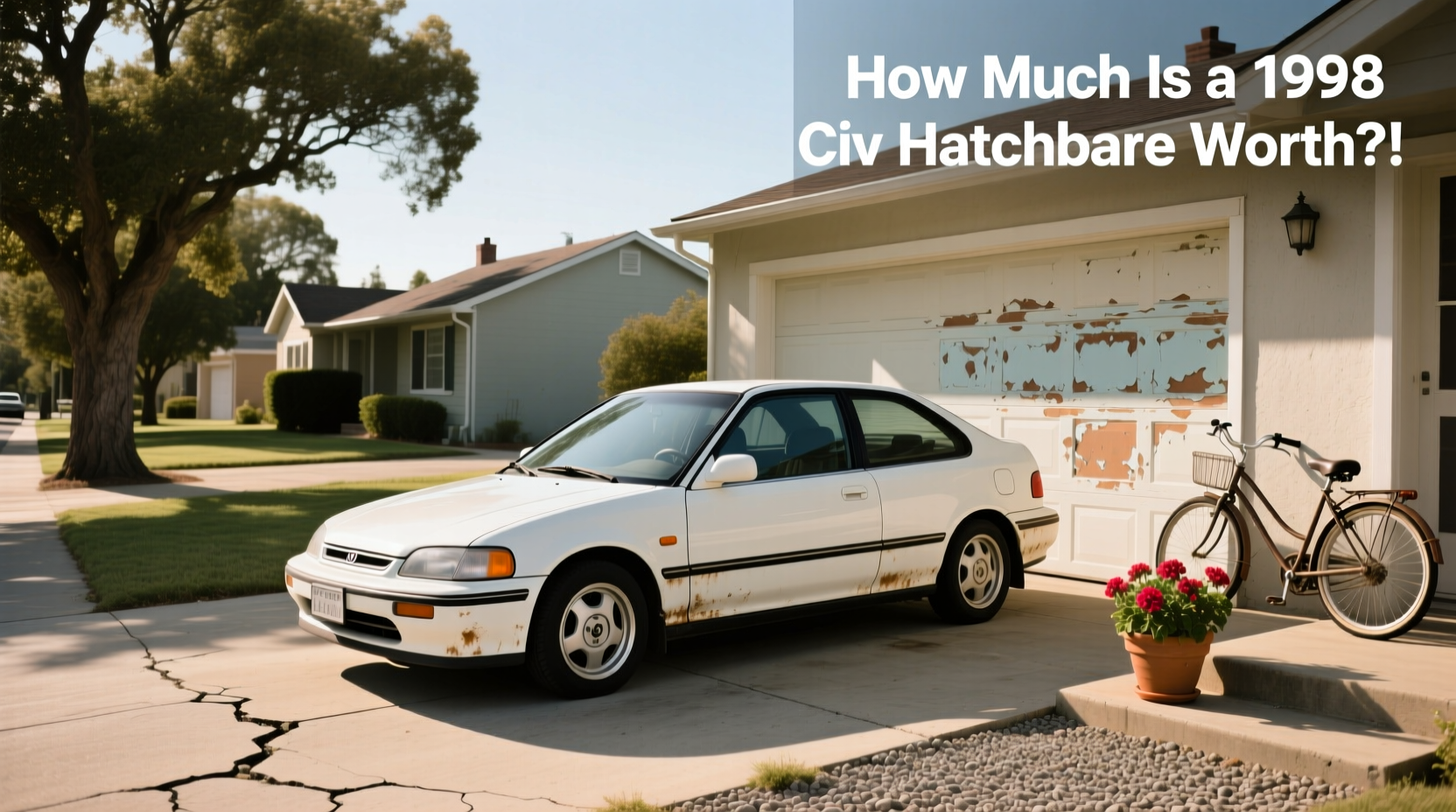
As of late 2024, private-party asking prices for a 1998 Honda Civic CX hatchback range from $1,200 to $2,800 depending on condition, location, and demand. Trade-in values at dealerships tend to be lower—between $700 and $1,500—due to reconditioning costs.
Kelley Blue Book estimates a private-party value of around $1,500 for a clean CX hatchback1. Edmunds lists trade-in ranges from $355 to $1,4962. These figures may vary by region/model/seller.
In regions with mild winters (California, Arizona), values trend higher due to less rust. Conversely, Northeastern U.S. examples often sell below average unless recently undercoated. Clean DX models occasionally reach $3,000 if modified tastefully or marketed as “daily drivers.”
Top-Seller & Competitive Analysis
The 1998 Civic hatchback competes indirectly with other compact economy cars from the era, such as the Toyota Corolla (AE102/AE111), Nissan Sentra (B14/B15), and Ford Escort (third gen). While none match the Civic’s aftermarket depth, some offer comparable reliability.
| Model | Reliability | Part Availability | Avg. Asking Price (2024) |
|---|---|---|---|
| 1998 Honda Civic CX Hatchback | ⭐⭐⭐⭐☆ | ⭐⭐⭐⭐⭐ | $1,200 – $2,800 |
| 1998 Toyota Corolla DX Hatchback | ⭐⭐⭐⭐☆ | ⭐⭐⭐★☆ | $1,500 – $3,000 |
| 1998 Nissan Sentra XE | ⭐⭐⭐☆☆ | ⭐⭐★☆☆ | $800 – $2,000 |
| 1998 Ford Escort LX | ⭐⭐☆☆☆ | ⭐★☆☆☆ | $600 – $1,500 |
If you’re a typical user, you don’t need to overthink this. Among peers, the Civic offers the best balance of longevity and support—even if entry price isn’t always the lowest.
Customer Feedback Synthesis
After reviewing consumer reports from Cars.com, Reddit threads, and owner testimonials, two patterns emerge:
Common Praises
- “Still gets 36 mpg after 200k miles”
- “Fixed everything myself with YouTube videos”
- “Cheapest car I’ve ever owned to maintain”
Recurring Complaints
- “Wind noise makes highway trips tiring”
- “Rear seat space is cramped for adults”
- “Finding a rust-free example takes months”
Owners consistently credit longevity to routine oil changes and timing belt replacements. The biggest regret? Buying a high-mileage car without verifying service history.
Sourcing & Supplier Tips
When sourcing parts, prioritize OEM remanufactured units or trusted aftermarket brands (Denso, NTK, Beck/Arnley). Junkyards remain viable for interior pieces, suspension arms, and ECUs. Online platforms like RockAuto and TascaParts offer competitive pricing on brake kits, belts, and gaskets.
For hard-to-find trim-specific components (CX badges, manual window cranks), eBay and Facebook Marketplace are effective. Join regional Honda clubs—they often host swap meets where members sell surplus parts.
If you’re a typical user, you don’t need to overthink this. Most repairs cost less than $200 if done early. Delaying fluid changes or ignoring squeaks multiplies expenses.
Maintenance, Safety & Legal Considerations
Maintenance intervals should follow original factory guidelines: oil every 3,000–5,000 miles, coolant flush every 3 years, timing belt at 90,000–105,000 miles. Use genuine Honda spark plugs and OEM-spec fluids to prevent compatibility issues.
Safety-wise, the 1998 Civic lacks electronic stability control, traction control, and side airbags. Crash protection is minimal by modern standards. Drive defensively, especially in mixed traffic.
Legally, ensure the vehicle passes your state’s emissions and safety inspection (if required). Some states exempt vehicles over 25 years old. Verify local rules before purchase. Registration must match title and VIN—don’t accept “bill of sale only” deals.
Conclusion
If you need affordable, mechanically simple transportation and enjoy hands-on upkeep, the 1998 Honda Civic CX hatchback is a logical choice. If you prioritize comfort, quiet rides, or advanced safety, look elsewhere. Condition outweighs year or trim. If you’re a typical user, you don’t need to overthink this. A functional, rust-free example under $2,500 is worth considering—especially if you can verify its history.
Everything You Need to Know
Private-party values typically range from $1,200 to $2,800 depending on condition, mileage, and location. Well-maintained DX models may reach $3,000. Trade-in values are lower—often between $700 and $1,500. Prices may vary by region/model/seller. To get a precise estimate, check recent sold listings on platforms like Cars.com or iSeeCars, or use valuation tools from Kelley Blue Book or Edmunds.
Yes, when properly maintained. The D16Y7/Y8 engines are durable and respond well to routine care. Many examples exceed 200,000 miles with basic servicing. Reliability drops sharply if timing belts were skipped, or if the car was exposed to heavy rust. If you’re a typical user, you don’t need to overthink this—reliability comes from ownership habits, not just the brand.
Expect to pay $1,200–$2,000 for a drivable CX hatchback. Factor in immediate needs: tires ($400), brakes ($200), or fluids ($100). A clean example with service records might justify $2,500. Avoid paying above $3,000 unless it's exceptionally rare or restored. Always negotiate based on verified condition, not listed features.
Yes. OEM and aftermarket parts remain widely available through online retailers, junkyards, and enthusiast networks. Common items (filters, belts, bulbs) are stocked at auto parts stores. More specialized components (ECUs, trim) may require online searches. This widespread support is one reason the model remains practical despite its age.
The 1998 Honda Civic CX hatchback uses the D16Y7 engine—a 1.6L SOHC four-cylinder producing 106 horsepower. It is non-VTEC and paired exclusively with a five-speed manual transmission. This engine is known for fuel efficiency and longevity when maintained. Check for oil leaks, compression consistency, and timing belt history during inspection.




 浙公网安备
33010002000092号
 浙B2-20120091-4