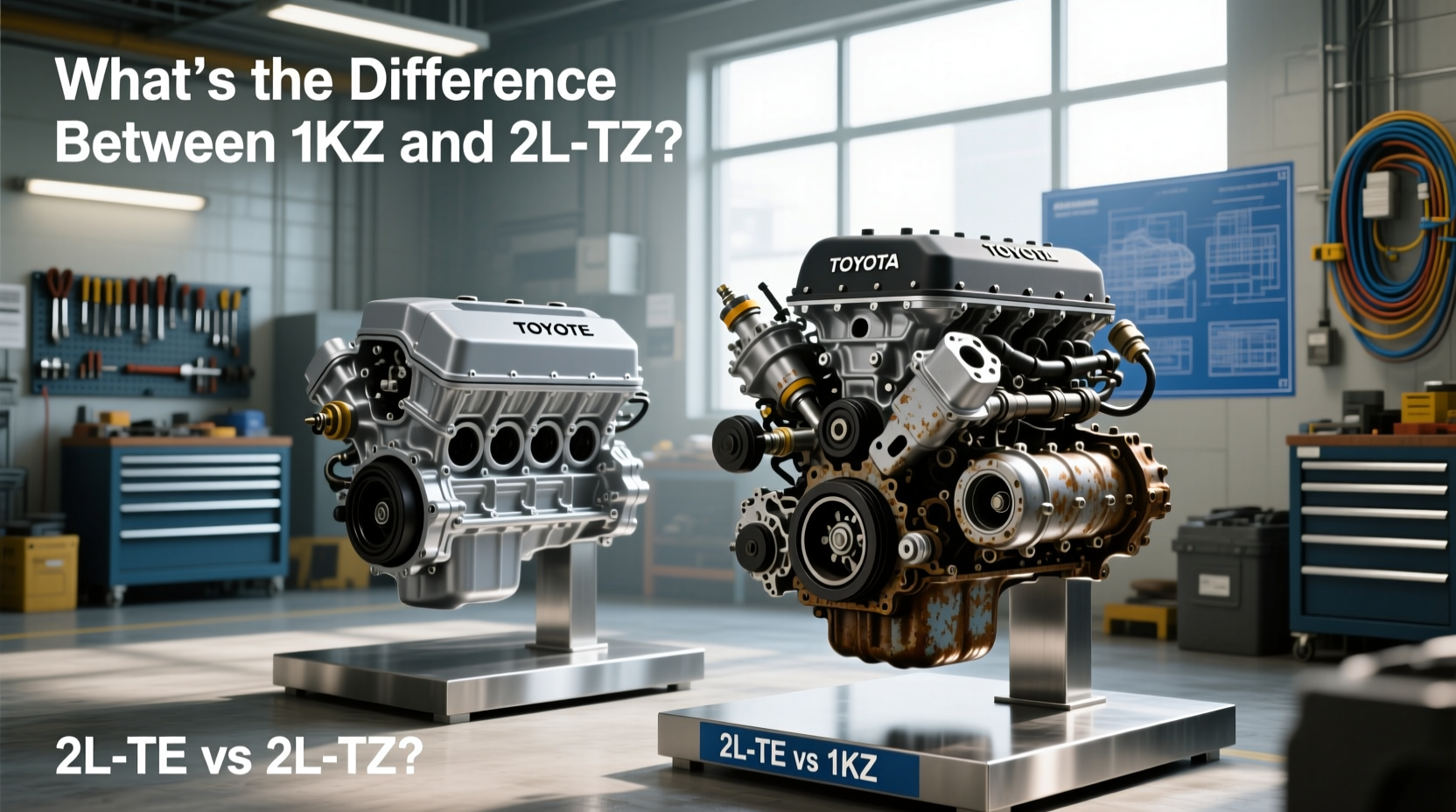
✅ If you need more power, better fuel economy, and long-term reliability, the Toyota 1KZ-TE is generally the better choice over the 2L-T engine. For budget-conscious buyers prioritizing simplicity and lower upfront cost, the 2LTE may suffice—but expect higher long-term maintenance and lower performance. When choosing a Toyota diesel engine 2LT, understanding the difference between 1KZ and 2LTE is critical for matching engine specs to your driving needs like towing, off-roading, or daily commuting.
Short Introduction
When evaluating how to choose a Toyota diesel engine 2LT, one of the most common decisions drivers face is whether to go with the older 2L-T (often referred to as 2LTE) or upgrade to the more advanced 1KZ-TE. This buying guide breaks down what to look for in toyota diesel engine 2lt,What is the difference between 1KZ and 2lte?—from displacement and horsepower to durability and parts availability. The 1KZ offers significantly more torque (up to 343 N·m), electronic fuel injection, and proven longevity beyond 500,000 km, making it ideal for heavy-duty use. In contrast, the 2LTE delivers only 85–93 HP and is prone to cylinder head cracks, though it has a simpler mechanical system and lower initial price. Your final decision should depend on intended use, maintenance access, and total cost of ownership—not just upfront savings.
About Toyota Diesel Engine 2LT: What Is the Difference Between 1KZ and 2LTE?
The terms "Toyota diesel engine 2LT" typically refer to two distinct generations of inline-four turbocharged diesel engines: the 2L-T (or 2LTE) and the 1KZ-TE. Despite similar naming conventions, these engines differ fundamentally in design, output, and application.
The 2L-T is a 2.4L (2,446cc) mechanical-injection diesel introduced in the mid-1980s, used widely in the Toyota Hilux, 70 Series Land Cruiser, and early 4Runner models until the early 1990s 1. It features a cast-iron block and head, indirect injection, and no intercooler. Its simplicity made it popular in rugged, remote environments where electronic systems were unreliable.
In contrast, the 1KZ-TE is a 3.0L (2,982cc) evolution launched in 1993, featuring electronic control via ETCS-i, an intercooler, aluminum cylinder head, and improved combustion efficiency 2. It powered later Prado, Hilux Surf, and Hiace vans into the 2000s. Understanding the difference between 1KZ and 2LTE helps clarify why many owners consider the 1KZ a major upgrade.
Why Toyota Diesel Engine 2LT: 1KZ vs 2LTE Is Gaining Popularity
Interest in both the 2LTE and 1KZ engines remains strong among off-road enthusiasts, commercial fleet operators, and vehicle restorers. The rise in popularity stems from several factors: increasing demand for reliable used diesel platforms, growing interest in engine swaps, and the need for durable powertrains in developing markets.
The 1KZ, in particular, has gained a cult following due to its balance of modern fuel delivery and mechanical robustness. Enthusiasts often seek out 1KZ-powered vehicles for overlanding or conversion projects because of their superior torque curve and compatibility with aftermarket tuning. Meanwhile, the 2LTE still appeals to those who value repairability without diagnostic tools or fear of complex electronics failing in harsh conditions.
As global supply chains affect new vehicle availability, used engines like the 1KZ and 2LTE are being re-evaluated not just as replacements but as strategic upgrades—especially when comparing cost-effectiveness across lifespan and workload.
Types and Variants
- ⚡ 2L-T / 2LTE (2.4L Mechanical Injection)
- Pros: Simple design, easy manual repairs, low-tech reliability, widely understood by mechanics.
- Cons: Lower power output, poor fuel efficiency, limited torque, susceptibility to head cracking under load or overheating.
- ⚡ 1KZ-TE (3.0L Electronic Injection)
- Pros: Higher horsepower and torque, intercooled turbocharging, better throttle response, longer service life with proper care.
- Cons: More complex ECU-dependent system, higher initial purchase cost, potential for injector and sensor issues if neglected.
While both engines are naturally aspirated base variants with turbo options, only the 1KZ received factory electronic management, allowing finer control over air-fuel ratios and emissions. Some modified versions of the 2LTE exist with upgraded turbos or injectors, but they remain fundamentally constrained by the mechanical pump’s limitations.
Key Features and Specifications to Evaluate
When assessing how to choose toyota diesel engine 2lt,What is the difference between 1KZ and 2lte?, focus on measurable performance and structural characteristics:
- 📏 Displacement: 1KZ (3.0L) vs 2LTE (2.4L) — larger displacement usually means more torque.
- ⚙️ Fuel System: Electronic (1KZ) vs mechanical (2LTE) — affects tuning potential and cold starts.
- 📊 Power & Torque: Compare peak numbers and RPM ranges. 1KZ produces up to 145 HP and 343 N·m, while 2LTE peaks at ~93 HP and 216 N·m.
- 🔧 Maintenance Complexity: Can it be serviced with basic tools? Does it require diagnostics?
- 🌍 Emissions & Efficiency: 1KZ averages 20–30 MPG; 2LTE manages 15–20 MPG. Consider local regulations.
- 📦 Parts Availability: 1KZ benefits from widespread global support; 2LTE parts are becoming scarcer.
Pros and Cons
| Aspect | 1KZ-TE | 2L-T (2LTE) |
|---|---|---|
| Power Output | High (128–145 HP) | Low (85–93 HP) |
| Torque | Strong (287–343 N·m) | Moderate (188–216 N·m) |
| Durability | Excellent (500k+ km possible) | Fair (head crack risk) |
| Fuel Efficiency | Better (20–30 MPG) | Poorer (15–20 MPG) |
| Repair Simplicity | Moderate (ECU involved) | High (fully mechanical) |
| Long-Term Cost | Lower TCO | Higher maintenance costs |
How to Choose Toyota Diesel Engine 2LT: 1KZ vs 2LTE
Follow this step-by-step checklist when deciding between the 1KZ and 2LTE:
- 📌 Define your primary use: Will you tow, carry heavy loads, or drive off-road frequently? → Choose 1KZ.
- 🔍 Assess maintenance access: Do you have access to skilled diesel mechanics or DIY capability? 2LTE can be fixed roadside; 1KZ may need diagnostics.
- 💰 Set a budget: Include not just purchase price but expected repairs and fuel over 5 years.
- 🌐 Check parts availability locally: Search online suppliers or junkyards for key components like injectors, pumps, and gaskets.
- 📋 Inspect engine history: Look for overheating signs, oil leaks, smoke levels, and service records.
Red flags to avoid:
- ❌ Excessive blue/white smoke — indicates worn turbo or cracked head (common in 2LTE).
- ❌ Rough idle or hard starting — could signal failing injectors or pump issues.
- ❌ Aftermarket ECU mods without cooling upgrades — increases failure risk in 1KZ.
- ❌ No service documentation — raises uncertainty about wear and maintenance quality.
Price & Market Insights
Used 2LTE engines typically sell for $800–$1,500 USD, depending on condition and region. Rebuilt units may cost slightly more. The 1KZ-TE commands $1,800–$3,000+, reflecting its higher demand and durability 3.
Prices vary significantly by country—higher in regions with strict emissions rules due to import restrictions. In Africa, Southeast Asia, and Oceania, 1KZ engines often retain stronger resale value. Always verify whether the price includes accessories like radiator, mounts, or wiring harnesses.
For best value, consider a professionally rebuilt 1KZ over a worn original 2LTE—even with a higher upfront cost, the 1KZ usually offers better long-term ROI through reduced downtime and fuel savings.
Top-Seller & Competitive Analysis
The 1KZ-TE stands out as the top-selling replacement engine in the Toyota diesel 2LT category today. While the 2LTE was once dominant, market trends show a clear shift toward 1KZ units for swaps and rebuilds.
| Model | Best For | Average Lifespan | Upgrade Potential |
|---|---|---|---|
| 1KZ-TE | Heavy-duty use, towing, long-distance travel | 400,000–600,000 km | High (turbo, intercooler, tuning) |
| 2L-T (2LTE) | Light work, rural areas, minimal tech environments | 200,000–300,000 km (with care) | Low (limited by mechanical pump) |
Customer Feedback Synthesis
Based on owner forums and service reports:
- ✅ 1KZ Common Praise: “Smooth power delivery,” “handles mountain grades well,” “lasted 400k km with basic servicing.”
- ❗ 1KZ Complaints: “Expensive injectors,” “ECU failures after water exposure,” “needs regular coolant changes to prevent corrosion.”
- ✅ 2LTE Praise: “Fixed with basic tools after breakdown,” “starts even in freezing temps with glow plug bypass.”
- ❗ 2LTE Complaints: “Head cracked during hot climb,” “struggles with AC and uphill loads,” “poor mileage compared to newer diesels.”
Sourcing & Supplier Tips
Buyers should source engines from reputable dismantlers or rebuilders. Look for:
- 📋 Detailed inspection reports including compression test results.
- 🔄 Warranty of at least 6 months.
- 📦 Complete units with injectors, pump, and brackets included.
Maintenance, Safety & Legal Considerations
Routine maintenance is crucial for both engines. Key practices include:
- 🧼 Change oil every 5,000–7,500 km using correct viscosity (e.g., 15W-40).
- 💧 Flush coolant regularly—especially for 1KZ, to reduce internal corrosion risk.
- 🌬️ Replace air filters frequently in dusty environments.
Conclusion
Choosing between the 1KZ and 2LTE comes down to balancing performance, complexity, and lifecycle cost. If you prioritize power, efficiency, and long-term reliability, the 1KZ-TE is the superior option. If you operate in remote areas with limited technical support and need a simple, fixable engine, the 2LTE remains viable. When exploring how to choose toyota diesel engine 2lt,What is the difference between 1KZ and 2lte?, always align your selection with real-world usage patterns rather than theoretical specs alone.
FAQs
Q: Can I swap a 1KZ engine into a vehicle originally equipped with a 2LTE?
A: Yes, but it requires modifications to the wiring harness, ECU mounting, cooling system, and transmission compatibility checks. Fabrication skills or professional help are recommended.
Q: Which engine lasts longer, 1KZ or 2LTE?
A: The 1KZ typically lasts longer—many reach 500,000 km with proper maintenance. The 2LTE is more prone to head cracking, limiting its lifespan under stress.
Q: Is the 1KZ more fuel-efficient than the 2LTE?
A: Yes, the 1KZ generally achieves 20–30 MPG due to electronic injection and intercooling, compared to 15–20 MPG for the 2LTE.
Q: Are parts easier to find for the 1KZ or 2LTE?
A: Parts are more readily available globally for the 1KZ. The 2LTE’s older design means fewer manufacturers now produce replacement components.
Q: Does the 1KZ require special tools for maintenance?
A: Basic servicing can be done with standard tools, but diagnosing ECU or injector issues may require OBD-compatible scanners or specialized equipment.




 浙公网安备
33010002000092号
 浙B2-20120091-4