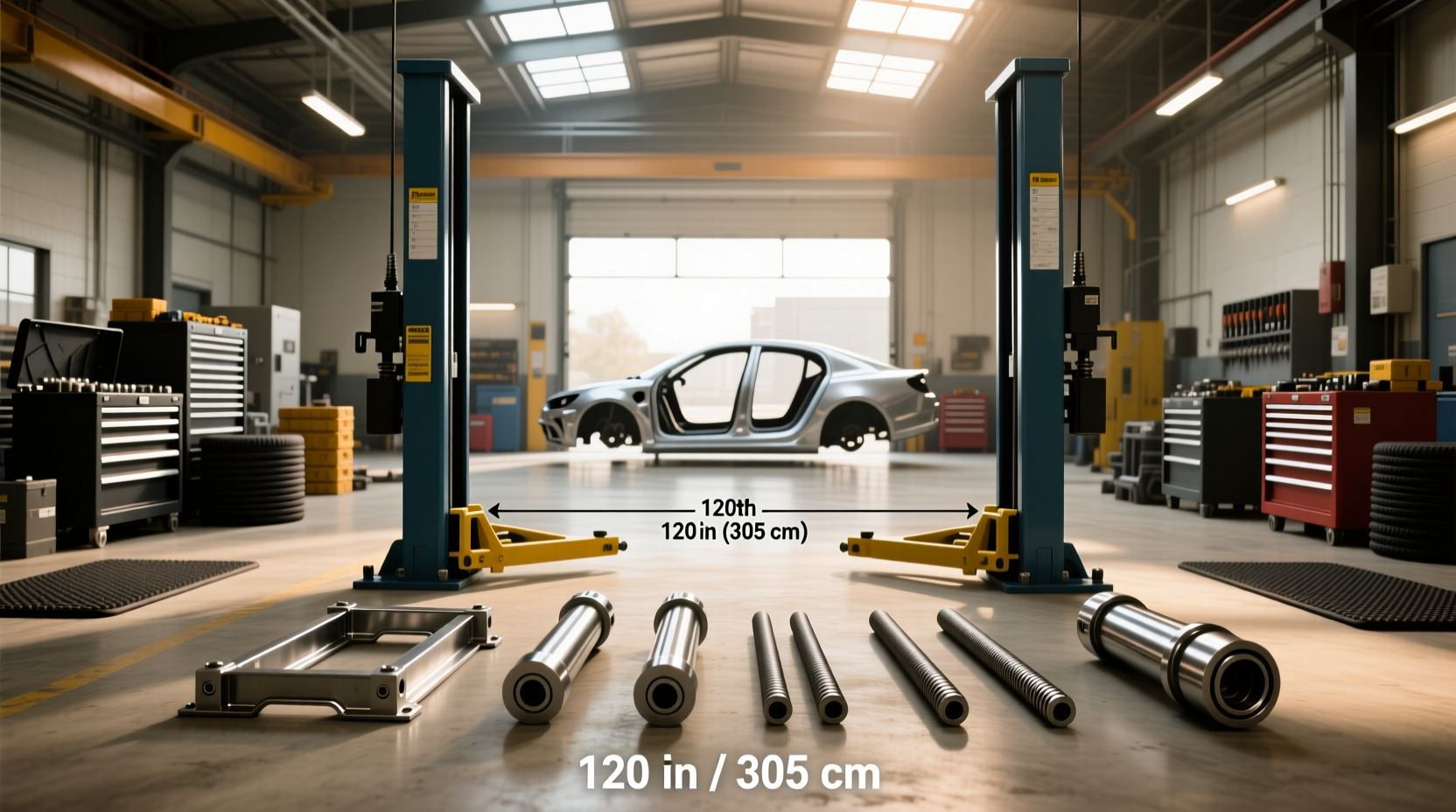
If you're asking how far apart are the posts on a 2 post lift, the typical center-to-center distance ranges from 9 to 11 feet (108–132 inches). When selecting two post lift spare parts, always verify compatibility with your model’s specifications, as mismatched components can compromise safety and performance. For garage planning, remember that total width—including arm swing—can reach 12–13 feet 1. Asymmetrical lifts save front space by positioning vehicles 30% forward and 70% behind posts, ideal for tighter garages. Always consult your lift’s manual before purchasing spare parts or finalizing placement.
📍 About Two Post Lift Spare Parts, How Far Apart Are the Posts on a 2 Post Lift?
A 2-post lift is a vertical lifting system used in automotive repair shops and home garages to elevate vehicles for maintenance, inspection, and repairs. The core structure consists of two upright columns connected by overhead beams or cables, with adjustable arms that support the vehicle at designated lift points.
The question “how far apart are the posts on a 2 post lift?” refers to the center-to-center distance between these two main columns. This measurement is critical because it determines the lift’s footprint, vehicle clearance, and compatibility with your workspace. Most models range between 9 and 11 feet apart at the post centers, though exact dimensions vary by brand and capacity.
Two post lift spare parts include mechanical, hydraulic, electrical, and structural components necessary for operation and maintenance. These may be needed due to wear, damage, or upgrades. Common replacements involve power units, lifting pads, chains, cables, bearings, and mounting hardware.
✨ Why Two Post Lift Spare Parts, How Far Apart Are the Posts on a 2 Post Lift? Is Gaining Popularity
Two-post lifts remain a top choice among professional mechanics and DIY enthusiasts due to their balance of functionality, cost, and space efficiency. Their popularity stems from several factors:
- Space optimization: Compared to four-post lifts, they require less floor area while still providing full undercarriage access.
- Versatility: With proper adapters, they can handle sedans, trucks, and SUVs.
- Cost-effectiveness: Lower initial investment and easier installation than larger systems.
- High demand for spare parts: As more users adopt these lifts, the need for reliable replacement components grows, especially for aging units.
As home garages become multifunctional spaces, understanding both spatial requirements (how far apart are the posts on a 2 post lift?) and maintenance needs (two post lift spare parts) ensures long-term usability without costly redesigns.
⚙️ Types and Variants
Understanding the different types of 2-post lifts helps clarify spacing requirements and spare part compatibility.
Symmetrical vs. Asymmetrical Arm Configurations
- 🔄 Symmetrical Lifts
Vehicle is centered evenly between the posts (50% in front, 50% behind).
Pros: Balanced weight distribution, easier access to both front and rear bumpers.
Cons: Requires more front and rear clearance; not ideal for shallow garages. - 🔄 Asymmetrical Lifts
Arms are angled so 30% of the vehicle sits in front and 70% behind the posts.
Pros: Allows deeper garage placement, freeing up space for opening doors and working on engines.
Cons: May limit rear bumper access; requires precise positioning.
Low-Profile vs. Standard Height
- 📏 Standard Lifts
Require 12+ feet of ceiling clearance.
Offer greater lifting height and versatility. - 📏 Low-Clearance Models
Designed for ceilings as low as 9.5 feet.
Ideal for basements or converted garages but may have reduced lift height.
Each variant affects not only installation space but also the type of spare parts required—especially arm assemblies, carriage systems, and overhead structures.
📋 Key Features and Specifications to Evaluate
When evaluating two post lift spare parts or determining how far apart are the posts on a 2 post lift, consider these key specifications:
Post-to-Post Distance
The center-to-center spacing typically falls between 9 and 11 feet. Some heavy-duty models exceed this range. Always confirm with manufacturer specs.
Total Footprint Width
Account for arm extension and swing. Total required width is usually 12–13 feet to allow safe operation and door opening 1.
Ceiling Height
Minimum recommended: 12 feet. Low-profile models work in 9.5-foot ceilings but may sacrifice maximum lift height.
Floor Requirements
- Concrete thickness: At least 4 inches
- Compressive strength: Minimum 3,000 psi
- Keep anchor bolts 12–18 inches away from cracks or seams 1
Spare Part Compatibility
Ensure replacement parts match:
- Manufacturer and model number
- Lift capacity (e.g., 6,000 lb, 10,000 lb)
- Arm type (symmetric/asymmetric)
- Hydraulic system pressure rating
Using incompatible two post lift spare parts risks failure and voids warranties.
✅ Pros and Cons
| Aspect | Pros | Cons |
|---|---|---|
| Space Efficiency | Smaller footprint than four-post lifts | Still requires significant side clearance (2–3 ft per side) |
| Access | Unobstructed undercarriage access | Arms must be repositioned for tire changes |
| Installation | Easier to install than in-ground lifts | Requires precise concrete anchoring |
| Maintenance | Common spare parts widely available | Hydraulic leaks and worn chains require regular checks |
| Versatility | Handles most passenger vehicles and light trucks | Not suitable for very wide or low-clearance supercars without adapters |
Best for: Home garages, repair shops, alignment bays.
Not ideal for: Extremely narrow spaces without adequate front/rear clearance or non-concrete floors.
🔍 How to Choose Two Post Lift Spare Parts, How Far Apart Are the Posts on a 2 Post Lift?
Follow this step-by-step guide when making decisions about lift selection or part replacement.
Step 1: Measure Your Garage Space
- Confirm interior width and length.
- Mark where the lift will go and simulate vehicle position.
- Ensure 3–4 feet of front/rear clearance and 2–3 feet on each side 1.
Step 2: Determine Post Spacing Needs
- For standard cars: 9–10 ft post spacing often suffices.
- For trucks/SUVs: Consider 10–11 ft models.
- Check if your lift uses symmetric or asymmetric arms—they affect optimal wall distance.
Step 3: Identify Required Spare Parts Accurately
- Consult the official parts manual for your lift model.
- Match serial numbers and component codes exactly.
- Avoid generic substitutes unless certified compatible.
Step 4: Verify Clearance from Walls and Cracks
- Asymmetric lifts: Place column centers ~9–10 ft from front wall.
- Symmetric lifts: Need ~12 ft from front wall 5.
- Stay 12–18 inches clear of floor cracks.
Red Flags to Avoid ❗
- ❌ Buying spare parts without verifying model compatibility.
- ❌ Installing near walls or ceiling obstructions.
- ❌ Using undersized concrete or improper anchors.
- ❌ Ignoring asymmetry requirements when parking vehicles.
💰 Price & Market Insights
Pricing varies significantly based on capacity, brand, and features.
- New 2-post lifts: $2,000–$6,000 depending on capacity (6K–15K lbs) and technology (low-profile, synchronized arms).
- Spare parts: $15–$500+
- Small items (pads, bolts): $15–$75
- Power units: $200–$500
- Chains/cables: $80–$200
Value tip: Rebuild kits (e.g., cylinder seal kits, bearing sets) often cost less than individual replacements. OEM parts are pricier but ensure fit and durability. Third-party alternatives exist but verify certifications like ALI (Automotive Lift Institute).
Note: Prices may vary by region and supplier. Always compare multiple vendors and check return policies.
📊 Top-Seller & Competitive Analysis
Below is a comparison of popular 2-post lift models highlighting key differences in spacing and compatibility.
| Model | Lift Capacity | Post-to-Post (ft) | Total Width (ft) | Clearance Type | Compatible Spare Parts |
|---|---|---|---|---|---|
| Coats 10K 2N1 | 10,000 lb | ~11.3 | 11.3 | Asymmetrical | Coats-specific hydraulic units, ALI-certified arms |
| Coats 20K | 20,000 lb | ~12.7 | 12.7 | Symmetrical | Heavy-duty chains, reinforced carriages |
| Generic 6K DIY Lift | 6,000 lb | 9–10 | ~12 | Asymmetrical | Universal adapters, standard hydraulic components |
When sourcing two post lift spare parts, ensure cross-compatibility even within brands—upgrades or revisions may alter component designs.
👥 Customer Feedback Synthesis
Analysis of user reviews reveals consistent themes:
Common Praises ✅
- “Easy to install with clear instructions.”
- “Durable construction lasts over a decade with maintenance.”
- “Asymmetrical design saved crucial space in my small garage.”
- “Replacement parts were easy to find online.”
Frequent Complaints ❌
- “Hydraulic pump failed after 3 years—replacement was expensive.”
- “Didn’t realize I needed 12 ft ceiling until too late.”
- “Wrong lifting pads damaged frame rails.”
- “Difficult to align arms on wider trucks.”
These insights highlight the importance of researching both spatial needs and long-term part availability before purchase.
🛒 Sourcing & Supplier Tips
Where you buy two post lift spare parts matters for reliability and compatibility.
- OEM Suppliers: Best for guaranteed fit and warranty coverage (e.g., Coats, Rotary).
- Specialty Retailers: Offer curated inventories and technical support (e.g., APlusLift, Derek Weaver).
- Marketplaces (e.g., Alibaba, Amazon): Wider selection but verify seller ratings and product specs carefully.
Tips:
- Request parts diagrams before ordering.
- Buy in bulk if maintaining multiple lifts.
- Inspect shipments immediately for damage or mismatches.
- Confirm return policy in case of incorrect parts.
🔧 Maintenance, Safety & Legal Considerations
Proper upkeep ensures longevity and safe operation.
Maintenance Checklist 🧼
- Monthly: Inspect chains, cables, and hydraulic hoses for wear.
- Quarterly: Lubricate pivot points and check bolt tightness.
- Annually: Test safety locks and verify leveling.
Safety Practices ⚠️
- Always use correct lifting points per vehicle manufacturer.
- Never exceed rated capacity.
- Engage safety locks before working under a lifted vehicle.
Compliance Reminder 🌐
While specific regulations vary by country and jurisdiction:
- Look for ALI certification in North America.
- Verify local occupational safety standards if used commercially.
- Retain installation records and inspection logs.
Always consult local authorities or industry bodies to confirm compliance requirements.
📌 Conclusion
Choosing the right two post lift spare parts and understanding how far apart are the posts on a 2 post lift are essential steps in maximizing utility and safety. If you have limited garage depth, opt for an asymmetrical model with ~9–10 ft post spacing. For larger shops handling diverse vehicles, symmetrical lifts with 10–12 ft widths offer better access. Always source spare parts using your lift’s exact model and serial number to avoid compatibility issues. Prioritize ALI-certified components and follow manufacturer guidelines for installation and maintenance. By planning around real-world dimensions and long-term serviceability, you’ll make a durable, efficient investment.
❓ FAQs
The center-to-center distance between posts typically ranges from 9 to 11 feet (108–132 inches), depending on the model and capacity.
Yes, many components like pads, adapters, and hydraulic hoses can be replaced with basic tools, but complex repairs (e.g., power units) may require professional help.
No—while standard models require 12+ feet, low-clearance lifts are designed for ceilings as low as 9.5 feet, though with reduced maximum lift height.
They can be, provided they meet original equipment specifications and safety standards like ALI certification. Always verify compatibility before installation.
Refer to your lift’s manual and match adapters to the vehicle’s frame contact points. Universal kits are available, but precision-fit options reduce risk of slippage or damage.




 浙公网安备
33010002000092号
 浙B2-20120091-4