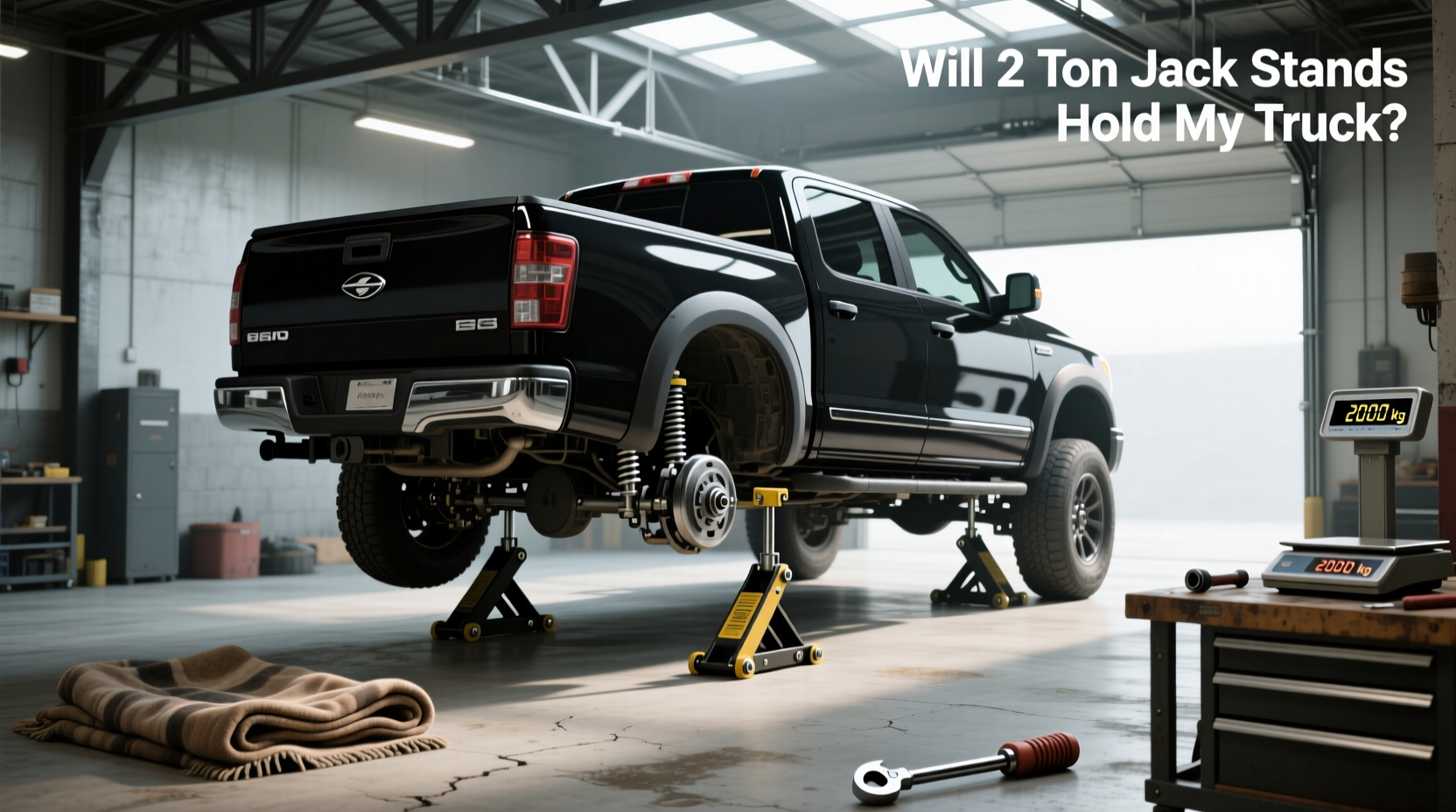
Are 2-Ton Jack Stands Safe for Your Pickup Truck?
If you’re a typical user, you don’t need to overthink this. For most full-size pickup trucks, 2-ton jack stands are not sufficient for safe, long-term lifting — especially when working under the vehicle. What to look for in jack stands: individual stand capacity, total support load, lift height range, and base stability. A common mistake is assuming that two 2-ton stands equal 4 tons of total support — while technically true, weight distribution on trucks is uneven, meaning one stand may bear far more than half the load. Always use stands rated at least 3 tons each for half-ton pickups like the F-150 or Silverado 1500, and consider 6-ton pairs for heavy-duty models (2500/3500 series). Over the past year, more DIYers have reported near-misses using undersized stands — a sign that mismatched gear is becoming a real risk.
About Pickup Truck Jack Stands
Jack stands are mechanical supports used to hold a vehicle in place after it has been lifted with a floor jack. Unlike jacks, which actively raise a vehicle, stands provide static support — a critical distinction for safety. They consist of a threaded screw mechanism inside a steel frame, designed to lock into position at various heights. Most consumer-grade sets come in 2-ton, 3-ton, and 6-ton capacities per stand.
Pickup trucks differ from passenger cars in both weight and frame design. Even a light-duty 'half-ton' truck typically weighs between 4,500 and 5,500 lbs, with up to 60% of that weight resting on the front axle when parked. That means a single jack stand placed under the front could face over 3,000 lbs — exceeding the safe limit of a 2-ton (4,000-lb) stand, even before accounting for dynamic loads during movement or tool use.
Why This Is Gaining Popularity
Lately, more owners of midsize and full-size pickups are performing their own maintenance — from oil changes to suspension upgrades. With rising labor costs and greater access to online tutorials, DIY repairs have become practical for many. However, this shift has exposed a knowledge gap around proper lifting equipment.
The popularity of compact, affordable 2-ton jack stands has grown alongside e-commerce platforms offering budget garage tools. While these work well for sedans and small SUVs, they’re increasingly being used — incorrectly — on heavier trucks. Recently, forums and community boards have seen a spike in questions like “Will 2-ton jack stands hold my truck?” indicating growing awareness of potential risks.
This isn’t just about weight ratings. It’s about recognizing that real-world conditions — uneven ground, rusted frames, improper placement — reduce effective safety margins. If you’re a typical user, you don’t need to overthink this: your truck demands stronger support than what entry-level kits offer.
Types and Variants
2-Ton Jack Stands
Commonly sold in budget sets, these are made for vehicles under 4,000 lbs gross weight. Often constructed with thinner steel and smaller bases.
- Pros: Inexpensive, lightweight, compact storage
- Cons: Limited height range (typically 9–15 inches), lower safety margin, prone to tipping on uneven surfaces
3-Ton Jack Stands
A step up in durability, suitable for most half-ton trucks when used correctly. Feature wider bases and beefier construction.
- Pros: Adequate for F-150, RAM 1500, Titan; better stability; longer lifespan
- Cons: Heavier, take more space; often overkill for smaller cars
6-Ton and Higher Jack Stands
Built for heavy-duty pickups and commercial use. Made with reinforced steel, larger contact pads, and taller lift ranges.
- Pros: Can safely support 3500-series trucks; high redundancy; compatible with large tires/lift kits
- Cons: Expensive; bulky; slower to adjust
Key Features and Specifications to Evaluate
When choosing jack stands for a pickup truck, focus on four non-negotiable factors:
Individual Capacity Rating
Always check the rating per stand, not per pair. A “2-ton” label means 4,000 lbs per stand — but never operate near maximum. Industry practice reserves a 25–33% safety buffer. So, a 2-ton stand should only support ~3,000 lbs in real use. For a 5,000-lb truck, that’s already risky.
Lift Height Range
Standard 2-ton stands max out around 15 inches — enough for low-clearance cars but insufficient for lifted trucks. If you’ve added all-terrain tires or a leveling kit, you’ll need stands with a minimum extended height of 18–20 inches.
Base Stability and Design
Wider bases resist tipping. Some models feature dual-pawl locking systems for added security. Avoid stands with narrow feet or plastic caps on the bottom — they reduce grip on concrete or gravel.
Material and Build Quality
Look for fully welded steel construction. Cast iron or aluminum variants exist but are less common. Powder-coated finishes help resist corrosion but don’t indicate strength.
If you’re a typical user, you don’t need to overthink this: prioritize capacity and stability over flashy features.
Pros and Cons
| Aspect | Pros | Cons |
|---|---|---|
| Using 2-Ton Stands on Trucks | Inexpensive, widely available | Risk of overload, inadequate height, poor stability |
| Upgrading to 3+ Ton Stands | Safer load margin, better fit for truck frames, longer service life | Higher upfront cost, heavier to store |
| Dual-Pawl vs Single-Pawl | Dual-pawl offers redundancy if one fails | More complex mechanism, slightly slower adjustment |
How to Choose Jack Stands for a Pickup Truck
Selecting the right stands isn’t complicated — it’s about matching your truck’s actual needs.
Step-by-Step Checklist
- Determine your truck’s curb weight – Check the door jamb sticker or owner’s manual. Don’t guess.
- Estimate weight per axle – Front axles usually carry more, especially with V8 engines.
- Choose stands rated for at least 1.5x the expected load per point – For a 3,500-lb front end, use 3-ton (6,000-lb) stands.
- Verify lift range – Ensure stands can reach high enough without overextending.
- Inspect base width – Wider is safer, especially on soft or sloped surfaces.
Decision Flow
- If you drive a compact pickup (e.g., Toyota Tacoma, Colorado): 3-ton stands are ideal.
- If you drive a full-size half-ton (F-150, Silverado 1500): Use 3-ton minimum; 6-ton preferred for modified trucks.
- If you drive a heavy-duty model (RAM 3500, F-450): Only use 6-ton or higher-rated stands.
Recommendations by Scenario
- Basic oil change on level ground: 3-ton stands acceptable for unmodified half-tons.
- Suspension work or tire rotation: Upgrade to 6-ton stands for safety margin.
- Off-road or lifted truck: 6-ton stands with extended height are required.
Red Flags / What to Avoid
- Avoid combo kits with 2-ton stands – Many include undersized stands despite a 3-ton jack.
- Never rely solely on a scissor jack or hydraulic jack – These are for emergency use only.
- Don’t stack stands or blocks – This creates instability and voids any safety rating.
- Ignore vague labels like “heavy duty” – Stick to verified tonnage ratings from reputable brands.
Price & Market Insights
Prices vary significantly by region, brand, and retailer. A pair of 2-ton stands can cost as little as $30, while 6-ton industrial models may exceed $150. In North America, major hardware chains and automotive suppliers dominate sales, while international buyers may source through regional distributors or online marketplaces.
Be cautious of extremely low prices — substandard welding or incorrect labeling has been reported in off-brand sets. Always verify capacity markings directly on the product, not just the packaging. Prices may vary by region/model/seller, so compare multiple sources and read recent reviews.
Top-Seller & Competitive Analysis
No single brand dominates globally, but several consistently receive positive feedback for reliability:
| Brand/Model | Capacity | Height Range | Notable Feature |
|---|---|---|---|
| Husky 3-Ton | 3 tons per stand | 11.5" – 17.5" | Wide base, dual-pawl |
| CRAFTSMAN 6-Ton | 6 tons per stand | 14" – 20.5" | High lift, reinforced legs |
| Powerbuilt 2-Ton Aluminum | 2 tons per stand | 9.5" – 15.16" | Lightweight, corrosion-resistant |
While aluminum 2-ton stands are popular for portability, they lack the rigidity needed for trucks. Steel models with dual-pawl systems offer superior safety. If you’re a typical user, you don’t need to overthink this: invest in steel, avoid aluminum for trucks, and skip anything below 3 tons.
Customer Feedback Synthesis
Analysis of recent forum discussions and product reviews reveals consistent patterns:
High-Frequency Praise
- “Stable even on gravel” – users appreciate wide-base designs
- “Easy to adjust with gloved hands” – tactile handles and smooth threads valued
- “Lasted over 5 years with regular use” – longevity noted for trusted brands
Common Complaints
- “Couldn’t reach high enough on my lifted Jeep” – height limitations frequently cited
- “One pawl slipped under load” – single-pawl models questioned for reliability
- “Label said 3-ton but bent at first use” – counterfeit or misrepresented products reported
Many negative experiences trace back to using 2-ton stands beyond their intended scope. One Reddit thread summed it up: “I thought I was saving money — turns out I was gambling with my spine.”
Sourcing & Supplier Tips
Buy from authorized dealers or well-reviewed suppliers. When purchasing online, confirm return policies and warranty terms. Check manufacturer specs directly — do not rely solely on marketplace descriptions.
If sourcing internationally, ensure compatibility with local voltage (for powered tools) and verify unit measurements (imperial vs metric). Be aware that some regions lack strict enforcement of load-rating standards, increasing risk of mislabeled products. Always inspect weld quality and locking mechanisms upon arrival.
Maintenance, Safety & Legal Considerations
Jacks stands require minimal maintenance but must be inspected before each use. Look for signs of:
- Bent or cracked frames
- Worn or stripped screw threads
- Missing safety pins or damaged pawls
- Corrosion at stress points
Clean with a dry cloth after use; avoid water immersion. Store upright in a dry place.
Safety practices:
- Always place stands on solid, level ground
- Use wheel chocks
- Double-check engagement before crawling underneath
- Never exceed rated capacity
Legal requirements vary by jurisdiction. Some workplaces require OSHA-compliant equipment, but personal use is generally unregulated. Still, liability may arise if an accident occurs due to known misuse. Verify local regulations through official government portals or trade associations.
Conclusion
If you need reliable, safe support for a full-size pickup truck, choose jack stands rated at 3 tons minimum — preferably 6 tons for heavy-duty or modified vehicles. If you’re a typical user, you don’t need to overthink this: 2-ton stands are not designed for the loads imposed by modern trucks. Upgrade your gear to match your vehicle’s demands.
Everything You Need to Know
They might lift it, but they shouldn't be relied upon for safe support. Most full-size pickup trucks exceed the safe working load of 2-ton stands, especially at the front axle. Use 3-ton or higher-rated stands instead.
Each 2-ton jack stand is rated for 4,000 pounds, but industry best practice limits usage to about 3,000 lbs to maintain a safety margin. Never exceed the manufacturer's stated capacity.
You can, but it creates a weak link. The jack may lift the vehicle, but the stands must safely hold it. Always match or exceed the jack’s capacity with your stands — better yet, size both to your vehicle’s weight.
Overloading can cause sudden collapse due to bent screws, failed pawls, or cracked housings. There is no warning — failure is immediate and dangerous. Always stay within rated limits.
For a stock F-150, 3-ton stands are generally sufficient. However, if you have a crew cab with a heavy engine, aftermarket accessories, or a lift kit, upgrading to 6-ton stands provides a safer margin.




 浙公网安备
33010002000092号
 浙B2-20120091-4