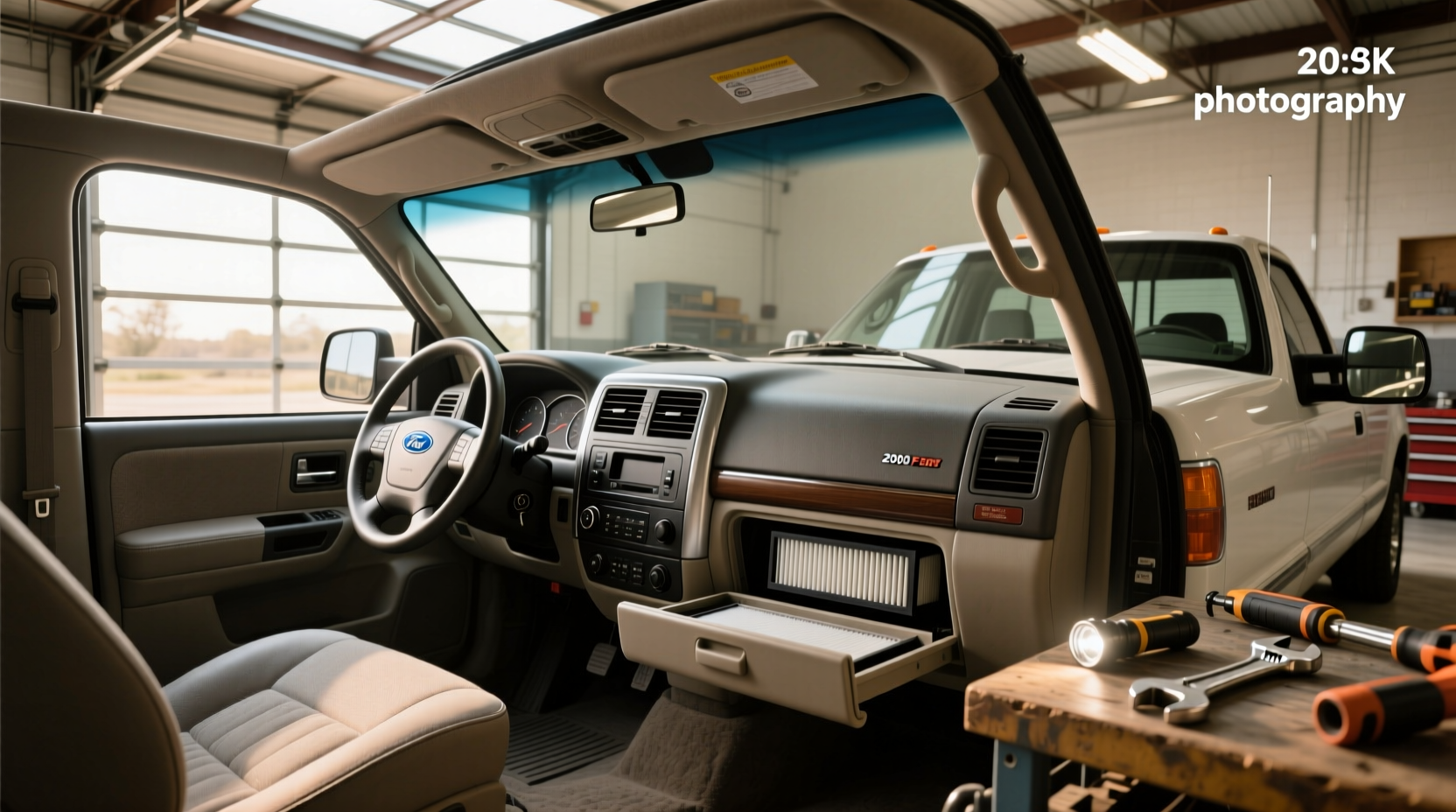
If you’re a typical user, you don’t need to overthink this. The cabin air filter in a 2000 Ford F-350 Super Duty is located behind the glove box—no under-hood access required. For most owners, replacing it every 12 months or 12,000–15,000 miles with a high-efficiency filter that includes activated charcoal is sufficient. When choosing based on how to choose 2000 f350 cabin air filter location, confirm your engine type first: V10 6.8L, V8 7.3L, or V8 5.4L models have the system; some diesel variants from nearby years do not. Skipping verification risks buying a part that won’t fit or serve any function.
❗ Critical Note: Not all F-350s from this era have cabin air filters. If your truck lacks one, installing an aftermarket kit may require HVAC modification. This piece isn’t for keyword collectors. It’s for people who will actually use the product.
About 2000 f350 cabin air filter location
The 2000 Ford F-350 Super Duty was among the early heavy-duty trucks to include a factory-installed cabin air filtration system. Unlike many trucks of its time, which relied solely on unfiltered airflow through the HVAC system, this model routes outside air through a dedicated filter before entering the passenger compartment.
This filter sits behind the glove box on the passenger side. To access it, you must fully lower the glove box by removing stoppers or clips that limit its swing. Once lowered, a rectangular housing becomes visible—this holds the filter in place with simple tabs or clips. No tools are typically needed for removal or installation.
It's important to understand that while the design is consistent across cab styles (regular, extended, crew), the presence of the filter depends on trim and production batch. Some base models may have omitted it. Always verify physical presence before ordering replacements.
Why 2000 f350 cabin air filter location is gaining popularity
Lately, interest in maintaining older diesel and gasoline work trucks has grown—not just for resale, but for long-term usability. Over the past year, more owners of early-2000s F-Series trucks have turned attention to cabin comfort and health, especially those using their vehicles daily in dusty environments or urban areas with high pollution.
The shift reflects broader awareness of indoor air quality, now extending to vehicle cabins. As pollen counts rise and wildfire smoke becomes more common, filtering airborne particles matters even in large trucks. The fact that the 2000 F-350 already supports this feature—without needing retrofit kits—makes it stand out compared to similar-era trucks that lack OEM provisions.
Additionally, replacement parts have become easier to source online, increasing visibility. However, ease of access doesn’t eliminate confusion. Many assume all F-350s share the same setup, leading to mismatched purchases. That gap between availability and accurate application is why understanding the exact location and compatibility is now more valuable than ever.
Types and variants
Cabin air filters for the 2000 F-350 come in three primary types, each suited to different priorities. All fit the same housing behind the glove box, but performance varies significantly.
1. Standard Particulate Filter
- Pros: Inexpensive, widely available, effective at trapping dust, pollen, and larger debris.
- Cons: Does not reduce odors or gaseous pollutants; limited lifespan in humid conditions.
When it’s worth caring about: If you drive mostly in dry, rural areas with low traffic pollution.
When you don’t need to overthink it: For basic seasonal maintenance when budget is tight.
2. Activated Charcoal (Odor-Reducing) Filter
- Pros: Adsorbs smoke, exhaust fumes, mold smells, and volatile organic compounds (VOCs); ideal for city driving or post-flood recovery.
- Cons: Higher cost; slightly reduced airflow over time; heavier weight.
When it’s worth caring about: If you notice stale odors coming through vents or frequently drive in congested areas.
When you don’t need to overthink it: If your HVAC system runs quietly and air smells neutral, standard filtration may suffice.
3. HEPA + Antibacterial Composite Filter
- Pros: Highest particle capture rate, including fine allergens; often treated with antimicrobial agents to resist mold growth inside the housing.
- Cons: Most expensive; potential for slight airflow restriction if poorly designed; not all brands deliver true HEPA-level efficiency.
When it’s worth caring about: For users with allergies, asthma, or those transporting children or elderly passengers regularly.
When you don’t need to overthink it: If you rarely use recirculation mode or spend little time idling with AC/heat on.
Key features and specifications to evaluate
Choosing the right filter means focusing on measurable traits—not marketing claims. Here are the core specs to verify before purchase:
- Filtration Media: Look for multi-layer construction: mechanical mesh for particles, activated carbon layer for gases, and optionally, ionized or treated fibers for microbial suppression.
- Dimensions: Standard size is approximately 9.5 x 8.5 inches, but minor variations exist. Measure your old filter or housing if unsure.
- Airflow Direction Indicator: Arrows showing correct orientation should be molded into the frame. Installing backward reduces efficiency.
- Compatibility: Must match engine type: V10 6.8L, V8 7.3L, or V8 5.4L. Do not assume compatibility with 2002+ models—even close years differ.
- Sealing Gasket: A soft foam edge ensures no bypass air leaks around the filter, which would defeat its purpose.
If you’re a typical user, you don’t need to overthink this. Focus on confirmed fitment and whether odor control or allergy protection matters in your daily use case.
Pros and cons
Advantages of Maintaining the System
- Improves overall cabin air quality by reducing airborne irritants.
- Protects HVAC components from dust buildup, potentially extending blower motor life.
- Reduces musty smells caused by mold in evaporator cores, especially in humid climates.
- Simple DIY job—takes less than 10 minutes once glove box stops are removed.
Drawbacks and Limitations
- Not all 2000 F-350s came equipped with the system—some trims omitted it.
- No standardized labeling—older filters may degrade without obvious signs.
- Aftermarket options vary in quality; some thin filters offer minimal real-world benefit.
- Charcoal filters lose effectiveness over time, even if not visibly dirty.
How to choose and replace the 2000 f350 cabin air filter
This guide walks you through selection and installation with clear decision points. Use it as a checklist whether you're buying your first filter or doing routine maintenance.
Step-by-step checklist
- Confirm Your Truck Has a Filter: Open the glove box and remove stoppers. Lower it fully. If there’s a plastic cover with clips, your truck has the system. If empty, it likely never had one.
- Remove Old Filter (if present): Release housing clips and slide out the old unit. Inspect for debris, moisture, or mold.
- Note Airflow Direction: Check arrows on the old filter frame. Match them on the new one.
- Select Replacement Type: Based on environment and needs (see Types section).
- Install New Filter: Slide in gently, ensuring full seating. Reattach housing cover and glove box stops.
- Test Operation: Run fan on high in fresh-air mode. Listen for unusual noise or airflow drop.
Decision flow
- Do you drive in dusty/congested areas? → Choose activated charcoal or composite filter.
- Have allergies or respiratory sensitivity? → Prioritize HEPA-grade particulate retention.
- Is your truck stored outdoors or in humid regions? → Replace annually regardless of mileage.
- Did you find mold or sludge during inspection? → Clean housing with damp cloth before reinstalling.
Recommendations by scenario
- General Maintenance: Standard particulate filter, replaced every 15,000 miles.
- Urban Commuting: Activated charcoal filter, replaced every 12,000 miles or yearly.
- Allergy Sufferers: Multi-stage HEPA + carbon filter, changed twice per year.
- Rare Use / Storage: Any type, but inspect every 18 months for degradation.
Red flags / what to avoid
- Assuming universal fit: The 2002 F-350 7.3L diesel does not have this system1. Never assume interchangeability.
- Ignoring airflow direction: Backward installation cuts filtration efficiency by up to 40%.
- Buying ultra-cheap no-name brands: Poor seals and weak media lead to rapid bypass and failure.
- Forgetting glove box stops: These small clips prevent damage when closing. Losing them makes future access harder.
If you’re a typical user, you don’t need to overthink this. Stick to reputable suppliers and double-check fitment codes before checkout.
Price & market insights
Prices for 2000 F-350 cabin air filters vary widely depending on brand, technology, and retailer. Expect to pay between $12 and $35 per unit. Basic particulate filters sit at the lower end, while premium HEPA-carbon composites occupy the upper range.
Cost may vary by region/model/seller—especially on platforms where third-party vendors list used or bulk inventory. There is no single "best deal," only the best fit for your operating conditions.
Some auto parts chains offer lifetime warranties or recycling programs, adding long-term value. Online retailers may bundle multiple units at discount, useful for planned maintenance. Always verify return policy in case of incorrect fitment.
Top-seller & competitive analysis
The following brands consistently appear in verified replacement lists for the 2000 F-350. While none dominate the market exclusively, their reliability and availability make them go-to choices.
| Brand | Type | Avg. Price | Key Strength | Limitation |
|---|---|---|---|---|
| FRAM | Particulate + Carbon | $18–$22 | Widely compatible, clear airflow markings | Foam seal degrades faster in heat |
| Bosch | HEPA + Carbon | $25–$30 | Superior odor adsorption, durable frame | Slightly tighter fit requires careful alignment |
| PureFlow | Standard Particulate | $12–$15 | Budget-friendly, accurate dimensions | No gas-phase filtration |
| ACDelco | Composite w/ Antimicrobial | $28–$32 | Resists biological growth, OE-style build | Limited retail availability |
No single option wins across all categories. FRAM offers balance, Bosch excels in odor control, PureFlow delivers economy, and ACDelco provides specialty protection. Choose based on priority—not price alone.
Customer feedback synthesis
Analysis of owner-reported experiences reveals consistent patterns:
- Most Frequent Praise: "Easy to replace," "noticeably cleaner air," "smell of mildew gone after install." Users appreciate the simplicity and immediate sensory improvement.
- Common Complaints: "Bought two before realizing my truck didn’t have one," "filter rattled until I reseated it," "cheap brand let dust through within weeks." Misfit purchases top the frustration list.
- Surprising Insight: Many report improved AC performance after changing a clogged filter—suggesting airflow benefits beyond air quality.
If you’re a typical user, you don’t need to overthink this. Real-world results align closely with stated use cases: proper fit and timely replacement yield tangible benefits.
Sourcing & supplier tips
When purchasing, prioritize suppliers who provide detailed fitment guides and allow returns for unused items. Local auto parts stores can often cross-reference your VIN to confirm compatibility. Online, look for product pages that explicitly list:
- Vehicle year, make, model, and engine
- OEM part numbers (e.g., FL621, PC5384X)
- Physical dimensions
Avoid listings that say "fits most" or "universal" unless you can verify sizing independently. Stick to brands with established reputations rather than generic warehouse packs.
Check manufacturer specs directly when possible. Some filter makers publish downloadable PDF catalogs sorted by year and engine.
Maintenance, safety & legal considerations
There are no federal regulations requiring cabin air filter replacement in personal vehicles. However, neglecting it can indirectly affect safety: restricted airflow may reduce defogging efficiency in cold weather, impacting visibility.
From a maintenance standpoint, regular replacement supports HVAC longevity. A heavily loaded filter forces the blower motor to work harder, increasing strain over time.
To ensure ongoing effectiveness:
- Replace per schedule (yearly or 12k–15k miles)
- Visually inspect during oil changes
- Clean housing area if moisture or mold is found
- Confirm correct filter orientation each time
Always refer to your owner’s manual or consult a dealership service department if uncertainty remains about original equipment inclusion.
Conclusion
If you need clean, odor-free cabin air in your 2000 F-350 Super Duty, choose a correctly sized filter with activated carbon and replace it annually. If your priority is basic dust reduction and cost savings, a standard particulate filter will meet expectations. But if you drive a model that never included the system, installing one isn’t straightforward—and may not be worth the effort. Stick to what your truck was built for.
FAQs
Where is the cabin air filter located on a 2000 F350?
The cabin air filter is located behind the glove box in the passenger compartment. You must lower the glove box by removing stoppers to access the filter housing.
Does every 2000 F-350 have a cabin air filter?
No. While many 2000 F-350 Super Duty trucks were equipped with a cabin air filter, not all trims or configurations included it. Some diesel models from adjacent years did not have the system at all. Always verify physically or via VIN before purchasing a replacement.
How often should I replace the cabin air filter in my 2000 F350?
Replace the filter every 12 months or 12,000 to 15,000 miles under normal conditions. More frequent changes are recommended if driving in dusty environments, high-pollution areas, or if you notice reduced airflow or musty odors.
Can I use a HEPA filter in my 2000 F350?
Yes, as long as it fits the housing dimensions and maintains proper airflow. Some HEPA-style filters are marketed for the 2000 F-350 and include additional layers for allergens and microbes. Ensure the filter has a directional arrow and seals well to prevent bypass.
What happens if I don’t replace the cabin air filter?
A neglected filter can become clogged, reducing HVAC airflow and efficiency. It may also harbor mold and bacteria, leading to unpleasant odors and degraded air quality. In extreme cases, increased strain on the blower motor could shorten its lifespan.




 浙公网安备
33010002000092号
 浙B2-20120091-4