
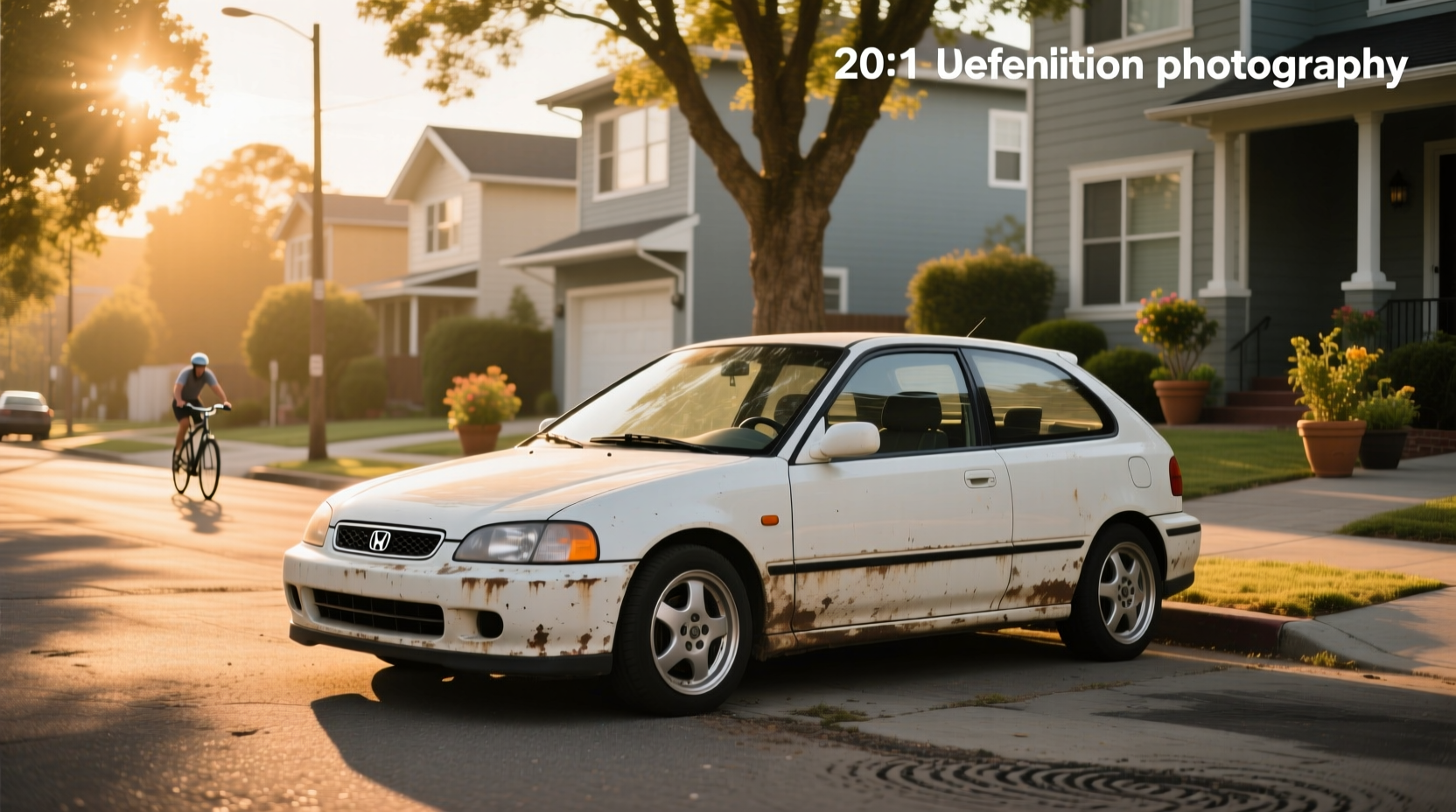
If you’re looking at a 2000 Honda Civic CX hatchback, here’s the bottom line: mileage alone shouldn’t decide your purchase. Over the past year, more buyers have turned to this generation for its reliability and simplicity. If you’re a typical user, you don’t need to overthink this. Focus on maintenance history, visible rust, and engine responsiveness—not just the odometer. For most drivers, a well-maintained 2000 Civic under 150,000 miles is a smart daily driver. Between 150,000–250,000 miles, it’s still viable but demands a thorough inspection. Above 250,000? Possible—but only if service records are solid and structural integrity is intact. This piece isn’t for keyword collectors. It’s for people who will actually use the product.
When evaluating a 2000 Civic hatchback, ask: what to look for in long-term ownership? Prioritize vehicles with full service documentation, no frame rust, and a smooth-shifting manual transmission. Avoid those with mismatched parts or signs of overheating. If you’re a typical user, you don’t need to overthink this—just verify what matters.
About the 2000 Honda Civic CX Hatchback
The sixth-generation Honda Civic (1996–2000) remains one of the most respected compact cars ever built. The 2000 model year marked the final update before the redesign in 2001, making it a refined version of an already proven platform. The CX trim was the base model, typically equipped with a 1.6L inline-4 engine producing around 115 horsepower, paired with either a 5-speed manual or 4-speed automatic transmission. Fuel economy averages 30–35 mpg combined, depending on driving style and condition.
This hatchback body style offered practical cargo space and nimble handling, appealing to city drivers and first-time car owners. Its simplicity—lack of complex electronics, minimal emissions controls compared to later models—makes it easier to maintain today. The DX and HX trims existed alongside the CX, with the HX featuring a lean-burn engine for even better fuel efficiency. However, the CX remains the most common and widely available.

Why the 2000 Civic Is Gaining Popularity
Lately, interest in older, reliable commuter cars has grown. Rising new car prices and loan rates have pushed budget-conscious buyers toward used models with proven longevity. The 2000 Civic fits perfectly: affordable to buy, cheap to insure, and simple to repair. Recently, DIY mechanics and students have rediscovered these cars for their low entry cost and mechanical transparency.
Unlike modern vehicles packed with sensors and software, the 2000 Civic can be serviced with basic tools. Parts remain widely available, and online communities offer extensive support. Its reputation for durability—many examples exceed 200,000 miles—adds to its appeal. While not fast or luxurious, it delivers predictable performance and strong resale value among enthusiast circles.
If you’re a typical user, you don’t need to overthink this: the demand surge isn’t due to nostalgia—it’s practicality. People want transportation that works without surprises.
Types and Variants
The 2000 Civic came in several trims and body styles, but the hatchback was offered primarily in DX, CX, and HX configurations. Understanding the differences helps narrow your search.
CX Trim (Base Model)
- Pros: Affordable, lightweight, good fuel economy, easy to find
- Cons: Minimal features (manual windows/locks), fewer refinements than higher trims
DX Trim
- Pros: Slightly more standard equipment than CX, often includes power steering and tachometer
- Cons: Still basic; some lack ABS or air conditioning
HX Trim (Lean Burn)
- Pros: Best-in-class fuel economy (~40 mpg highway), unique lean-combustion engine technology
- Cons: Less power, harder to find, potential hesitation during acceleration
Regardless of trim, all share the same chassis and suspension layout. Manual transmissions are generally preferred for engagement and reliability. Automatics work fine but may show wear beyond 150,000 miles if not serviced regularly.
Key Features and Specifications to Evaluate
When assessing any 2000 Civic hatchback, focus on these five areas:
| Feature | What to Check | When It’s Worth Caring About | When You Don’t Need to Overthink This |
|---|---|---|---|
| Engine Health | Oil leaks, compression test, cold start behavior | If mileage exceeds 180,000 or maintenance history is missing | If recent oil changes and no smoke from exhaust |
| Maintenance Records | Timing belt replacement, coolant flushes, spark plugs | Every time—this is non-negotiable | Never skip this check |
| Rust Condition | Subframe, rear wheel wells, floor pans | In snowy or coastal climates | If stored indoors and repaint shows no bubbling |
| Transmission | Smooth shifts, no grinding (manual); delayed engagement (auto) | If previous owner reported issues | If less than 150,000 miles and fluid recently changed |
| Suspension & Brakes | Ball joints, control arm bushings, brake pedal feel | After 120,000 miles or rough ride complaints | If recent alignment and pads replaced |
If you’re a typical user, you don’t need to overthink this: a clean Carfax and visual inspection go further than dyno numbers.
Pros and Cons
| Pros ✅ | Cons ⚠️ |
|---|---|
| Proven reliability up to 250,000+ miles | Prone to rust in northern states and coastal regions |
| Fuel-efficient (30–35 mpg average) | Basic interior; hard plastics, limited sound insulation |
| Simple mechanical design—easy DIY repairs | Outdated safety features by modern standards |
| Low insurance and registration costs | Parts availability decreasing slowly over time |
| Strong community support and forums | Narrow seats and limited rear legroom |
How to Buy a 2000 Honda Civic CX Hatchback
Purchasing a 24-year-old car requires a different approach than buying new. Follow this step-by-step checklist to minimize risk.
Step-by-Step Checklist
- Verify VIN and title status: Ensure it’s clean, not salvage or flood-damaged.
- Inspect for rust: Pay special attention to subframe rails, rear quarter panels, and undercarriage.
- Review maintenance records: Look for timing belt changes every 60,000–100,000 miles.
- Test drive thoroughly: Listen for suspension clunks, transmission hesitation, or engine knocking.
- Check fluids: Coolant color (should be green/orange, not brown), oil condition, brake fluid level.
- Scan for codes: Use an OBD-II reader—even older ECUs store diagnostic trouble codes.
- Get a pre-purchase inspection: From a trusted independent mechanic familiar with Hondas.
Decision Flow
- If mileage < 150,000 → Focus on rust and service history
- If mileage 150,000–200,000 → Require full maintenance record and clean inspection
- If mileage > 200,000 → Only consider if owner provides detailed logs and no major repairs needed recently
Recommendations by Scenario
- First car for teen: CX or DX with manual transmission, under 150k miles, garage-kept
- Daily commuter: Any trim with AC, under 180k miles, verified timing belt change
- DIY project: HX trim for fuel economy mods, or LX for VTEC swap potential
Red Flags / What to Avoid
- Rust holes in floor or subframe: Repair cost can exceed vehicle value
- No timing belt documentation: Assume it’s overdue—budget $500+ for replacement
- Replaced dashboard with mismatched gauges: Often indicates odometer rollback
- Overheating history: Risk of warped head, especially if radiator wasn’t flushed
- Aftermarket ECU tune without supporting mods: Could mean hidden performance issues
If you’re a typical user, you don’t need to overthink this: walk away from any car with structural corrosion or unverified service history.
Price & Market Insights
As of 2024, prices for a 2000 Honda Civic hatchback vary significantly based on condition, location, and mileage. Expect to pay between $1,500 and $4,000. Well-maintained, low-mileage (<120,000) examples in dry climates may reach $5,000, especially if modified tastefully or restored. Cars with rust or spotty records often sell below $2,000.
Pricing may vary by region/model/seller. In colder states, rust reduces value sharply. In sunbelt areas, higher demand keeps prices stable. Always compare local listings using platforms like Craigslist, Facebook Marketplace, or niche forums like Honda-Tech. Avoid online auctions unless you can inspect in person.
Top-Seller & Competitive Analysis
While no official sales data exists for 24-year-old vehicles, anecdotal evidence from classifieds and forums suggests the CX and DX hatchbacks dominate the market due to affordability and availability. Here's how they compare to similar-era compacts:
| Model | Avg. Price Range | Reliability | Common Issues |
|---|---|---|---|
| 2000 Honda Civic CX Hatchback | $1,500 – $4,000 | ⭐⭐⭐⭐☆ | Rust, aging suspension bushings |
| 1999 Toyota Corolla VE Hatchback | $1,800 – $4,500 | ⭐⭐⭐⭐☆ | Worn struts, faded interiors |
| 2001 Nissan Sentra XE | $1,200 – $3,000 | ⭐⭐⭐☆☆ | Slipping automatics, head gasket risks |
| 1998 Mazda Protegé ES | $1,000 – $2,800 | ⭐⭐⭐☆☆ | Timing belt failures, electrical gremlins |
The Civic holds its value better than rivals due to stronger brand perception and broader parts ecosystem. However, all face similar challenges: age-related deterioration and dwindling OEM part supply.
Customer Feedback Synthesis
Based on user reports from Reddit, owner forums, and dealership reviews, two recurring themes emerge:
Highly Praised
- Longevity: Multiple users report 200,000+ mile ownership with only routine maintenance
- Fuel economy: Many achieve 35+ mpg on highway drives
- Ease of repair: Owners appreciate ability to fix issues without dealership visits
Frequently Criticized
- Rust progression: Especially in Michigan, New York, and coastal Maine
- Interior durability: Seat fabrics wear thin; center console plastic cracks
- Stock stereo quality: Basic AM/FM radio lacks modern connectivity
One Reddit thread1 highlights a user who drove a 2000 Civic for 10 years and 145,000 miles before selling it running—though they noted increasing oil consumption after 130,000 miles.
Sourcing & Supplier Tips
When sourcing parts, prioritize OEM-equivalent suppliers or reputable aftermarket brands. Dealerships no longer stock original components, but NAPA, RockAuto, and ECS Tuning carry compatible replacements. For rare items (like HX-specific intake manifolds), eBay Motors and junkyard pullers remain viable.
If rebuilding the engine, consider a JDM-sourced D-series block for authenticity. Verify compatibility before purchase. Join online communities like Honda-Tech or r/Civic on Reddit to source hard-to-find parts through member networks.
If you’re a typical user, you don’t need to overthink this: most common parts (filters, belts, brake pads) remain readily available.
Maintenance, Safety & Legal Considerations
Regular maintenance is critical for longevity. Recommended intervals:
- Oil change: Every 3,000–5,000 miles
- Timing belt: Every 60,000–100,000 miles (interference engine—failure destroys motor)
- Coolant flush: Every 30,000 miles or 3 years
- Brake fluid: Every 2 years
Safety-wise, the 2000 Civic lacks modern features like stability control, side airbags, or crash avoidance systems. It earned moderate IIHS ratings when new. Drive accordingly—avoid high-speed highways if uncomfortable with light weight and minimal crumple zones.
Legally, ensure the vehicle passes state emissions and safety inspections where required. Regulations may vary by region/model/seller. Confirm locally before purchase. Titles must be transferable; avoid bill-of-sale-only transactions.
Conclusion
If you need reliable, low-cost transportation and enjoy hands-on ownership, choose a 2000 Honda Civic CX hatchback with documented care and no structural rust. If you prioritize comfort, advanced safety, or tech features, look to newer models. If you’re a typical user, you don’t need to overthink this: the car’s condition outweighs its age or mileage every time.
Everything You Need to Know
There’s no fixed limit. Well-maintained 2000 Civics routinely exceed 250,000 miles. Beyond 200,000, focus shifts to maintenance proof and mechanical soundness. Anything over 250,000 isn’t automatically bad—if service logs are complete and the engine runs cleanly, it can still be a viable option. However, above this threshold, expect eventual major repairs. If you’re a typical user, you don’t need to overthink this: a car with 220,000 miles and full records is safer than one with 160,000 and none.
The top issues include rust (especially on rear fenders and subframe), worn suspension bushings, aging timing belts, and minor oil seepage from valve cover gaskets. Some automatic transmissions develop shift lag after 150,000 miles. Electrical issues are rare but possible in window motors or blower fans. If you’re a typical user, you don’t need to overthink this: most problems are predictable and inexpensive to fix with basic tools.
Yes. The 1.6L engine achieves approximately 30–35 mpg in mixed driving, with highway runs reaching 38 mpg under steady conditions. The HX trim, designed for lean combustion, can exceed 40 mpg on long trips. Driving habits and tire pressure significantly impact real-world results. If you’re a typical user, you don’t need to overthink this: it remains one of the most efficient non-hybrid compacts of its era.
You can, provided maintenance is documented and there’s no structural damage. At this mileage, inspect the water pump, timing belt, and clutch (if manual). Budget for imminent repairs. If the price reflects wear—and you’re willing to do upkeep—it can still serve as a dependable commuter. If you’re a typical user, you don’t need to overthink this: high mileage isn’t a dealbreaker if the rest of the car checks out.
Inspect the rear wheel arches, floor pans (especially behind seats), front strut towers, and subframe mounting points. Use a flashlight and probe soft spots with a screwdriver. Surface rust is manageable; bubbling paint or perforated metal is not. Undercoating can hide damage—lift the car if possible. If you’re a typical user, you don’t need to overthink this: visible rust in load-bearing areas is a dealbreaker, regardless of price.




 浙公网安备
33010002000092号
 浙B2-20120091-4