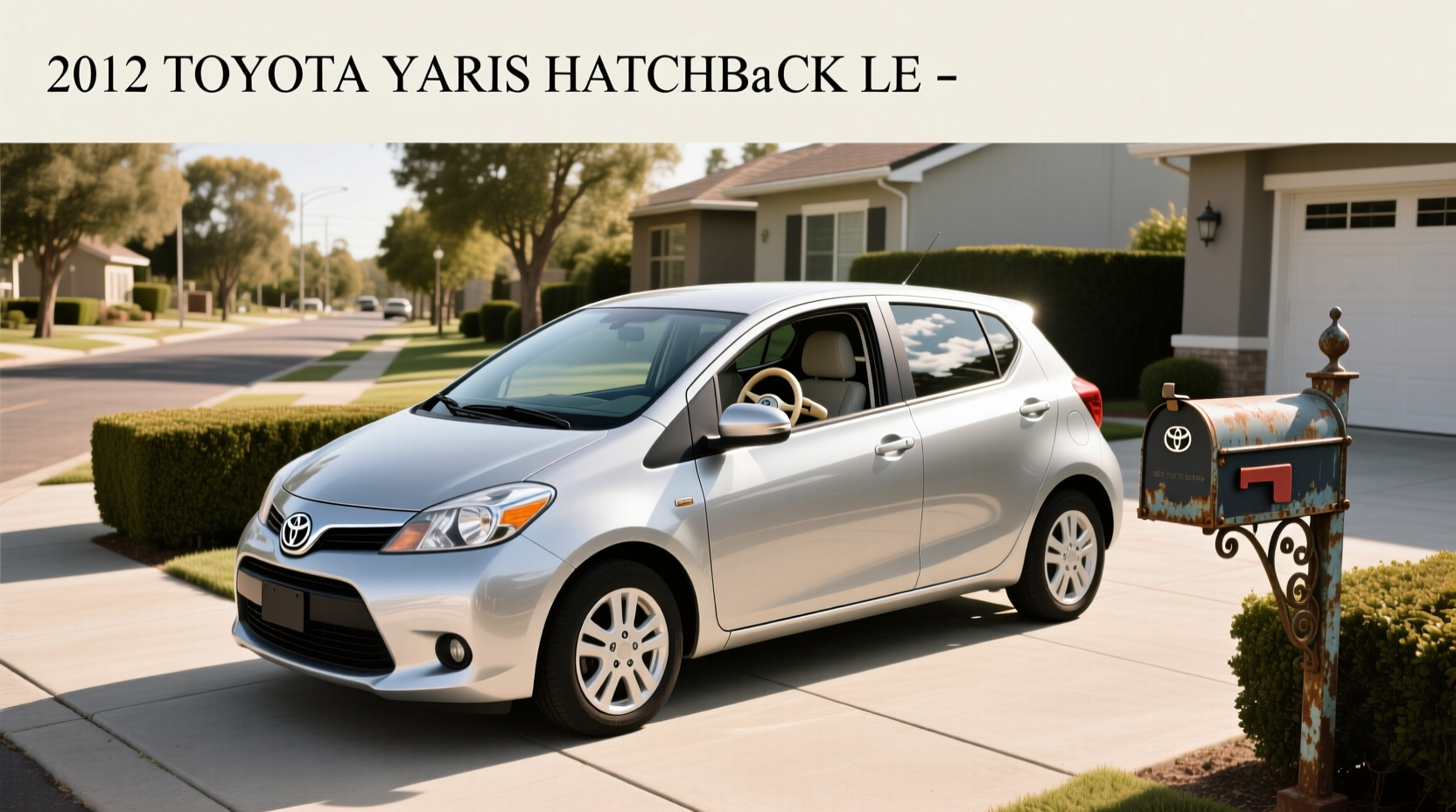
If you’re looking for a reliable, fuel-efficient city car with low running costs, the 2012 Toyota Yaris Hatchback LE is a strong candidate. When choosing a 2012 Toyota Yaris hatchback LE, focus on verified maintenance history, accident-free records, and actual mileage—these matter far more than trim-level differences. Avoid vehicles with salvage titles or unverified service gaps. If you’re a typical user, you don’t need to overthink this: prioritize condition over specs. Over the past year, rising fuel prices and urban congestion have renewed interest in compact, economical cars like the Yaris, making it a practical pick for budget-conscious drivers.
About 2012 Toyota Yaris Hatchback LE
The 2012 Toyota Yaris Hatchback LE belongs to the third generation of the Yaris lineup, introduced in 2011. It’s a front-wheel-drive subcompact designed primarily for urban commuting and light daily use. With its 1.5L inline-four engine producing 106 horsepower and 103 lb-ft of torque, the Yaris delivers modest performance but excels in fuel economy—rated at 30 mpg city and 35 mpg highway 1. Weighing around 2,315 lbs, it’s lightweight and easy to maneuver in tight spaces.
The LE trim sits above the base model, adding convenience features such as keyless entry, power windows, power mirrors (with heating), cruise control, Bluetooth connectivity, and a USB audio input. Seating is configured for five passengers, with a 60/40 split-folding rear bench that enhances cargo flexibility. Its interior is simple but functional, emphasizing durability over luxury.
Why 2012 Toyota Yaris Hatchback LE is gaining popularity
Lately, there's been a quiet resurgence in demand for older, proven economy cars. As living costs rise and remote work reduces annual mileage, many buyers are turning away from large SUVs and opting for affordable, efficient vehicles they can park easily and insure cheaply. The 2012 Yaris LE fits this trend perfectly. It doesn’t offer cutting-edge tech or sporty handling, but it consistently delivers where it counts: dependability, ease of repair, and predictable ownership costs.
This shift isn't driven by nostalgia—it’s a response to real economic pressure. Used car prices spiked after 2020, but now that the market has cooled slightly, value-focused shoppers are rediscovering models like the Yaris. If you’re a typical user, you don’t need to overthink this: what matters isn’t the latest infotainment system, but whether the car starts every morning and gets you where you need to go without draining your wallet.
Types and variants
The 2012 Yaris was offered in both hatchback and sedan body styles, with the hatchback available in three trims: Base, LE, and S. This guide focuses on the LE hatchback—the most balanced option for everyday drivers.
LE Trim (Recommended for Most Buyers)
- Pros: Includes power accessories, keyless entry, heated mirrors, cruise control, and Bluetooth—features absent in the base model.
- Cons: Still uses a 4-speed automatic transmission (older tech), no advanced driver aids, basic interior materials.
Base Trim
- Pros: Lower purchase price, lighter weight may improve fuel economy slightly.
- Cons: Manual windows and locks, no keyless entry, fewer comfort features—only worth considering if you're doing a full upgrade yourself.
S Trim
- Pros: Sportier styling, alloy wheels, upgraded suspension, steering wheel audio controls.
- Cons: Higher original MSRP, often paired with manual transmission (less desirable for city driving), limited availability today.
If you’re a typical user, you don’t need to overthink this: the LE trim offers the best blend of affordability and convenience. The S trim adds style but little functional benefit for most drivers.
Key features and specifications to evaluate
When assessing a used 2012 Yaris LE, some specs matter more than others. Here’s how to prioritize them:
Engine & Transmission
The 1.5L DOHC 16-valve I-4 engine is known for longevity if maintained properly. However, the 4-speed automatic transmission feels outdated compared to modern 6+ speed units. While it works reliably, expect slower acceleration and higher RPMs on highways.
When it’s worth caring about: If you frequently drive on highways or hilly terrain, the limited gear range will be noticeable.
When you don’t need to overthink it: For short commutes and city driving, the transmission performs adequately. If you’re a typical user, you don’t need to overthink this.
Fuel Economy
EPA estimates are 30 mpg city / 35 mpg highway. Real-world results vary based on driving habits and maintenance.
When it’s worth caring about: If fuel costs are a primary concern or you drive high mileage, even small inefficiencies add up.
When you don’t need to overthink it: Most well-maintained Yarises achieve close to EPA ratings under normal conditions.
Safety Features
Standard safety includes ABS, stability control, traction control, front airbags, side-impact airbags, and full-length side curtain airbags. No backup camera or lane assist (not expected for this class/year).
When it’s worth caring about: For families or new drivers, having curtain airbags and stability control improves crash protection.
When you don’t need to overthink it: Among 2012 subcompacts, the Yaris had above-average safety ratings. Don’t skip a vehicle just because it lacks modern ADAS.
| Specification | Detail |
|---|---|
| Engine | 1.5L I-4 DOHC 16-valve |
| Horsepower | 106 hp @ 6000 RPM |
| Torque | 103 lb-ft @ 4200 RPM |
| Transmission | 4-speed Automatic |
| Drivetrain | Front-Wheel Drive (FWD) |
| Fuel Economy (MPG) | 30 City / 35 Highway |
| Curb Weight | 2,315 lbs (1,050 kg) |
| Wheelbase | 98.8 in (2,510 mm) |
| Passenger Capacity | 5 |
| Seating Configuration | 60/40 Split-Folding Rear Bench |
| Standard Safety Features | ABS, Stability Control, Traction Control, Front/Side/Curtain Airbags, Child-Proof Rear Locks |
Pros and cons
- Excellent long-term reliability when serviced regularly
- Low insurance and repair costs
- Fuel-efficient for city driving
- Compact size makes parking and maneuvering easy
- Available with useful convenience features (LE trim)
- Outdated 4-speed automatic transmission
- Underpowered for aggressive merging or mountainous areas
- Basic interior with hard plastics
- No factory-installed navigation or touchscreen
- Limited cargo space behind rear seats
How to buy a 2012 Toyota Yaris Hatchback LE
Purchasing a decade-old vehicle requires diligence. Follow this step-by-step checklist to avoid costly mistakes.
Step-by-step checklist
- Verify VIN through Carfax or AutoCheck for accidents and title status
- Inspect service records—look for regular oil changes and timing belt replacement
- Test drive during rush hour to assess transmission shifts and noise levels
- Check for rust, especially in northern climates or salt-treated roads
- Confirm all electronics work: windows, locks, HVAC, Bluetooth, defroster
- Have an independent mechanic perform a pre-purchase inspection
Decision flow
Ask yourself:
- Will this be a primary or secondary vehicle? → Prioritize reliability.
- Do you live in a rural or snowy area? → Consider tire clearance and ground height.
- Is backseat access frequent? → Test legroom with your tallest passenger.
- Are you mechanically inclined? → A clean base model might save money.
Recommendations by scenario
- First-time buyer: Choose a low-mileage LE with full service history.
- City commuter: Ideal match—compact, efficient, easy to park.
- College student: Durable and cheap to insure; avoid flood-damaged examples.
- Backup/fleet vehicle: High-mileage Yarises still serve reliably if maintained.
Red flags / what to avoid
- Salvage or rebuilt title—risk of hidden structural damage
- Mileage inconsistencies or missing maintenance logs
- Transmission slipping or delayed shifting during test drive
- Signs of water intrusion (musty smell, stained carpets)
- Vehicles advertised "as-is" without inspection option
This piece isn’t for keyword collectors. It’s for people who will actually use the product.
Price & market insights
As of recent listings, retail prices for a 2012 Yaris Hatchback LE typically range from $4,000 to $7,500, depending on condition, mileage, and location. Trade-in values are lower—between $2,000 and $3,500 1. Auction data shows wide variation: clean examples with under 60,000 miles can sell for over $7,000, while high-mileage or accident-damaged units go for under $3,000 4.
Prices may vary by region/model/seller. Always compare multiple sources and verify local market trends. In colder regions, winter-ready models (heated mirrors, good tires) command small premiums.
Top-seller & competitive analysis
The 2012 Yaris competes with other subcompact hatchbacks like the Honda Fit, Ford Fiesta, Hyundai Accent, and Nissan Versa Note. Below is a comparison of key factors:
| Model | Fuel Economy (City/Hwy) | Reliability Score | Common Issues | Owner Sentiment |
|---|---|---|---|---|
| 2012 Toyota Yaris LE | 30/35 mpg | High | 4-speed auto, underpowered | "Dependable daily driver" |
| 2012 Honda Fit | 28/35 mpg | Very High | Timing belt service critical | "Great utility, peppy engine" |
| 2012 Ford Fiesta | 27/33 mpg | Moderate | Powertrain glitches, interior wear | "Fun to drive, less reliable" |
| 2012 Hyundai Accent | 28/38 mpg | Good | CVT hesitation, plastic trim cracks | "Solid value, decent warranty" |
| 2012 Nissan Versa Note | 27/36 mpg | Average | Noisy cabin, soft brakes | "Cheap to buy, costly to love" |
Reliability and sentiment based on aggregated owner reports. Fuel economy from manufacturer estimates.
The Yaris stands out not for excitement, but for predictability. If you’re a typical user, you don’t need to overthink this: among peers, few beat Toyota’s reputation for low-cost ownership.
Customer feedback synthesis
Analysis of owner reviews and forum discussions reveals consistent patterns:
- Most praised: Longevity (many exceed 200k miles), low repair frequency, ease of DIY maintenance.
- Most criticized: Lack of power, noisy cabin at highway speeds, dated interior design.
- Surprising positives: Heated mirrors appreciated in winter climates, Bluetooth pairing remains stable.
- Recurring complaints: Premature brake wear if driven aggressively, weak stock stereo speakers.
Owners who treat the Yaris as a no-frills tool tend to rate it highly. Those expecting refinement or performance express disappointment.
Sourcing & supplier tips
When sourcing parts or verifying authenticity:
- Use VIN lookup tools to confirm original equipment and recall completion.
- Genuine Toyota parts are available through dealers and reputable online suppliers 5.
- Aftermarket components are widely available due to shared platforms with other Toyotas.
- Avoid sellers who refuse third-party inspections or pressure quick decisions.
For certified pre-owned (CPO) vehicles, Toyota’s extended warranty covers powertrain up to 84 months or 100,000 miles from original in-service date, plus 12-month comprehensive coverage 3. Check eligibility before purchase.
Maintenance, safety & legal considerations
Routine maintenance includes oil changes every 5,000 miles, tire rotation, brake inspection, and coolant flush every 30,000–60,000 miles. The timing belt should be replaced around 90,000 miles—a critical service to prevent engine damage.
Safety-wise, ensure all airbag indicators function correctly and seat belts retract smoothly. While no federal recalls remain open for all 2012 Yaris models, individual vehicles may have unresolved campaigns. Verify via NHTSA’s website using the VIN.
Local regulations vary—some states require emissions testing for vehicles under 25 years old. Confirm requirements in your area before registration.
Conclusion
If you need a simple, economical car for city driving and occasional trips, the 2012 Toyota Yaris Hatchback LE is a sensible choice. Focus on overall condition rather than minor spec differences. If you’re a typical user, you don’t need to overthink this: a well-maintained example with a clean history will serve you reliably for years. Avoid damaged or poorly documented units, and always get a professional inspection.
FAQs
❓ Is the 2012 Toyota Yaris Hatchback LE reliable?
Yes, it has a strong reputation for mechanical reliability when maintained regularly. Many exceed 200,000 miles with basic care.
❓ What is the average lifespan of a 2012 Yaris?
With proper maintenance, 150,000–250,000 miles is common. Key services include timing belt replacement (~90k miles) and fluid changes.
❓ Does the 2012 Yaris LE have Bluetooth?
Yes, Bluetooth connectivity is standard on the LE trim for hands-free calling and audio streaming.
❓ How much should I pay for a 2012 Yaris LE?
Expect $4,000–$7,500 for a clean, low-mileage example. Prices may vary by region/model/seller—always compare local listings.
❓ Can I find a 2012 Yaris LE with low mileage?
Yes, some examples have under 60,000 miles, often from single-owner or garage-kept vehicles. Verify mileage with service records.




 浙公网安备
33010002000092号
 浙B2-20120091-4