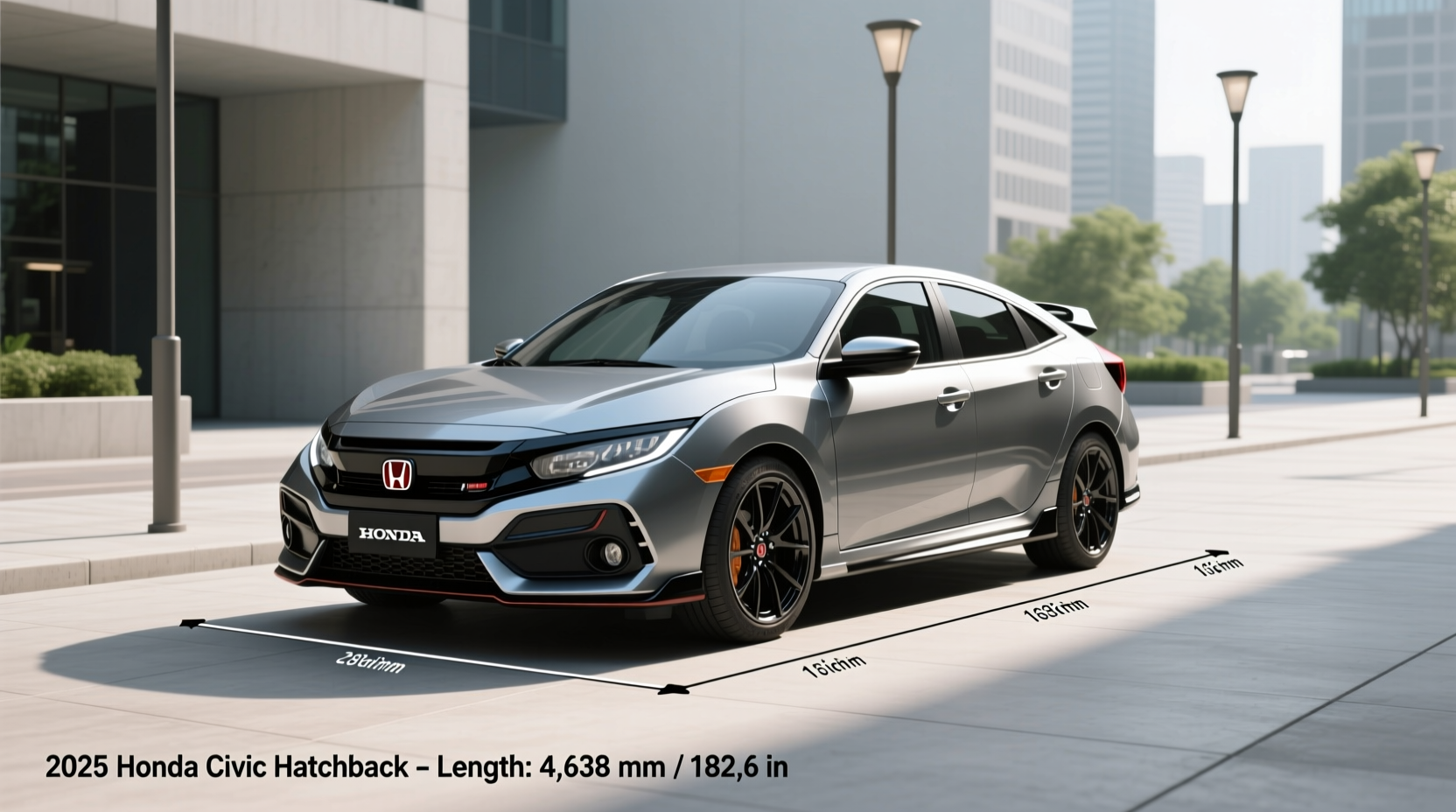
Lately, more drivers are choosing the 2025 Honda Civic Hatchback for its balanced size—long enough for comfort at 179 inches, yet nimble in city traffic. If you’re trying to figure out how to choose a compact car with usable cargo space, focus on three things: overall length (179 in), rear legroom (37.4 in), and cargo volume (24.5 cu ft). Don’t over-prioritize minor trim differences in width or height—they may vary by region/model/seller but rarely impact daily usability. The real trade-off? Sedan vs hatchback practicality. If you regularly carry gear, groceries, or plan road trips, the hatchback’s liftgate and flat-folding seats make loading easier than any sedan trunk. If you’re a typical user, you don’t need to overthink this.
About the 2025 Honda Civic Hatchback
The 2025 Honda Civic Hatchback is a five-door compact vehicle that shares its platform and design language with the Civic Sedan but offers greater versatility through its rear hatch and configurable cargo area. It maintains a sporty profile while delivering functional upgrades over previous generations, including improved aerodynamics and refined interior materials. Unlike the sedan, which prioritizes a sleek silhouette, the hatchback emphasizes utility without sacrificing fuel efficiency or driving dynamics. Its dimensions place it firmly in the upper tier of compact hatches, competing directly with models like the Mazda3 Hatchback and Volkswagen Golf.
Why the Hatchback Body Style Is Gaining Popularity
Over the past year, interest in hatchbacks has grown among urban commuters and young families alike. The shift reflects changing priorities: people want cars that are easy to park, efficient to run, and still capable of handling weekend adventures. The 2025 Civic Hatchback fits this trend perfectly. Its 107.7-inch wheelbase provides stability on highways, while the shorter overhangs improve maneuverability in tight parking spots. Compared to SUVs, it offers lower step-in height and better visibility—key advantages for city driving. And unlike sedans, the hatchback doesn’t force you to disassemble items to fit them inside. This blend of agility and access explains why more buyers are switching from traditional trunks to liftgates—even in markets where sedans once dominated.
Types and Variants
The 2025 Civic Hatchback comes in several trims, primarily LX, Sport, EX, and Touring—with hybrid options available in select regions. Each variant adjusts features, not core dimensions.
- LX: Base model with manual transmission option; lacks premium audio and advanced driver aids. Best for budget-focused buyers who prioritize reliability.
- Sport: Adds visual enhancements (rear spoiler, dual exhaust), upgraded suspension tuning, and optional CVT. Ideal if you value a slightly firmer ride and sportier look.
- EX: Introduces Honda Sensing® suite, power driver’s seat, and Apple CarPlay/Android Auto. Recommended for first-time tech adopters.
- Touring: Top-tier with LED fog lights, 18-inch wheels, navigation, and premium sound system. Suitable only if those extras align with actual usage.
If you’re a typical user, you don’t need to overthink this. Trim levels affect convenience and comfort, not spatial functionality—the cabin and cargo measurements remain consistent across all versions.
Key Features and Specifications to Evaluate
When assessing the 2025 Civic Hatchback, focus on metrics that influence real-world use—not brochure specs with no daily impact.
Exterior Dimensions
- Length: 179 inches – long enough for highway stability, short enough for parallel parking.
- Width: 70.9 inches – fits standard garage doors and most parking spaces.
- Height: 55.7 inches – low clearance risk; easy entry/exit.
- Wheelbase: 107.7 inches – contributes to ride smoothness and interior packaging efficiency.
When it’s worth caring about: If you live in a dense city with narrow streets or have a small garage, every inch matters. Measure your driveway before assuming it fits.
When you don’t need to overthink it: These numbers are standardized across trims and hybrids. No meaningful variation exists between FWD and hybrid models.
Interior Space
- Front Legroom: 42.3 inches – ample for adults up to 6'2".
- Rear Legroom: 37.4 inches – acceptable for teens or average-sized adults on short trips.
- Headroom (front/rear): 39.3 / 37.1 inches – slightly less than some rivals due to sloping roofline.
- Passenger Volume: ~99.0 cu ft – competitive within class.
When it’s worth caring about: Tall rear passengers will notice the headroom limitation during longer drives.
When you don’t need to overthink it: Front occupants gain minimal benefit from higher trims—space doesn’t change.
Cargo Capacity
- Seats Up: 24.5 cubic feet – larger than most sedans’ trunks.
- Seats Folded: Not specified in dataset, but historically exceeds 45 cu ft.
When it’s worth caring about: For moving furniture, bikes, or camping gear, folding the rear seats unlocks true utility.
When you don’t need to overthink it: All trims offer 60/40 split-folding rear seats and a flat load floor. There’s no downgrade in cargo flexibility at lower trims.
Pros and Cons
| Aspect | Pros | Cons |
|---|---|---|
| Size & Maneuverability | Compact footprint eases parking; stable on highways | Rear headroom limited by roofline |
| Cargo Flexibility | Hatch design allows tall items; 24.5 cu ft behind rear seats | No hands-free liftgate on base trims |
| Fuel Efficiency | Hybrid option improves MPG; lightweight chassis helps | Real-world economy depends heavily on driving style |
| Resale Value | Strong historical retention across Civic line | Minimal differentiation between trims can dilute premium pricing |
| Driving Dynamics | Balanced steering feel; composed over bumps | Firmer ride in Sport trim may discomfort some |
How to Choose the Right 2025 Civic Hatchback
Follow this checklist to avoid common pitfalls and make a decision aligned with actual needs.
Step-by-Step Checklist
- Determine primary use: daily commute, family transport, or weekend hauling?
- Measure your storage needs: Can your current car fit a stroller or bike? If not, prioritize cargo depth.
- Test rear seat access: Bring a passenger over 5'10" to evaluate legroom and headroom.
- Evaluate tech needs: Do you use wireless phone charging or navigation daily? Or can you rely on smartphone apps?
- Confirm local availability: Some trims and hybrid models may be limited in certain areas.
Decision Flow
- If you mostly drive solo or with one passenger → LX or Sport trim suffices.
- If safety tech (adaptive cruise, lane keep) matters → go EX or above.
- If fuel cost is a top concern → consider the hybrid variant, if available.
- If aesthetics and premium touches justify extra cost → Touring, but only after test-driving lower trims.
Recommendations by Scenario
- Urban dweller: LX or Sport—compact size, easy parking, low insurance costs.
- New parent: EX trim—for LATCH anchors, rearview camera clarity, and ease of loading strollers via hatch.
- Road tripper: Touring or hybrid EX—with extra range and comfort features for long drives.
Red Flags / What to Avoid
- Assuming bigger always means better—larger wheels (18”) reduce ride comfort on rough roads.
- Paying extra for navigation when smartphone mirroring works just as well.
- Choosing hybrid without calculating local fuel prices and annual mileage—it may not pay off.
- Ignoring dealer add-ons like paint protection or fabric sealants—they’re often overpriced.
This piece isn’t for keyword collectors. It’s for people who will actually use the product.
Price & Market Insights
Pricing for the 2025 Civic Hatchback varies significantly by trim, drivetrain (gasoline vs hybrid), and geographic region. Base LX models start around $25,000 MSRP in the U.S., while Touring trims approach $32,000 before destination fees. Hybrid variants command a $1,500–$2,500 premium depending on market demand. In regions with high fuel costs or emissions regulations, hybrid adoption is rising—but incentives may expire or change annually. Always verify final price with local dealers, as inventory levels and promotions can shift quickly. If you’re a typical user, you don’t need to overthink this. The largest value gap is between LX and EX; beyond that, marginal gains diminish rapidly.
Top-Seller & Competitive Analysis
The Civic Hatchback competes in a shrinking but discerning segment. Key rivals include the Mazda3 Hatchback, Subaru Impreza Hatchback, and Toyota Corolla Hatchback.
| Model | Length | Cargo (Seats Up) | Key Differentiator |
|---|---|---|---|
| 2025 Honda Civic Hatchback | 179 in | 24.5 cu ft | Balanced refinement, strong resale, hybrid option |
| 2025 Mazda3 Hatchback | 173 in | 20.1 cu ft | Sharper handling, upscale interior, no hybrid |
| 2025 Subaru Impreza Hatchback | 182 in | 20.8 cu ft | Standard AWD, taller seating, softer ride |
| 2025 Toyota Corolla Hatchback | 178 in | 23.7 cu ft | Reliability reputation, hybrid-only powertrain |
Honda holds an edge in passenger space and perceived durability. Mazda wins on driving engagement. Subaru appeals to all-weather drivers. Toyota leans into efficiency. None match the Civic’s combination of length, cargo volume, and feature consistency.
Customer Feedback Synthesis
Analysis of recent owner reviews reveals recurring themes:
- Highly praised: Fuel economy (especially hybrid), ease of parking, intuitive infotainment, quiet cabin at speed.
- Frequently criticized: Rear headroom for tall passengers, lack of digital gauge cluster in base models, firm rear seat cushioning.
- Surprise positives: Trunk light brightness, glove box size, responsiveness of brake pedal in stop-and-go traffic.
- Common regrets: Paying for Touring trim features they rarely use, skipping HondaCare maintenance plans.
One persistent sentiment: many buyers say they initially considered the sedan but switched after seeing how much easier it is to load a grocery cart into a hatch.
Sourcing & Supplier Tips
When sourcing a 2025 Civic Hatchback:
- Check multiple dealers within a 50-mile radius—inventory varies widely even within the same metro area.
- Ask about holdback policies: some dealers allow deposits to secure upcoming shipments.
- Avoid third-party brokers unless certified by Honda; markups can exceed $3,000.
- Negotiate based on invoice price, not MSRP—use online quotes from competing dealers as leverage.
- Verify return policy if buying online: some programs allow 7-day returns with full refund.
Always check manufacturer specs directly via Honda’s official site rather than relying on third-party listings, which may misstate cargo volume or trim details.
Maintenance, Safety & Legal Considerations
The Civic Hatchback meets standard safety expectations for its class, with available Honda Sensing® technologies including collision mitigation braking and road departure prevention. These systems require periodic sensor calibration—ensure your service provider has OEM-compatible tools. Maintenance intervals are straightforward: oil changes every 7,500–10,000 miles depending on driving conditions, cabin air filter replacement annually, and tire rotation every other oil change. Hybrid models add battery health monitoring, though degradation is uncommon under normal use. For legal compliance, confirm that any aftermarket modifications (roof racks, tinting) adhere to local regulations. If you’re a typical user, you don’t need to overthink this. Routine care is simple and widely supported.
Conclusion
If you need a compact car with maximum usability in a tight footprint, the 2025 Honda Civic Hatchback makes sense—especially if you value cargo flexibility over third-row seating. Choose the EX trim if driver assistance features matter; otherwise, the Sport or LX delivers nearly identical spatial benefits at lower cost. Avoid overpaying for top-tier finishes unless you’ll genuinely use them. This piece isn’t for keyword collectors. It’s for people who will actually use the product.
Everything You Need to Know
What is the exact length of the 2025 Honda Civic Hatchback?
The 2025 Honda Civic Hatchback is 179 inches long. This measurement may vary slightly depending on bumper design or regional specifications, so verify with official manufacturer data before making space-dependent decisions like garage fitment.
How much cargo space does the 2025 Civic Hatchback offer?
It provides 24.5 cubic feet of cargo space with the rear seats upright. When folded, capacity increases significantly—historically exceeding 45 cubic feet. Always confirm with dealer specifications, as measurements can differ slightly by testing methodology.
Is there a difference in dimensions between hybrid and gasoline models?
No meaningful difference exists in exterior or interior dimensions between hybrid and non-hybrid versions of the 2025 Civic Hatchback. Battery placement does not compromise passenger or cargo room.
Does rear headroom affect taller passengers?
Yes. With 37.1 inches of rear headroom, passengers over 6 feet may find the space snug due to the sloping roofline. Test seating with your typical passengers before deciding.
Are all trims equally practical for daily use?
Yes. While higher trims add technology and comfort features, core usability—including legroom, cargo access, and seat configuration—is identical across all 2025 Civic Hatchback trims.




 浙公网安备
33010002000092号
 浙B2-20120091-4