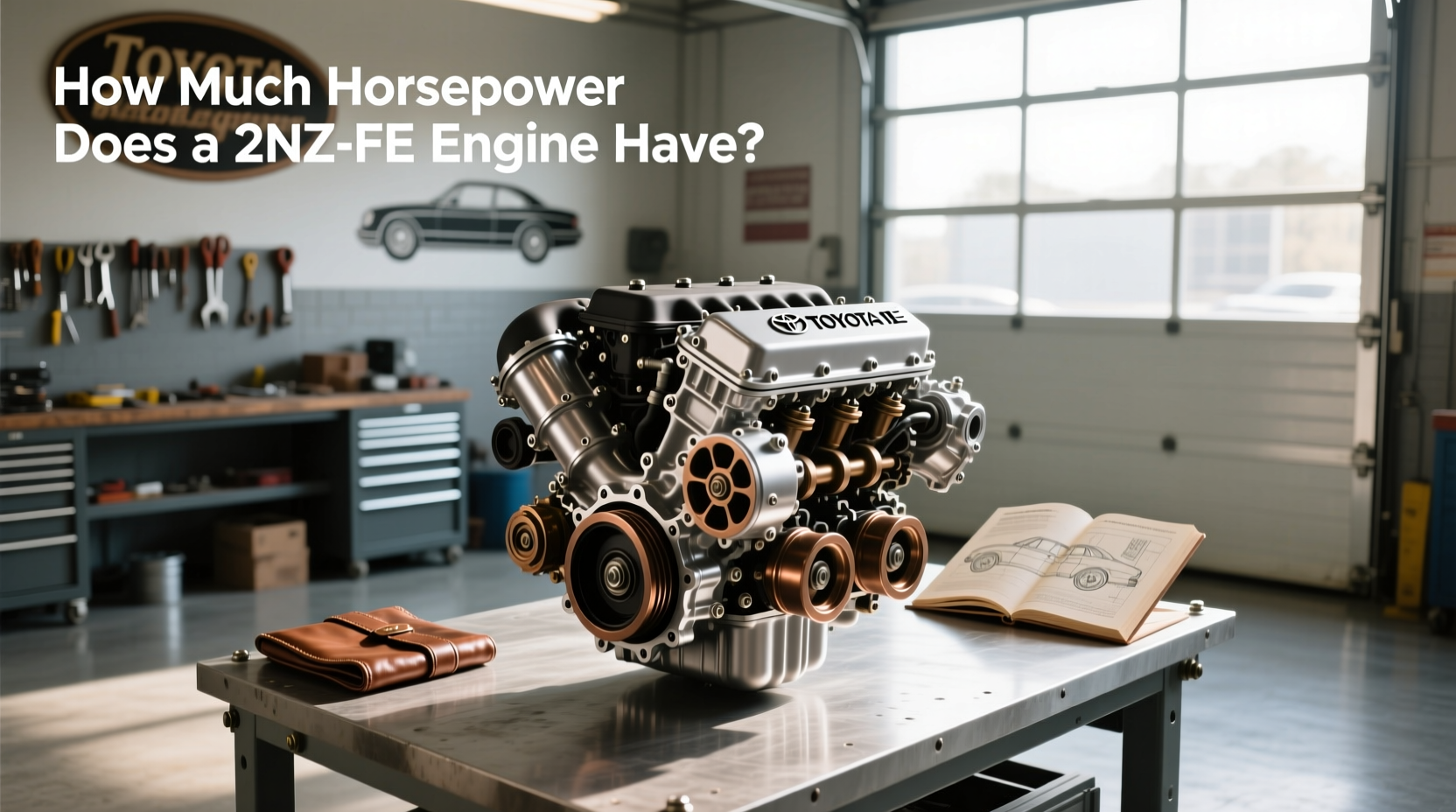
Short Introduction: What to Look for in a Toyota 2NZ-FE Engine
If you're asking how much horsepower does a 2NZ-FE engine have?, the answer is typically between 84.5 and 88 horsepower (HP), with torque around 121–124 Nm. However, choosing the right Toyota 2NZ-FE engine—whether for replacement, restoration, or performance tuning—requires more than just knowing peak output. When evaluating how to choose a Toyota 2NZ-FE engine, focus on its variant type, regional specifications, VVT-i presence, mileage history, and common mechanical issues like timing chain wear or oil consumption 1. Avoid engines without service records or those showing signs of oil leaks under the chain cover, as these can signal costly repairs ahead. This guide breaks down everything you need—from specs to sourcing tips—to make an informed decision.
About the Toyota 2NZ-FE Engine: Definition and Typical Use Cases
The Toyota 2NZ-FE is a 1.3-liter (1298 cc), inline-four, DOHC, 16-valve gasoline engine introduced in 1999. It features an aluminum block and head, making it lightweight (~92.5 kg), and uses Toyota’s VVT-i (Variable Valve Timing with intelligence) system on the intake camshaft for improved efficiency and responsiveness ⚙️ 2. Designed primarily for compact and subcompact vehicles, it powers models such as the Toyota Yaris (XP10, XP20), Echo, Platz, and FunCargo.
This engine was engineered for urban commuting and fuel-efficient daily driving rather than high-performance applications. Its balance of modest power, low weight, and strong reliability made it ideal for entry-level sedans and hatchbacks in global markets including Japan, Europe, Southeast Asia, and North America.
Why the 2NZ-FE Engine Is Gaining Popularity Among Buyers
Despite being discontinued in many regions, the 2NZ-FE remains popular among used car buyers, mechanics, and DIY engine swappers due to its proven durability and widespread availability ✅. In 2000, it won the International Engine of the Year award in the 1.0–1.4L category, reinforcing its reputation for refinement and efficiency 3.
Today, demand persists because:
- ✅It's commonly found in salvage yards and online marketplaces at affordable prices.
- ✅Parts are widely available and relatively inexpensive.
- ✅Its simple design makes repairs accessible even for home mechanics.
- ✅Fuel economy averages around 5–6 L/100km in city driving, appealing to budget-conscious drivers.
For buyers looking to replace a failed engine or restore a classic Yaris/Echo, the 2NZ-FE offers a reliable, cost-effective solution.
Types and Variants: Differences in Output and Design
Not all 2NZ-FE engines are identical. There are several variants based on region, emissions standards, and model year, which directly affect performance and compatibility.
1. Standard VVT-i Version (Most Common)
Found in most post-2000 models, this version includes the VVT-i system and delivers approximately 86–88 HP and 121–124 Nm of torque. Ideal for standard replacements where original performance is desired.
- Pros: Better fuel economy, smoother idle, optimized valve timing.
- Cons: Potential for VVT-i actuator rattle; requires timely maintenance.
2. Non-VVT-i Version (Pre-2000 or Certain Markets)
Some early or developing-market models lack VVT-i to accommodate lower-octane or leaded fuels. Power drops slightly to about 80–81 PS (≈80 HP).
- Pros: Simpler design, fewer moving parts.
- Cons: Lower efficiency, reduced low-end torque.
3. Euro IV Compliant Redesign (Post-2003)
Updated to meet stricter emissions, featuring revised pistons, exhaust manifold, and dual catalytic converters. Output remains similar but tuning differs.
- Pros: Cleaner emissions, better compliance in regulated areas.
- Cons: Slightly more complex; potential backpressure from second cat.
Key Features and Specifications to Evaluate
When assessing a used or replacement 2NZ-FE engine, verify these critical specifications:
- 📊Horsepower: Expect 84.5–88 HP depending on source and measurement standard (SAE vs JIS).
- ⚙️Torque: 119–124 Nm @ 4,200–4,400 rpm.
- 🔍Compression Ratio: 10.5:1 — indicates good thermal efficiency.
- 🧼VVT-i System: Confirm functionality; listen for cold-start rattles.
- 🔧Timing Chain: Check if replaced; factory interval is ~150,000 km.
- 🧰Weight: ~92.5 kg — important for swaps or balancing.
- 🌍Emissions Compliance: Match to your region’s regulations (Euro III vs IV).
| Source | Horsepower (HP) | Torque (Nm) | RPM (HP) | RPM (Torque) |
|---|---|---|---|---|
| Wikipedia | 86–88 HP | 121–123 Nm | 6,000 rpm | 4,400 rpm |
| AutoManiac | 86 HP | 124 Nm | 6,000 rpm | - |
| Scribd | 106 HP | 119 Nm | 6,000 rpm | 4,200 rpm |
| Toyota-club | 86 HP | 121 Nm | 6,000 rpm | 4,400 rpm |
| Engine-specs.net | 84.5 HP | 121 Nm | 6,000 rpm | 4,400 rpm |
Note: The outlier 106 HP figure from Scribd may reflect dyno testing, mislabeling, or non-standard conditions. Always cross-check with OEM data.
Pros and Cons: Who Should (and Shouldn’t) Buy This Engine
How to Choose a Toyota 2NZ-FE Engine: Step-by-Step Buying Guide
Follow this checklist when selecting a 2NZ-FE engine:
- 📍Confirm Compatibility: Match engine code, mount points, ECU type, and wiring harness to your vehicle model.
- 🔍Verify Horsepower Spec: Ask whether it’s VVT-i equipped and check documentation for rated output.
- 📋Inspect Service History: Engines with full records are less risky. Ask about oil changes and major services.
- 🧰Check for Known Issues: Look for oil leaks near chain cover, rear main seal, or tensioner. Listen for VVT-i rattle on startup.
- ⏱️Ask About Mileage: Over 150,000 km? Ensure timing chain, guides, and sprockets were replaced.
- 🔧Test Run If Possible: Watch for smoke, unusual noises, or unstable idle.
- ❗Avoid These Red Flags: No documentation, evidence of overheating, mismatched parts, or modified internals.
Price & Market Insights: What to Expect to Pay
Prices vary significantly by region, condition, and supplier type:
- Used (Salvage Yard): $300–$700 USD
- Rebuilt/Remanufactured: $800–$1,300 USD
- New Old Stock (Rare): Up to $2,000+ USD
In Asia and Eastern Europe, prices tend to be lower due to higher availability. In North America and Australia, shipping and import costs can increase final price. Consider labor costs—installation typically takes 8–12 hours—when weighing total investment.
Top-Seller & Competitive Analysis
While no single “top-seller” brand exists for complete 2NZ-FE engines, certain suppliers stand out:
| Supplier Type | Pros | Cons | Best For |
|---|---|---|---|
| Junkyard/Salvage | Low cost, real-world tested | Limited warranty, unknown history | Budget rebuilds |
| Certified Rebuilder | Warranty (1–3 yrs), inspected parts | Higher upfront cost | Long-term reliability |
| Online Marketplace (e.g., eBay) | Wide selection, buyer reviews | Risk of scams, inconsistent quality | Niche needs, rare variants |
Customer Feedback Synthesis: Common Praises and Complaints
Based on owner forums and mechanic reports:
👍 Frequent Praises
- “Runs smoothly after proper warm-up.”
- “Gets great gas mileage—over 40 MPG highway.”
- “Easy to work on; lots of online help.”
👎 Common Complaints
- “Timing chain failed at 160k miles with loud noise.”
- “Burns oil after 150k km—needs valve seals.”
- “VVT-i rattle on cold start drives me crazy.”
Sourcing & Supplier Tips
To reduce risk when buying:
- 🌐Buy from suppliers who provide VIN-linked histories or dismantling reports.
- 🛒Use platforms with buyer protection (e.g., eBay Money Back Guarantee).
- 🚚Clarify shipping terms—engines are heavy and damage-prone.
- 📎Request photos of the actual unit, especially oil passages and mounts.
- ✅Consider paying extra for a core exchange program to ensure authenticity.
Maintenance, Safety & Legal Considerations
To maximize lifespan:
- 🔧Replace timing chain, guides, and tensioner every 150,000 km.
- 🧼Clean throttle body and MAF sensor annually to prevent idle issues.
- ⛽Use quality 5W-30 or 10W-30 motor oil and change every 8,000–10,000 km.
Safety note: Always disconnect the battery before working on the engine. Use proper lifting equipment—never rely on makeshift jacks.
Legally, verify that engine swaps comply with local emissions laws. In some regions, installing a non-certified engine voids registration.
Conclusion: Final Recommendation
The Toyota 2NZ-FE engine is a solid choice for economical transportation and straightforward replacements. If you need a reliable, fuel-efficient 1.3L engine for a Yaris, Echo, or similar platform, and you're prepared to maintain it properly—especially replacing the timing chain proactively—the 2NZ-FE is a sensible pick. But if you require more power or plan aggressive modifications, consider upgrading to a larger displacement engine like the 1NZ-FE or 2ZR-FE instead.
Frequently Asked Questions
- Q: How much horsepower does a 2NZ-FE engine have?
A: Most versions produce between 84.5 and 88 horsepower, depending on region and configuration. - Q: Is the 2NZ-FE engine reliable?
A: Yes, it's generally reliable, though timing chain and oil consumption issues may arise past 150,000 km. - Q: Does the 2NZ-FE have a timing belt or chain?
A: It uses a timing chain, which lasts longer but still requires inspection and replacement around 150,000 km. - Q: Can I swap a 2NZ-FE into a different car?
A: Possible, but requires careful planning for mounts, wiring, and ECU compatibility. - Q: Why does my 2NZ-FE burn oil?
A: Increased oil consumption often occurs after 150,000 km due to worn piston rings or valve seals.




 浙公网安备
33010002000092号
 浙B2-20120091-4