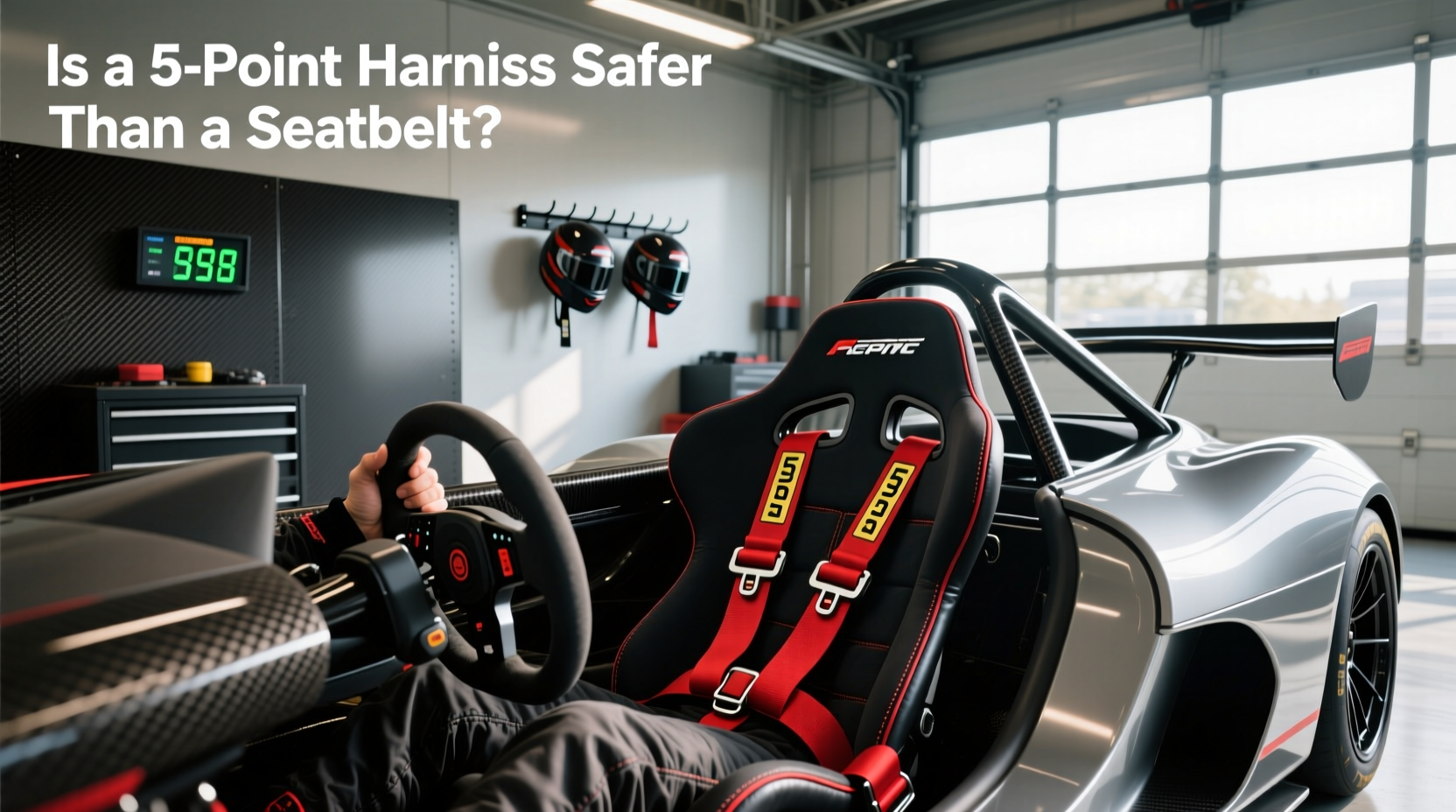
If you're asking how to choose a 5 point racing seat belt or wondering is a 5-point harness safer than a seatbelt?, the answer depends on context. In high-performance or motorsport environments, a 5-point harness offers superior restraint by securing the occupant at five points—two shoulders, two hips, and one between the legs (anti-submarine strap)—distributing crash forces more evenly across the pelvis, chest, and shoulders 1. This design significantly reduces forward movement, prevents submarining, and enhances torso control during impact 2. However, for daily passenger vehicles, standard 3-point belts integrated with airbags remain optimal due to comfort, ease of use, and compatibility. When selecting a 5-point harness, prioritize certified models (e.g., FIA, SFI), correct fitment, and intended use—racing, child seats, or specialty vehicles—to avoid interference with OEM safety systems.
About 5 Point Racing Seat Belt, Is a 5-Point Harness Safer Than a Seatbelt?
A 5-point racing seat belt is a multi-point restraint system consisting of five straps: two shoulder straps, two lap straps, and one crotch strap (anti-submarine belt). Unlike standard 3-point seat belts found in consumer vehicles, which anchor at the shoulder, buckle, and floor, the 5-point harness creates a tighter, more comprehensive hold on the body. The central crotch strap plays a critical role in preventing "submarining," where the pelvis slides under the lap belt during frontal collisions—a common cause of abdominal and spinal injuries.
The question "Is a 5-point harness safer than a seatbelt?" must be evaluated within specific contexts. Biomechanically, yes—the 5-point configuration provides better load distribution and occupant retention. However, this advantage applies primarily in controlled environments like motorsports or child restraints. In regular passenger cars, airbag timing, seat geometry, and crash energy management are calibrated for 3-point systems. Introducing a 5-point harness without modifying these factors can disrupt the vehicle’s integrated safety design.
Why 5 Point Racing Seat Belt, Is a 5-Point Harness Safer Than a Seatbelt? Is Gaining Popularity
Interest in 5 point racing seat belts has grown beyond racetracks due to rising awareness of advanced safety solutions. Enthusiasts modifying street-legal performance cars, parents seeking maximum protection for children, and operators of off-road or custom-built vehicles are increasingly exploring harness options. Online forums, motorsport media, and safety advocacy groups have amplified discussions around crash dynamics, leading more users to ask "is a 5-point harness safer than a seatbelt?" as they seek improved personal protection.
This trend is also fueled by real-world accident reports showing reduced injury severity when proper harnesses were used. Additionally, affordable aftermarket kits and universal-fit harnesses have made installation more accessible. Still, popularity does not equate to universal suitability. Misapplication—such as installing a racing harness in an unmodified sedan—can introduce new risks, including compromised airbag function and delayed egress in emergencies.
Types and Variants
Understanding the different types of 5-point harnesses helps align selection with your needs:
🏁 Fixed-Back Racing Harness
- Pros: High durability, consistent tension, ideal for dedicated race cars.
- Cons: Permanent installation required; not suitable for dual-use street vehicles.
🔧 Bolt-In Universal Harness
- Pros: Easy to install using existing seat or floor anchors; compatible with many roll cages.
- Cons: May require reinforcement if mounting points aren’t structurally sound.
🛒 Quick-Release Competition Harness
- Pros: Features a single-center or dual-side release mechanism for rapid exit—critical in fire or water immersion scenarios.
- Cons: More complex mechanism may require periodic maintenance.
👶 Child Safety Seat Integrated Harness
- Pros: Designed specifically for pediatric anatomy; often adjustable as child grows.
- Cons: Not transferable to adult use; limited to approved car seats meeting NHTSA standards 3.
Key Features and Specifications to Evaluate
When assessing a 5 point racing seat belt, consider these measurable criteria:
- ✅ Certification Standards: Look for compliance with FIA 8853/98, SFI 16.1, or ISO 10409. These indicate rigorous testing for strength and durability.
- ⚙️ Webbing Material: Polyester webbing is standard; check tensile strength (typically rated above 6,000 lbs).
- 🔧 Buckle Type: Pull-up or push-button quick-release mechanisms vary in reliability—opt for those with positive lock feedback.
- 📏 Adjustability: Shoulder and lap strap lengths should be adjustable to accommodate different body sizes and seat positions.
- 📌 Mounting Configuration: Ensure anchor points match your seat or chassis setup (e.g., 3” or 2” bolt patterns).
- ✨ Padding & Comfort: Padded shoulder straps reduce pressure during long sessions but may add bulk.
Pros and Cons
| Aspect | Advantages ✅ | Disadvantages ❗ |
|---|---|---|
| Safety Performance | Better force distribution, reduced submarining, enhanced upper-body control | Risk of improper fit negating benefits |
| Use Case Fit | Superior in racing, off-road, or child safety applications | Poor ergonomics for daily commuting |
| Integration | Works well with roll cages and HANS devices | May interfere with factory airbags and seat sensors |
| Ease of Use | Secure fit minimizes movement during aggressive driving | Slower entry/exit; harder for elderly or mobility-limited users |
How to Choose a 5 Point Racing Seat Belt, Is a 5-Point Harness Safer Than a Seatbelt?
Follow this step-by-step guide when deciding how to choose a 5 point racing seat belt and evaluating whether it's right for your situation:
- Determine Your Use Case: Are you building a track car, upgrading a daily driver, or securing a child? Only proceed with a 5-point harness if it matches a high-G or specialized environment.
- Check Vehicle Compatibility: Confirm your vehicle has appropriate anchor points or a roll cage. Never rely on stock seat belt anchors unless explicitly rated for racing harness loads.
- Select Certified Equipment: Choose harnesses labeled FIA 8853/98 or SFI 16.1. Avoid uncertified imports lacking traceable test data.
- Ensure Proper Fit: Straps should lie flat without twisting. The anti-submarine strap must sit snugly between the legs without pinching.
- Test Egress Speed: Practice unbuckling under time pressure. A slow release could be dangerous in emergencies.
- Avoid These Red Flags:
- Using a 5-point harness in a vehicle without a head restraint or roll bar.
- Pairing with airbags without professional guidance.
- Ignoring manufacturer expiration dates.
- Purchasing second-hand harnesses with unknown history.
Price & Market Insights
Pricing for 5 point racing seat belts varies widely based on certification, brand, and region:
- $80–$150: Entry-level SFI-certified kits (common brands: Crow, Simpson).
- $150–$250: Mid-tier FIA-approved harnesses with better materials and adjustability.
- $250+: Premium competition-grade sets with lightweight components and custom colors.
Prices may differ by country due to import duties and local regulations. While higher cost often reflects better quality, always verify certification over brand reputation. For occasional track use, mid-range FIA models offer the best value. Bulk purchases (e.g., for车队 teams) typically unlock discounts through authorized distributors.
Top-Seller & Competitive Analysis
| Model | Certification | Quick Release | \th>Price Range |
|---|---|---|---|
| OMP HTE-2 5-Point | FIA 8853/98 | Center pull | $220–$260 |
| Crow XRS 5-Point | SFI 16.1 / FIA | Dual side | $180–$210 |
| Simpson Excel 5-Point | SFI 16.1 | Center pull | $120–$150 |
| SPARCO Evo 5-Point | FIA 8853/98 | Center pull | $200–$240 |
All listed models are top sellers due to reliability and widespread availability. OMP and SPARCO lead in European circuits, while Crow and Simpson dominate North American markets. When comparing, note that FIA certification generally exceeds SFI in testing rigor, making it preferable for international events.
Customer Feedback Synthesis
Analysis of buyer reviews reveals consistent themes:
- 👍 Frequent Praise: Improved driver confidence, secure fit during cornering, ease of adjustment, durable stitching, and clean aesthetics.
- 👎 Common Complaints: Difficulty entering/exiting the vehicle, discomfort on long drives, complexity of routing straps, and challenges achieving perfect fit without aftermarket seats.
- ⚠️ Critical Issues Reported: Rare cases of buckle sticking or difficulty releasing under stress—underscoring the need for regular inspection and lubrication.
Sourcing & Supplier Tips
When sourcing a 5 point racing seat belt:
- Purchase from authorized dealers or directly from manufacturer websites to ensure authenticity.
- For bulk orders (5+ units), contact suppliers for distributor pricing—common among racing schools or rental fleets.
- Inspect packaging for certification labels and serial numbers upon delivery.
- Avoid third-party marketplaces unless seller reputation is verified—counterfeit harnesses exist.
- Request documentation proving compliance with FIA/SFI standards before finalizing purchase.
Maintenance, Safety & Legal Considerations
To maintain effectiveness:
- Inspect webbing monthly for fraying, cuts, or chemical damage.
- Clean only with mild soap and water; never use solvents.
- Lubricate buckles annually with silicone-based spray.
- Replace immediately after any collision, even minor ones.
Legally, most countries permit 5-point harnesses in modified or competition vehicles registered for track use. However, public road legality varies—always check local regulations before installing. Some jurisdictions require removal of airbags or submission of technical inspections. When in doubt, consult a motorsport sanctioning body or certified automotive safety inspector.
Conclusion
The core question—is a 5-point harness safer than a seatbelt?—has a nuanced answer. Yes, in terms of biomechanical performance and crash protection, especially in motorsports or child restraints. But for everyday drivers, the practical trade-offs outweigh the theoretical gains. If you’re building a dedicated race car, participating in time trials, or securing a young child, a certified 5-point harness is the safer choice. If you drive a standard vehicle daily, stick with the OEM 3-point system. When choosing a 5 point racing seat belt, prioritize certification, fit, and intended use over price or appearance. Your safety depends not just on having the equipment, but on using it correctly and legally.
Frequently Asked Questions
❓ Can I install a 5-point harness in my daily driver?
It's technically possible but not recommended. Doing so may interfere with airbag deployment and is often illegal for road use unless the vehicle is registered as a competition vehicle. Always check local laws before modification.
❓ How often should I replace my 5-point racing harness?
Manufacturers typically recommend replacement every 5–10 years, regardless of visible wear, due to material fatigue and UV degradation. Replace immediately after any collision.
❓ Does a 5-point harness eliminate the need for a HANS device?
No. A harness secures the torso, but a Head and Neck Support (HANS) device is still essential to prevent basilar skull fractures during high-speed impacts.
❓ Are all 5-point harnesses the same size?
No. While many are adjustable, sizing varies by model and manufacturer. Always check shoulder and lap strap length specifications to ensure compatibility with your seat and body dimensions.
❓ What happens if the harness buckle fails?
Buckle failure is rare with certified products maintained properly. To minimize risk, inspect regularly, avoid dirt/debris buildup, and never modify the release mechanism.




 浙公网安备
33010002000092号
 浙B2-20120091-4