Short introduction
If you’re building a high-output car audio system, here’s what you need to know: A 5000 watt amplifier draws over 400 amps at 12V, requiring at least dual batteries, a 400+ amp alternator, and heavy-gauge wiring (0/1 AWG or larger). Lithium (LiFePO4) batteries are preferred for their efficiency and space savings. If you’re a typical user, you don’t need to overthink this—start with two high-capacity deep-cycle batteries and upgrade your alternator first. What to look for in a 5000 watt setup? Focus on sustained power delivery, not peak ratings, and avoid undersized wiring—it’s the most common cause of voltage drops and equipment failure.
Lately, more users have been exploring 5000 watt systems due to falling lithium battery prices and wider availability of high-output alternators. This isn’t just about louder bass—it’s about stability under load. Over the past year, forums like r/CarAV and technical guides from SonusGear and Elite Auto Gear have highlighted recurring issues: inadequate charging systems and mismatched components. That’s why understanding real power demands matters more now than ever.
About 5000 Watt Amplifiers
A 5000 watt amplifier is designed for extreme sound pressure level (SPL) applications, typically used in competitive car audio builds or large mobile entertainment rigs. These amplifiers are usually Class D monoblocks or multi-channel configurations optimized for subwoofers. They operate at high current draws, especially when bridged or running at low impedances (e.g., 1 ohm).
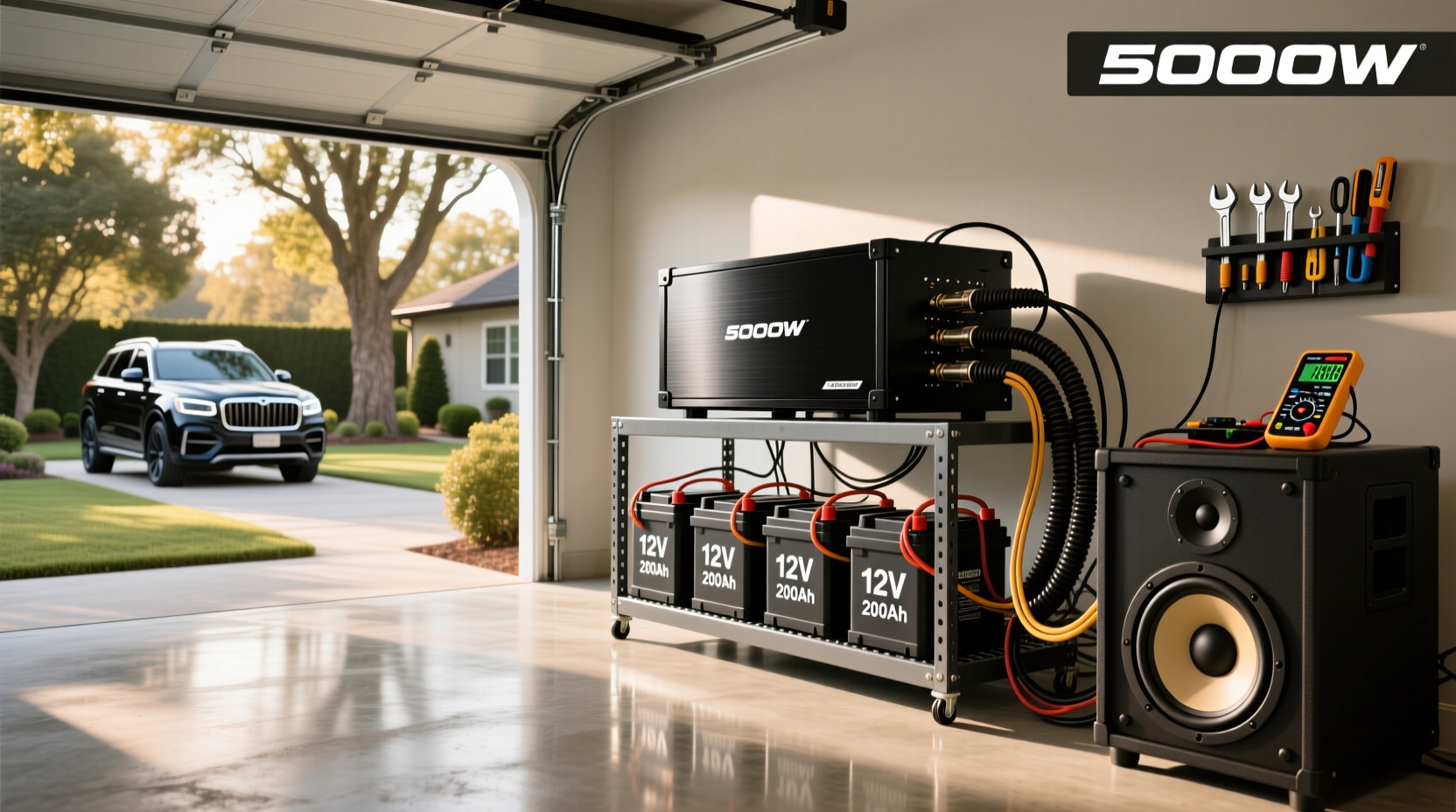
The term “5000 watts” can be misleading. Many units advertise peak or “advertising” power, not RMS (continuous) output. Real-world performance depends on stable voltage input. At 12 volts, a true 5000W RMS draw equals roughly 417 amps—before inefficiencies. That means your vehicle’s stock electrical system won’t suffice. You’ll need upgrades across the board.
If you’re a typical user, you don’t need to overthink this: focus on RMS ratings, not flashy labels. Check manufacturer specs for actual power output at 14.4V, and verify if the rating applies to one channel or total system output.
Why 5000 Watt Systems Are Gaining Popularity
Recently, interest in 5000 watt amplifiers has grown—not because people suddenly want louder systems, but because supporting technology has become more accessible. High-output alternators once cost $1,000+ and required custom fabrication; now, bolt-on 300–400A units are available from multiple suppliers. Lithium iron phosphate (LiFePO4) batteries have dropped in price by nearly half over three years, making them viable for mobile installations.
Social media and audio competitions have also normalized extreme builds. Platforms like Reddit’s r/CarAV show users comparing voltage sag during bass hits or sharing capacitor setups. But popularity doesn’t equal practicality. Most daily drivers don’t benefit from 5000 watts. The real shift is in component reliability—people are attempting these builds because they believe they can sustain them.
This piece isn’t for keyword collectors. It’s for people who will actually use the product.
Types and Variants
Amplifier Types
- Monoblock (Single Channel): Designed for subwoofers, handles low impedances, efficient at high power.
- Multi-Channel (4–5 Channel): Can power full-range speakers and subs, but rarely delivers full 5000W unless heavily bridged.
Battery Types
- Flooded Lead-Acid (FLA): Inexpensive, widely available. Requires maintenance, heavier, less efficient under high drain.
- AGM (Absorbent Glass Mat): Sealed, maintenance-free, better vibration resistance. More expensive than FLA, still limited cycle life under deep discharge.
- Lithium (LiFePO4): Lightweight, high energy density, supports higher discharge rates, longer lifespan. Costlier upfront, but fewer units needed for same output.
If you’re a typical user, you don’t need to overthink this: go with LiFePO4 if budget allows. For occasional use, dual AGM batteries may suffice.
Key Features and Specifications to Evaluate
When evaluating a 5000 watt system, don’t rely on wattage alone. Look at:
- Voltage Rating: Is it designed for 12V, 24V, or 48V? Higher voltage reduces current draw—halving amperage at 24V vs 12V.
- Efficiency: Class D amps are 80–90% efficient. The rest becomes heat. Poor thermal management leads to shutdowns.
- Continuous (RMS) vs Peak Power: Only RMS matters for power planning. A “5000W peak” amp might only deliver 2500W continuously.
- Current Draw Calculation: Use Watts ÷ Volts = Amps. At 12V: 5000W ÷ 12V ≈ 417A. Add 20% for losses: ~500A surge capacity needed.
- Impedance Stability: Can it handle 1-ohm loads? Lower impedance increases current draw.
When it’s worth caring about: if you’re running long sessions or competing. When you don’t need to overthink it: for short demos or background music at moderate volume.
Pros and Cons
Pros
- Extreme sound pressure possible
- Lithium integration improves runtime and response
- Aftermarket support has improved significantly
Cons
- Massive electrical load strains stock vehicles
- Heat buildup requires active cooling
- Installation complexity increases risk of fire or damage
- Diminishing returns above 3000W for most listening environments
If you’re a typical user, you don’t need to overthink this: more watts don’t mean better sound. They mean more stress on your system.
How to Choose a Power System for a 5000 Watt Amp
Follow this step-by-step checklist to build a reliable setup:
Step-by-Step Checklist
- Confirm actual RMS output of your amplifier (not peak).
- Calculate max current draw: Watts ÷ 12V × 1.2 (for inefficiency).
- Select battery type: LiFePO4 recommended for weight and performance.
- Determine Ah (Amp-hour) requirement: For 1 hour at full load, you’d need ~500Ah at 12V.
- Choose alternator: Minimum 300A, ideally 400A+ 1.
- Use proper wire gauge: 0/1 AWG or larger for main power and ground.
- Install a capacitor (optional): Helps buffer sudden bass transients.
- Test voltage under load: Should stay above 12.6V during operation.
Decision Flow
- Are you running continuous high volume? → Upgrade alternator first.
- Do you park and play without engine running? → Add second (or third) battery.
- Is space or weight a concern? → Choose lithium over lead-acid.
- Is this for competition? → Consider 24V or 48V system to reduce current.
Recommendations by Scenario
- Daily Driver with Occasional Bass: Dual AGM batteries, 220A upgraded alternator, 0 AWG wire.
- Weekend Cruiser / Show Car: Two 100Ah LiFePO4 batteries, 300A alternator, capacitor.
- SPL Competitor: 24V system, 400A+ alternator, three or more lithium batteries, dual charging paths.
Red Flags / What to Avoid
- Using stock alternator (usually 120–180A) — it will fail under load.
- Running 4-gauge wire — insufficient for 500A+ surges.
- Ignoring grounding points — poor grounding causes noise and voltage drop.
- Assuming one battery is enough — even high-capacity units deplete fast.
- Skipping fusing — always fuse near battery terminal.
Price & Market Insights
Prices vary significantly by region, brand, and configuration. A 5000 watt amplifier may cost $400–$1,200. High-output alternators range from $300–$900. Lithium batteries: $300–$600 per 100Ah unit. AGM: $150–$250 each. Installation labor can add $500+.
These figures may vary by region/model/seller. Always check manufacturer specs and compare retailer return policies before purchase. Alibaba.com hosts suppliers offering integrated kits, but verify compatibility before ordering.
Top-Seller & Competitive Analysis
Based on community feedback and technical reviews, top-performing components include:
| Component | Model Example | Key Strength | Limitation |
|---|---|---|---|
| Amplifier | Pioneer XX-5000 | Stable 1-ohm operation | Requires 24V for full spec |
| Alternator | PowerMaster 220A HD | Bolt-in fit for many trucks | Not sufficient alone for 5000W |
| Battery (LiFePO4) | Renogy 100Ah | Lightweight, long cycle life | Pricier than AGM |
| Capacitor | Rockford Fosgate 2.0 Farad | Fast recharge, durable | Minor impact on sustained draw |
If you’re a typical user, you don’t need to overthink this: brand names matter less than verified performance data. Look for independent test results, not marketing claims.

Customer Feedback Synthesis
Analysis of Reddit threads 2 and Quora discussions reveals consistent patterns:
Highly Praised When:
- System remains stable during extended play
- Voltage stays above 12.5V under load
- Lithium batteries maintain charge after hours of use
- Alternator doesn’t overheat after 30+ minutes
Most Common Complaints:
- “My lights dim on every beat” — sign of undersized alternator or wiring
- “Battery died overnight” — parasitic drain or lack of isolation
- “Amplifier shuts off after 10 minutes” — thermal or voltage protection triggered
- “Too expensive to fix once something burns out” — skipped fuses or improper grounding
If you’re a typical user, you don’t need to overthink this: complaints almost always trace back to power supply flaws, not the amp itself.
Sourcing & Supplier Tips
When sourcing parts for a 5000 watt system:
- Buy from suppliers with clear technical documentation.
- Check if batteries specify continuous discharge rating (CDR)—should exceed 200A for single unit.
- Verify alternator output at idle RPM, not just max RPM.
- Use Alibaba.com to find bulk-compatible kits, but request spec sheets before ordering.
- Avoid bundled deals that don’t disclose individual component ratings.
If you’re a typical user, you don’t need to overthink this: transparency beats price. A slightly more expensive but well-documented part is safer than an ambiguous bargain.
Maintenance, Safety & Legal Considerations
Maintain your system with quarterly checks:
- Inspect terminals for corrosion or looseness.
- Test alternator output voltage (should be 13.8–14.4V when engine runs).
- Ensure battery cells are balanced (especially lithium).
- Clean ventilation ports on amplifiers.
Safety first: Always disconnect power before servicing. Use inline fuses rated just above max draw. Keep flammable materials away from batteries.
Legality varies by jurisdiction. Some regions limit sound pressure levels or require vehicle modifications to pass inspection. Confirm local regulations before installing permanent high-power systems.
Conclusion
If you need sustained, high-volume output for events or competitions, choose a 5000 watt system with a 400A+ alternator, dual (or more) lithium batteries, and 0/1 AWG wiring. If you’re using it occasionally at moderate levels, a simpler dual AGM setup with a 300A alternator may be sufficient. If you’re a typical user, you don’t need to overthink this—focus on stable power delivery, not maximum wattage.
Everything You Need to Know
❓ How many batteries do I need for a 5000 watt amp?
It depends on battery type and usage. For a 12V system, you’ll likely need at least two high-capacity AGM or lithium batteries. Lithium units (e.g., 100Ah LiFePO4) provide more usable capacity and require fewer units. For extended runtime without engine running, three or more batteries may be necessary. System voltage also affects count—a 24V setup halves current draw, reducing battery strain.
❓ What size alternator do I need for a 5000 watt amplifier?
You need at least a 300A alternator, but 400A or higher is recommended. A standard vehicle alternator (120–180A) cannot keep up with a 5000W load, which draws over 400 amps at 12V. Without sufficient alternator output, your battery drains quickly and voltage drops occur. Upgrading the alternator is often the first and most critical step.
❓ Can I run a 5000 watt amp with one battery?
Not reliably. A single battery—even a high-capacity one—will deplete rapidly under full load. Voltage will drop, triggering amplifier protection or causing distortion. Dual batteries are the minimum for any serious 5000W setup. If you’re a typical user, you don’t need to overthink this: one battery is a bottleneck.
❓ Do I need a capacitor for a 5000 watt system?
A capacitor helps smooth out brief voltage dips during bass hits, but it doesn’t replace battery capacity or alternator output. It’s optional for most users. If your system already has dual batteries and a strong alternator, a capacitor adds marginal benefit. When it’s worth caring about: if you notice headlight dimming despite adequate power supply. When you don’t need to overthink it: if you’re focused on sustained performance over transient response.
❓ Is a 5000 watt amplifier suitable for daily driving?
It can be, but only if properly supported. Without upgrades, it risks draining your battery or overloading the alternator. For daily use at moderate volumes, such high power is unnecessary. However, if you’ve upgraded the electrical system, it can coexist with normal driving. Just monitor battery health and ensure cooling.




 浙公网安备
33010002000092号
 浙B2-20120091-4