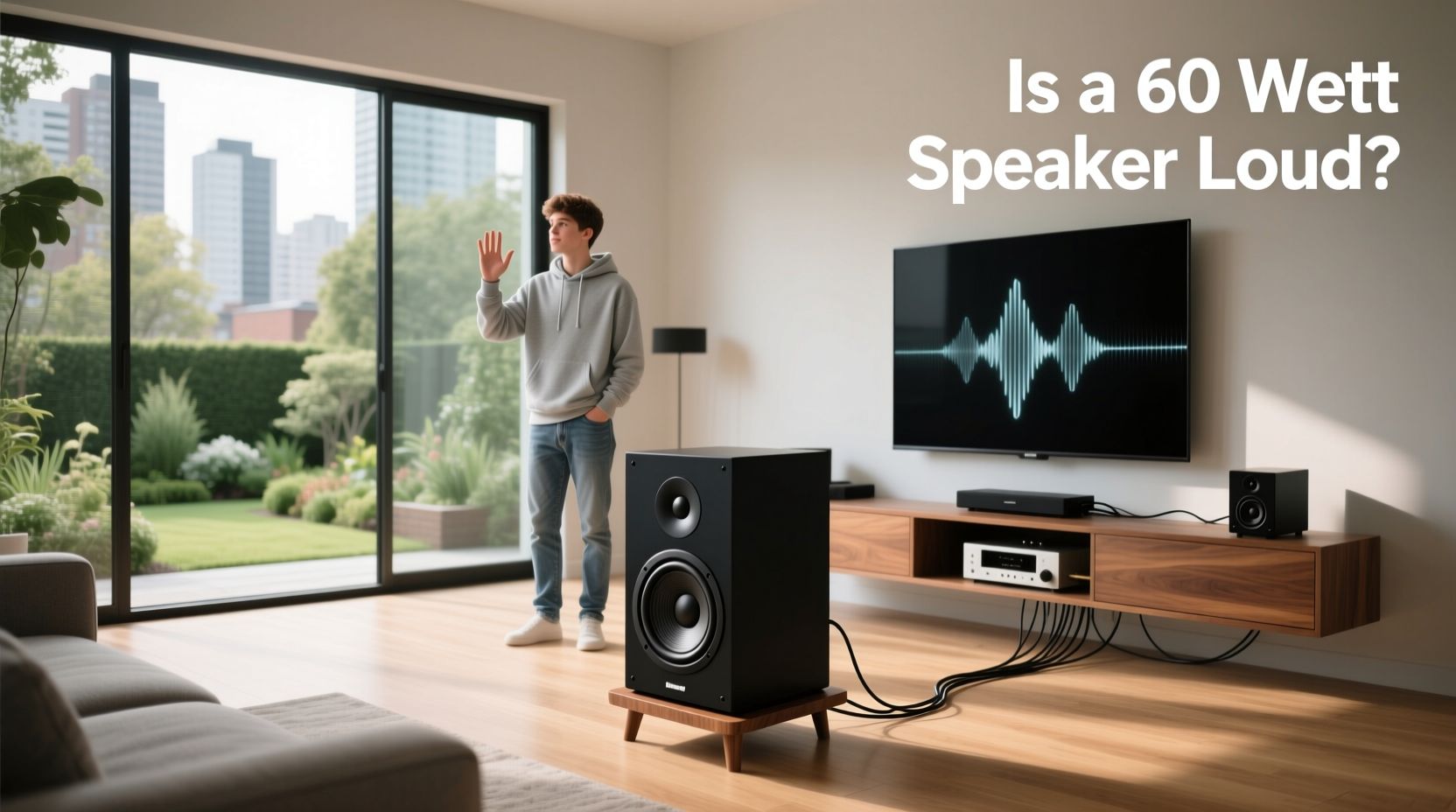
Short introduction
If you're asking "Is a 60 watt speaker loud?", the answer depends—not on wattage alone, but on sensitivity, room size, and system integration. A 60 watt subwoofer can deliver rich, room-filling bass for movies and music in medium-sized spaces, especially when paired with efficient drivers and properly tuned amplifiers. When learning how to choose a 60 watt subwoofer, Is a 60 watt speaker loud?, prioritize sensitivity (measured in dB @ 1W/1m) over raw power. Avoid models without RMS power ratings or unclear specs. For most home theater or stereo setups under 300 sq ft, a well-matched 60W sub enhances depth without distortion—ideal for listeners who value balanced audio over extreme volume.
✨ Key Insight: Doubling amplifier power only increases loudness by ~3dB—barely noticeable. To double perceived loudness, you need a 10dB increase, requiring 10x more power 1.
About 60 watt subwoofer,Is a 60 watt speaker loud?
A 60 watt subwoofer is designed to reproduce low-frequency sounds (typically 20–200 Hz), adding depth to music, movies, and gaming audio. The question "Is a 60 watt speaker loud?" often arises because consumers assume higher wattage means louder sound. However, loudness is influenced more by speaker efficiency than power alone. A 60W sub with high sensitivity (e.g., 95 dB @ 1W/1m) can outperform a 100W model with low sensitivity (85 dB).
These subwoofers are commonly used in compact home theaters, desktop setups, and secondary entertainment rooms. They integrate with AV receivers or powered speakers and are ideal where space or budget limits larger systems. Their output is sufficient for enhancing dialogue clarity in films and providing tactile bass response during action scenes or electronic music playback.
Why 60 watt subwoofer,Is a 60 watt speaker loud? is gaining popularity
The demand for 60 watt subwoofers has grown due to rising interest in affordable, space-efficient audio upgrades. As streaming content delivers richer soundtracks, users seek immersive experiences without investing in large enclosures or high-power amplifiers. Compact living spaces, such as apartments and condos, favor smaller subs that minimize vibration transmission and neighbor disturbance.
Additionally, advancements in driver materials and amplifier efficiency allow modern 60W units to produce deeper, cleaner bass than older models. Consumers also appreciate plug-and-play connectivity with soundbars and smart TVs. This combination of affordability, performance, and adaptability makes the 60 watt subwoofer a practical choice for entry-level to mid-tier audio enhancement.
Types and variants
- 🛒 Powered (Active) Subwoofers: Include built-in amplifiers; require only line-level input. Most 60W models fall into this category.
- Pros: Easy setup, optimized amp-driver pairing, consistent performance.
- Cons: Less flexibility in amplifier matching; fixed power output.
- 🔧 Passive Subwoofers: Require external amplifier; rare at 60W due to complexity.
- Pros: Customizable power and tuning.\li>
- Cons: Need additional equipment; harder to configure correctly.
- 📍 Down-Firing vs. Front-Firing: Driver orientation affects placement and bass dispersion.
- Pros (Down-firing): Blends better with room acoustics; less visual impact.
- Cons: Performance varies with flooring type (carpet vs. hardwood).
- Front-firing: Easier to aim toward listening position; clearer cone visibility.
- 🏭 Sealed vs. Ported Enclosures:
- Sealed: Tighter, more accurate bass; better for music. Lower efficiency.
- Ported: Louder output at lower frequencies; enhanced boom. May lack precision.
Key features and specifications to evaluate
When assessing what to look for in a 60 watt subwoofer, Is a 60 watt speaker loud?, focus on these technical aspects:
- 📊 Sensitivity (SPL): Measured in dB @ 1W/1m. Higher values (≥90 dB) mean louder output with less power. Compare across models.
- ⚡ Power Handling – RMS vs Peak: RMS (continuous) power indicates real-world performance. Ignore peak ratings—they’re marketing tools 2.
- 🏠 Room Size Compatibility: 60W suits rooms up to 300 sq ft. Larger spaces may need multiple subs or higher wattage.
- 🎛️ Crossover & Phase Controls: Allow seamless blending with main speakers. Look for adjustable frequency (50–150 Hz) and phase (0°/180°).
- 🔌 Input Options: RCA (analog), LFE (for home theater), and wireless connectivity affect compatibility.
- 📏 Driver Size: 8-inch common at 60W; 10-inch offers deeper extension but requires more power.
- 📉 Frequency Response: Wider range (e.g., 30–200 Hz) suggests better low-end reach, though actual in-room performance varies.
Pros and cons
| Pros ✅ | Cons ❌ |
|---|---|
| Energy efficient and cost-effective | Limited output in large or poorly insulated rooms |
| Compact size fits small spaces | May not satisfy bass-heavy genres (e.g., EDM, action films at high volume) |
| Easy integration with mid-range AV receivers | Lower headroom before distortion sets in |
| Reduces strain on main speakers by handling lows | Performance highly dependent on placement and room acoustics |
How to choose 60 watt subwoofer,Is a 60 watt speaker loud?
Follow this step-by-step guide when deciding how to choose a 60 watt subwoofer, Is a 60 watt speaker loud?:
- 🔍 Determine Your Room Size: Measure your primary listening area. Under 250 sq ft? A 60W unit should suffice. Over 300 sq ft? Consider upgrading or supplementing later.
- 👂 Assess Listening Habits: Prefer subtle movie ambiance or deep bass drops? Sealed enclosures suit jazz/classical; ported ones enhance cinematic impact.
- 🔗 Check Amplifier Compatibility: Match sub’s input type (RCA/LFE) with receiver. Ensure gain controls exist for level balancing 3.
- 📈 Compare Sensitivity Ratings: Prioritize models ≥90 dB. A 3dB difference equals perceived doubling of loudness effort.
- 📌 Evaluate Placement Flexibility: Can it go near a wall or corner? Corners boost bass via boundary gain. Avoid center-of-room setups unless using isolation pads.
- ❗ Watch Out For:
- Unspecified RMS power (only peak listed)
- No crossover control
- Poor build quality (thin MDF, wobbly feet)
- Lack of user reviews or third-party testing
Price & market insights
Most 60 watt subwoofers range from $80 to $250 USD. Entry-level ($80–$120) models offer basic functionality with plastic cabinets and limited tuning options. Mid-tier ($130–$200) units feature sturdier construction, adjustable crossovers, and better sensitivity. Premium ($200+) versions may include digital signal processing (DSP), wireless subwoofers, or advanced cabinet designs.
Prices vary by region, brand reputation, and retailer. Always compare specs per dollar rather than relying on branding. Note: Some brands inflate wattage claims—verify through independent reviews or manufacturer datasheets.
Top-seller & competitive analysis
Popular models like the Monoprice 8248 (8” 60W) demonstrate strong value with positive user feedback on bass accuracy and integration ease. Below is a comparison of representative units:
| Model | Sensitivity (dB) | Enclosure Type | Price Range | Notable Feature |
|---|---|---|---|---|
| Monoprice 8248 | 89 | Sealed | $90 | Balanced output, reliable build |
| Klipsch R-100SW | not public | Ported | $200 | All-metal grille, front-firing driver |
| Pioneer TS-WX1210A | not public | Sealed | $150 | Compact design for tight spaces |
Note: Sensitivity data may not be published for all models. Check official product pages or contact support directly.
Customer feedback synthesis
Analysis of buyer reviews reveals recurring themes:
- Common Praises:
- "Great improvement over TV speakers"
- "Easy to set up with my soundbar"
- "Adds depth without overwhelming the room" 3
- Frequent Complaints:
- "Bass cuts out at higher volumes" (often due to protection circuit or weak amp)
- "No remote control or app" (expected in modern devices)
- "Difficult to tune without test tones or calibration mic"
Sourcing & supplier tips
Buy from authorized dealers or reputable online platforms (e.g., Amazon, Crutchfield, B&H). For bulk purchases or resale:
- Request spec sheets and compliance certificates (FCC, CE).
- Negotiate MOQs (Minimum Order Quantities) with manufacturers via Alibaba or direct OEM contacts.
- Inspect samples for driver alignment, port smoothness, and terminal durability.
- Verify return policies and warranty terms—prefer at least 1-year coverage.
Maintenance, safety & legal considerations
To ensure longevity:
- Keep vents clear of dust and fabric.
- Avoid continuous operation at maximum volume.
- Use surge protectors to prevent electrical damage.
Conclusion
If you need moderate bass enhancement in a small to medium room and are wondering "Is a 60 watt speaker loud?", a 60 watt subwoofer is likely sufficient—provided it has good sensitivity and proper system matching. It’s an excellent starting point for first-time upgraders or those on a budget. Avoid it if you host frequent parties or watch action films at reference levels in large spaces. Instead, consider higher-powered models or dual-sub setups. Ultimately, success lies in integration, not raw power.
FAQs
- Can a 60 watt subwoofer work with a 100 watt amplifier?
- Yes, as long as the sub’s input accepts the signal and volume is managed properly. The sub uses only the power it needs.
- Does higher wattage always mean louder bass?
- No. Speaker sensitivity and room acoustics play larger roles. A 50W high-efficiency sub can outperform a 100W inefficient one.
- Where should I place a 60 watt subwoofer for best results?
- Start near the front speakers or in a corner for boosted bass. Use the 'subwoofer crawl' method to find optimal spots.
- Do I need a separate crossover with a 60 watt powered sub?
- No—powered subs have built-in crossovers. Adjust settings to blend with your main speakers’ frequency response.
- Are 60 watt subwoofers suitable for music production?
- Generally not. Music production requires flat response and high headroom. Most 60W models emphasize consumer-friendly 'boom' over accuracy.




 浙公网安备
33010002000092号
 浙B2-20120091-4