
Short introduction
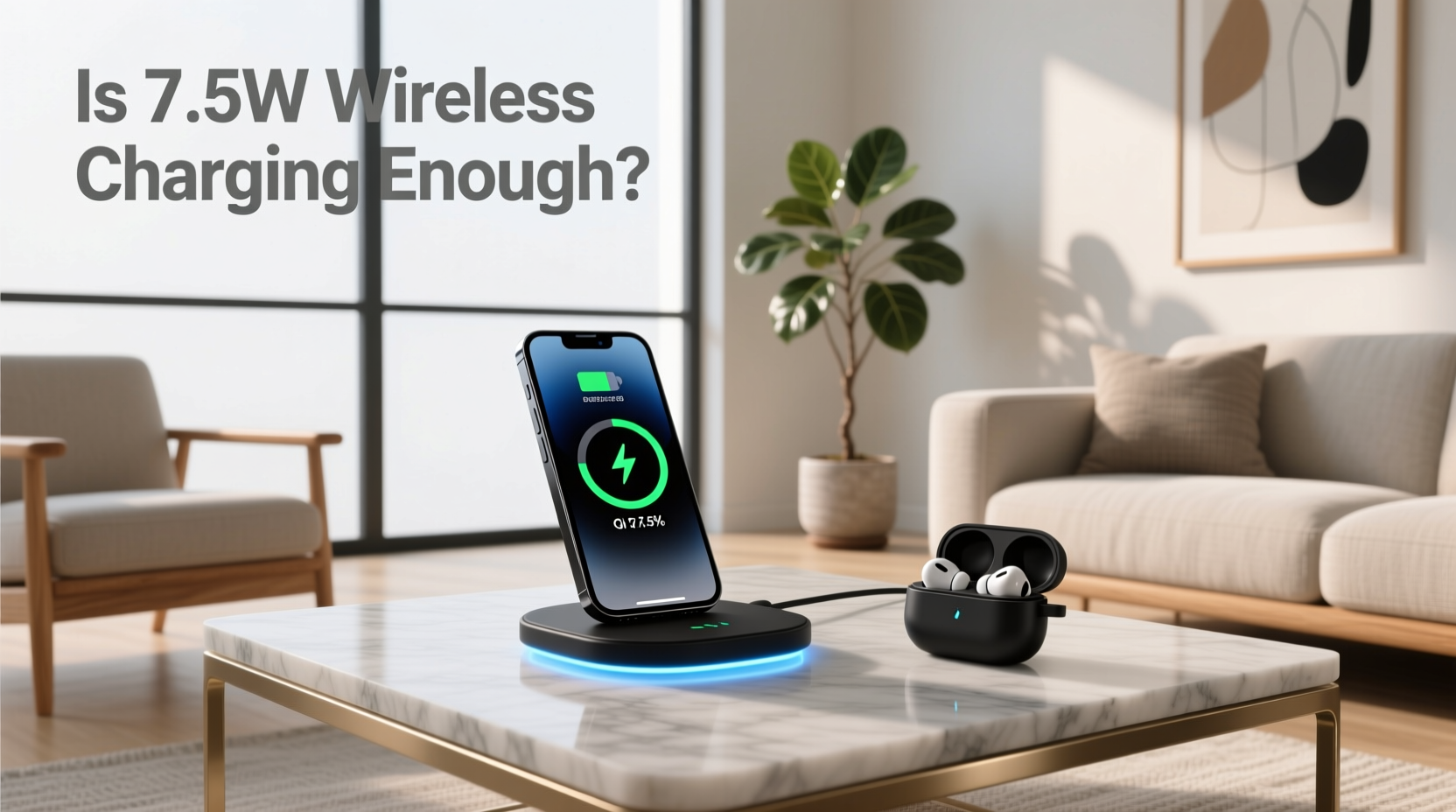
If you’re wondering what to look for in a Qi wireless charger, here’s the quick verdict: 7.5 watts is fast compared to old 5W standards but not by today’s benchmarks. For iPhone users with models from iPhone 8 through iPhone 12 (non-Pro), 7.5W is the maximum supported wireless speed. Over the past year, newer standards like Qi2 and MagSafe have raised expectations—many now expect 15W for true fast wireless charging. If you need a full charge in under an hour, 7.5W won’t cut it. But if you're topping up overnight or using it as a desk convenience station, 7.5W is perfectly functional and gentler on battery health.
If you’re a typical user, you don’t need to overthink this. Most people aren’t charging from 0% to 100% multiple times a day. They want reliability, compatibility, and no cable clutter. For that, 7.5W works. The real decision isn't about wattage alone—it's about how you use your phone. Ask: Is it for a quick top-up during the day, or mainly overnight while you sleep? For overnight charging, even 7.5W is sufficient, and slower rates may extend long-term battery life 1.

About Qi Wireless Charging Up to 7.5W
Qi (pronounced “chee”) is a global standard for inductive wireless power transfer developed by the Wireless Power Consortium. Devices compliant with Qi can charge simply by being placed on a compatible charging pad. While early versions capped at 5W, Apple's adoption of Qi in 2017 pushed support for up to 7.5W on iPhones starting with the iPhone 8 and X.
This increase was marketed as “fast wireless charging,” though only relative to previous slow speeds. Unlike wired fast charging (which can exceed 18W on modern phones), 7.5W wireless remains constrained by heat dissipation, alignment sensitivity, and efficiency loss inherent in electromagnetic induction.
It’s important to clarify: not all phones support 7.5W. Only certain iPhones do. Most Android devices bypass this tier entirely, jumping straight to 10W, 15W, or higher via proprietary extensions (like Samsung’s Adaptive Fast Charging). So if you own an iPhone and are considering a wireless charger, 7.5W is the ceiling unless you move to MagSafe or Qi2.
Why 7.5W Qi Charging Is Gaining Popularity
Lately, interest in 7.5W chargers has resurged—not because they’ve gotten faster, but because consumers are reevaluating what “good enough” means. With rising concerns over battery degradation and electronic waste, some users prefer moderate charging speeds that generate less heat and stress.
The shift toward minimalism also plays a role. People want fewer cables, simpler routines, and one charging spot that works across devices. A 7.5W pad fits well on nightstands or office desks where the goal isn’t speed, but consistency. It charges slowly enough to avoid thermal throttling yet fast enough to replenish most daily drain.
If you’re a typical user, you don’t need to overthink this. You likely already own a phone that supports Qi. What matters more than peak wattage is whether the system integrates smoothly into your routine. And for many, especially iPhone owners without access to MagSafe, 7.5W represents a stable, widely available option.
Types and Variants
| Type | Max Output | Pros | Cons |
|---|---|---|---|
| Standard Qi (5W) | 5W | Universal compatibility; low heat; safe for older devices | Very slow; outdated for modern smartphones |
| Enhanced Qi (7.5W) | 7.5W | Faster than 5W; supported by iPhones; widely available | Still slow vs wired; limited to specific Apple models |
| Fast Qi / Proprietary (10–15W) | 10–15W | Noticeably quicker; better for daytime top-ups | Requires compatible phone & charger; more expensive |
| MagSafe (Apple) | 15W | Strong magnetic alignment; optimized for iPhone 12+ | Only works reliably with MagSafe-certified accessories |
| Qi2 (New Standard) | Up to 15W+ | Magnetic alignment like MagSafe; cross-brand compatibility | Newer; limited device support as of 2024 |
Key Features and Specifications to Evaluate
- Device Compatibility: Check if your phone supports 7.5W Qi. iPhones from 8 onward do. Most Androids skip this level.
- Charging Speed Realism: Advertised wattage isn’t sustained output. Actual average may be 5–6W due to efficiency losses.
- Heat Management: Higher wattage generates more heat. Look for pads with temperature control or ventilation.
- Cable & Adapter Requirements: A 7.5W charger needs at least a 5V/2A power adapter. Using a weak wall plug limits performance.
- Foreign Object Detection (FOD): Prevents charging when metal objects (coins, keys) are on the pad—critical for safety.
- Stand vs Pad Design: Stands allow viewing while charging; pads are compact and portable.
When it’s worth caring about: If you frequently charge in short bursts or rely on your phone throughout the day, these specs directly impact usability. When you don’t need to overthink it: For occasional use or overnight charging, any reputable Qi-certified pad will suffice.
Pros and Cons
| Pros | Cons |
|---|---|
| ✅ No cable wear and tear | ❌ Slower than wired fast charging |
| ✅ Convenient drop-and-charge setup | ❌ Efficiency loss (~30% energy wasted as heat) |
| ✅ Supports moderate speed gains over 5W | ❌ Limited to certain iPhone models |
| ✅ Gentler on battery with slower charge cycles | ❌ Misalignment reduces speed significantly |
| ✅ Widely available and affordable | ❌ Not future-proof compared to 15W+ standards |
How to Choose a 7.5W Qi Wireless Charger
Step-by-Step Checklist
- Confirm your phone model supports 7.5W Qi. This applies primarily to iPhone 8 through iPhone 12 series.
- Determine your primary use case: Overnight? Desk use? Emergency top-up?
- Select form factor: Pad (compact), stand (viewable), or multi-device (for phone + watch).
- Ensure proper power supply: Use a USB-A or USB-C adapter rated at least 5V/2A (10W).
- Look for Qi certification: Avoid uncertified clones that lack FOD or overvoltage protection.
- Test placement ease: Does it require precise centering? Magnetic alignment helps.
- Check reviews for heat issues: Some budget models run hot after 30 minutes.
Decision Flow
- You own an iPhone → Supports 7.5W → Consider 7.5W pad if not using MagSafe.
- You charge mostly overnight → 7.5W is sufficient → Prioritize build quality over speed.
- You need quick midday recharge → 7.5W too slow → Upgrade to 15W Qi2 or wired PD.
- You value simplicity → Any Qi-certified pad works → Skip premium features.
Recommendations by Scenario
- Nightstand charging: Go for a padded base model; focus on safety certifications.
- Office desk: Choose a vertical stand so you can see notifications.
- Travel: Pick a foldable or ultra-thin design; include a matching 2A adapter.
- Multi-device household: Select a dual-coil or multi-port station.
Red Flags / What to Avoid
- Chargers labeled "up to 10W" but meant for Android — may default to 5W on iPhones.
- No Qi certification logo — risk of poor efficiency or damage.
- Extremely cheap units (<$10) from unknown brands — often lack thermal regulation.
- Claims of "fast charging" without specifying conditions — misleading marketing.
- Bundled with weak adapters (e.g., 5V/1A) — bottlenecks performance.
If you’re a typical user, you don’t need to overthink this. Your behavior matters more than specs. If you leave your phone on the charger all night, speed differences between 5W and 7.5W vanish by morning. Focus instead on durability, safety, and fit within your space.
Price & Market Insights
Prices for 7.5W Qi chargers vary significantly by region, brand, and included accessories. Basic pads start around $12, while branded stands (like Belkin or Anker) range from $25–$40. Premium models with cooling fans or multi-device support go above $50.
What hasn’t changed: value compression. Even at $15, many third-party options now include features once reserved for high-end units—such as foreign object detection, slip-resistant surfaces, and pass-through charging for cases.
However, price doesn’t always reflect performance. Some expensive units prioritize aesthetics over engineering. Conversely, budget options may meet minimum standards but degrade faster. Always check manufacturer specs and verify retailer return policies before purchase.
Top-seller & Competitive Analysis
While exact sales rankings may vary by market, several models consistently appear in top-seller lists across major platforms:
| Model | Output | Key Feature | Drawback |
|---|---|---|---|
| Anker PowerWave Pad | 7.5W (iPhone) | Reliable performance; compact | No stand option in base model |
| Belkin Boost Charge Stand | 7.5W | Sturdy build; angled design | Pricier than alternatives |
| UGREEN Qi Pad | 7.5W | Affordable; includes wall plug | Plastic feel; runs warm |
| Apple MagSafe Charger | 15W (with MagSafe) | Perfect alignment; iOS integration | Expensive; unnecessary for non-MagSafe users |
Note: The Apple MagSafe charger technically exceeds 7.5W but defaults to that level when used with non-MagSafe certified accessories. True 15W requires both hardware and firmware handshake.
Customer Feedback Synthesis
Based on aggregated user discussions 2, common themes emerge:
Highly Praised:- “Just drop and forget” convenience
- No port debris buildup (vs frequent plugging)
- Works well with thick cases (within 3mm limit)
- Peace of mind knowing it stops when fully charged
- “Takes forever” — especially when expecting fast results
- Phone gets hot after prolonged use
- Must reposition repeatedly for charging to start
- LED lights too bright at night
If you’re a typical user, you don’t need to overthink this. Many complaints stem from mismatched expectations. Users who treat wireless charging as a replacement for fast wired charging are disappointed. Those who treat it as a lifestyle tool report higher satisfaction.
Sourcing & Supplier Tips
When sourcing 7.5W Qi chargers, especially in bulk or for resale:
- Verify Qi certification through the Wireless Power Consortium website.
- Request test reports for temperature rise and foreign object detection.
- Prefer suppliers offering compliance documentation (CE, FCC, RoHS).
- Ask about warranty terms—reputable brands offer 18+ months.
- Beware of exaggerated claims like “universal 15W” — physics limits apply.
Manufacturing origin may affect cost but not necessarily quality. Units made in China dominate the market, but final assembly and QC vary widely. Onsite audits or third-party inspections reduce risk.
Maintenance, Safety & Legal Considerations
Wireless chargers require minimal maintenance. Wipe the surface regularly to prevent dust or oil buildup that interferes with coil contact. Avoid placing near water sources or extreme temperatures.
Safety-wise, always use chargers with overcurrent, overvoltage, and overheating protection. Remove metal objects before placing your phone. If the unit emits burning smells or excessive heat, discontinue use immediately.
Legally, ensure products meet local electrical safety regulations. In the EU, CE marking is mandatory. In the U.S., FCC compliance is required. These aren’t optional badges—they’re enforceable requirements. To verify: check packaging labels, request conformity documents, or consult national regulatory databases.
Conclusion
If you need a simple, reliable way to keep your iPhone topped up during downtime, a 7.5W Qi charger is a solid choice. It balances speed and safety, avoids cable fatigue, and integrates seamlessly into low-friction routines. But if you regularly need rapid recharges—say, going from 20% to 80% in under 30 minutes—then 7.5W isn’t enough. In that case, step up to MagSafe, Qi2, or fast wired charging.
This piece isn’t for keyword collectors. It’s for people who will actually use the product.
Everything You Need to Know
Compared to the old 5W standard, yes—7.5W is faster. But by modern standards, it’s not considered fast. True fast wireless charging starts at 15W (via MagSafe or Qi2). For context, 7.5W adds about 15–20% battery per 30 minutes, which is adequate for overnight or casual use but slow for urgent top-ups.
Yes, but your iPhone will only draw up to 7.5W unless it supports MagSafe. A 15W Android-compatible charger will work, but default to 7.5W on non-MagSafe iPhones. To unlock 15W, you need both a MagSafe-certified charger and an iPhone 12 or later.
Not inherently. All charging causes minor wear, but slower methods like 7.5W generate less heat than fast wired charging, potentially extending long-term battery health. However, leaving your phone on a charger all day increases cycle exposure. Best practice: charge to 80–90%, then remove.
Several factors: misalignment, thick case (>3mm), low-power adapter (e.g., 5V/1A), background app activity, or battery protection mode. Ensure proper centering, use a strong wall plug, and close intensive apps. Also, actual charging rate often averages 5–6W due to efficiency loss—even if peak is 7.5W.
They’re already being phased out in favor of 15W+ standards like Qi2. However, existing 7.5W pads will continue working with older iPhones. Unless you upgrade to a new phone or demand faster speeds, obsolescence isn’t immediate. Think of them as transitional tech—still useful, just not cutting-edge.




 浙公网安备
33010002000092号
 浙B2-20120091-4