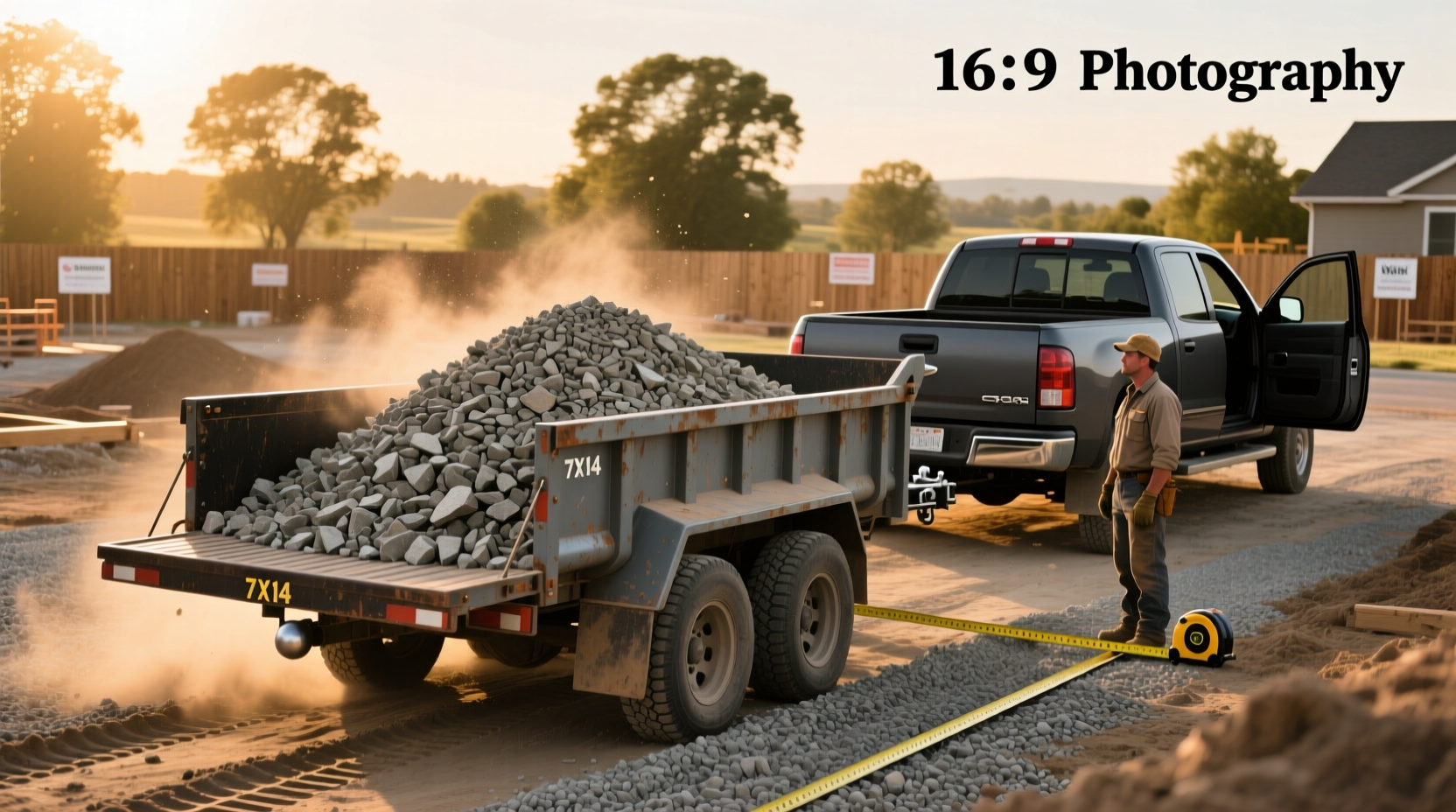
If you’re a typical user, you don’t need to overthink this. A 7x14 dump trailer can hold between 7 and 9 cubic yards by volume—but when hauling gravel, weight is the real limit. Most standard 7x14 tandem axle trailers have a payload capacity of around 10,000 lbs after subtracting the trailer’s empty weight from its GVWR. Since gravel weighs roughly 3,000 lbs per cubic yard, you’ll likely only be able to carry 3 to 4 full yards safely. What to look for in a dump trailer for pickup trucks? Focus on payload rating, not just size. Overloading risks tire failure, suspension damage, or unsafe towing—especially on inclines or during dumping.
If you’re moving gravel regularly, prioritize knowing your trailer’s actual payload over advertised volume. If you’re a typical user, you don’t need to overthink this: always calculate based on weight first, volume second.
About 7x14 Dump Trailers
A 7x14 dump trailer refers to a utility trailer that is 7 feet wide and 14 feet long, commonly used with half-ton or three-quarter-ton pickup trucks. These trailers are designed with hydraulic or mechanical dumping mechanisms, making them ideal for transporting loose materials like gravel, dirt, mulch, or demolition debris. They typically come with side walls ranging from 18 to 24 inches in height, though some models offer taller sides or removable extensions.
The key specification that determines usability isn't just physical dimensions—it's the Gross Vehicle Weight Rating (GVWR), which includes both the trailer’s dry weight and the maximum allowable cargo. For example, a common 7x14 tandem axle model might have a GVWR of 14,000 lbs and weigh about 4,000 lbs empty, leaving 10,000 lbs of payload. This number directly limits how much gravel you can haul, regardless of how much space is available.
Why 7x14 Dump Trailers Are Gaining Popularity
Lately, more homeowners, landscapers, and small contractors have turned to 7x14 dump trailers as a cost-effective alternative to renting dump trucks or making multiple trips with smaller equipment. Their popularity stems from improved towing capabilities in modern pickups, better availability of lightweight yet durable steel designs, and rising demand for DIY site prep and property improvement projects.
This piece isn’t for keyword collectors. It’s for people who will actually use the product.
Over the past year, increased residential development and landscaping activity has driven interest in mid-sized hauling solutions. The 7x14 size strikes a balance: large enough to move meaningful volumes, small enough to be towed legally without requiring commercial licensing in most states—provided weight limits are respected.
Types and Variants
Tandem Axle Standard Duty (12,000–14,000 lb GVWR)
Ideal for general-purpose use. These models usually feature 2” x 3” tongue frames, electric brakes on both axles, and 24” side walls.
- Pros: Balanced performance, widely available, compatible with most ¾-ton trucks
- Cons: Limited headroom for very dense materials; may require spring upgrades on older trucks
Heavy-Duty Models (15,000+ lb GVWR)
Built with thicker steel, reinforced hitches, and higher-rated components. Often include upgraded suspensions and larger tires.
- Pros: Higher payload allows fuller loads of heavy materials like crushed concrete or wet soil
- Cons: Heavier empty weight reduces net payload; requires full-size pickups or diesel trucks
Lightweight Aluminum Trailers
Less common due to cost, but offer significant weight savings. Useful if maximizing payload per pound matters.
- Pros: Corrosion-resistant, lighter tare weight (up to 1,000 lbs less than steel)
- Cons: More expensive, lower impact resistance, fewer service centers
If you’re a typical user, you don’t need to overthink this: steel tandem axle models dominate the market for good reason—they’re reliable, repairable, and priced right for most jobs.
Key Features and Specifications to Evaluate
When choosing a 7x14 dump trailer, focus on these four factors:
1. Payload Capacity (Most Important)
Payload = GVWR minus empty trailer weight. Always verify both numbers via the manufacturer’s spec sheet or VIN tag. Don’t rely on dealer estimates.
When it’s worth caring about: Hauling high-density materials like gravel, sand, or stone. A 10,000-lb payload supports about 3.3 cubic yards of average gravel (3,000 lbs/yd).
When you don’t need to overthink it: Carrying light materials like mulch or dry topsoil (<1,500 lbs/yd)—volume becomes the limiting factor instead.
2. Side Wall Height
Standard heights range from 18” to 24”. Some allow add-on kits for extra depth.
When it’s worth caring about: Maximizing volume for low-weight materials. A 24”-high box holds ~7.2 cubic yards (7×14×2÷27); 18” holds ~5.4 yd³.
When you don’t need to overthink it: With gravel, even tall sides won’t help—you’ll hit weight limits before filling the box.
3. Suspension Type
Leaf spring vs. torsion axle. Leaf springs dominate in work trailers for durability and ease of repair.
When it’s worth caring about: Off-road or uneven terrain use. Torsion axles offer smoother ride but harder to fix remotely.
When you don’t need to overthink it: Paved roads and flat job sites—both types perform adequately.
4. Dump Mechanism
Electric-hydraulic systems are standard. Check pump reliability and hose routing.
When it’s worth caring about: Frequent dumping or sloped terrain. Poorly mounted pumps fail under stress.
When you don’t need to overthink it: Occasional use on level ground—most units handle basic cycles reliably.

Pros and Cons
| Aspect | Pros | Cons |
|---|---|---|
| Capacity | Holds up to 7–9 yd³ depending on wall height | Weight limits often restrict usable volume with dense loads |
| Towing Efficiency | Fewer trips compared to truck beds or small trailers | Requires capable pickup (¾-ton or heavier recommended) |
| Unloading Speed | Dumps in minutes without manual labor | Hydraulic system adds complexity and maintenance needs |
| Durability | Steel models last 10+ years with care | Rust-prone if neglected; drainage design varies by brand |
| Cost | Lower lifetime cost than rental or dump truck services | Upfront investment may exceed $8,000 for new models |
If you’re a typical user, you don’t need to overthink this: the benefits outweigh the drawbacks if you haul bulk materials more than a few times per year.
How to Choose the Right 7x14 Dump Trailer – Buying Guide
Follow this step-by-step process to avoid overspending or underperforming.
Step-by-Step Checklist
- Determine your primary material type (gravel, dirt, etc.) and its approximate weight per cubic yard
- Assess your truck’s towing capacity and braking system compatibility
- Calculate required payload: (Material weight per yd³) × (Desired load size in yd³)
- Find trailers with GVWR and tare weight that support your target payload
- Verify brake type (electric vs. surge), tire rating, and frame material
- Test hydraulic operation if buying used; inspect for rust at weld points
- Confirm warranty terms and local dealer service availability
Decision Flow
Ask:
- Will I haul gravel or similar heavy material? → Prioritize payload over volume
- Do I have a ½-ton or smaller truck? → Consider lighter-duty or aluminum models
- Am I using it weekly or seasonally? → Invest in heavy-duty components
- Is storage space limited? → Look at fold-down tailgate options
Recommendations by Scenario
- Landscaping Contractor (Weekly Use): Choose a 14,000+ lb GVWR tandem axle with 24” sides and upgraded leaf springs
- DIY Homeowner (Seasonal Projects): Opt for a mid-range model with 12,000 lb GVWR—sufficient for 2–3 yd³ of gravel
- Builder / Demolition Crew: Select a heavy-wall steel body with reinforced floor and high-cycle hydraulic pump
Red Flags / What to Avoid
- Unclear or missing GVWR labels—never assume capacity
- Trailers advertised by volume alone without payload data
- Used units with repaired frames or replaced axle assemblies unless documented
- Dealers who won’t provide written specs or refuse test operation
- Models with undersized tongue frames (less than 2” x 3” steel)
This piece isn’t for keyword collectors. It’s for people who will actually use the product.
Price & Market Insights
New 7x14 dump trailers range from $7,000 to $14,000, depending on build quality, axle rating, and features. Prices may vary by region/model/seller. Basic models from regional manufacturers tend to be more affordable, while national brands often include better warranties and standardized parts.
Used units appear frequently on classified platforms between $3,500 and $6,500. Condition varies widely—inspect thoroughly. Over the past year, prices have stabilized after inflation-driven increases in 2022–2023. Buyers report better value in late fall when dealers clear inventory.
Top-Seller & Competitive Analysis
No single brand dominates the 7x14 segment, but several consistently receive positive feedback for durability and support.
| Brand | Typical GVWR | Notable Feature | User Feedback Summary |
|---|---|---|---|
| Silvermoon | 14,000 lb | Reinforced floor, smooth dump action | High satisfaction for gravel hauling; strong resale |
| Mirage Inc. | 12,000–14,000 lb | Clear payload charts, modular options | Praised for transparency; fewer premium finishes |
| Kaufman Trailers | 15,000 lb+ | Heavy-duty suspension, long warranty | Favored by pros; higher entry price |
| Sunhunk | 13,000 lb | Budget-friendly, decent specs | Mixed reviews—good value if inspected pre-purchase |
If you’re a typical user, you don’t need to overthink this: any reputable brand with verifiable payload ratings will serve well. Differences in long-term ownership cost stem more from maintenance habits than brand origin.
Customer Feedback Synthesis
Based on recent online discussions 12, users highlight:
High-Frequency Praise:
- Time saved on unloading compared to pickup beds
- Reliability of electric-hydraulic systems when maintained
- Ability to reuse for multiple project types (demolition, grading, delivery)
Common Complaints:
- Underestimated weight leading to overloaded towing situations
- Inconsistent build quality in budget-tier imported models
- Lack of drainage causing mud buildup in rainy climates
Sourcing & Supplier Tips
Buy from dealers who provide full documentation, including weight distribution diagrams and component warranties. Regional fabricators often allow customization and faster delivery. When sourcing online, verify return policies and shipping costs—some sellers quote low prices but add high freight fees.
Check manufacturer specs before purchase. If buying used, request maintenance records and inspect for structural wear. Confirm compatibility with your hitch type (gooseneck vs. bumper pull) and brake controller.
Maintenance, Safety & Legal Considerations
Maintain your trailer with regular checks: lubricate pivot points, inspect hydraulic fluid levels, and test lights and brakes before each use. Clean out debris after hauling sticky materials to prevent corrosion and imbalance.
Safety starts with loading correctly—distribute weight evenly and never exceed GVWR. Use wheel chocks when dumping. Ensure your vehicle has a proper brake controller matched to the trailer’s electric brake system.
Legally, most U.S. states require trailers over 3,000 lbs gross weight to have functioning brakes and registration. Exact rules may vary by state—confirm local regulations through your DMV website or law enforcement agency. Weigh your loaded trailer at a certified scale if unsure.
Conclusion
If you need to haul gravel regularly and own a capable pickup, a 7x14 dump trailer with at least 10,000 lbs of payload is a practical investment. If you’re a typical user, you don’t need to overthink this: choose based on verified payload, not advertised volume. Prioritize robust construction and clear specifications over flashy features. For occasional use, a mid-range model meets most needs without overspending.
Everything You Need to Know
❓ How many cubic yards does a 7x14 dump trailer hold?
A 7x14 dump trailer with 24-inch sides holds about 7.2 cubic yards (7×14×2÷27). With 18-inch sides, it holds approximately 5.4 cubic yards. However, actual usable capacity depends on material weight and trailer payload limits.
❓ Can I haul gravel with a 7x14 dump trailer?
Yes, but cautiously. Gravel weighs about 3,000 lbs per cubic yard. If your trailer has a 10,000-lb payload, you can safely carry about 3.3 cubic yards—even if the box could physically fit more. Always check your specific trailer’s GVWR and tare weight.
❓ What size truck do I need to tow a 7x14 dump trailer?
A three-quarter-ton pickup (e.g., Ram 2500, Ford F-250, Chevrolet Silverado 2500) is recommended. Half-ton trucks may tow lighter configurations, but only if their max towing and payload ratings aren’t exceeded. Always match trailer weight to your truck’s factory-rated capacity.
❓ How do I calculate my trailer’s payload capacity?
Payload = GVWR (Gross Vehicle Weight Rating) minus the trailer’s empty weight (tare weight). Find GVWR on the VIN sticker. Weigh the empty trailer at a scale if exact tare weight is unknown. Never guess—overloading compromises safety and legality.
❓ Is a 7x14 dump trailer legal to tow without a CDL?
In most U.S. states, yes—provided the combined weight of the trailer and cargo stays below 26,000 lbs GVWR and you’re not operating commercially. However, individual state laws vary; confirm requirements with your local DMV.




 浙公网安备
33010002000092号
 浙B2-20120091-4