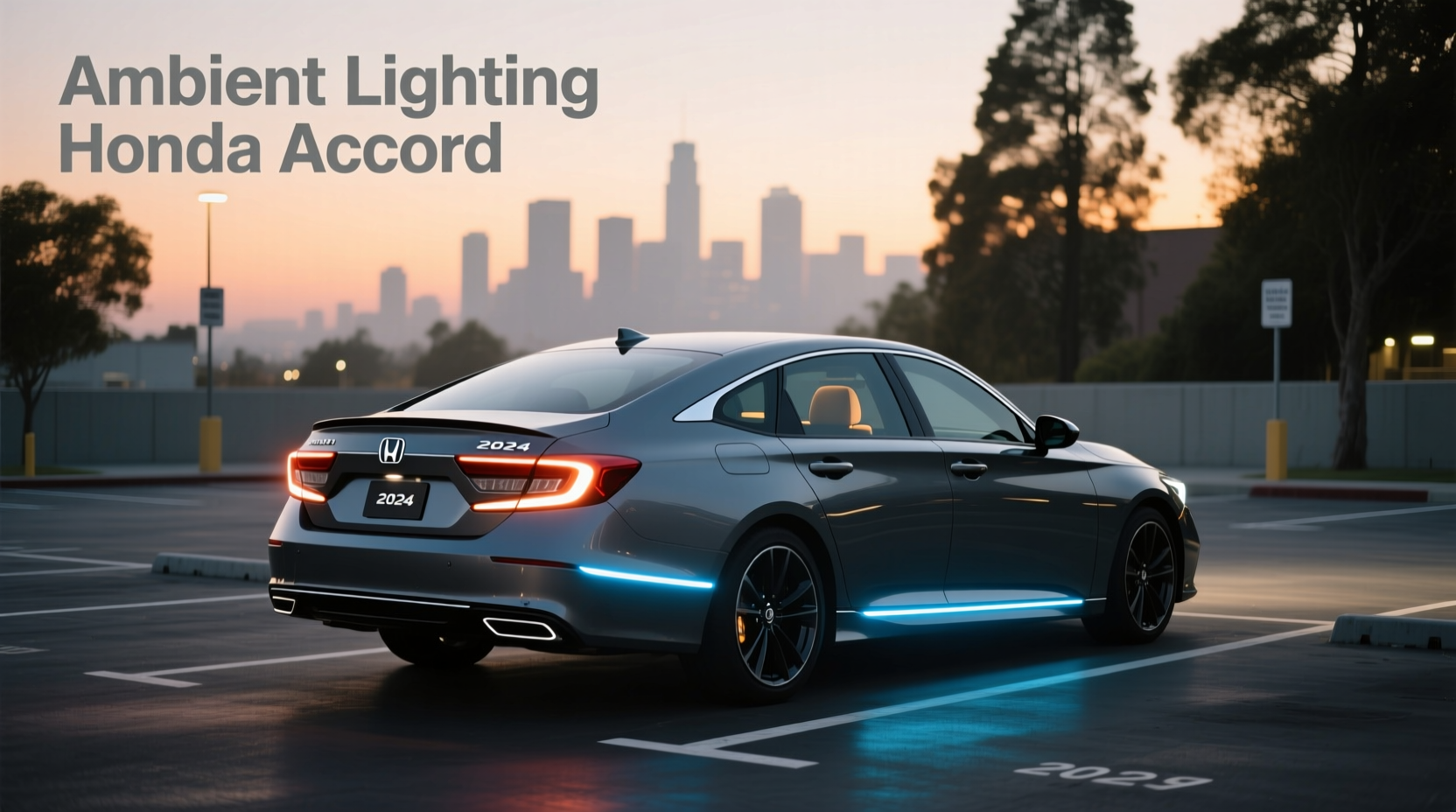
Lately, adding ambient lighting to a Honda Accord has become one of the most cost-effective ways to elevate interior feel without upgrading vehicles. If you’re a typical user, you don’t need to overthink this: start with LED footwell and door panel strips — they offer the best balance of visibility, aesthetics, and ease of installation. When choosing ambient lighting for your Honda Accord, focus on compatibility with 2018–2023 models, plug-and-play wiring, and RGB color control via app or remote. Avoid kits requiring dashboard disassembly unless you plan professional installation. Over the past year, demand has risen due to increased availability of model-specific kits that reduce guesswork in fitment and wiring paths.
About ambient lighting car honda accord
Ambient lighting in the Honda Accord refers to strategically placed LED systems that enhance interior atmosphere and usability. Unlike factory-installed mood lighting in premium trims, aftermarket options allow owners of base or mid-tier models to achieve a similar luxury aesthetic. These lights typically emit soft glows along trim edges, under dashboards, or in footwells, improving nighttime visibility while personalizing cabin ambiance. The trend aligns with how modern drivers view their cars not just as transportation but as extensions of personal space.
If you’re a typical user, you don’t need to overthink this: basic illumination zones like footwells and doors deliver 80% of perceived value at minimal cost. What matters most is whether the kit is designed specifically for the Accord’s interior geometry — especially around door cards and center console gaps where generic strips often misalign.
Why ambient lighting car honda accord is gaining popularity
Over the past year, more Accord owners have opted for ambient lighting upgrades as part of subtle, high-impact personalization. This shift reflects broader consumer behavior: people now expect customizable environments even in non-luxury vehicles. Factory trims like the Touring model include limited ambient lighting, creating awareness and desire among owners of LX or Sport trims.
The rise of smartphone-controlled RGB systems has also made these upgrades more appealing. Users can sync colors with music, set calming hues for night drives, or match seasonal themes — all without altering core vehicle functions. Additionally, social media showcases of clean installations have normalized the mod, reducing hesitation around DIY complexity.
This piece isn’t for keyword collectors. It’s for people who will actually use the product.
Types and variants
Not all ambient lighting serves the same purpose. Below are common types available for the Honda Accord, each with distinct use cases.
Interior LED Light Strips
Pros: Flexible, easy to cut and position, low power draw.
Cons: Adhesive may degrade over time; uneven light if poorly routed.
When it’s worth caring about: You want full control over placement and intensity.
When you don’t need to overthink it: For temporary setup or testing color schemes before permanent install.
LED Footwell Lights
Pros: Functional safety benefit; automatic activation with door opening.
Cons: May interfere with floor mat positioning.
When it’s worth caring about: Frequent night driving or passengers entering dark cabins.
When you don’t need to overthink it: If your Accord already has factory footwell lights.
Door Sill Illumination
Pros: Adds branded entry elegance; durable metal plates.
Cons: Can scratch flooring if stepped on.
When it’s worth caring about: You prioritize curb appeal and guest impressions.
When you don’t need to overthink it: In single-driver households where sill lighting goes unnoticed.
Dashboard Lights
Pros: Highlights design contours; complements instrument cluster glow.
Cons: Risk of glare on windshield at night.
When it’s worth caring about: You drive often in darkness and appreciate cohesive lighting.
When you don’t need to overthink it: If factory dash backlighting meets your needs.
LED Cup Holder Lights
Pros: Subtle utility; helps locate drinks at night.
Cons: Limited visual impact.
When it’s worth caring about: Families or ride-share drivers needing quick access.
When you don’t need to overthink it: As standalone mods — best paired with other lighting.
Underbody/Underglow Lights
Pros: Dramatic visual effect; increases visibility from outside.
Cons: Legally restricted in some areas; vulnerable to road debris.
When it’s worth caring about: Show cars or weekend displays.
When you don’t need to overthink it: For daily drivers concerned with practicality.
Fiber Optic Lights
Pros: Creates starry ceiling effect; high luxury perception.
Cons: Expensive; complex installation involving headliner removal.
When it’s worth caring about: Premium customization on higher-mileage Accords.
When you don’t need to overthink it: Unless you're committed to full interior retrim.
Sound-Activated Lights
Pros: Interactive experience; great for younger audiences.
Cons: Distracting during focused driving; inconsistent syncing.
When it’s worth caring about: Car audio enthusiasts or mobile content creators.
When you don’t need to overthink it: For commuters prioritizing calm and focus.
Seatback LED Lighting
Pros: Unique rear-cabin presence; good for rideshares.
Cons: Can disturb rear passengers if too bright.
When it’s worth caring about: You frequently carry passengers.
When you don’t need to overthink it: In solo-use vehicles.
Projection Lights
Pros: Projects logos or welcome messages; personalized greeting.
Cons: Requires precise alignment; visible only when parked.
When it’s worth caring about: Brand pride or valet scenarios.
When you don’t need to overthink it: As a primary upgrade — better as an add-on.
Key features and specifications to evaluate
When comparing ambient lighting options for your Honda Accord, assess these five criteria:
- Model Compatibility: Confirm support for your Accord’s year (especially 2018–2023 facelift differences).
- Power Source: Look for OBD-II or fuse box tap-ins; avoid cigarette port adapters that block outlets.
- Control Method: App-based controls offer more effects but require Bluetooth stability; IR remotes are simpler but limited.
- Color Options: RGB allows full spectrum; single-color LEDs are cheaper and more reliable.
- Installation Complexity: Kits labeled 'plug-and-play' reduce risk, but verify connector match with Accord harnesses.
If you’re a typical user, you don’t need to overthink this: choose app-controlled RGB if you enjoy customization, or fixed white/blue if you prefer consistency.
Pros and cons
Pros:
- Enhances interior luxury perception ✨
- Improves low-light usability ⚡
- Offers personalization through color and patterns 🌐
- Non-invasive modification (if properly installed) 🔧
- Can increase resale appeal in well-maintained examples 📈
Cons:
- Poor installs lead to buzzing, flickering, or wire exposure ❗
- Some kits drain battery if not wired to ignition-switched circuits 🔋
- May void dealer warranty if installed improperly at third-party shops 🏭
- Local laws may restrict underglow or flashing modes 🌍
- Diminished return on investment for short-term ownership 📊
How to choose ambient lighting car honda accord
Follow this checklist to make a confident decision:
Step-by-step checklist
- Determine your primary goal: aesthetics, functionality, or both.
- Identify target zones (footwell, doors, console).
- Select between universal and model-specific kits.
- Choose control type: app, remote, or factory-integrated.
- Verify power connection method matches your comfort level.
- Check reviews for Accord-specific fitment feedback.
- Confirm return policy in case of compatibility issues.
Decision flow
If budget < $50 → consider universal strip kits with remote.
If budget $50–$150 → opt for Accord-specific footwell + door panel sets.
If budget > $150 → explore full-flow RGB systems with app control.
If DIY skills low → skip trim removal kits; look for surface-mount options.
If keeping car long-term → invest in durable, professionally installable system.
Recommendations by scenario
- Daily commuter: LED footwell + cup holder lights (white or warm white).
- Night driver: Dashboard + door panel strips with dimming function.
- Car enthusiast: Full interior RGB kit with sound activation.
- Rideshare operator: Door sill + seatback lighting for passenger experience.
Red flags / what to avoid
- Kits without polarity protection (risk of LED burnout)
- No clear wiring diagram or Accord-specific instructions
- Advertised as 'no trim removal' but still require deep access
- Bluetooth apps with poor iOS/Android ratings
- Brands that don't list voltage requirements (must be 12V DC)
Price & market insights
Prices vary significantly based on scope and brand. Basic universal LED strips start around $20, while complete Honda Accord-specific kits range from $80 to $200. Professional installation adds $100–$250 depending on region and shop rates. Note that pricing may vary by region/model/seller, especially for newer 2023+ models where supply is limited. Always check manufacturer specs and compare total cost including tools or accessories not included in the kit.
Top-seller & competitive analysis
The following table compares leading ambient lighting kits marketed for the Honda Accord.
| Product | Compatibility | Features | Installation | Price Range |
|---|---|---|---|---|
| Invoke Concepts AEM Flow RGB Kit | 2018–2023 Accord | Full interior coverage, smooth color transition, adjustable brightness | Professional recommended | $179–$199 |
| Redlinemods Premium Kit | 2018–2022 Accord | High-density LEDs, seamless trim integration, 1-year warranty | Intermediate DIY | $129–$149 |
| Universal Symphony App-Controlled Kit | All models (custom fit) | 200+ colors, sound mode, free app, multi-zone control | Beginner-friendly | $49–$69 |
If you’re a typical user, you don’t need to overthink this: the Redlinemods kit offers the best blend of quality and fitment assurance for most owners.
Customer feedback synthesis
Analysis of user reviews reveals consistent themes:
Highly praised when:
- Kit includes detailed Accord-specific wiring map 📋
- Colors remain consistent across multiple strips ✅
- App connects reliably without repeated pairing 📱
- Trim clips are included to prevent damage during install 🧰
Common complaints:
- One-size-fits-all strips require trimming and lose waterproofing 🛠️
- IR remotes fail within months due to weak signal 📡
- Battery drain reported when connected to always-live circuits 🔋
- Inconsistent color temperature between batches 🎨
Sourcing & supplier tips
Purchase from suppliers who provide:
- Clear model-year filters (e.g., separate listings for 2018 vs 2020+ Accord)
- Wiring schematics specific to Honda electrical layout
- Responsive customer support for technical questions
- Return windows of at least 30 days
If possible, buy from platforms allowing verification of seller location and shipping origin. Avoid third-party marketplaces with no review moderation. Direct brand sites often offer better post-purchase support.
Maintenance, safety & legal considerations
Well-installed ambient lighting requires little maintenance. However, periodically check connections for looseness and ensure wires aren’t pinched by moving parts. Use only 12V-rated components to avoid electrical overload.
Safety-wise, avoid placing lights where they reflect on the windshield or distract the driver. Never splice into airbag-related harnesses.
Legality varies by jurisdiction. Underglow and flashing colors are prohibited in several states and countries. To stay compliant: verify local regulations before installing external or animated lighting. When in doubt, keep colors white or amber and limit illumination to interior surfaces.
Conclusion
If you need subtle elegance and improved nighttime usability, choose a simple footwell and door panel LED kit with warm white lighting. If you want full customization and enjoy tech integrations, go for a model-specific RGB system with app control. If you’re a typical user, you don’t need to overthink this — prioritize fitment accuracy over flashy features. Focus on reliability, correct voltage, and clean installation over maximum brightness or color count.
FAQs
Will ambient lighting drain my Honda Accord’s battery?
Only if wired to a constant power source. Most quality kits connect to switched circuits that turn off with the engine. Verify wiring configuration before installation.
Can I install ambient lighting myself on a Honda Accord?
Yes, if you choose a beginner-friendly kit. Simple strip installations under dash or in footwells take 1–3 hours. Complex setups involving door panels or center console may require professional help.
Are RGB ambient lights legal in cars?
Interior RGB lights are generally legal as long as they don’t shine outside the vehicle or distract the driver. Check local laws regarding color usage, especially for underglow or projection lights.
Do ambient lights fit all Honda Accord model years?
No. Interior dimensions changed slightly after 2018, so always confirm kit compatibility with your specific year. Universal kits require manual adjustment.
How do I control the color of my ambient lighting?
Most systems use an IR remote, Bluetooth app, or in-dash interface. App-based controls offer the most options but depend on phone connectivity.




 浙公网安备
33010002000092号
 浙B2-20120091-4