Short introduction
Lately, adding ambient lighting to the Tesla Model Y has become one of the most common interior upgrades—but it comes with real warranty concerns. If you’re a typical user, you don’t need to overthink this: choose a high-quality, plug-and-play kit that connects via USB-C or a non-invasive fuse tap. These installations minimize risk and preserve factory wiring. How to choose ambient lighting for Tesla Model Y safely? Focus on kits designed specifically for Tesla’s electrical system, avoid splicing any wires, and never interfere with sensors near Autopilot cameras or airbags. The biggest mistake? Assuming all LED strips are equal—some draw too much power or flicker when the car powers down.
If you’re a typical user, you don’t need to overthink this: most plug-and-play kits pose minimal risk if installed correctly. Over the past year, DIY modifications have drawn more attention due to increased availability of Tesla-specific kits and rising owner customization trends. The change signal isn’t policy—it’s accessibility. More users now attempt installations themselves, increasing both success stories and cautionary tales from improper wiring.
About ambient lighting for Tesla Model Y
Ambient lighting refers to low-intensity LED strips placed inside a vehicle to highlight contours like door sills, footwells, dash edges, and center consoles. Unlike functional lighting (like dome lights), ambient systems serve aesthetic and psychological purposes—improving perceived space, aiding nighttime orientation, and personalizing the driving experience.
Tesla does not offer factory-installed ambient lighting across all trims for the Model Y, creating demand for aftermarket solutions. While some higher-end variants may include subtle lighting elements, full coverage requires third-party hardware. This gap has led to a surge in compatible kits tailored to Tesla’s unique architecture, including CAN bus compatibility and sleep-mode behavior alignment.
This piece isn’t for keyword collectors. It’s for people who will actually use the product.
Why ambient lighting is gaining popularity
Over the past year, owners have increasingly sought ways to personalize their EVs beyond software themes. Ambient lighting offers an immediate visual upgrade at relatively low cost. Recent improvements in flexible PCB design, color accuracy, and power efficiency make modern kits nearly indistinguishable from OEM components when properly installed.
The rise also reflects broader cultural shifts toward experiential ownership—drivers want their cars to reflect identity, not just utility. Social media showcases of well-lit interiors have amplified visibility, but practical benefits matter too: soft illumination helps locate pedals and controls at night without blinding occupants.
If you’re a typical user, you don’t need to overthink this: emotional appeal drives initial interest, but long-term satisfaction depends on reliability and integration quality.
Types and variants
1. USB-Powered Kits
These connect directly to the car’s USB-C ports, typically under the center console or rear climate panel.
- Pros: Reversible, no permanent modification, easy to remove
- Cons: May stay powered after shutdown unless paired with timed outlets; limited placement options
2. Fuse-Tap Kits (Add-A-Circuit)
Plug into the fuse box using existing circuits (e.g., courtesy lights) via blade-style adapters.
- Pros: Syncs with vehicle power state, turns off automatically, reliable voltage
- Cons: Requires accessing the glovebox fuse panel; incorrect circuit choice can trip fuses
3. Hardwired Kits
Involves cutting and splicing into factory wiring harnesses.
- Pros: Permanent, clean look if expertly done
- Cons: High risk of warranty issues; potential damage to control modules; not recommended for most users
If you’re a typical user, you don’t need to overthink this: avoid hardwiring. The marginal gain in neatness isn’t worth the service complications.
Key features and specifications to evaluate
- Power Source: Prefer switched circuits over constant power to prevent battery drain.
- Color Options: RGB allows customization; white-only matches factory aesthetics better.
- Control Method: App-based vs physical switch vs automatic activation.
- Dimming Behavior: Should fade in/out with door events or ignition cycle.
- Build Quality: Look for silicone-coated LEDs resistant to heat and vibration.
When it’s worth caring about: If you frequently drive at night or share the car with others sensitive to bright lights. When you don’t need to overthink it: If you only care about daytime appearance—most lighting is invisible in sunlight.
Pros and cons
✅ Pros
- Enhances interior ambiance and luxury feel
- Improves nighttime usability of foot areas
- Relatively low-cost upgrade ($80–$200)
- Reversible with proper installation method
- No impact on vehicle performance or range
❌ Cons
- Risk of electrical issues if poorly installed
- Potential warranty disputes on related systems
- Some kits cause CAN bus interference or error codes
- May require troubleshooting after OTA updates
- Removal needed for certain service procedures
If you’re a typical user, you don’t need to overthink this: the pros outweigh the cons only when installation is simple and non-invasive.
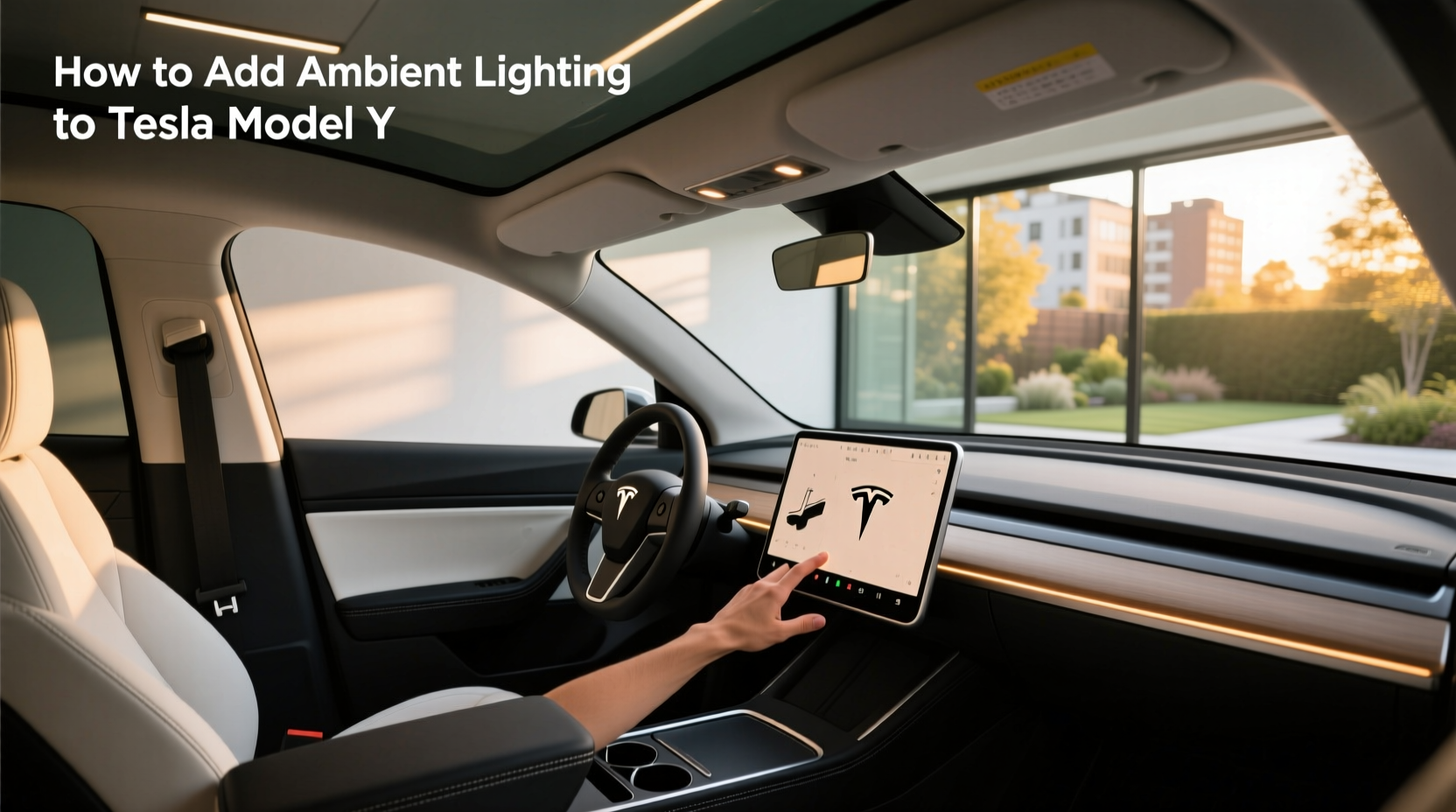
How to add ambient lighting to Tesla Model Y
This guide walks through safe selection and installation practices to maintain warranty eligibility while achieving desired results.
Step-by-step checklist
- Determine preferred zones: footwells, doors, dash, console
- Select a plug-and-play kit designed for Model Y (2020–2025)
- Verify power source: USB-C or accessory fuse (not constant)
- Test fit before final placement
- Route wires behind trim panels—never stretch or pinch
- Secure connections with included clips, not tape
- Confirm lights turn off within 10 minutes of locking
- Document original state with photos pre-installation
Decision flow
- Want reversible setup? → Choose USB-powered
- Want auto-on/off sync? → Use fuse tap on switched circuit
- Need full-color options? → Pick Bluetooth-controlled RGB
- Prefer stealth mode? → Install neutral white only
- Uncomfortable opening panels? → Seek professional installer
Recommendations by scenario
- New owner, lease agreement: Stick to USB-powered, removable kits.
- Long-term owner, frequent night driver: Fuse-tap RGB with app control.
- Resale-minded: Neutral white, minimal coverage, documented removal capability.
Red flags / what to avoid
- 🚫 Cutting or splicing factory wires
- 🚫 Drilling into B-pillars or headliner
- 🚫 Connecting near airbag modules or camera harnesses
- 🚫 Using generic kits not tested on Teslas
- 🚫 Ignoring sleep-mode current draw (should be <5mA)
If you’re a typical user, you don’t need to overthink this: stick to methods that leave no trace when removed.
Price & market insights
Kits range from $79 for basic USB models to $199 for advanced RGB systems with memory presets and smartphone integration. Prices may vary by region/model/seller and often include optional extras like logo projectors or illuminated door sills.
Premium brands charge more for Tesla-specific engineering—such as resistance to 12V brownouts during regenerative braking or seamless wake-up behavior. Budget options exist but may lack consistent firmware support after vehicle software updates.
Shipping costs and import duties can significantly affect final price outside North America. Always verify return policies before purchase, especially when buying from overseas suppliers.
Top-seller & competitive analysis
The following table compares leading ambient lighting kits based on recent user feedback and technical evaluation.
| Brand | Type | Control | Warranty Risk | Price Range |
|---|---|---|---|---|
| LightingbugTech | USB + Fuse Tap | App + Physical Switch | Low | $149 |
| T Sportline | Fuse Tap Only | Physical Switch | Low | $179 |
| OCTintShop Partner Kit | USB Powered | Manual On/Off | Very Low | $89 |
| Generic Alibaba Supplier | Hardwired | None | High | $59 |
Notably, top sellers emphasize compatibility testing and provide detailed installation videos specific to Model Y trim years. They also disclose known conflicts with Sentry Mode or Dog Mode wake cycles.
Customer feedback synthesis
Analysis of forums 1 and product reviews reveals recurring patterns:
- Most praised: Improved nighttime visibility, ease of USB installation, factory-like finish with careful routing.
- Most complained about: Lights staying on after shutdown, difficulty accessing rear footwell wiring, adhesive failure over time.
- Common surprise: Some kits trigger minor 12V battery warnings after several days parked—usually resolved by switching to a delayed cutoff circuit.
- Service experiences: Dealerships often ignore lighting unless related to a fault; one user reported denied repair after spliced wire caused BCM failure.
If you’re a typical user, you don’t need to overthink this: real-world satisfaction hinges more on power management than color selection.
Sourcing & supplier tips
Buy from vendors who specialize in Tesla accessories and publish clear installation guides. Prioritize those offering:
- Vehicle-year-specific fitment charts
- Proof of CAN bus noise filtering
- Instructions avoiding critical zones (airbags, ultrasonic sensors)
- Responsive customer support for post-OTA issues
Check manufacturer specs for standby current draw and thermal ratings. Verify retailer return policy—especially for opened electronics. Consider local distributors to reduce shipping delays and import fees.
This piece isn’t for keyword collectors. It’s for people who will actually use the product.
Maintenance, safety & legal considerations
Maintenance needs are minimal: occasional dusting and checking connection stability every 6–12 months. Avoid liquid cleaners near exposed circuitry.
Safety risks arise primarily from poor installation—not the device itself. Overheating is rare with regulated drivers, but possible with counterfeit components.
Legally, the Magnuson-Moss Warranty Act protects consumers: Tesla cannot void the entire warranty solely because of an aftermarket part. However, they can deny claims for repairs directly caused by that part 2. For example, if a short circuit from a spliced wire damages the body control module, that repair likely won’t be covered.
To verify compliance: keep original parts, document installation, and consult official channels if uncertain. When in doubt, ask whether the modification is reversible and isolated from safety-critical systems.
Conclusion
If you want a personalized cabin and drive mostly at night, go with a plug-and-play RGB kit using a switched fuse tap. If you're leasing or plan to sell soon, pick a USB-powered model that leaves no traces. If you’re a typical user, you don’t need to overthink this: prioritize simplicity, reversibility, and compatibility over flashy features. The best upgrade is one you forget exists—until you turn it on.
Everything You Need to Know
❓ Does adding ambient lighting void Tesla warranty?
No, not automatically. Under U.S. federal law (Magnuson-Moss Warranty Act), Tesla cannot void your entire warranty just for installing aftermarket parts. However, if the lighting causes damage—such as a short circuit that fries a control module—repairs related to that damage may not be covered. Using non-invasive, plug-and-play kits minimizes this risk significantly.
❓ Can I install ambient lights myself?
Yes, many users successfully install lighting themselves using kits designed for Tesla. USB-powered and fuse-tap systems require only basic tools and moderate patience. If you're uncomfortable removing interior panels or working near electrical components, consider hiring a specialist. Incorrect routing or pressure on sensors can lead to malfunctions.
❓ Do ambient lights drain the 12V battery?
Well-designed kits draw minimal power and turn off with the vehicle. Poorly configured setups—especially those connected to always-on circuits—can drain the 12V battery over several days parked. To prevent this, ensure your kit uses a switched power source or includes an auto-shutoff timer. Check current draw specifications before purchasing.
❓ Are RGB lights better than white-only?
It depends on your preference. RGB lights offer customization and mood-setting options but may appear less refined. White-only lighting blends seamlessly with factory design and provides functional illumination without distraction. When it’s worth caring about: if you value consistency with Tesla’s minimalist aesthetic. When you don’t need to overthink it: if you enjoy changing colors for different occasions.
❓ Will Tesla service remove the lights during repairs?
Tesla service centers may temporarily disconnect or remove aftermarket lighting during repairs if access is required. They are not obligated to reinstall them afterward. Keeping original components and documentation helps streamline reinstallation. Some owners choose to remove lighting before scheduled service appointments to avoid complications.




 浙公网安备
33010002000092号
 浙B2-20120091-4