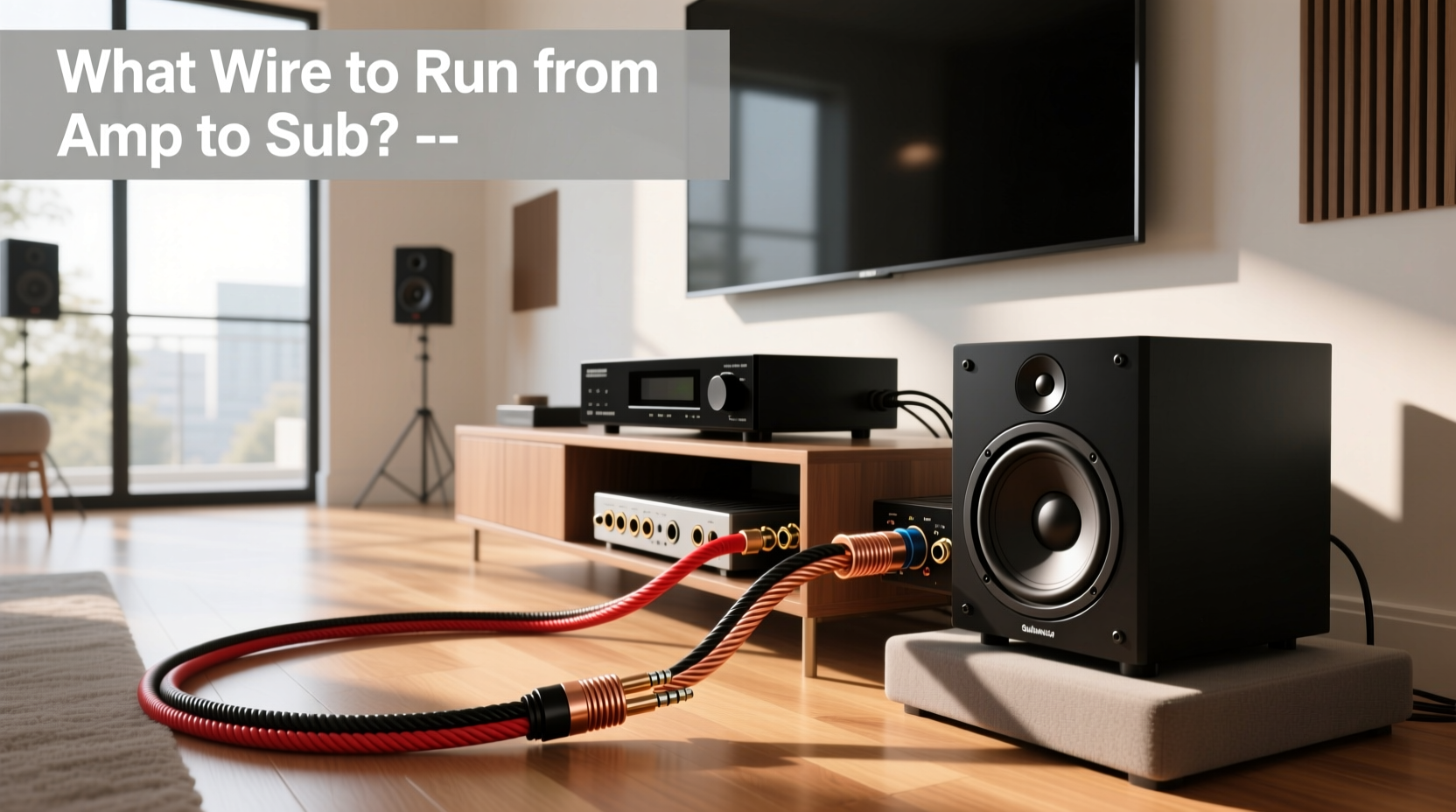
If you're setting up a car audio system, here's how to choose the right wire from amp to subwoofer: use oxygen-free copper (OFC) speaker wire, 12-gauge for 500–1500W RMS systems, 8-gauge for 1500–3000W, and consider 4-gauge for setups exceeding 3000W. Longer runs may require one gauge thicker to prevent resistance. Avoid copper-clad aluminum (CCA)—it overheats under high load. If you’re a typical user, you don’t need to overthink this: match wire gauge to your amplifier’s power output and distance, stick with OFC, and follow manufacturer diagrams for dual voice coil wiring.

About Amp to Subwoofer Wiring
Connecting an amplifier to a subwoofer isn't just about plugging in cables—it's about ensuring clean, efficient power transfer. The wire between these components carries high-current audio signals that drive bass performance. Unlike low-level RCA cables or power wires from battery to amp, this connection uses speaker-grade wire designed to handle dynamic current flow without significant voltage drop or heat buildup.
This link is often overlooked until distortion, clipping, or even equipment damage occurs. Over the past year, more DIY installers have reported issues tied to undersized or poor-conductivity wiring—especially in upgraded systems where original wiring was reused. A proper setup starts with understanding what kind of wire handles your system’s demands reliably.
Why Proper Wiring Is Gaining Popularity
Lately, car audio enthusiasts are paying closer attention to component matching—not just speakers and amps, but also the wiring that connects them. As affordable high-power amplifiers become more common, users are pushing older or generic cables beyond their limits. This shift has made correct gauge selection a practical necessity rather than a niche concern.
The rise in sealed enclosure builds, compact powered subs, and multi-sub configurations means more people are customizing setups instead of buying all-in-one kits. These changes increase variability in impedance loads and current draw—making informed wiring choices essential. If you’re a typical user, you don’t need to overthink this: most mid-range systems work well with standard 12-gauge OFC wire. But if you've upgraded your amp or added multiple subs, verifying your wire capacity matters now more than before.
Types and Variants
Not all speaker wires are equal. Three main types dominate the market, each with trade-offs:
Oxygen-Free Copper (OFC)
- Pros: Highest conductivity, durable, resists corrosion, maintains signal integrity
- Cons: More expensive, heavier than alternatives
Best for systems above 500W RMS. Offers consistent performance over time.
Copper-Clad Aluminum (CCA)
- Pros: Lower cost, lighter weight
- Cons: Lower conductivity (~60% of pure copper), prone to overheating, can degrade faster at connections
Suitable only for short runs under 500W RMS. Often found in budget kits. Not recommended for long-term reliability.
Silver-Plated Copper
- Pros: Slightly better high-frequency conductivity, resists oxidation
- Cons: Marginal real-world benefit for subwoofers, significantly higher price
Marketing-heavy option. For sub-bass applications, advantages are negligible. When you’re choosing wire for deep bass delivery, conductivity and current handling matter far more than micro-signal nuances. If you’re a typical user, you don’t need to overthink this: silver-plated variants won’t improve your bass impact.
Key Features and Specifications to Evaluate
Selecting the right wire means focusing on measurable traits—not brand names or flashy packaging.
Wire Gauge (AWG)
Gauge indicates thickness—lower numbers mean thicker wire. Thicker wire reduces electrical resistance, allowing more power to reach the subwoofer. Key thresholds:
- 16-gauge: Only for very short runs (<10 ft) under 500W
- 14-gauge: Acceptable for 500W systems with moderate run lengths
- 12-gauge: Ideal baseline for most single-sub systems (500–1500W)
- 8-gauge: Required for 1500–3000W systems or runs over 15 feet
- 4-gauge: Used in extreme setups (3000W+), especially with multiple subs
When it’s worth caring about: You’re installing a high-power amplifier or running wire over 12 feet.
When you don’t need to overthink it: Your system is under 800W RMS and wiring distance is under 10 feet—12-gauge OFC covers nearly all such cases.
Conductor Material
Pure copper (OFC) delivers optimal performance. CCA cuts costs but sacrifices safety and efficiency at scale.
When it’s worth caring about: You’re using a high-output amp or plan to upgrade later.
When you don’t need to overthink it: In low-power applications (<500W), both materials perform similarly—but OFC still lasts longer.
Insulation Quality
Thick, abrasion-resistant jackets protect against chafing, moisture, and heat. Look for UV resistance if routing near sunlight (e.g., trunk lids).
When it’s worth caring about: Routing through tight spaces or exposed areas.
When you don’t need to overthink it: Interior cabin runs with minimal flex or exposure.
Pros and Cons
| Factor | Advantage | Drawback |
|---|---|---|
| Correct Gauge | Maximizes power transfer, prevents overheating | Requires planning; thicker wire harder to route |
| OFC Material | Better durability and conductivity | Higher upfront cost |
| Proper Length | Avoids unnecessary resistance | Too long increases loss, too short limits placement options |
| Dual Voice Coil Wiring | Flexibility in impedance matching | Error-prone without diagrams; wrong setup damages amp |
How to Choose Amp to Subwoofer Wire
Follow this step-by-step process to make a confident decision.
Step-by-Step Checklist
- Determine your amplifier’s RMS output (not peak)
- Measure the distance from amp to sub location
- Check subwoofer impedance (single vs. dual voice coil)
- Select wire gauge based on power and length (see chart below)
- Choose OFC over CCA unless budget strictly limits options
- Buy enough length with slack for movement and future adjustments
- Use terminal connectors or spades for secure connections
Decision Flow
- Is your amp output < 500W? → 14–12 gauge OFC sufficient
- Between 500–1500W? → Use 12-gauge minimum, 8-gauge preferred for long runs
- Over 1500W? → Start at 8-gauge, go to 4-gauge as power increases
- Using DVC sub? → Refer to wiring diagram for series vs. parallel configuration
Recommendations by Scenario
- Single 10” sub, 600W RMS: 12-gauge OFC, 8–10 ft run
- Dual 12” subs, 2000W RMS: 8-gauge OFC, possibly 4-gauge if run exceeds 15 ft
- Compact hatchback, 400W system: 14-gauge OFC acceptable, 12-gauge ideal
Red Flags / What to Avoid
- Using CCA wire in high-power systems (>800W)
- Reusing old or frayed cables from previous setups
- Running excessively long wires without upsizing gauge
- Ignoring polarity when connecting voice coils
- Twisting wires instead of using proper crimp connectors
Price & Market Insights
Prices vary widely based on length, material, and branding. A 10-foot 12-gauge OFC speaker wire typically ranges from $15–$35 USD. 8-gauge or 4-gauge bundles cost $25–$60 for similar lengths. Premium brands may charge more for aesthetic features like colored jackets or braided sleeves, but these don’t affect performance.
Be cautious of extremely low prices—many sub-$10 “high-gauge” kits use CCA cores. While labeled as 8-gauge, their actual conductivity matches thinner pure copper wire. Always verify conductor type before purchase. Pricing may vary by region/model/seller. Check manufacturer specs and compare conductive cross-section area when possible.
Top-Seller & Competitive Analysis
Popular products focus on value and clarity. Top sellers often bundle wire with installation kits (connectors, tools, fuses). Brands like Rockford Fosgate, Kicker, and Monoprice offer reliable OFC options backed by clear documentation.
| Product | Gauge | Material | Key Strength | Limitation |
|---|---|---|---|---|
| Monoprice 12GA Speaker Wire | 12 | OFC | Affordable, widely available | No bundled accessories |
| Kicker 8-Gauge Kit | 8 | OFC | Includes connectors and fuse holder | Premium pricing |
| Rocketfish 4-Gauge CCA | 4 | CCA | Low-cost entry for thick gauge | Poor long-term reliability |
Customer Feedback Synthesis
Analysis of recent reviews shows recurring themes:
- Positive: Users praise easy installation, clear labeling, and noticeable improvement in bass response after upgrading from thin or CCA wire.
- Negative: Complaints center on misleading product titles (e.g., “8-gauge” CCA sold as equivalent to copper), poor connector quality in budget kits, and insufficient length in pre-cut packs.
- Common realization: Many buyers didn’t realize their old wire was limiting performance until they upgraded.
Sourcing & Supplier Tips
Buy from reputable suppliers who clearly state conductor material and gauge. Online marketplaces may list inaccurate specs—double-check product descriptions and look for detailed close-ups of cut ends to identify copper vs. aluminum core.
- Look for seller-provided test reports or conductivity specs
- Favor vendors offering return policies for electrical components
- Consider local car audio shops for immediate inspection and advice
Maintenance, Safety & Legal Considerations
Regularly inspect connections for looseness or corrosion, especially in humid climates. Tighten terminals during routine maintenance. Avoid pinching wires during interior reassembly.
Overheated wires indicate undersized gauge or faulty grounding—address immediately. While no universal regulation governs internal car wiring, fire risk from sustained overheating is real. Ensure fuses are correctly rated for your system’s draw.
To verify compliance with safe practices: check manufacturer specs, consult certified installers, and confirm local vehicle modification guidelines if required.
Conclusion
If you need reliable bass without signal loss or hardware strain, choose OFC wire in the appropriate gauge for your system’s power and layout. For most users, 12-gauge OFC is sufficient. High-output systems demand 8-gauge or thicker. If you’re a typical user, you don’t need to overthink this: avoid CCA, measure your run, match the gauge, and install securely.
Everything You Need to Know
What gauge wire should I use for a 1000-watt amplifier?
For a 1000-watt RMS amplifier, 12-gauge OFC wire is recommended for runs under 12 feet. If the distance exceeds 15 feet, step up to 8-gauge to minimize resistance. Always confirm your amplifier’s actual RMS rating—not peak power—as this determines real current draw. If you’re a typical user, you don’t need to overthink this: 12-gauge OFC handles most 1000W installations effectively.
Can I use CCA wire for my subwoofer setup?
CCA wire can work for low-power systems (<500W) and short runs, but it has higher resistance and lower thermal tolerance than OFC. In medium or high-power setups, CCA may overheat, degrade connections, or limit output. While cheaper upfront, it often leads to rework. If you’re building a lasting system, invest in OFC. This piece isn’t for keyword collectors. It’s for people who will actually use the product.
Does wire length affect subwoofer performance?
Yes. Longer wire runs increase electrical resistance, which causes power loss and potential heat buildup. For every 10 feet beyond 10 ft, consider stepping up one gauge size. For example, a 20-foot run at 1500W should use 4-gauge instead of 8-gauge. Keep runs as direct as possible and avoid coiling excess wire. If you’re a typical user, you don’t need to overthink this: stay under 15 feet when possible and adjust gauge accordingly.
How do I wire a dual voice coil subwoofer?
Use a wiring diagram specific to your subwoofer’s impedance (e.g., 2Ω or 4Ω per coil). Dual voice coils can be wired in series (additive impedance) or parallel (halved impedance) to match your amplifier’s stable load. Incorrect wiring can cause amp shutdown or damage. Most manufacturers provide diagrams. Connect positive to positive, negative to negative within each coil path. This piece isn’t for keyword collectors. It’s for people who will actually use the product.




 浙公网安备
33010002000092号
 浙B2-20120091-4