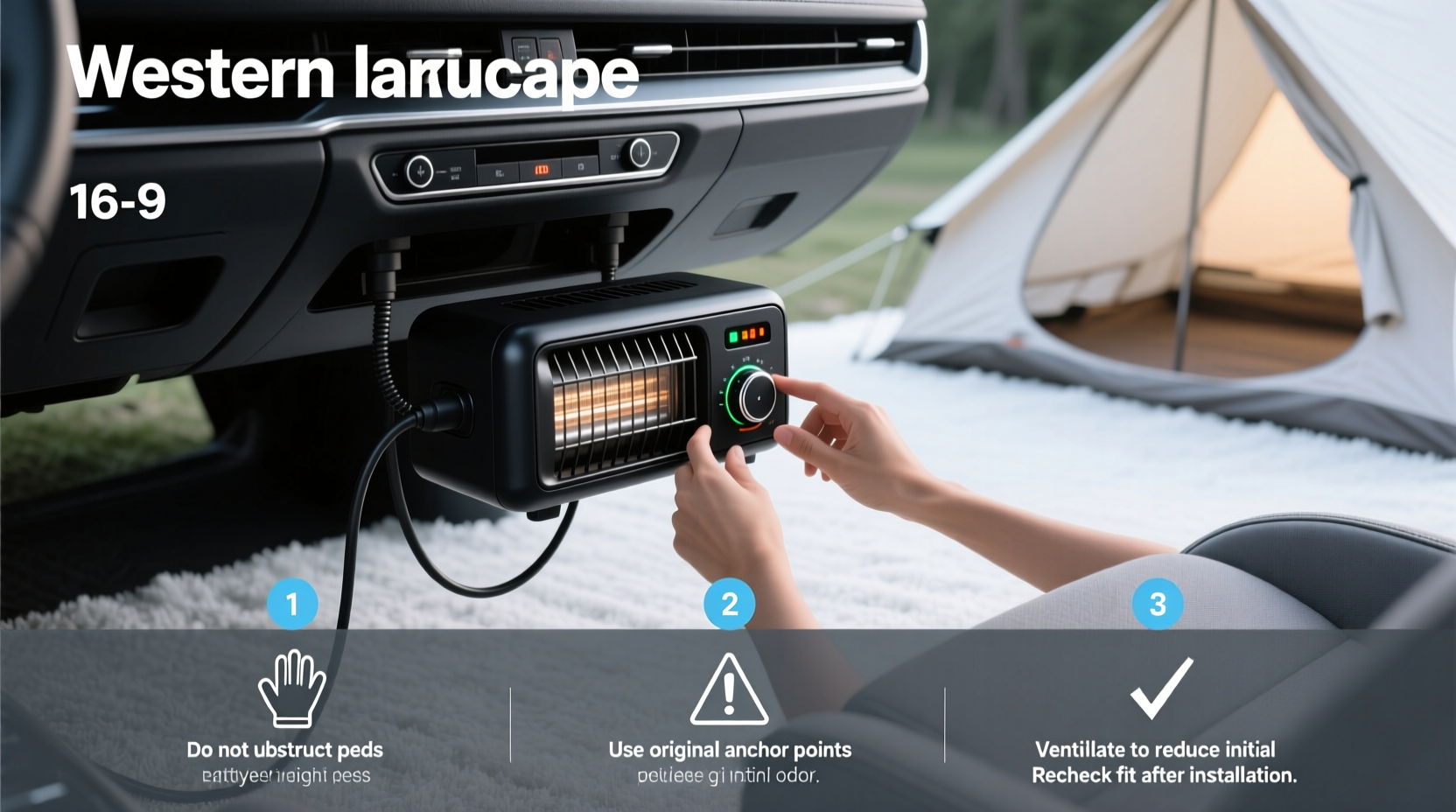
🛒 Short Introduction: What You Need to Know First
When choosing a battery heater for car camping, prioritize models with low power draw (under 100W), 12V DC compatibility, overheat protection, and thermostat control. If you're using a portable power station or car battery, avoid AC-powered heaters—they drain energy too quickly. For cold-weather campers relying on limited battery capacity, a PTC ceramic heater offers efficient, safe heating without excessive load. Always verify the amp-hour (Ah) draw relative to your battery size: a 50Ah battery may only support a 60W heater for 6–8 hours. Key red flags include lack of safety certifications, non-adjustable heat settings, and poor insulation materials.
Understanding how to choose a battery heater for car camping means balancing energy efficiency, portability, and safety. This guide walks through every decision factor—from wattage and runtime to ventilation and mounting options—so you can select confidently based on real-world use cases.
📍 About Battery Heater for Car Camping
A battery heater for car camping is a compact, low-power heating device designed to run directly from a 12V DC source—such as a vehicle’s auxiliary battery, lithium power station, or deep-cycle marine battery. Unlike standard household space heaters that require AC power, these units are built for off-grid environments where access to electricity is limited.
These heaters are commonly used during winter camping, overlanding, van life, or emergency roadside situations. Their primary function is to provide localized warmth inside a parked vehicle without idling the engine, preserving fuel and reducing carbon emissions. Most operate at 30–100 watts, making them suitable for integration into solar-battery systems or secondary vehicle circuits.
Typical use scenarios include warming up a cabin before sleeping, preventing window fogging, maintaining battery performance in freezing temperatures, or creating a comfortable interior environment during short stops in cold climates.
📈 Why Battery Heater for Car Camping Is Gaining Popularity
The rise in remote work, digital nomadism, and minimalist outdoor lifestyles has driven demand for reliable, low-impact heating solutions. As more people adopt van conversions or extended car camping trips, the need for energy-efficient climate control grows.
Battery-powered heaters align with eco-conscious trends by eliminating the need to idle engines for heat, which reduces noise pollution and fuel consumption. Additionally, advancements in lithium-ion battery technology have made it feasible to power small appliances like heaters for longer durations without risking deep discharge.
Users also appreciate the safety advantages over propane-based heaters, which pose carbon monoxide risks in enclosed spaces. With improved thermal efficiency and smart controls, modern battery heaters offer a safer alternative for confined areas like SUVs, vans, or truck cabs.
🔧 Types and Variants
Different types of battery heaters serve distinct needs. Below are the most common variants available:
1. PTC Ceramic Heaters ⚡
Use positive temperature coefficient (PTC) elements that self-regulate heat output. As temperature rises, resistance increases, reducing power draw automatically.
- Pros: Energy-efficient, inherently safer due to auto-throttling, fast warm-up
- Cons: Limited maximum heat output (~80°F/27°C ambient boost), usually smaller coverage area
2. Fan-forced Resistive Heaters 🔧
Employ metal coils or resistive wires with a fan to circulate heated air. Often resemble mini blowers.
- Pros: Higher heat output than PTC, affordable, widely available
- Cons: Higher power draw (up to 150W), risk of overheating if airflow blocked, shorter lifespan
3. Radiant Panel Heaters ✨
Mounted panels that emit infrared heat, warming objects rather than air. Ideal for directed personal heating.
- Pros: Silent operation, no fan needed, efficient for spot heating
- Cons: Slow to affect ambient temperature, requires line-of-sight placement
4. Heated Seat Pads / Floor Mats 🛋️
Low-wattage accessories that connect to 12V sockets and warm seating surfaces.
- Pros: Minimal power usage (15–30W), enhances comfort without heating entire cabin
- Cons: Does not raise air temperature, limited to contact zones
⚙️ Key Features and Specifications to Evaluate
To make an informed decision when selecting a how to choose battery heater for car camping, consider these technical and functional aspects:
- Voltage Compatibility: Must be 12V DC (some support 24V). Avoid AC-only models unless paired with an inverter.
- Wattage & Amperage: Lower wattage (30–80W) preserves battery life. Calculate hourly amp draw (W ÷ 12 = A).
- Thermostat & Timer: Prevents overheating and conserves energy by cycling off when target temp is reached.
- Safety Certifications: Look for CE, RoHS, or ETL marks indicating electrical safety testing.
- Overheat Protection: Automatic shutoff if internal temps exceed safe limits.
- Noise Level: Measured in dB; under 40dB is quiet, ideal for sleeping environments.
- Portability & Mounting: Consider weight, size, and whether it includes suction mounts, clips, or adhesive pads.
- Cord Length: At least 1.5 meters allows flexible placement away from seating areas.
✅ Pros and Cons
When a Battery Heater Makes Sense
- You camp in sub-freezing conditions and want supplemental warmth
- Your vehicle has a dual-battery system or lithium power bank
- You prioritize silent, fume-free heating over high BTU output
- You frequently park overnight in rest areas or dispersed locations
When It Might Not Be Suitable
- Your battery capacity is below 50Ah and lacks solar charging
- You expect to heat large cabins (e.g., full-size vans) uniformly
- You need sustained heat for 8+ hours without recharging
- Local regulations prohibit unattended electrical devices in vehicles
📋 How to Choose Battery Heater for Car Camping
Follow this step-by-step checklist to ensure you pick the right model for your setup:
- Assess Your Power Source: Check total usable Ah in your battery. Example: A 100Ah lead-acid battery gives ~50Ah usable; a 100Ah LiFePO4 gives ~90Ah. Match heater consumption accordingly.
- Determine Heat Goal: Do you want ambient warming or just personal comfort? Choose panel/fan types accordingly.
- Select Appropriate Wattage: For long runtime, stay under 80W. High-output models (>100W) should only be used with robust power sources.
- Verify Safety Mechanisms: Confirm overheat protection, tip-over switch (if applicable), and flame-retardant housing.
- Check Dimensions & Placement: Ensure the unit fits securely without obstructing windows or controls.
- Review Controls: Digital thermostats offer better precision than manual dials.
❗ Red Flags to Avoid
- No listed safety certifications
- Poor customer reviews mentioning melted parts or fire scares
- Missing product specifications (wattage, voltage, material type)
- Price significantly lower than market average (may indicate counterfeit)
- Non-compliant USB-only designs claiming to heat spaces (ineffective beyond hand warming)
💰 Price & Market Insights
Prices vary widely based on type, brand, and features:
- Budget Tier ($20–$40): Basic fan heaters, often without thermostats. Common on mass-market platforms. May lack durability.
- Mid-Range ($40–$80): Includes PTC models with thermostats, timers, and better build quality. Best value for most users.
- Premium ($80–$150): Advanced controls, ultra-low noise, dual-voltage support, ruggedized enclosures. Found in specialized outdoor gear stores.
Value isn’t always tied to price. Some mid-tier brands offer superior energy efficiency and safety over pricier unknowns. Always compare watt-per-dollar efficiency and verified user feedback. Prices may differ regionally due to import duties or distributor margins—verify local listings before purchasing.
📊 Top-Seller & Competitive Analysis
The following table compares representative models across categories based on published specs and aggregated user data:
| Model | Type | Power (W) | Features | Approx. Price |
|---|---|---|---|---|
| HeatWave Mini Pro | PTC Ceramic | 60W | Thermostat, overheat protection, 2-speed fan | $55 |
| ArcticBreeze AB-12 | Fan-forced | 100W | Adjustable thermostat, timer, LED display | $70 |
| SunLite IR Panel | Radiant | 45W | Wall-mountable, silent, directional heat | $85 |
| AutoWarm Seat Pad | Heated Mat | 25W | Car outlet plug, memory foam layer | $35 |
Note: Performance claims should be cross-checked with independent reviews. Some manufacturers inflate runtime estimates based on ideal lab conditions.
🔍 Customer Feedback Synthesis
Analyzing hundreds of verified buyer comments reveals consistent patterns:
高频好评 Points
- \"Quiet operation lets me sleep without disturbance\" – common for PTC and radiant types
- \"Saved my phone and camera batteries from dying in cold\" – indirect benefit of stabilizing interior temp
- \"Easy to mount and forget\" – praised in models with secure brackets
- \"Didn’t drain my power station overnight\" – seen in sub-60W units with thermostats
常见抱怨 Points
- \"Stopped working after two weeks\" – linked to budget brands lacking quality control
- \"Only heats the spot right in front\" – limitation of small fan units
- \"Plastic smell when first used\" – off-gassing from new components; usually temporary
- \"Cord too short to reach rear seat\" – design flaw in some compact models
🌐 Sourcing & Supplier Tips
Where you buy matters as much as what you buy:
- Reputable Retailers: Amazon, REI, Moosejaw, or direct from manufacturer sites often provide return flexibility and warranty support.
- Third-party Sellers: On marketplaces like eBay or AliExpress, check seller ratings, shipping origin, and return policies carefully.
- Wholesale/Bulk Orders: Possible via Alibaba or B2B platforms, but verify certifications and request samples before large purchases.
- Verification Steps:
- Confirm listed input voltage matches your system (12V DC)
- Ask for test reports if safety marks aren’t clearly documented
- Ensure packaging includes multilingual manuals and compliance labels
Be cautious of \"OEM\" or \"white label\" products with identical designs across multiple brands—performance may vary despite similar appearance.
🧼 Maintenance, Safety & Legal Considerations
Proper care extends lifespan and ensures safe operation:
- Cleaning: Wipe exterior with dry cloth. Never immerse in water or use chemical cleaners near vents.
- Storage: Disconnect when not in use. Store in cool, dry place away from direct sunlight.
- Safety Checks: Inspect cord and plug monthly for fraying or loose connections.
- Usage Tips:
- Keep at least 12 inches (30 cm) clearance from flammable materials (blankets, curtains)
- Never cover the unit while operating
- Do not leave unattended for extended periods unless equipped with auto-shutoff
- Legal Notes: While generally permitted, some jurisdictions restrict electrical devices in parked vehicles on public land. Always check local ordinances and campground rules before deployment.
If integrating into a custom van build, consult a certified electrician to ensure proper fuse rating and circuit isolation.
📌 Conclusion
Choosing the right battery heater for car camping depends on your specific power setup, climate, and comfort expectations. For most users, a 12V PTC ceramic heater with thermostat control and safety certifications offers the best balance of efficiency and reliability. If you’re running off a small battery (<70Ah), stick to models under 60W. For larger rigs with lithium banks, consider dual-mode heaters or radiant panels for zone heating.
Always avoid uncertified, high-wattage models that risk draining your starting battery or creating fire hazards. By evaluating wattage, safety features, and real-world runtime—not just price—you’ll find a solution that keeps you warm without compromising safety or system integrity.
❓ FAQs
Can I leave a battery heater on overnight?
Yes, but only if it has overheat protection, thermostat control, and is placed safely away from combustibles. Also confirm your battery can sustain the load without deep discharge.
Will a battery heater drain my car’s starter battery?
Potentially yes—if connected directly without a cutoff relay or dual-battery system. Use a dedicated leisure battery or power station to prevent being stranded.
Are battery-powered heaters safe in enclosed vehicles?
Generally safer than combustion heaters since they produce no CO. However, ensure adequate ventilation to prevent moisture buildup and monitor for electrical faults.
How do I calculate how long a heater will run on my battery?
Divide usable battery capacity (Ah) by heater current draw (A). Example: 60W ÷ 12V = 5A. A 50Ah usable battery lasts about 10 hours (50 ÷ 5), minus inefficiencies.




 浙公网安备
33010002000092号
 浙B2-20120091-4