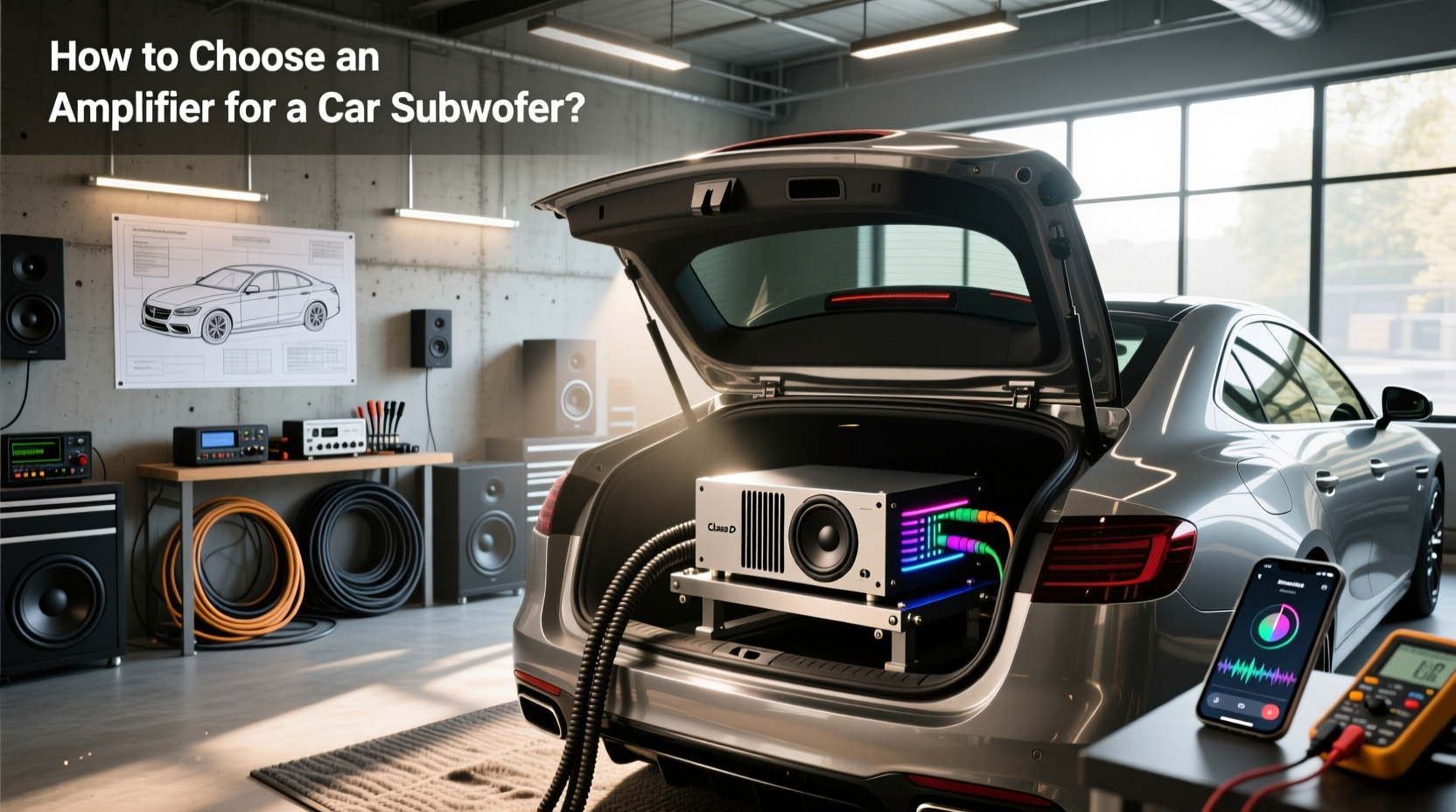
Short introduction
If you’re adding bass to your car audio, start here: match the amplifier’s RMS output to your subwoofer’s RMS rating, ensure the amp is stable at the final impedance (ohm load), and use a mono (single-channel) amplifier. This isn’t about brand loyalty or wattage wars—it’s about clean, reliable power delivery. Over the past year, more drivers have upgraded factory systems with aftermarket subs, but many still overpay or underpower due to two common mistakes: focusing on peak power instead of RMS, and ignoring wiring configuration impacts on performance.
What to look for in a car subwoofer amplifier? Focus on continuous power handling, not flashy specs. If you’re a typical user, you don’t need to overthink this. Most dual voice coil (DVC) subs can be wired to 2 ohms or 4 ohms—choose an amp that delivers steady power at that load without overheating. Avoid amplifiers labeled “high power” with no RMS specification at specific impedances. And skip multi-channel amps unless you're also powering full-range speakers.
About Amplifiers for Car Subwoofers
A car subwoofer amplifier boosts low-frequency signals from your head unit and sends them to one or more subwoofers with enough power to move air and produce deep bass. Unlike full-range amps, subwoofer amps are optimized for frequencies below 100 Hz and typically come in mono (single-channel) designs because bass is non-directional.
The core job of the amplifier is matching electrical output to mechanical capability. Too little power strains the sub; too much risks distortion and damage. The goal is alignment: voltage, current, and impedance all working within safe, efficient ranges. Factory stereos rarely provide enough signal strength, which is why dedicated amplification is necessary for serious bass response.
If you’re a typical user, you don’t need to overthink this. You’re not building a competition rig—you want solid thump during daily drives, not maximum SPL readings. That means prioritizing reliability over extremes.
Why Car Subwoofer Amplifiers Are Gaining Popularity
Lately, factory infotainment systems have improved in connectivity and interface design—but their built-in amplifiers remain underpowered. Even premium brands often limit sub output to protect cabin acoustics or reduce heat buildup. As a result, enthusiasts and casual listeners alike are turning to aftermarket solutions for richer, fuller sound.
Modern digital signal processing (DSP) integration has also made standalone amplifiers more appealing. Many now include adjustable crossovers, bass boost controls, and input flexibility (like speaker-level inputs), making them compatible with both factory and aftermarket head units. Compact Class D designs run cooler and draw less current, fitting neatly under seats or in tight trunks.
This piece isn’t for keyword collectors. It’s for people who will actually use the product.
Types and Variants
Not all amplifiers work equally well with subwoofers. Here are the main types used in car audio:
- Mono (Single-Channel): Designed specifically for subs. Handles low frequencies efficiently, supports bridged outputs internally, and maintains stability at low impedances (down to 1 ohm on some models).
- 2-Channel: Can power a single sub if bridged, but only when impedance matches. Less ideal due to phase alignment issues and reduced efficiency compared to mono amps.
- 4+ Channel: Typically used for component speakers. Some allow bridging two channels to drive a sub, but again, thermal management and damping control suffer versus purpose-built mono units.
Class Comparisons:
| Class | Efficiency | Heat Output | Best For |
|---|---|---|---|
| Class A/B | Low-Medium | High | High-fidelity setups (rarely used for subs) |
| Class D | High | Low | Subwoofers – standard choice today |
| Class T (Tripath) | Medium-High | Medium | Niche applications; limited availability |
If you’re a typical user, you don’t need to overthink this. Stick with a Class D mono amplifier. It offers the best balance of size, efficiency, and power delivery for bass duties.
Key Features and Specifications to Evaluate
When comparing amplifiers, focus on these five parameters:
- RMS Power at Specific Impedance: Always check watts RMS per channel at 4Ω, 2Ω, and sometimes 1Ω. Ignore “peak” or “max” power claims—they’re meaningless for real-world performance.
- Impedance Stability: Can it handle 2Ω or 1Ω loads continuously? Unstable amps shut down or fail under sustained load.
- Signal-to-Noise Ratio (SNR): Look for ≥80 dB. Higher values mean cleaner output with less background hiss.
- Damping Factor: Indicates control over cone movement. Values above 100 help tighten bass response, especially important for ported enclosures.
- Built-in Filters: Subsonic filter (cuts below ~30 Hz) protects the driver in ported boxes. Low-pass crossover prevents midbass bleed into the sub.
When it’s worth caring about: If you’re running a high-excursion sub in a large ported box, damping factor and subsonic filtering matter. When you don’t need to overthink it: For sealed enclosures with moderate tuning, basic filtering and decent SNR are sufficient.
Pros and Cons
| Aspect | Pros | Cons |
|---|---|---|
| Adding an Amp | Deeper, cleaner bass; protects head unit; enables system expansion | Requires wiring effort; consumes battery power; space needed |
| Mono vs Multi-Channel | Mono: Efficient, stable, compact | Multi: Inflexible for future upgrades if misused |
| Digital (Class D) | Cool-running, small footprint, high efficiency | Sensitive to poor grounding; some budget models distort early |
How to Choose an Amplifier for a Car Subwoofer
Follow this checklist to make a confident decision:
Step-by-Step Checklist
- Determine your subwoofer’s RMS power and impedance (e.g., 500W RMS @ 2Ω).
- Select a mono amplifier with RMS output matching or slightly exceeding the sub’s requirement at that impedance.
- Verify the amp is stable at the final load (e.g., does it support 2Ω mono? Check manual).
- Check for essential features: subsonic filter, gain control, low-pass crossover.
- Ensure input compatibility: RCA inputs if using aftermarket head unit; speaker-level inputs if keeping factory radio.
- Confirm physical fit and ventilation space in your vehicle.
Decision Flow
Start with the subwoofer. Its specs dictate what the amplifier must deliver. Then ask:
- Are you keeping the factory stereo? → Need speaker-level inputs.
- Running multiple subs? → Calculate total RMS and final impedance.
- Using a ported enclosure? → Prioritize subsonic filter and higher damping.
- Space-constrained? → Opt for low-profile Class D mono amp.
Recommendations by Scenario
- Single 10" or 12" sub, factory head unit: 500–800W mono Class D amp with speaker-level inputs and built-in crossover.
- Dual subs, aftermarket setup: 1000W+ mono amp stable at 1Ω or 2Ω, depending on wiring.
- Compact SUV or sedan: Slim-profile mono amp (under-seat install), 300–600W range.
Red Flags / What to Avoid
- Amplifiers advertising “1500W MAX” with no RMS rating.
- No stated impedance stability (e.g., “supports 2Ω” without confirmation of mono mode).
- Poor customer reviews mentioning shutdowns or distortion at volume.
- Missing protection circuits (thermal, short-circuit, overload).
- Overly complex remote controls with no practical benefit.
If you’re a typical user, you don’t need to overthink this. Stick to known specifications and avoid marketing fluff.
Price & Market Insights
Prices vary widely based on power output, build quality, brand reputation, and region. Entry-level mono amplifiers (300–600W RMS) may cost $80–$150 USD. Mid-tier models ($150–$300) offer better components, stability, and filtering. High-end units ($300+) include advanced topology, DSP integration, or extreme power handling.
These figures may vary by region/model/seller. To get accurate pricing:
- Check manufacturer websites for MSRP.
- Compare authorized dealers to avoid counterfeit units.
- Verify return policies before purchase.
Top-seller & Competitive Analysis
While exact sales rankings fluctuate, certain brands consistently appear in trusted retailer inventories and enthusiast forums due to reliability and service networks. Below is a representative comparison of common categories:
| Brand Tier | Example Models | Strengths | Limitations |
|---|---|---|---|
| Budget (e.g., Boss Audio, Rockford Fosgate P-Series) | RFP1000X1D, BOSS BE600U | Affordable, decent power claims, basic protection | Inconsistent long-term durability, vague spec sheets |
| Mid-Range (e.g., JL Audio, Kenwood, Alpine) | JL Audio JD Series, Kenwood KAC-M1804 | Clear specs, good filtering, proven stability | Premium pricing for entry-level power |
| Performance (e.g., Rockford Fosgate Punch, Hifonics) | RF Prime R1500-1D, Hifonics HFR1500.1D | High damping, robust construction, wide impedance tolerance | Larger size, higher current draw |
Note: Performance differences become noticeable only at high volumes or in demanding installations. For average users, mid-tier models offer the sweet spot.
Customer Feedback Synthesis
Based on recent forum discussions and verified buyer comments:
- Frequent Praise: Compact size of Class D amps, ease of installation with included hardware, noticeable improvement over factory bass.
- Common Complaints: Under-delivered power (especially in budget brands), misleading labeling (“max power”), difficulty finding space for larger heatsinks.
- Surprising Insight: Many buyers underestimated wiring needs—especially ground cable thickness and battery distribution.
If you’re a typical user, you don’t need to overthink this. Read beyond star ratings—look for mentions of real-world performance and thermal behavior after extended use.
Sourcing & Supplier Tips
Where you buy matters as much as what you buy:
- Purchase from authorized dealers to ensure warranty validity.
- Avoid third-party marketplaces with inconsistent inventory tracking.
- Look for suppliers offering technical support documentation online.
- Consider kits that bundle amp, sub, and wiring—often better matched than piecing together separately.
Always check manufacturer specs directly before finalizing. If specs aren't publicly listed, treat that as a red flag.
Maintenance, Safety & Legal Considerations
Once installed:
- Inspect connections annually for corrosion or looseness.
- Ensure ventilation around the amp to prevent overheating.
- Use proper fusing near the battery—never bypass safety devices.
- Ground to bare metal close to the amplifier, not random bolts.
No universal laws govern amplifier power, but local noise ordinances may restrict volume levels while driving. To stay compliant:
- Keep cabin rattle-free at moderate volumes.
- Verify local regulations through transportation department resources.
Conclusion
If you need clean, powerful bass without constant maintenance, choose a Class D mono amplifier matched to your subwoofer’s RMS and impedance. Don’t chase peak numbers or oversized cases. Focus on stability, correct wiring, and realistic expectations. If you’re a typical user, you don’t need to overthink this. The right amp isn’t the loudest—it’s the one that runs cool, sounds clear, and lasts.
Everything You Need to Know
❓ How do I match an amplifier to my subwoofer?
Match the amplifier's RMS power output to your subwoofer's RMS rating at the same impedance (e.g., 500W RMS @ 2Ω). Ensure the amp is stable at that load. Use a mono amplifier for best results. Verify wiring configuration (parallel/series) achieves desired final ohm load.
❓ Can I use a 2-channel amp for a subwoofer?
You can bridge a 2-channel amp to power a sub, but only if it’s stable at the resulting impedance. Mono amplifiers are preferred because they’re designed for low-frequency loads, have better damping control, and maintain stability more reliably. If you’re a typical user, you don’t need to overthink this—just use a mono amp.
❓ What size wire do I need for a car subwoofer amplifier?
Power wire gauge depends on amplifier current draw and length. For most 500–1000W amplifiers, 4 AWG is standard. Larger amps (1500W+) may require 2 AWG or even 0 AWG. Always follow manufacturer recommendations and include an in-line fuse near the battery. Ground wire should match power wire gauge.
❓ Do I need a capacitor with my subwoofer amplifier?
Most modern electrical systems don’t require an external capacitor unless you experience headlight dimming at high volume. A stiffening capacitor helps stabilize voltage but doesn’t add energy. Upgrading alternator output or battery is more effective for chronic voltage drops. When it’s worth caring about: Only if you’ve already optimized wiring and still see issues. When you don’t need to overthink it: For systems under 1000W RMS, capacitors are usually unnecessary.
❓ How important is the damping factor?
Damping factor affects how quickly the amplifier stops the subwoofer cone after a signal ends. Higher values (above 100) improve transient response and tighten bass, especially in ported enclosures. When it’s worth caring about: For high-performance systems or large enclosures. When you don’t need to overthink it: For sealed boxes or moderate listening levels, damping factor has minimal audible impact.





 浙公网安备
33010002000092号
 浙B2-20120091-4