Short introduction
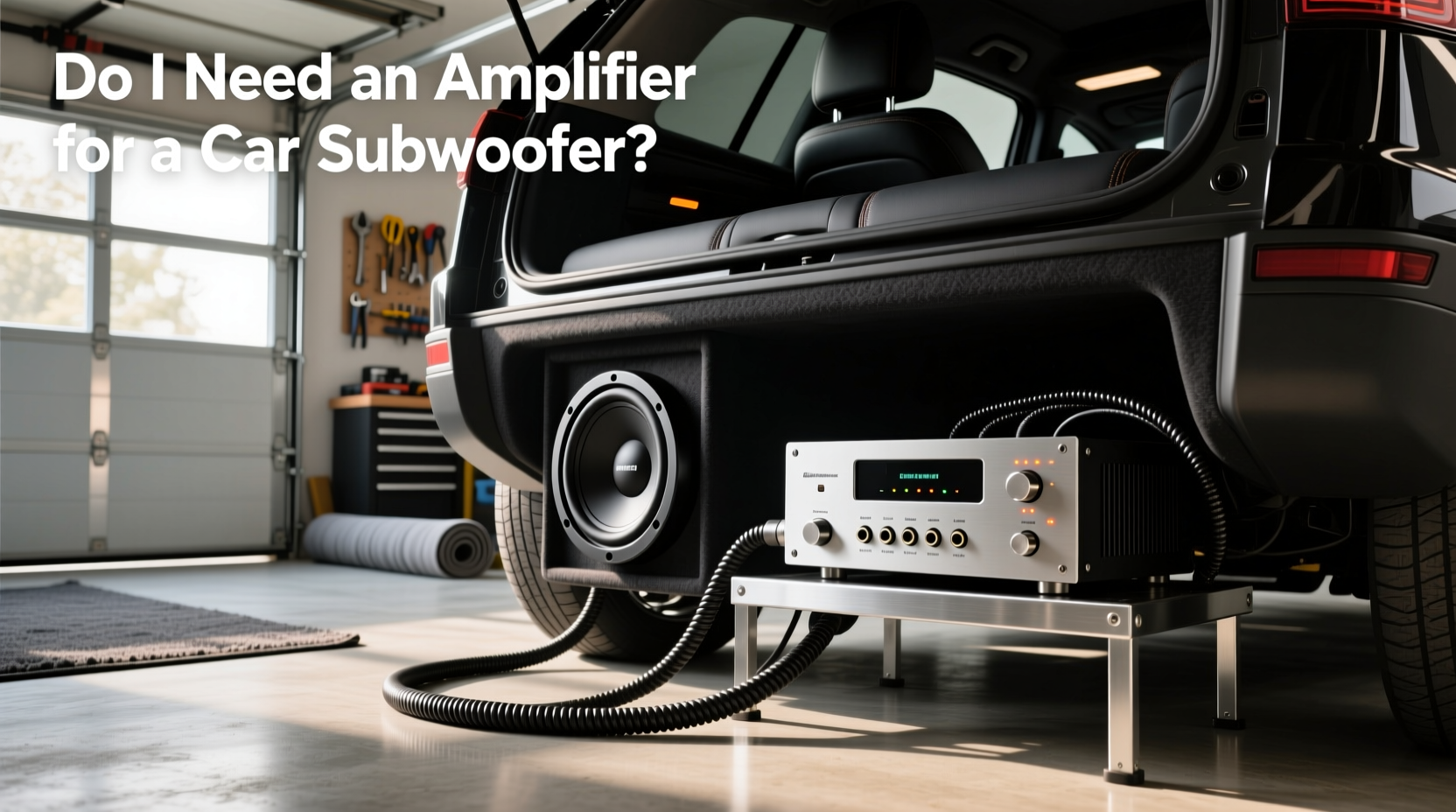
If you're adding a subwoofer to your car audio system, the answer is clear: yes, you almost always need an amplifier. The question isn't whether but what kind. Most passive subwoofers require external amplification because factory head units can't deliver enough clean power for deep bass. For most users, a mono amplifier matched to your sub’s RMS wattage and impedance is the right move. Over the past year, more drivers have upgraded their in-car sound experience—not just for music, but for clarity in podcasts and ride comfort. If you’re a typical user, you don’t need to overthink this: get a dedicated amp or choose a powered (active) subwoofer. Avoid mismatched power ratings—this causes distortion or damage. What to look for in a car subwoofer amplifier? Focus on RMS output, impedance stability, and input options that fit your existing stereo.
About car subwoofers and amplifiers
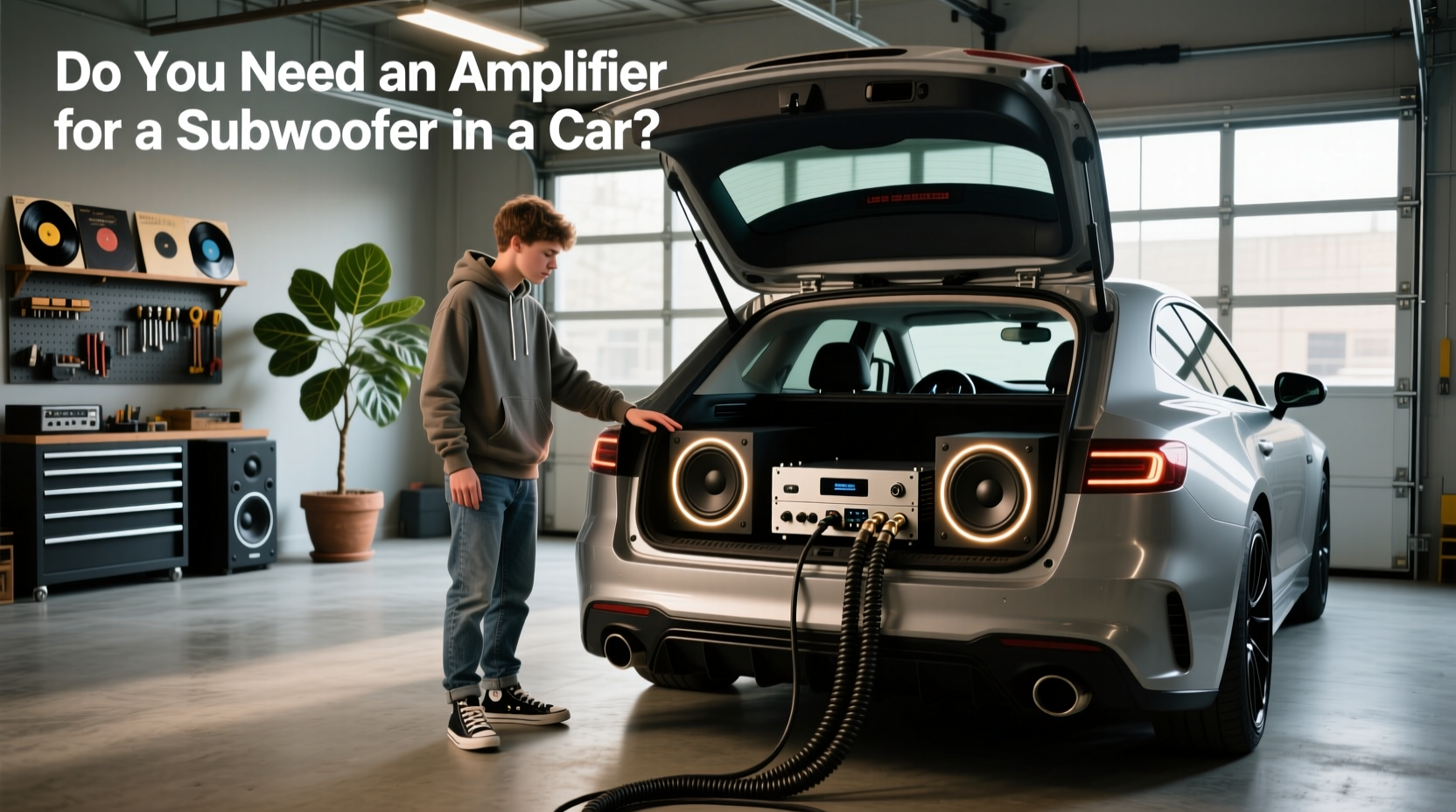
A car subwoofer reproduces low-frequency sounds—typically below 80 Hz—that standard speakers can’t handle effectively. But unlike regular speakers, subwoofers demand significantly more power to move air and create physical impact. This is where amplifiers come in. An amplifier boosts the audio signal from your head unit (radio) to a level capable of driving the subwoofer efficiently.
There are two main types of subwoofer systems: passive and active. Passive subwoofers have no built-in power source and rely entirely on an external amplifier. Active (or powered) subwoofers include a built-in amplifier, eliminating the need for a separate unit. Understanding this distinction answers the core question: Do I need an amplifier for a car subwoofer? Only if it's a passive model. If you’re a typical user, you don’t need to overthink this—just check whether your sub has a built-in amp.
Why this setup is gaining popularity
Lately, car audio upgrades have shifted from niche hobbyist projects to mainstream enhancements. With the rise of streaming services offering high-resolution audio and noise-canceling headphones setting new expectations, listeners notice when their car systems fall short. Deep, accurate bass improves not only music enjoyment but also speech intelligibility and cabin ambiance during long drives.
Another change signal: modern vehicles often come with lightweight speaker materials and digital signal processing that prioritizes efficiency over fidelity. While convenient, these designs limit dynamic range. Adding a subwoofer with proper amplification restores balance. It’s not about volume—it’s about restoring missing frequencies. This piece isn’t for keyword collectors. It’s for people who will actually use the product.
Types and variants
Understanding the different configurations helps narrow down what you actually need.
Passive Subwoofers + External Amplifier
- Pros: Full control over power and tuning; scalable for future upgrades; better heat dissipation with standalone amps
- Cons: Requires additional space, wiring, and fuse protection; installation complexity increases
Powered (Active) Subwoofers
- Pros: All-in-one design; simpler installation; pre-matched amp-to-driver calibration
- Cons: Limited upgrade path; heat buildup possible in enclosed spaces; may lack fine-tuning options
Monoblock vs. Multi-Channel Amplifiers
For passive setups, amplifier type matters. Monoblock amps are single-channel units optimized for subwoofers. They deliver stable power at low impedances (like 2Ω or 1Ω). Multi-channel amps (4-channel or 5-channel) can power full-range speakers and a sub simultaneously, useful if replacing multiple components.
If you’re a typical user, you don’t need to overthink this: choose a monoblock amp for dedicated subwoofer duty unless you’re upgrading all speakers at once.
Key features and specifications to evaluate
Not all amplifiers are created equal. Here’s what actually impacts performance—and when you can safely ignore marketing noise.
Power Output (RMS Watts)
When it’s worth caring about: Matching RMS (Root Mean Square) wattage between your amplifier and subwoofer prevents underpowering (weak output) or overpowering (distortion, voice coil damage). Always match RMS values, not peak ratings.
When you don’t need to overthink it: If both devices are within ±10–15% of each other’s RMS rating, it’s acceptable. Small variances won’t harm performance. If you’re a typical user, you don’t need to overthink this—just avoid doubling or halving the recommended power.
Impedance (Ohms)
When it’s worth caring about: Impedance affects how much current flows through the circuit. Most subs are 2Ω or 4Ω. Your amp must be stable at the load you present. Running a 1Ω load on a non-1Ω-stable amp risks overheating.
When you don’t need to overthink it: Single sub setups usually run at 2Ω or 4Ω—most modern monoblocks handle both. Only dive deeper if wiring multiple subs in series/parallel. This piece isn’t for keyword collectors. It’s for people who will actually use the product.
Signal Inputs: Preamp vs. Speaker-Level
When it’s worth caring about: Factory head units often lack RCA preamp outputs. In those cases, an amplifier with speaker-level inputs (high-level inputs) lets you tap into existing speaker wires to extract the signal.
When you don’t need to overthink it: Aftermarket stereos usually include RCA outputs. If yours does, any standard amp will work. Just confirm input compatibility before buying.
Gain, Bass Boost, and Filters
When it’s worth caring about: Proper gain setting prevents clipping. Low-pass filters direct only bass frequencies to the sub. These controls matter for integration and clarity.
When you don’t need to overthink it: Basic presets work fine for daily driving. You can adjust later. Don’t stress initial calibration—focus on correct wiring first.
Pros and cons
| Aspect | With Amplifier | Without Amplifier |
|---|---|---|
| Bass Quality | Deep, clean, impactful | Weak, distorted, thin |
| Head Unit Strain | Minimal — amp handles load | High — risk of overheating |
| Installation Complexity | Moderate to high | Low (only for powered subs) |
| Upgrade Flexibility | High — modular system | Low — fixed design |
| Cost | Higher upfront | Lower, but limited results |
How to choose the right amplifier for your car subwoofer
This guide walks through the practical steps—not theoretical specs—to make a confident decision.
Step-by-step checklist
- Determine if your subwoofer is passive or active
- Check the sub’s RMS power and impedance (e.g., 300W @ 2Ω)
- Select an amplifier with matching RMS output and impedance stability
- Verify input type compatibility with your head unit (RCA or high-level)
- Ensure adequate power and ground wiring gauge (usually 4 AWG for 500W or less)
- Plan mounting location and routing paths for safety and accessibility
Decision flow
- Are you keeping your factory radio? → Choose an amp with speaker-level inputs.
- Upgrading only the sub? → Use a monoblock amp.
- Replacing all speakers too? → Consider a 5-channel amp.
- Want plug-and-play ease? → Choose a powered subwoofer.
Recommendations by scenario
- Budget commuter: Powered subwoofer with compact footprint (e.g., 8-inch).
- Music enthusiast: Passive 10" or 12" sub + 500W monoblock amp.
- Truck or SUV owner: Larger enclosure with dual 12" subs and 1000W amp for cabin-filling bass.
Red flags / what to avoid
Price & market insights
Prices vary widely depending on brand, power output, and region. Entry-level monoblock amplifiers start around $50–$80, while mid-tier models ($100–$200) offer better build quality and thermal management. High-end units exceed $300 but are typically unnecessary for most users. Powered subwoofers range from $100 to $400, combining driver and amp in one enclosure.
May vary by region/model/seller. To verify value: compare RMS wattage per dollar, read verified buyer reviews, and check return policies before purchase.
Top-seller & competitive analysis
While specific rankings shift frequently, certain brands consistently appear in user discussions due to reliability and support: MTX, Rockford Fosgate, Kenwood, and JL Audio. Performance differences among top models are often marginal in real-world use.
| Model Type | Typical Power (RMS) | Impedance Support | Best For |
|---|---|---|---|
| MTX Thunder500/1 | 500W @ 2Ω | 1–4Ω stable | Singles 10"–12" subs |
| Rockford Fosgate P300-1 | 300W @ 4Ω | 2–4Ω | Premium powered subs |
| Kenwood KAC-9106D | 600W max (mono) | 2–4Ω | Balanced budget option |
If you’re a typical user, you don’t need to overthink this—mid-tier models from reputable brands deliver consistent results without hype-driven pricing.
Customer feedback synthesis
Based on recent user reports across forums and retail sites:
- Most praised: Ease of setup with powered subs, noticeable sound improvement, compact designs fitting tight trunks.
- Most complained about: Poorly labeled wiring diagrams, misleading peak power advertising, insufficient heat sinks causing shutdowns.
- Common surprise: Many didn’t realize factory radios lack line-level outputs—leading to signal issues until corrected.
Sourcing & supplier tips
Buy from suppliers that provide complete technical documentation and clear warranty terms. Look for product listings that specify RMS power, frequency response, and input sensitivity—not just flashy features. If purchasing online, confirm return windows and test equipment upon arrival. May vary by seller. Always check manufacturer specs directly before finalizing.
Maintenance, safety & legal considerations
Regularly inspect wiring connections for corrosion or looseness, especially in humid climates. Ensure fuses are correctly rated and accessible. Ground the amplifier to bare metal, not painted surfaces.
No major legal restrictions exist for amplifier use, but some regions regulate maximum sound levels inside vehicles. To stay compliant: verify local noise ordinances, particularly for idling vehicles. This avoids fines and community complaints.
Conclusion
If you need strong, clean bass and own a passive subwoofer, choose a dedicated external amplifier matched to its RMS and impedance. If you prefer simplicity and moderate performance gains, go with a powered (active) subwoofer. If you’re a typical user, you don’t need to overthink this—your listening habits and vehicle type should guide the choice, not marketing jargon.




 浙公网安备
33010002000092号
 浙B2-20120091-4