Short introduction
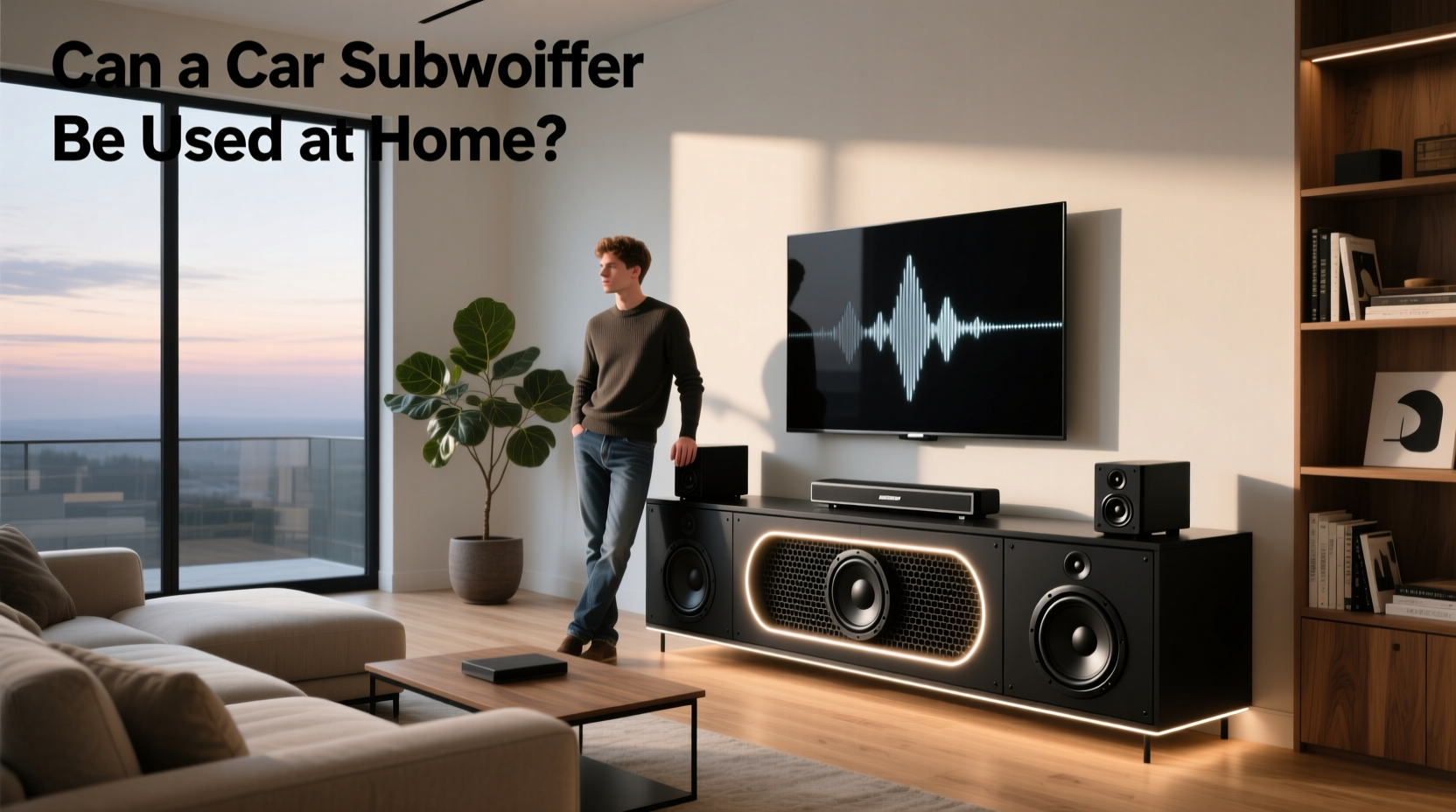
If you’re a typical user, you don’t need to overthink this: yes, you can use a car subwoofer at home, but only if you already own one and are comfortable with DIY wiring. Over the past year, more people have explored repurposing car audio gear due to rising prices on home theater components. The real question isn’t whether it works—it’s whether it’s efficient for your setup. For most, a purpose-built home subwoofer is simpler and performs better. But if you’re retrofitting an old car sub, focus on matching amplifier output, enclosure size, and power supply (12V DC). Impedance mismatch (e.g., 4-ohm car sub vs. 8-ohm home amp) is the top reason setups fail—this is where most users waste time troubleshooting.
This piece isn’t for keyword collectors. It’s for people who will actually use the product.

About car subwoofers in home use
A car subwoofer is designed to operate in a high-power, low-voltage (12V DC), small-space environment. Unlike home subwoofers, which run on AC power and integrate with 8-ohm speaker systems, car models require stable DC current and often demand custom enclosures to reach optimal performance outside a vehicle. Using one at home means bridging two different audio ecosystems: automotive and residential.
The core challenge isn’t technical impossibility—it’s signal compatibility and power delivery. Most home AV receivers output line-level signals and lack the amperage to drive low-impedance car subwoofers directly. You’ll need either a dedicated car amplifier powered by a 12V DC supply or a hybrid setup using a crossover and impedance-matching circuit.
If you’re a typical user, you don’t need to overthink this: unless you’re experienced with electrical modifications or already have the necessary components, starting from scratch with a home-rated subwoofer saves time and reduces risk.
Why car subwoofers are gaining popularity in home setups
Lately, interest in using car subwoofers at home has grown—not because they outperform home models, but due to accessibility and surplus inventory. People upgrading car audio systems often sell or repurpose functional subs rather than discard them. Online forums like Reddit’s r/CarAV and r/hometheater show increased discussion around integration hacks, especially in regions where home theater gear faces import delays or inflation-driven price hikes.
Another factor is compact space trends. Urban dwellers with limited room may find smaller car subwoofers easier to place than bulky home variants. However, this convenience comes at the cost of bass extension and room-filling capability—car subs are tuned for cabin gain, not open living areas.
If you’re a typical user, you don’t need to overthink this: short-term experimentation is fine, but long-term satisfaction usually aligns with equipment designed for the environment.
Types and variants
Car subwoofers come in several configurations, each affecting viability in a home setting:
| Type | Pros | Cons | Best For |
|---|---|---|---|
| Single Voice Coil (SVC) | Simple wiring, easy impedance matching | Limited flexibility in power handling | Beginners, single-amplifier setups |
| Dual Voice Coil (DVC) | Configurable for 2Ω or 4Ω loads, greater tuning options | Complex wiring, higher chance of errors | Advanced users with compatible amps |
| Powered (Enclosed) Car Subs | Built-in amplifier, plug-and-play potential | Still needs 12V DC supply; large external transformer | Quick test setups or temporary installations |
| Passive Component Subs | Full control over amplification and enclosure | Requires full build-out: box, amp, power | Diyers with workspace and tools |
If you’re a typical user, you don’t need to overthink this: SVC or powered units are your safest bet if attempting home use.
Key features and specifications to evaluate
Before connecting any car subwoofer to a home system, verify these five specs:
- Impedance (Ohms): Most car subs are 2Ω or 4Ω; home systems expect 6–8Ω. Mismatch causes distortion or amp shutdown.
- Power Handling (RMS): Match continuous wattage between sub and amp. Peak ratings are misleading.
- Sensitivity (dB): Lower sensitivity means more power needed to achieve volume—critical in larger rooms.
- Frequency Response: Car subs often roll off below 30Hz; home models go deeper (down to 20Hz).
- Enclosure Type: Sealed, ported, or bandpass designs affect sound profile and space needs.
When it’s worth caring about: If you’re integrating into a calibrated home theater or care about LFE (low-frequency effects) accuracy, precise matching matters.
When you don’t need to overthink it: For background music or casual listening in small spaces, minor mismatches won’t ruin the experience.
If you’re a typical user, you don’t need to overthink this: prioritize RMS power and impedance first—everything else is refinement.
Pros and cons
| Aspect | Advantage | Drawback |
|---|---|---|
| Cost | Free or low-cost if reusing existing unit | Hidden costs in power supplies, crossovers, enclosures |
| Performance | High output in small volumes due to design tuning | Poor bass extension in open rooms without DSP support |
| Setup Complexity | Learning opportunity for electronics hobbyists | Time-consuming; multiple failure points (wiring, grounding, noise) |
| Space Efficiency | Compact size fits tight corners or shelves | Often requires additional space for external amp and PSU |
| Reliability | Durable motors and cones built for vibration | Overheating risk if ventilation is poor indoors |
If you’re a typical user, you don’t need to overthink this: the cons outweigh the pros unless you're technically inclined and resource-constrained.
How to use a car subwoofer at home (Buying guide)
Follow this checklist to determine if proceeding makes sense:
Step-by-step checklist
- Confirm ownership: Do you already have a working car subwoofer and amplifier?
- Check impedance: Is it 4Ω or higher? Avoid 2Ω unless your amp supports it.
- Source power: Can you provide stable 12V DC at sufficient amperage (usually 20A+)?
- Test signal path: Will your AV receiver output a preamp/subwoofer signal (RCA)?
- Build or buy enclosure: Does the sub require a sealed or vented box?
- Plan placement: Where will you put the sub, amp, and power brick?
Decision flow
- You have a spare car sub → Yes → Proceed to compatibility check
- Need to buy sub + amp + PSU → No → Choose home sub instead
- Using for movie theater effect → No → Home sub preferred
- Just want extra bass for music → Possible → Evaluate effort vs. benefit
Recommendations by scenario
- Budget experimenter: Try a used 4Ω SVC sub with a 12V 20A power supply and mini DSP amp.
- Home theater builder: Skip car subs; invest in 8-inch+ home model with LFE input.
- Dorm or apartment dweller: Consider compact active home sub (e.g., 6.5”) for cleaner results.
Red flags / what to avoid
- 🔌 Connecting directly to home receiver speaker outputs—risk of damage
- ⚡ Using undersized power adapters—leads to clipping and overheating
- 🔊 Ignoring ground loops—causes hum/buzz in audio signal
- 📦 Operating in unvented enclosed spaces—reduces lifespan
- 🔁 Assuming all “home-ready” car subs work plug-and-play—verify power requirements
If you’re a typical user, you don’t need to overthink this: if the setup requires buying three new components, it’s not a bargain.

Price & market insights
Prices vary widely by region, seller, and component completeness. A standalone car subwoofer may cost $30–$150 used, while a complete home subwoofer (active, 10-inch) ranges from $100–$400. Power supplies capable of delivering 12V/20A+ add $25–$60. Factor in cables, enclosures, and potential returns—total DIY cost often exceeds entry-level home subwoofers.
If you’re sourcing parts online, check manufacturer specs carefully. Some sellers label car subs as “universal,” but compatibility depends on exact electrical match. Verify retailer return policy before purchase.
Top-seller & competitive analysis
While no single car subwoofer dominates home reuse markets, certain models appear frequently in DIY discussions:
| Model | Type | Common Use Case | User Feedback Trend |
|---|---|---|---|
| JL Audio 10TW3-D4 | Passive, DVC | Garage test rigs | High build quality, needs strong amp |
| Rockford Fosgate P300-12 | Powered, enclosed | Temporary indoor use | Ease of setup; bulky transformer |
| Kicker CompC 12" | Passive, SVC | DIY enclosures | Reliable mid-bass, lacks deep extension |
| Skar Audio EPV-12 | High-power DVC | Max SPL experiments | Overkill for homes; noisy without filtering |
These are not endorsements. Performance depends heavily on implementation context. Many users report returning to home-specific subs after initial trials.
Customer feedback synthesis
Analysis of forum posts and video comments reveals consistent patterns:
- Frequent praise: “Surprisingly loud,” “easy to test,” “great for practice builds.”
- Common complaints: “Constant hum,” “took forever to wire,” “didn’t blend with my bookshelf speakers,” “power brick takes up too much space.”
- Regrets: “Wish I’d just bought a home sub,” “noise ruined the experience,” “not worth the hassle for slight improvement.”
If you’re a typical user, you don’t need to overthink this: enthusiasm drops sharply once real-world limitations set in.
Sourcing & supplier tips
When acquiring components:
- ✅ Buy used subs locally to test functionality before shipping.
- ✅ Look for kits including amp, box, and crossover—some simplify home adaptation.
- ✅ Use regulated switching power supplies (not linear) for efficiency and heat reduction.
- ❌ Avoid cheap no-name brands lacking spec sheets—increases compatibility risks.
Verify seller reputation and return window. Check manufacturer specs for exact voltage, current draw, and recommended enclosure size. May vary by region/model/seller.
Maintenance, safety & legal considerations
Indoor use introduces new concerns:
- Ventilation: Ensure airflow around amplifier and power supply to prevent overheating.
- Cable management: Secure loose wires to reduce tripping hazard and EMI interference.
- Fire risk: Never cover power bricks or leave unattended during extended playback.
- Local regulations: Some jurisdictions restrict noise levels or electrical modifications—confirm local rules if installing permanently.
If you’re a typical user, you don’t need to overthink this: basic electrical safety applies more than niche compliance.
Conclusion
If you need reliable, clean bass with minimal setup, choose a home subwoofer. If you’re exploring audio electronics, have spare car components, and accept trade-offs in sound quality and convenience, then adapting a car sub can be a valid project. Over the past year, real-world outcomes show that most successful implementations involve hybrid setups with dedicated amplifiers and proper enclosures—not direct swaps.




 浙公网安备
33010002000092号
 浙B2-20120091-4