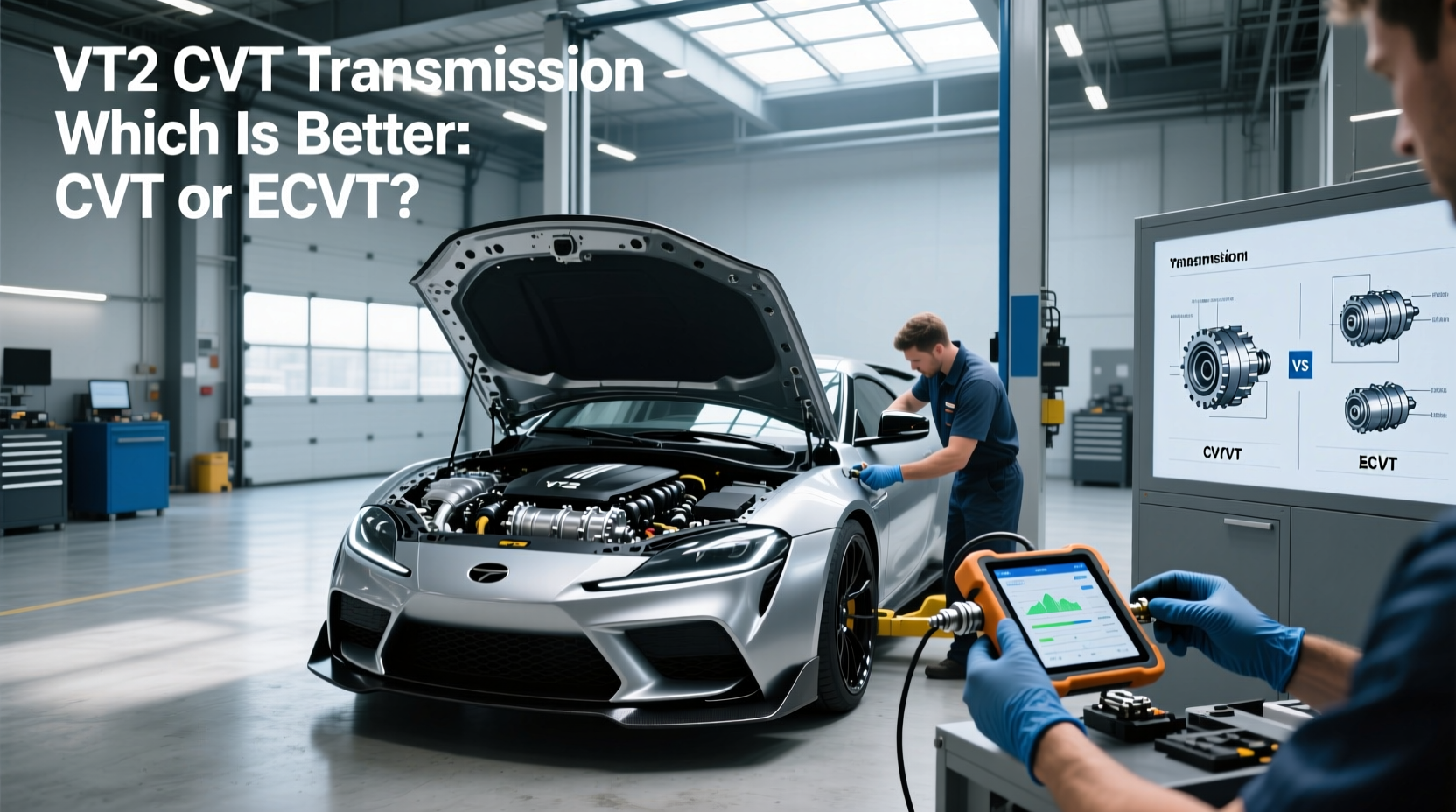
If you're asking how to choose vt2 cvt transmission,Which is better CVT or ECVT?, the answer depends on your vehicle type and driving priorities. For hybrid vehicles like the Toyota Prius or Honda Accord Hybrid, the e-CVT is not just better—it's essential. It uses a planetary gearset and electric motors instead of belts, offering superior reliability and seamless power delivery 1. Traditional CVTs, found in non-hybrid models, use belt-and-pulley systems that provide smooth acceleration but may require more maintenance over time 2. When evaluating what to look for in vt2 cvt transmission,Which is better CVT or ECVT?, consider fuel efficiency goals, maintenance expectations, and whether you're buying a hybrid. Avoid assuming they are interchangeable—they serve different powertrains entirely.
Understanding CVT and e-CVT: A Practical Buyer’s Guide
About vt2 cvt transmission,Which is better CVT or ECVT?
The terms CVT (Continuously Variable Transmission) and e-CVT (Electronic Continuously Variable Transmission) are often confused, but they represent fundamentally different technologies designed for distinct vehicle types. A traditional CVT uses a steel belt or chain running between two variable-diameter pulleys to deliver seamless, stepless gear ratios. This allows the engine to operate at optimal RPM across various speeds, improving fuel economy and reducing shift shock 1.
In contrast, an e-CVT is not a belt-driven system at all. Found exclusively in hybrid vehicles such as the Toyota Prius and Ford Escape Hybrid, it relies on a planetary gearset combined with two electric motors to manage power flow from both the internal combustion engine and the electric motor 3. Often called a Power Split Device (PSD), this setup enables electric-only driving at low speeds, regenerative braking integration, and highly efficient energy management without physical gears.
Why vt2 cvt transmission,Which is better CVT or ECVT? is gaining popularity
As automakers push for improved fuel efficiency and lower emissions, both CVT and e-CVT systems have gained traction. The traditional CVT has become common in compact and midsize sedans due to its ability to keep engines in their most efficient range. Models from Nissan, Subaru, and Honda increasingly feature CVTs to meet consumer demand for economical daily drivers 2.
Meanwhile, the rise of hybrid vehicles has propelled the e-CVT into mainstream relevance. With brands like Toyota selling millions of hybrids globally, the e-CVT has proven itself as a durable, low-maintenance solution tailored for electrified powertrains 3. Its lack of wearable components such as belts or clutches contributes to long-term reliability, making it ideal for urban commuting and stop-and-go traffic.
Types and variants
Traditional CVT (Belt/Chain-Driven)
Used in non-hybrid vehicles, these transmissions adjust gear ratios continuously using pulleys and a metal belt or chain. Some advanced versions include launch gears to reduce strain during initial acceleration.
- ✅ Pros: Smooth ride, good fuel economy, widely available
- ❗ Cons: Belt wear under heavy load, potential for overheating, higher maintenance needs
e-CVT (Hybrid Power Split Device)
This is not a conventional transmission but a sophisticated electromechanical system blending engine and motor outputs through a planetary gearset.
- ✅ Pros: Extremely reliable, no belt to fail, excellent integration with hybrid systems
- ❗ Cons: Limited to hybrid vehicles, complex electronics, costly if high-voltage components fail
Key features and specifications to evaluate
When deciding what to look for in vt2 cvt transmission,Which is better CVT or ECVT?, focus on these measurable criteria:
- ⚡ Powertrain Compatibility: Ensure the transmission matches your vehicle’s propulsion system—hybrid vs. gasoline-only.
- 🔧 Maintenance Intervals: Check manufacturer-recommended fluid change schedules (typically every 60,000–100,000 miles).
- 📊 Durability Record: Research model-specific reliability data; some CVTs have known issues under towing or aggressive driving.
- 🌐 Software Integration: e-CVTs rely heavily on control software—ensure firmware updates are supported by dealers.
- 🚚 Towing Capacity: Most CVTs are not designed for heavy towing; verify limits before purchase.
Pros and cons
✅ Advantages of CVT
- Improved fuel efficiency in city driving
- Smooth, jerk-free acceleration
- Available in a wide range of affordable vehicles
- No discrete gear shifts enhance comfort
❗ Limitations of CVT
- Belt degradation over time, especially with poor maintenance
- Unnatural engine drone during acceleration
- Limited suitability for performance or towing applications
- Fewer repair specialists outside dealership networks
✅ Advantages of e-CVT
- No belts, clutches, or torque converters to wear out
- Nearly silent operation in electric mode
- Highly optimized for hybrid efficiency and emission reduction
- Proven longevity in high-volume models like the Prius
❗ Limitations of e-CVT
- Only available in hybrid or plug-in hybrid vehicles
- Repairs involve specialized diagnostic tools and training
- High-voltage battery replacement can be expensive
- Driving feel lacks engagement for enthusiasts
How to choose vt2 cvt transmission,Which is better CVT or ECVT?
Follow this step-by-step checklist when considering how to choose vt2 cvt transmission,Which is better CVT or ECVT?:
- 📌 Determine your vehicle type: Are you buying a hybrid? If yes, e-CVT is standard and recommended. For gas-only cars, only traditional CVT applies.
- 📍 Assess your driving patterns: City commuters benefit from e-CVT’s smoothness and EV-mode capability. Highway drivers may prefer CVT’s consistent efficiency.
- 🔧 Review maintenance history: Ask about past transmission fluid changes. Neglect is a red flag for CVTs.
- 🛒 Compare ownership costs: While e-CVT requires less mechanical service, battery health impacts long-term value.
- ❗ Avoid these pitfalls:
- Using a CVT-equipped vehicle for frequent towing
- Assuming all ‘CVT’ labels mean the same technology
- Skipping scheduled transmission servicing
- Purchasing used hybrids without battery diagnostics
Price & market insights
New vehicles with CVT transmissions typically cost $200–$800 less than comparable hybrids with e-CVT, depending on brand and region. However, total cost of ownership often favors e-CVT due to better fuel economy and lower mechanical failure rates 3.
Replacement costs vary significantly:
- 🛠️ CVT replacement: $3,500–$6,000 (aftermarket options may be cheaper)
- 🔋 e-CVT + hybrid battery: $4,000–$8,000+, though individual component repairs are sometimes possible
Top-seller & competitive analysis
Popular models featuring each transmission type include:
| Model | Transmission Type | Fuel Economy (MPG) | Reliability Notes |
|---|---|---|---|
| Toyota Corolla | CVT | 32 city / 41 hwy | Solid record with proper maintenance |
| Honda Civic | CVT | 31 city / 40 hwy | Improved clutch materials in newer models |
| Toyota Prius | e-CVT | 57 city / 56 hwy | Over 20 years of proven durability |
| Ford Escape Hybrid | e-CVT | 44 city / 37 hwy | Good integration with turbo engine |
When reviewing top-sellers, note that Toyota’s e-CVT design has one of the strongest track records for longevity, while some early Nissan CVTs faced premature failures—later models show improvement.
Customer feedback synthesis
Analysis of owner reviews reveals recurring themes:
- ✨ Positive (e-CVT): “Seamless driving,” “great gas mileage,” “no transmission issues after 150k miles.”
- ❗ Criticisms (e-CVT): “Feels disconnected,” “expensive hybrid battery replacement,” “not fun to drive.”
- ✨ Positive (CVT): “Smooth in traffic,” “affordable to buy,” “good highway efficiency.”
- ❗ Criticisms (CVT): “Whining engine noise,” “hesitant under hard acceleration,” “had to replace at 90k miles.”
Long-term satisfaction tends to be higher with e-CVT in hybrids, while CVT owners report mixed experiences depending on brand and usage.
Sourcing & supplier tips
For replacements or upgrades:
- 🔍 Buy OEM or reputable aftermarket units (e.g., Jatco, Aisin)
- 📋 Verify part number compatibility with your VIN
- 🧰 Consider purchasing from suppliers offering core exchange programs
- 🤝 Work with ASE-certified technicians experienced in CVT or hybrid systems
- 🧼 Inspect fluid condition and check for error codes before installation
Maintenance, safety & legal considerations
Both systems require attention:
- ⏱️ Change CVT fluid per manufacturer schedule (often overlooked)
- 🔋 Monitor hybrid battery state-of-charge and cooling system health
- ⚠️ Avoid sudden throttle inputs after cold starts to protect CVT belts
- 🌐 Confirm local emissions regulations—some regions incentivize hybrids with e-CVT
- 📝 Always follow OEM service procedures; improper resets can impair performance
Conclusion
The question which is better CVT or ECVT? doesn’t have a universal answer—it hinges on your vehicle choice and lifestyle. If you’re buying a hybrid, the e-CVT is the superior and necessary option, delivering unmatched efficiency and reliability within its intended application 2. For non-hybrid drivers seeking affordability and smooth operation, a well-maintained traditional CVT remains a practical choice. Ultimately, understanding the fundamental differences—not just performance metrics—is key to making an informed decision when exploring vt2 cvt transmission,Which is better CVT or ECVT? buying guide options.
Frequently Asked Questions
- Can I tow with a vehicle that has a CVT or e-CVT?
- Most CVT-equipped vehicles have very limited towing capacity (under 2,000 lbs), and frequent towing can shorten transmission life. e-CVT hybrids are generally not designed for towing. Always consult your owner’s manual for specific limits.
- Is the e-CVT more reliable than a traditional CVT?
- Yes, in general. The e-CVT has fewer moving parts and no belt to wear out, contributing to higher long-term reliability, especially in models like the Toyota Prius. However, its electronic complexity means failures, though rare, can be costly.
- Do CVTs require special maintenance?
- Yes. CVTs need regular fluid changes using manufacturer-specified fluid. Skipping service is a leading cause of premature failure. Refer to your vehicle’s maintenance schedule for exact intervals.
- Why does my CVT engine rev so high during acceleration?
- This is normal behavior. The CVT keeps the engine at optimal RPM for efficiency, which can create a droning sound. It’s not a malfunction, though some drivers find it unsettling compared to traditional automatics.
- Are e-CVTs repairable, or must they be replaced?
- While complete replacement is common, some specialized shops can rebuild e-CVT units. However, diagnosis requires hybrid-capable tools, and repairs should only be done by qualified technicians due to high-voltage system risks.




 浙公网安备
33010002000092号
 浙B2-20120091-4