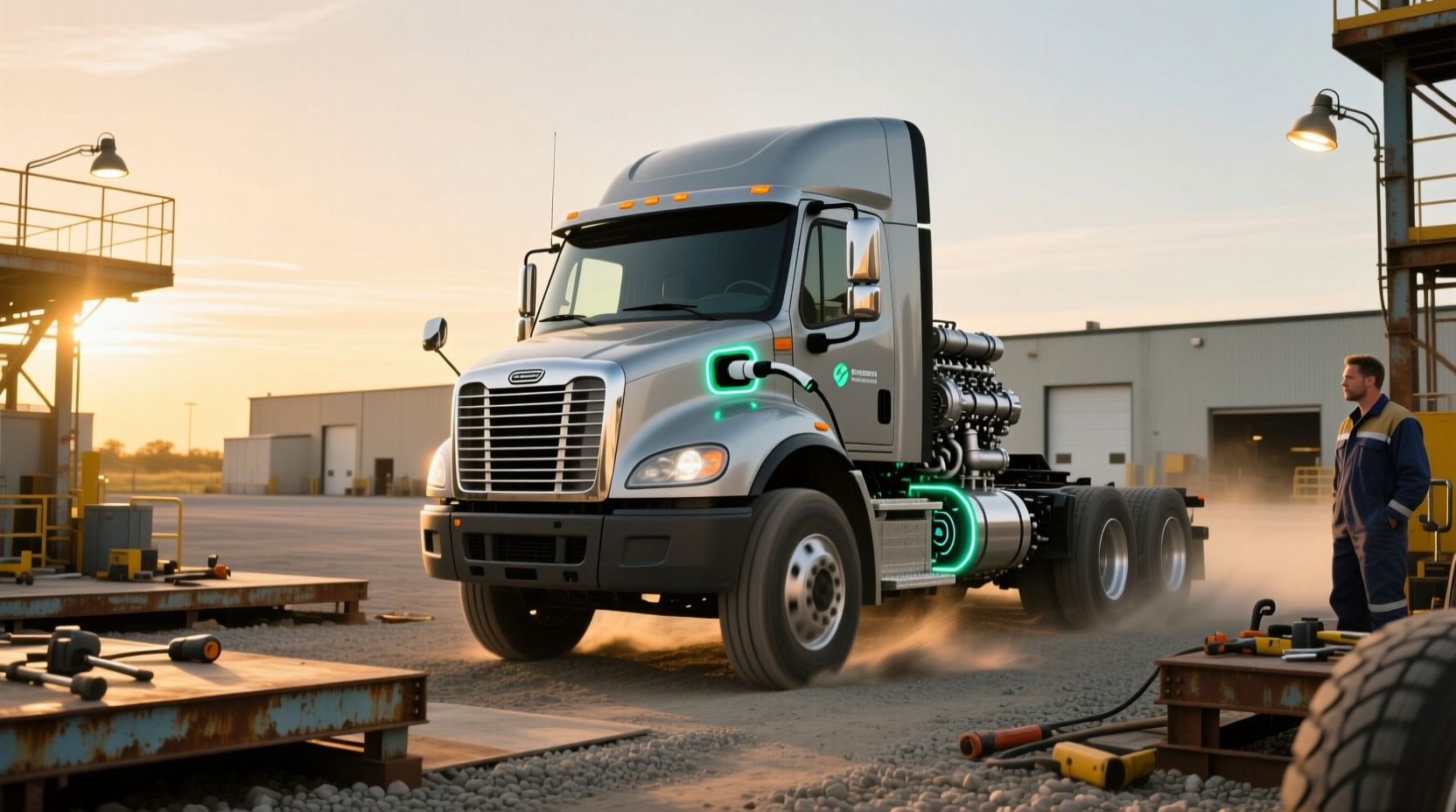
If you’re a typical user, you don’t need to overthink this. Over the past year, demand for efficient heavy-duty powertrains has risen—especially in off-grid work and long-haul logistics. How to choose a diesel plug-in hybrid truck? Focus on your duty cycle: if it includes frequent idling, stop-and-go terrain, or high torque demands, a diesel-electric hybrid may offer measurable fuel savings and drivetrain responsiveness. Look for models with scalable battery capacity and proven generator integration. Avoid overestimating consumer availability—most options are commercial prototypes or retrofits, not showroom-ready pickups. If you need extended range without full electrification, this is a viable path.
About Diesel Plug-in Hybrid Trucks
A diesel plug-in hybrid (PHEV) combines a diesel engine with an electric motor and a rechargeable battery pack that can be charged externally. Unlike conventional hybrids that rely solely on regenerative braking, plug-in systems allow users to pre-charge the battery, enabling all-electric operation for short distances—typically 20 to 50 miles depending on configuration.
These vehicles operate in series or parallel setups. In a series design, the diesel engine powers a generator that charges the battery or directly supplies electricity to drive motors. The wheels are driven exclusively by electric motors. In parallel systems, both the diesel engine and electric motor can drive the wheels independently or together, offering flexibility but increased mechanical complexity.
Why Diesel Plug-in Hybrids Are Gaining Popularity
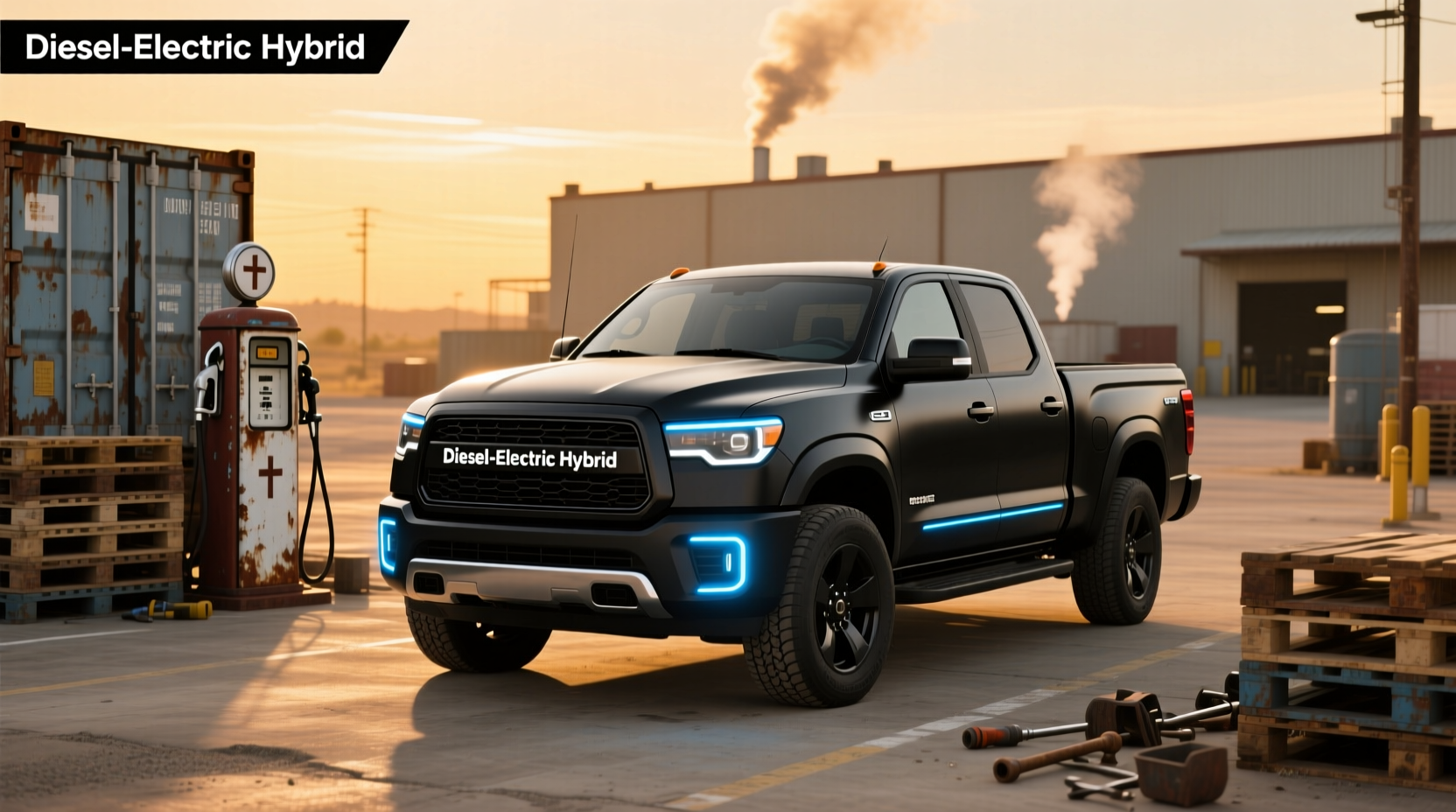
Lately, interest in diesel-electric hybrid trucks has grown due to rising fuel costs, stricter emissions standards in certain regions, and the need for resilient off-grid performance. While full battery-electric trucks face range and charging infrastructure limitations, diesel hybrids offer a transitional solution—retaining the energy density of liquid fuel while reducing consumption through electric assist.
The appeal lies in operational flexibility. For example, construction fleets operating in remote areas benefit from reduced idling fuel burn when using electric-only mode for hydraulic functions. Similarly, delivery operators in urban zones can meet local zero-emission requirements during last-mile segments.
This piece isn’t for keyword collectors. It’s for people who will actually use the product.
Types and Variants
1. Series Diesel-Electric Hybrids
In this architecture, the diesel engine acts only as a generator. It does not mechanically connect to the wheels. Power flows from the engine → generator → battery/inverter → electric motor(s) → wheels.
- Pros: Simpler drivetrain layout; consistent torque delivery; easier integration into existing chassis
- Cons: Lower peak efficiency under steady highway loads; added weight from redundant components
When it’s worth caring about: Frequent low-speed operations (mining, logging, municipal services) where constant engine load improves efficiency.
When you don’t need to overthink it: If your route involves long stretches at consistent speed, a conventional diesel may suffice.
2. Parallel Diesel-Electric Hybrids
Both the diesel engine and electric motor(s) can drive the wheels. They may operate together or separately based on driving conditions.
- Pros: Higher overall efficiency on mixed routes; better highway performance; more compact packaging
- Cons: Complex control systems; higher maintenance potential due to mechanical coupling
When it’s worth caring about: Mixed-use applications like regional hauling with city entries.
When you don’t need to overthink it: For dedicated highway runs, simplicity often wins.
3. Retrofit Conversion Kits
Third-party companies like ReVolt Motors have developed kits to convert existing diesel trucks into diesel-electric hybrids 1. These replace or supplement the original drivetrain with electric axles and battery packs.
- Pros: Extends life of older trucks; reduces upfront cost compared to new builds
- Cons: Integration risks; limited warranty coverage; may void original manufacturer support
When it’s worth caring about: You operate aging fleet vehicles and want incremental upgrades.
When you don’t need to overthink it: If your trucks are already near end-of-life, replacement may be safer.
Key Features and Specifications to Evaluate
Not all diesel hybrids perform equally. Prioritize these specifications based on use case:
- Battery Capacity (kWh): Determines all-electric range. Larger batteries enable longer zero-emission operation but increase weight and cost.
- Generator Output (kW): Must match average power draw. Undersized generators lead to constant loading and reduced lifespan.
- Plug-in Charging Time: Typically 4–8 hours on Level 2 (240V). DC fast charging is rare in current models.
- Torque Delivery Curve: Electric motors provide instant torque. Confirm peak output aligns with load requirements.
- Thermal Management: Critical for sustained operation. Look for active cooling systems for both battery and power electronics.
If you’re a typical user, you don’t need to overthink this. Most real-world gains come from matching system specs to actual workload—not chasing maximum numbers.
Pros and Cons
| Advantages | Drawbacks |
|---|---|
| Reduced fuel consumption in stop-and-go cycles | Limited availability in consumer markets |
| Lower emissions during electric operation | Higher initial investment than standard diesels |
| Extended engine life due to load leveling | Complex diagnostics and repair needs |
| Quiet operation in electric mode | Added weight affects payload capacity |
| Compatible with existing diesel infrastructure | Few certified service centers |
How to Choose a Diesel Plug-in Hybrid Truck
Step-by-Step Checklist
- Evaluate your daily route: percentage of stop-and-go vs. highway driving
- Determine required all-electric range (e.g., urban delivery zones)
- Assess available charging infrastructure (on-site vs. public)
- Calculate total cost of ownership (TCO), including fuel, maintenance, and downtime
- Verify compatibility with current fleet maintenance practices
- Request real-world performance data from pilot programs or early adopters
Decision Flow
- If most trips are >300 miles with minimal stops → consider traditional diesel
- If >40% of time spent idling or moving slowly → diesel-electric hybrid becomes viable
- If operating in regulated emission zones → prioritize plug-in capability and EV range
- If budget-constrained but own aging trucks → explore retrofit options cautiously
Recommendations by Scenario
- Construction Fleets: Edison Motors’ prototype Class 8 truck uses a series setup with dual electric rear axles, ideal for heavy-load starts and on-site electrified PTO 2.
- Municipal Services: Vehicles like garbage trucks benefit from regenerative braking and silent night collection.
- Regional Hauling: Parallel hybrids offer best balance between highway efficiency and urban maneuverability.
Red Flags / What to Avoid
- Unverified range claims: Always ask for third-party test reports or field logs.
- Lack of thermal management details: Overheating kills battery longevity.
- No clear service network: Repairs shouldn't require shipping modules overseas.
- Proprietary charging connectors: Stick to standardized J1772 or CCS where possible.
- Vague software update policy: Firmware impacts performance and safety—ensure OTA or dealer-based updates are defined.
Price & Market Insights
Pricing varies significantly by region, model, and configuration. New diesel-electric hybrid trucks typically carry a 25–50% premium over equivalent conventional models. Retrofit kits start around $30,000 but may reach $80,000 for full Class 8 conversions.
Commercial availability remains limited. Most offerings are either prototypes (like Edison Motors’ ongoing development) or niche deployments. Consumer pickups remain speculative—while concepts like the MG9 have been discussed online 3, no major automaker has launched a mass-market diesel PHEV pickup as of mid-2025.
If you’re a typical user, you don’t need to overthink this. The market is still forming. Focus on proven applications rather than future promises.
Top-seller & Competitive Analysis
No single dominant player exists in the diesel plug-in hybrid truck space. Instead, innovation is fragmented across startups, military contractors, and retrofit specialists.
| Company | Model/Project | Type | Status | Key Feature |
|---|---|---|---|---|
| Edison Motors | Prototype 18-Wheeler | Series Hybrid | Testing Phase | Diesel generator + dual electric drive axles |
| ReVolt Motors | Retrofit Kit (Peterbilt) | Conversion | Debuted 2023 | Aftermarket hybridization of legacy trucks |
| U.S. Army | Shadow RST-V | Series Hybrid | Tested (2006) | Silent watch capability for reconnaissance |
| MG9 | Concept Pickup | Plug-in Hybrid | Announced (2026?) | Blends diesel range with EV torque |
Data may vary by region/model/seller. Always check manufacturer specs before procurement.
Customer Feedback Synthesis
Based on early adopter discussions and pilot program summaries:
- Most praised: Noticeable reduction in fuel use during urban cycles; smooth acceleration; ability to run auxiliary equipment without running main engine.
- Most criticized: Long payback period; lack of trained technicians; unexpected battery degradation in extreme climates.
- Surprising insight: Some users report improved driver retention due to quieter cabins and less vibration.
Sourcing & Supplier Tips
Procurement requires diligence:
- Engage directly with developers for technical documentation.
- Request references from existing customers in similar industries.
- Evaluate scalability: can the same platform support future upgrades?
- Confirm whether software and hardware are modular or locked.
- Verify return policy and trial periods—some vendors offer 30-day field tests.
Maintenance, Safety & Legal Considerations
Diesel-electric hybrids introduce new maintenance routines. High-voltage systems require insulated tools and certified personnel. Regular checks should include battery state-of-health, coolant levels in power electronics, and firmware integrity.
Safety protocols must address both high-voltage isolation and diesel fire risk. Emergency responders need access to shutdown procedures.
Legality depends on local regulations. While no universal ban exists on diesel hybrids, emissions compliance (e.g., EPA certifications in the U.S.) must be confirmed per jurisdiction. To verify: check official environmental agency databases or consult a compliance specialist.
Conclusion
If you need reduced fuel use in stop-and-go environments and operate outside reliable fast-charging corridors, a diesel plug-in hybrid truck is worth evaluating. If your operations are mostly highway-focused or you lack access to overnight charging, a conventional diesel remains practical. If you’re a typical user, you don’t need to overthink this—match the technology to your actual workflow, not theoretical benefits.




 浙公网安备
33010002000092号
 浙B2-20120091-4