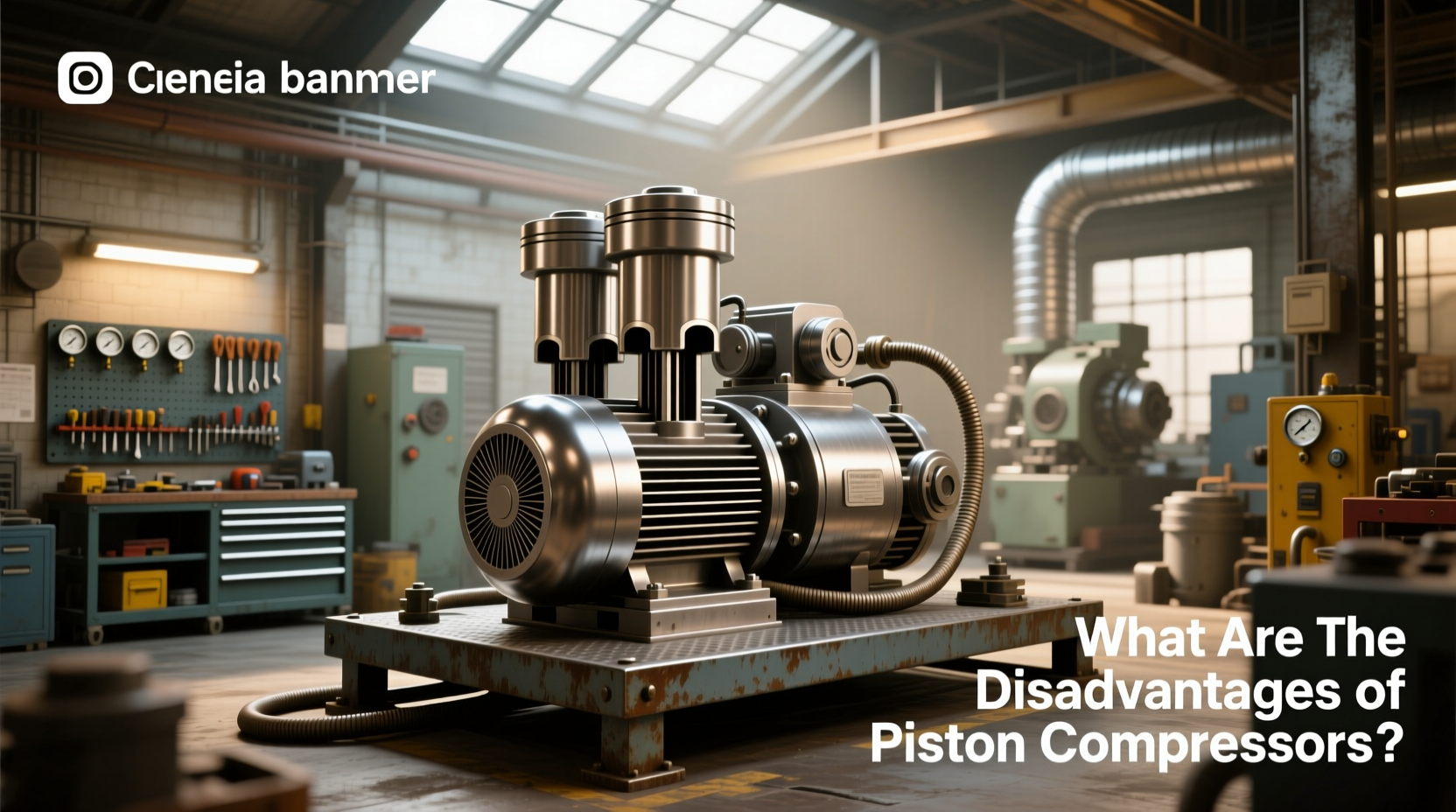
About Double Piston Air Compressors and Their Typical Use Cases
A double piston air compressor uses two pistons within a single cylinder or dual cylinders to compress air more efficiently than single-stage models. This design allows for higher pressure output and improved cooling, making it ideal for medium-duty applications that require sustained performance without full industrial load demands 2.
These compressors are commonly used in auto repair shops, woodworking studios, and fabrication environments where tools such as impact wrenches, spray guns, and nailers operate intermittently. They deliver consistent airflow for short bursts but are not designed for 100% duty cycles. Because of their mechanical complexity, understanding what are the disadvantages of piston compressors is crucial before purchase.
Why Double Piston Air Compressors Are Still Popular Despite Drawbacks
Despite known limitations, double piston air compressors remain popular due to their lower upfront cost and compact footprint compared to rotary screw systems. Small businesses and home users often prioritize initial affordability over long-term operational savings. Additionally, advancements in vibration damping and sound insulation have made newer models quieter and more user-friendly.
User motivation centers around reliability for occasional use, ease of integration into existing setups, and widespread availability of replacement parts. For those asking how to choose a double piston air compressor, these practical benefits must be weighed against maintenance frequency and energy inefficiencies.
Types and Variants of Piston Air Compressors
Piston compressors come in several configurations, each suited to different operational needs:
- ⚙️Single-Stage Piston Compressors: Compress air in one stroke up to 120–135 PSI. Best for light-duty tasks like inflating tires or powering small pneumatic tools. Lower efficiency and shorter lifespan under heavy loads.
- ⚙️Two-Stage (Double Piston) Compressors: Use two compression stages for higher pressures (up to 175 PSI). More efficient and cooler running than single-stage units. Ideal for moderate commercial use but still subject to wear and noise issues.
- ⚙️Oil-Lubricated Models: Offer better durability and heat dissipation. However, risk oil carryover into the air stream—critical in food, medical, or painting applications unless filtered properly 3.
- ⚙️Oil-Free Models: Reduce contamination risk and simplify maintenance. Typically have shorter lifespans and are limited to lighter tasks.
Key Features and Specifications to Evaluate
When exploring what to look for in a double piston air compressor, consider these technical and functional parameters:
- ⚡Horsepower (HP): Indicates motor strength, though actual performance depends on CFM and pressure. Don’t assume higher HP means better output.
- 📊Cubic Feet per Minute (CFM): Measures airflow volume at specific PSI. Match this to your tool requirements—always add a 25–30% buffer for safety.
- 📍Duty Cycle: Expressed as a percentage (e.g., 50%). A 50% duty cycle means the compressor should run no more than 5 minutes every 10. Double piston models typically range from 30–60%, far below rotary screw compressors’ 100% capability.
- 🔊Noise Level (dB): Ranges from 70 dB (moderate) to over 90 dB (very loud). If used indoors or near people, aim for sub-80 dB models.
- 🔧Maintenance Needs: Check accessibility of filters, oil ports, and valves. Frequent servicing increases downtime and labor costs.
- 🏭Tank Size (Gallons/Liters): Larger tanks reduce cycling frequency. For continuous tool use, pair with a receiver tank even if built-in.
- 🌍Portability: Wheel kits and handles matter for job site mobility. Stationary units may offer better stability and cooling.
Pros and Cons: Is a Double Piston Compressor Right for You?
| Aspect | Advantages | Disadvantages |
|---|---|---|
| Cost | Lower initial investment | Higher lifetime operating cost due to energy and maintenance |
| Noise | N/A | Loud operation (75–90+ dB); may require soundproofing |
| Maintenance | Parts widely available | Frequent oil changes, valve replacements, belt adjustments needed |
| Efficiency | Suitable for short bursts | Inefficient for continuous use; high energy consumption |
| Air Quality | Affordable filtration add-ons | Risk of oil contamination in lubricated models |
| Lifespan | Can last years with care | Shorter than rotary screw compressors under similar loads |
Suitable for: Home garages, mobile repair services, seasonal construction work, hobbyists.
Not recommended for: Manufacturing lines, paint booths requiring oil-free air, facilities needing 24/7 compressed air supply.
How to Choose a Double Piston Air Compressor: Step-by-Step Guide
To make an informed decision on how to choose a double piston air compressor, follow this checklist:
- ✅Assess Your Air Demand: List all tools and their required CFM at operating PSI. Sum peak usage and add margin.
- 📌Determine Duty Requirements: If tools run continuously for >20 minutes, consider rotary alternatives. Double piston units excel in start-stop workflows.
- 🔍Evaluate Noise Constraints: In shared spaces, prioritize models with noise ratings below 80 dB or plan for acoustic enclosures.
- 🧼Decide on Oil vs. Oil-Free: For clean air applications, select oil-free or install coalescing filters. Note reduced longevity in oil-free variants.
- 🛒Compare Total Cost of Ownership: Factor in electricity rates, expected maintenance intervals, and part costs—not just sticker price.
- ❗Watch Out For: Overrated HP claims, lack of service documentation, non-standard fittings, poor ventilation design.
Avoid models without clear duty cycle specifications or those marketed solely on peak horsepower. Always verify manufacturer specs rather than relying on retailer descriptions alone.
Price & Market Insights
Double piston air compressors typically range from $200 to $800 for 2–6 HP models with 20–80 gallon tanks. Prices vary significantly by brand, build quality, and included features (e.g., thermal overload protection, automatic drain).
Budget models (<$400) often sacrifice durability and noise control. Mid-range ($400–$600) offers better balance between performance and longevity. Premium units approach $1,000 and may include enhanced cooling, digital gauges, and extended warranties.
Value isn’t always tied to price—some mid-tier brands offer comparable reliability to high-end names. Consider total ownership cost: a $600 unit with low maintenance needs may outperform a $400 model requiring frequent repairs.
Top-Seller & Competitive Analysis
Popular models include the California Air Tools 8010, DEWALT DW75130, and Quincy QT-54. While direct comparisons are useful, focus on real-world performance metrics.
| Model | HP | CFM @ 90 PSI | Tank Size | Noise (dB) | Duty Cycle |
|---|---|---|---|---|---|
| California Air Tools 8010 | 2 | 4.2 | 80 gal | 70 | 100% |
| DEWALT DW75130 | 6.5 | 13.1 | 30 gal | 89 | 50% |
| Quincy QT-54 | 5.5 | 12.0 | 60 gal | 85 | 60% |
Note: The California Air Tools model achieves near-continuous operation through oil-free design and advanced cooling—rare among piston types. Others reflect typical trade-offs: higher power at increased noise and reduced duty time.
Customer Feedback Synthesis
Analysis of buyer reviews reveals recurring themes:
- ⭐Positive Feedback: Appreciation for durability (with proper maintenance), ease of setup, sufficient power for intended tasks, and availability of replacement parts.
- ❗Common Complaints: Unexpected breakdowns after 1–2 years, difficulty sourcing seals or gaskets, excessive noise, overheating during prolonged use, and inaccurate pressure gauge readings.
- 📝Recurring Suggestions: Run unloaded after shutdown to dry moisture, change oil regularly, inspect belts monthly, and use external regulators for sensitive tools.
Users frequently mention underestimating maintenance effort—many expect ‘plug-and-play’ reliability similar to electric tools, which piston compressors do not provide without upkeep.
Sourcing & Supplier Tips
Double piston compressors are widely available through industrial suppliers (Grainger, McMaster-Carr), online retailers (Amazon, Northern Tool), and equipment dealers. For bulk purchases or B2B sourcing:
- 🌐Work with distributors offering technical support and local service networks.
- 🚚Verify shipping terms—these units are heavy and may incur additional delivery fees.
- 🔎Request product manuals and spec sheets before ordering to confirm compatibility.
- 📋For resellers: Ensure warranty terms are transferable and marketing materials don’t misrepresent performance.
Always inspect units upon arrival for shipping damage, especially to gauges and pump housings.
Maintenance, Safety & Legal Considerations
Regular maintenance extends life and ensures safe operation:
- 🔧Drain tank moisture daily to prevent corrosion.
- 🧰Change oil every 500 hours or annually (whichever comes first) in oil-lubricated models.
- ⚠️Inspect safety valves and pressure switches periodically.
- 🔌Ensure electrical circuits match voltage and amperage requirements.
Safety standards (e.g., OSHA, CE) may apply depending on region and workplace setting. Confirm compliance with local regulations, particularly for fixed installations. Never modify pressure settings beyond manufacturer limits.
Conclusion
If you need a reliable, affordable solution for intermittent compressed air tasks in a garage or small shop, a double piston air compressor can be a practical choice. However, if you’re evaluating what are the disadvantages of piston compressors—such as high maintenance, noise, and inefficiency—you may find rotary screw models more cost-effective for continuous operations. Ultimately, how to choose a double piston air compressor depends on matching its capabilities to your workload, environment, and long-term cost expectations.
FAQs
Can I use a double piston air compressor for painting cars?
Yes, but only if equipped with proper moisture traps and oil filters—or use an oil-free model. Pulsating airflow may affect finish quality; consider adding a large receiver tank.
Are oil-free piston compressors worth it?
They eliminate oil contamination risk and reduce maintenance, but typically last fewer hours before rebuild. Best for clean environments with moderate usage.
How often should I maintain my piston compressor?
Check oil and filters monthly. Perform full inspection (valves, belts, drains) every 500 operating hours or per manufacturer schedule.
Why does my piston compressor overheat?
Causes include poor ventilation, dirty fins, excessive duty cycling, or worn internal components. Ensure adequate airflow and avoid exceeding rated duty cycle.
Is a larger tank always better?
Not necessarily. A larger tank reduces cycling but adds weight and space. Size should match your tool’s air demand and duty pattern.




 浙公网安备
33010002000092号
 浙B2-20120091-4