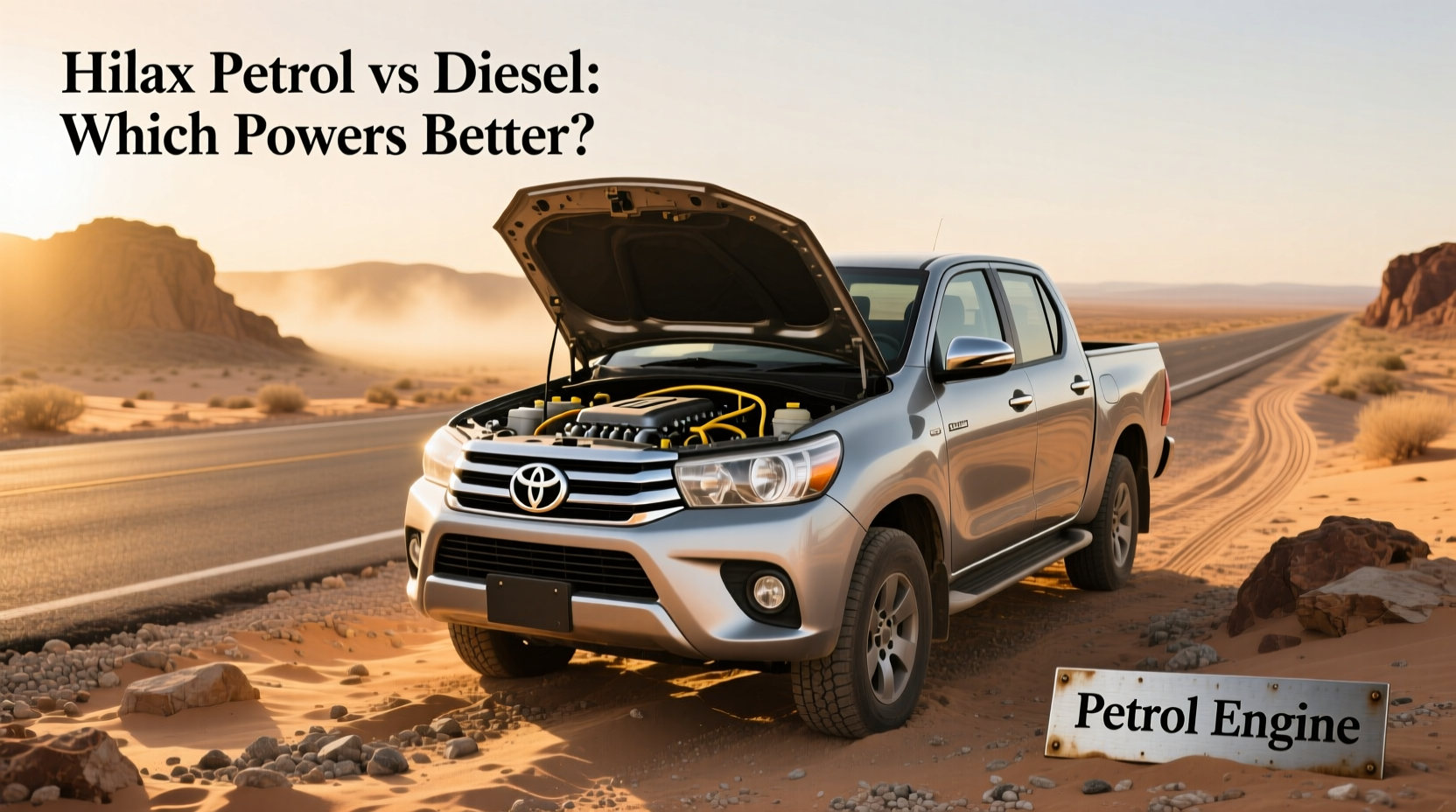
Short Introduction: How to Choose Toyota Hilux Petrol Engine, Which Is Better, Hilux Petrol or Diesel?
When deciding between a petrol or diesel Toyota Hilux, the best choice depends on your driving needs—not on which engine is universally superior. If you frequently tow heavy loads, drive long distances, or tackle off-road terrain, the diesel engine—especially the 2.8L GD-6—is the more capable option, offering higher torque (up to 500 Nm), better fuel economy (around 7.4 L/100km), and greater durability under stress 1. However, if your usage is primarily urban, with light payloads and shorter trips, a petrol Hilux—like the 4.0L V6—delivers smoother acceleration, lower upfront cost, and quieter operation, despite higher fuel consumption (up to 11.8 L/100km) 2. This guide will help you evaluate what to look for in a Toyota Hilux petrol engine and how to choose the right variant based on performance, cost, maintenance, and environmental impact.
About Toyota Hilux Petrol Engine, Which Is Better, Hilux Petrol or Diesel?
The debate over whether the Toyota Hilux petrol engine is better than its diesel counterpart centers on real-world application rather than raw specs alone. The Hilux has long been celebrated for its ruggedness, but engine choice significantly alters its character. Petrol models, including the 2.7L inline-4 and 4.0L V6, emphasize drivability and refinement, making them suitable for private owners who use the vehicle daily but don’t require extreme load capacity. Diesel variants, powered by 2.4L or 2.8L turbocharged units, are engineered for resilience and low-end torque, ideal for construction, farming, or overlanding.
Understanding what to look for in a Toyota Hilux petrol engine, which is better, Hilux petrol or diesel? starts with identifying your primary use case: Are you hauling equipment weekly, or commuting with occasional weekend adventures? Each engine type serves distinct lifestyles, and choosing incorrectly can lead to dissatisfaction over fuel costs, performance, or long-term reliability.
Why Toyota Hilux Petrol Engine, Which Is Better, Hilux Petrol or Diesel? Is Gaining Popularity
Interest in comparing petrol versus diesel Hilux models has grown due to shifting market dynamics and consumer priorities. In regions where diesel fuel is heavily taxed or where urban air quality regulations restrict diesel vehicles, petrol variants are seeing renewed interest 3. Additionally, buyers who value a quieter cabin and linear throttle response—especially in stop-and-go traffic—are turning to petrol engines despite their lower fuel efficiency.
The rise of dual-cab Hilux models as family vehicles has also influenced this trend. Many users no longer need maximum towing capacity but still appreciate the truck’s ground clearance and durability. As a result, the 4.0L V6 petrol engine, known for its strong acceleration and smooth ride, appeals to those treating the Hilux as a lifestyle vehicle rather than a workhorse.
Types and Variants
Toyota offers multiple petrol and diesel engine options across Hilux trims, each suited to different demands.
🔧 Petrol Variants
- 2.7L Inline-4 (122 kW, 245 Nm): A mid-range option offering balanced performance for light-duty use. It’s commonly found in single-cab configurations and is praised for reliability but lacks power for heavy towing.
- 4.0L V6 (175 kW, 376 Nm): The top-tier petrol engine, delivering strong acceleration and high-speed stability. Paired with a 6-speed automatic, it’s ideal for daily drivers who want comfort without sacrificing utility 1.
🚚 Diesel Variants
- 2.4L GD (110 kW, 343 Nm): Entry-level diesel with decent torque. Available with a 5-speed manual, it’s a budget-friendly work vehicle but less refined than newer models.
- 2.4L GD-6 (110 kW, 400 Nm): Upgraded version with a 6-speed transmission and improved fuel economy (~7.3 L/100km). Offers better responsiveness and highway cruising ability.
- 2.8L GD-6 (150 kW, 420–500 Nm): The most powerful diesel option, designed for demanding applications. Delivers excellent off-road control and towing capability up to 3,500 kg 1.
Key Features and Specifications to Evaluate
When evaluating how to choose a Toyota Hilux petrol engine—or deciding whether diesel is better—focus on these measurable factors:
- Power & Torque: Diesel engines produce more torque at low RPMs, crucial for towing and climbing. Petrol engines deliver peak power at higher RPMs, favoring speed and responsiveness.
- Fuel Consumption: Diesel typically achieves 20–30% better fuel economy on highways. For example, the 2.8L diesel averages 7.4 L/100km, while the 4.0L V6 petrol consumes 11.8 L/100km 1.
- Transmission Options: Higher trims offer 6-speed automatics, improving both performance and comfort. Manual transmissions remain common in base models.
- Emissions Technology: Modern diesels include Diesel Particulate Filters (DPF) and SCR systems, requiring specific maintenance. Petrol engines avoid these complexities.
- Towing & Payload Capacity: Diesel models generally support higher ratings—verify manufacturer specs as values vary by region and configuration.
Pros and Cons
❗ Diesel Cons: Higher initial cost, expensive emission system repairs, louder operation, potential DPF issues in short-trip driving.
❗ Petrol Cons: Higher fuel consumption, less low-end pulling power, may wear faster under constant heavy use.
How to Choose Toyota Hilux Petrol Engine, Which Is Better, Hilux Petrol or Diesel?
Follow this step-by-step checklist to make an informed decision:
- Assess Your Driving Patterns: Do you drive mostly in cities (petrol preferred) or cover long distances regularly (diesel better)?
- Evaluate Load Requirements: Will you tow trailers or carry heavy cargo weekly? If yes, diesel’s torque advantage is critical.
- Calculate Long-Term Fuel Costs: Estimate annual mileage and local fuel prices. Diesel saves money over time if you drive over 20,000 km/year.
- Consider Maintenance Access: Diesel DPFs require regeneration runs; if you only take short trips, carbon buildup could cause costly issues.
- Check Resale Market Trends: In many markets, diesel Hilux models retain value better due to demand from commercial users.
🚩 Red Flags to Avoid
- Avoid older diesel engines like the 2.0L, 2.2L, or early 2.4L models (L, 2L, 2LTE) known for reliability issues 4.
- Don’t buy a diesel if you rarely drive above 15 km continuously—this prevents proper DPF cleaning.
- Verify service history: neglected oil changes or poor-quality fuel can shorten any engine’s life.
Price & Market Insights
Petrol Hilux models typically have a lower sticker price—often $2,000–$5,000 less than equivalent diesel trims, depending on region and trim level. However, total cost of ownership may favor diesel over five years due to fuel savings, especially for high-mileage users. In emerging markets, diesel Hilux trucks command stronger resale value because of their reputation for durability and utility. Always compare fully loaded prices and consider financing terms, insurance premiums, and local tax structures (some regions impose higher taxes on high-emission petrol vehicles).
Top-Seller & Competitive Analysis
The 2.8L diesel and 4.0L V6 petrol are the most popular trims globally. Below is a comparison of key models:
| Model | Engine | Power (kW) | Torque (Nm) | Fuel Use (L/100km) | Best For |
|---|---|---|---|---|---|
| Hilux 4.0 V6 | Petrol | 175 | 376 | 11.8 | Urban driving, comfort, daily use |
| Hilux 2.8 GD-6 | Diesel | 150 | 500 (auto) | 7.4 | Towing, off-road, long-distance |
| Hilux 2.4 GD-6 | Diesel | 110 | 400 | 7.3 | Budget work use, mixed conditions |
Customer Feedback Synthesis
Based on aggregated user reviews and owner forums:
- Positive (Diesel): Owners praise the 2.8L diesel’s towing strength, fuel efficiency, and longevity—many report trouble-free operation beyond 300,000 km.
- Negative (Diesel): Complaints focus on DPF clogging when used for short trips and high repair costs for turbochargers or injectors.
- Positive (Petrol): Users enjoy the V6’s quiet operation, smooth power delivery, and lower upfront cost.
- Negative (Petrol): Frequent mention of high fuel bills, especially in dual-cab models, and insufficient grunt when fully loaded.
Sourcing & Supplier Tips
When purchasing a Hilux, consider authorized dealers for warranty coverage and certified pre-owned programs. For bulk or export buyers, verify compliance with destination country emissions standards. Inspect used vehicles thoroughly: check for rust, suspension wear, and service records. Test drive both petrol and diesel models back-to-back to feel the difference in throttle response and noise levels. Ensure any aftermarket modifications (e.g., lift kits, exhausts) don’t void warranties or violate local laws.
Maintenance, Safety & Legal Considerations
Diesel engines require regular long drives to maintain DPF health. Use only low-ash motor oil specified by Toyota. Petrol engines benefit from periodic fuel injector cleaning. Both types need timely timing belt replacements (if applicable) and coolant flushes. From a legal standpoint, ensure your vehicle meets local emissions regulations—some cities restrict older diesel models. Always confirm towing hitch ratings and brake requirements when hauling heavy loads. Regularly inspect tires and brakes, especially if using the Hilux for commercial purposes.
Conclusion
The answer to “which is better, Hilux petrol or diesel?” isn't one-size-fits-all. If you need a durable, fuel-efficient truck for heavy-duty tasks, the diesel engine—particularly the 2.8L GD-6—is the superior choice. If you prioritize a comfortable, affordable vehicle for city driving and occasional use, the petrol V6 offers a compelling alternative. By aligning engine type with your actual usage, you’ll maximize satisfaction and minimize long-term costs. Always verify specifications with your local dealer, as availability and ratings may vary by market.
FAQs
- Can a petrol Hilux handle off-road driving?
- Yes, the Hilux chassis and 4x4 system are capable off-road regardless of engine. However, the petrol model has less low-end torque, which can make rock crawling or sand driving more challenging compared to diesel.
- Is diesel maintenance really more expensive?
- Generally yes. Diesel engines have complex emission systems (DPF, SCR) that can incur high repair costs if not maintained properly. Petrol engines are simpler and cheaper to service under normal conditions.
- Do petrol Hilux models have good resale value?
- They hold value reasonably well, but diesel models typically command higher resale prices due to stronger demand from commercial buyers.
- Which Hilux engine lasts longer?
- Diesel engines are built for longevity under heavy loads and often exceed 400,000 km with proper care. Petrol engines may wear faster if consistently used for towing or hauling.
- Are there hybrid or electric Hilux versions available?
- As of now, Toyota does not offer a hybrid or electric Hilux. The lineup remains focused on internal combustion engines, though future electrification is possible.




 浙公网安备
33010002000092号
 浙B2-20120091-4