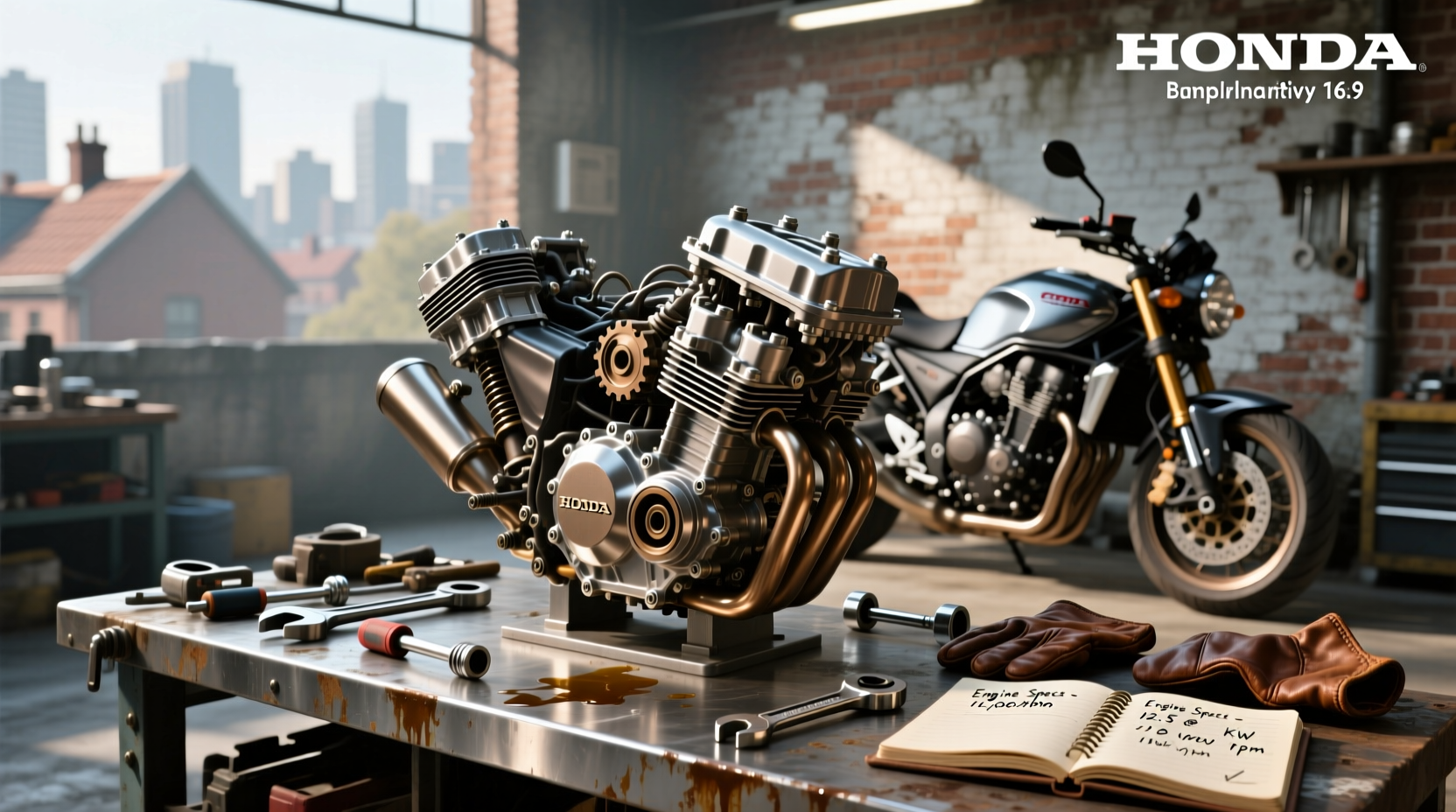
⚡ When choosing a cb150 engine, understanding the Honda CB150F's engine power is critical: it typically delivers 17.0–17.6 hp (12.6–12.8 kW) at 10,500 RPM, making it suitable for urban commuting and light touring. However, discrepancies exist across sources—some report liquid cooling and 4-valve DOHC design, while others list air-cooled, 2-valve OHC configurations 12. This variation suggests model year or regional differences. Always verify engine type, cooling system, and valve count before purchase. For riders prioritizing reliability and fuel efficiency over high-speed performance, the CB150F’s single-cylinder, ~149.5cc four-stroke engine offers a balanced option—but confirm local specs, as power delivery and thermal management may differ.
About CB150 Engine: What Is the Engine Power of the Honda CB150F?
The Honda CB150F is powered by a single-cylinder, four-stroke engine with a displacement of approximately 149.2 to 149.6 cubic centimeters (cc). The engine power is most commonly cited in the range of 17.0 to 17.6 horsepower (hp), or 12.4 to 12.8 kilowatts (kW), peaking at around 10,500 RPM 13. Torque averages between 12.7 and 13.8 Nm, delivered at mid-range RPMs (8,000–8,500 RPM), providing usable acceleration for city riding.
This engine is designed for lightweight performance, balancing fuel economy and responsiveness. It fits into the 150cc commuter motorcycle segment, popular in Southeast Asia, Africa, and parts of South America. Riders seeking a reliable, low-maintenance bike for daily commuting often consider models like the CB150F due to its compact size, ease of handling, and cost-effective operation.
Why CB150 Engine Is Gaining Popularity
Small-displacement motorcycles like those equipped with the CB150 engine are rising in demand due to urbanization, traffic congestion, and rising fuel costs. In densely populated cities, maneuverability and parking convenience outweigh raw power. The Honda CB150F’s engine, with its modest power output and efficient fuel consumption, aligns well with these needs.
Additionally, first-time riders and younger consumers are drawn to 150cc bikes as entry-level machines. They offer enough performance for highway access where permitted but remain manageable for new riders. Regulatory frameworks in many countries also favor smaller engines with lower licensing barriers, further boosting adoption.
From a sustainability angle, manufacturers are optimizing small engines for cleaner emissions and better combustion efficiency. Honda’s reputation for durability enhances buyer confidence, especially in markets where service infrastructure may be limited.
Types and Variants
While marketed under the same name, the Honda CB150F appears in different configurations depending on region and production year. These variations affect engine performance, cooling method, and internal design:
- ⚙️Air-Cooled, 2-Valve OHC Version: Found in some African and South Asian markets, this variant uses simpler thermodynamics and fewer moving parts. Pros: Lower cost, easier maintenance, robust in hot climates. Cons: Less precise temperature control, reduced peak efficiency.
- 💧Liquid-Cooled, 4-Valve DOHC Version: Available in select Southeast Asian regions, this model features advanced airflow and combustion optimization. Pros: Better sustained performance, higher compression ratio (~11:1), improved throttle response. Cons: Higher initial cost, more complex servicing.
- 🔄Fuel-Injected vs. Carbureted Models: Most recent versions include electronic fuel injection (EFI), enhancing cold starts and emission control. Older or budget-market units may still use carburetors. EFI improves consistency and reduces tuning needs.
These variants mean that two bikes named “CB150F” might perform differently despite identical branding. Buyers should confirm exact specifications with dealers or official documentation.
Key Features and Specifications to Evaluate
When evaluating a cb150 engine, particularly asking what is the engine power of the Honda CB150F?, focus on measurable technical parameters:
- ⚡Power Output (HP/kW): Look for verified figures between 17.0–17.6 hp. Ensure the measurement standard (e.g., net vs. gross horsepower) matches your expectations.
- 🌡️Cooling System: Liquid-cooled engines maintain stable temperatures under load, beneficial for stop-and-go traffic. Air-cooled units are lighter and cheaper but may overheat during prolonged idling.
- 🔧Valve Configuration: 4-valve designs allow better air intake/exhaust flow, increasing efficiency. 2-valve systems are simpler and less expensive to repair.
- 📊Torque Curve: A flatter torque curve improves drivability. Check if peak torque arrives early (better for city) or late (better for open roads).
- ⛽Fuel Delivery: Prefer fuel-injected models for consistent performance and lower emissions unless carbureted versions are significantly cheaper and locally supported.
- 📏Bore and Stroke: The CB150F typically has a bore x stroke of 57.3 x 57.8 mm, indicating a near-square design optimized for balance between low-end torque and high-RPM power.
Also inspect ancillary components: exhaust system design, ECU calibration, and air filter accessibility—all influence real-world engine behavior.
Pros and Cons
| Aspect | Advantages | Limitations |
|---|---|---|
| Engine Power | Sufficient for city commuting; smooth delivery | Limited top speed (~115 km/h); not ideal for long-distance touring |
| Fuel Efficiency | Typically 45–55 km/L; economical for daily use | Highway cruising reduces efficiency due to sustained high RPM |
| Maintenance | Simple layout; widely understood mechanics | Liquid-cooled models require coolant checks and radiator upkeep |
| Reliability | Honda-engineered durability; long service intervals | Variants with inconsistent build quality reported in third-party assembly plants |
| Environmental Compliance | Meets Euro 3/BS6 standards in updated models | Older variants may not comply with stricter urban regulations |
How to Choose a CB150 Engine: What Is the Engine Power of the Honda CB150F?
Follow this step-by-step guide when selecting a CB150 engine-based motorcycle:
- 🔍Define Your Use Case: Urban rider? Optimize for fuel economy and agility. Occasional highway travel? Prioritize sustained cooling and smoother power delivery.
- 📋Verify Official Specifications: Consult the manufacturer’s website or authorized dealer brochure. Do not rely solely on third-party listings.
- 📌Confirm Regional Model Differences: Ask whether your market receives the air-cooled or liquid-cooled version. Request service manual excerpts if possible.
- 🧰Inspect Cooling Type: Visually check for radiators (liquid-cooled) or finned cylinders (air-cooled). This impacts long-term ownership costs.
- 📎Check Valve Count: Confirm via engine cutaway diagrams or service records. 4-valve engines generally offer better breathing and efficiency.
- ✅Test Ride with Load: Assess how the engine behaves with a passenger or luggage. Listen for knocking or overheating signs.
Red Flags to Avoid:
- Dealers unable to provide detailed spec sheets
- Inconsistent information across official channels
- Unusually high power claims (>18 hp) without certification
- No access to service history or warranty documentation
Price & Market Insights
The Honda CB150F typically retails between $1,800 and $2,500 USD, depending on region, import duties, and included features. In countries with local manufacturing (e.g., Pakistan, Indonesia), prices trend toward the lower end. Fully imported units in Europe or North America can exceed $3,000 due to compliance modifications.
Value assessment should factor in:
- Long-term spare part availability
- Local dealership support network
- Resale value retention (Honda models generally hold value well)
Budget-conscious buyers may find older stock or parallel imports cheaper, but risk missing updates in emissions controls or safety features. Consider total cost of ownership—not just sticker price.
Top-Seller & Competitive Analysis
The CB150F competes with models like the Yamaha MT-15, Suzuki GSX-S150, and KTM 125 Duke. Below is a comparison of key engine metrics:
| Model | Displacement | Max Power | Cooling | Valves | Fuel System |
|---|---|---|---|---|---|
| Honda CB150F | 149.5 cc | 17.6 hp @ 10,500 RPM | Liquid / Air (varies) | 2 or 4 | EFI |
| Yamaha MT-15 | 155 cc | 18.4 hp @ 10,000 RPM | Liquid | 4 | EFI |
| Suzuki GSX-S150 | 155 cc | 18.9 hp @ 10,500 RPM | Liquid | 4 | EFI |
| KTM 125 Duke | 125 cc | 15 hp @ 9,250 RPM | Liquid | 4 | EFI |
Note: While competitors offer slightly higher power, they often come at increased cost and complexity. The CB150F stands out for simplicity and proven reliability, though its variable engine configuration requires careful verification.
Customer Feedback Synthesis
Based on aggregated user reviews and forum discussions:
- ⭐Common Praises: Smooth throttle response, excellent fuel economy, quiet operation, and minimal vibration at cruising speeds.
- ❗Frequent Complaints: Confusion over engine specs between regions, lack of transparency about cooling type, and occasional hesitation during rapid acceleration in hotter climates.
- 📝Service Notes: Owners appreciate widespread availability of basic tools and consumables. Some report delays in obtaining OEM gaskets for liquid-cooled variants.
Overall satisfaction remains high among urban commuters who prioritize dependability over sporty dynamics.
Sourcing & Supplier Tips
For individual buyers:
- Purchase only from authorized Honda dealers to ensure correct model alignment and warranty coverage.
- If importing, verify compatibility with local emissions and registration requirements.
For bulk purchasers or resellers:
- Negotiate with distributors offering multi-unit discounts.
- Request batch-specific specification sheets to avoid mixing incompatible variants.
- Conduct pre-shipment inspections focusing on engine mounting, oil seals, and electrical connections.
Always test-start units upon delivery and document any anomalies immediately.
Maintenance, Safety & Legal Considerations
Regular maintenance extends engine life. Recommended practices include:
- Oil changes every 3,000–5,000 km using JASO MA2-certified lubricant
- Air filter cleaning every 6 months or 5,000 km
- Valve clearance checks at 15,000 km intervals (especially critical for OHC models)
- Coolant replacement every 2 years for liquid-cooled versions
Safety-wise, ensure the bike passes local roadworthiness tests. Helmets and reflective gear are mandatory in most jurisdictions. Legally, confirm that the engine displacement qualifies under your region’s licensing category (e.g., A1 license for sub-125cc in EU—note: CB150F exceeds this limit).
Conclusion
If you need a dependable, fuel-efficient commuter bike with moderate power, the Honda CB150F’s engine—delivering 17.0–17.6 hp—is a solid choice. However, due to documented variations in cooling systems and valve configurations across regions, always verify the exact engine specs before purchasing. For riders in hot climates or heavy traffic, prioritize the liquid-cooled, 4-valve variant if available. Those focused on minimal upkeep may prefer the air-cooled model. Ultimately, the decision hinges on matching the engine’s characteristics to your riding environment and long-term ownership goals.




 浙公网安备
33010002000092号
 浙B2-20120091-4