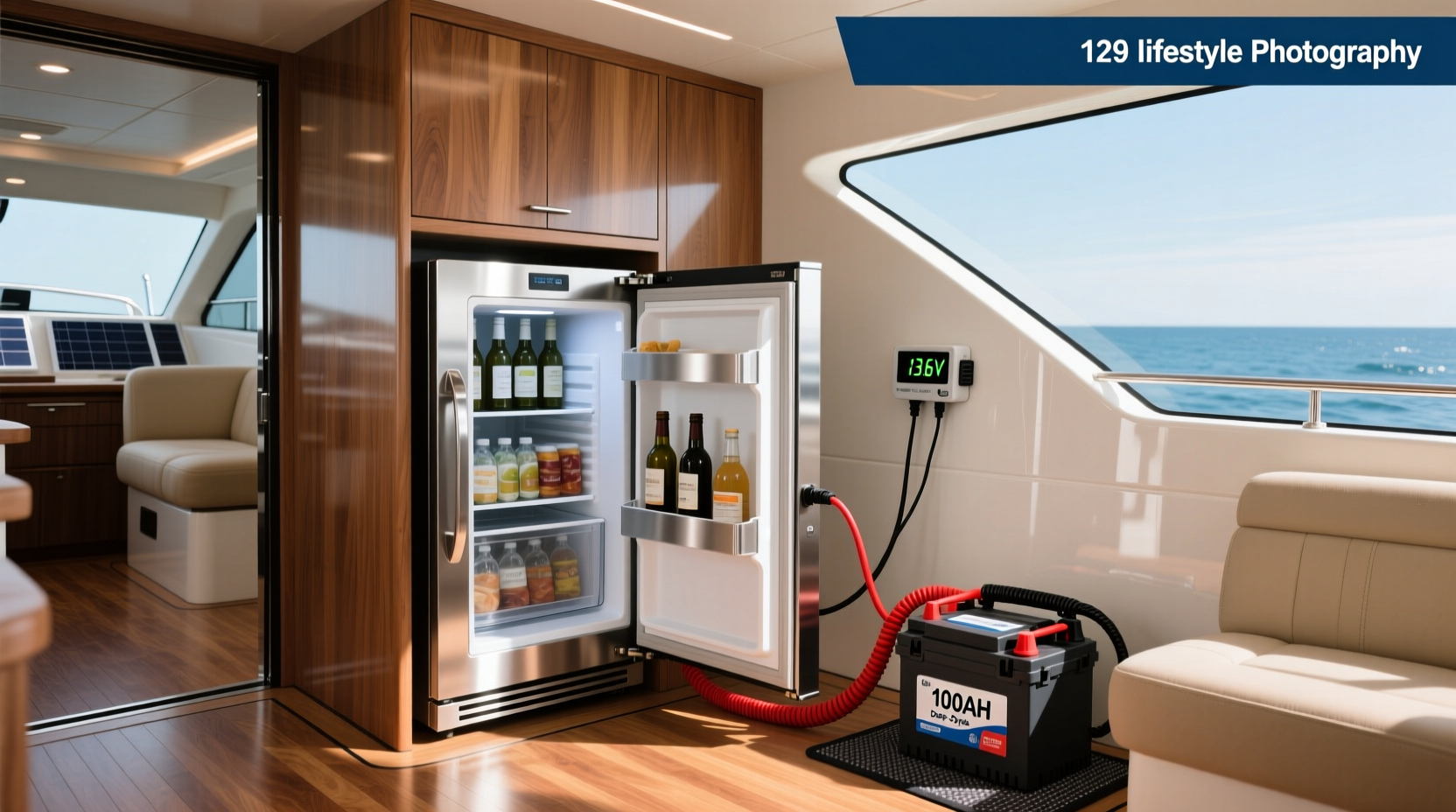
⚡ A 12V 100Ah battery can power a modern compressor yacht refrigerator for approximately 10–27 hours, depending on fridge efficiency and battery type. When evaluating how to choose a yacht refrigerator with limited battery capacity, prioritize energy-efficient compressor models and pair them with lithium batteries for longer runtime. Avoid older absorption fridges, which may only last 3–6 hours on the same battery. Key factors like ambient temperature, insulation quality, and usage habits significantly impact real-world performance—pre-cooling the fridge and minimizing door openings can extend usable time.
Short introduction
When planning extended time offshore, one of the most critical questions boaters face is: how long will a 12V fridge run on a 100Ah battery? This directly affects comfort, food safety, and overall energy management. The answer depends heavily on two main variables: the type of yacht refrigerator and the chemistry of your battery bank. For those researching how to choose a yacht refrigerator,How long will a 12V fridge run on a 100Ah battery?, understanding these factors early prevents overestimating system capabilities. Modern compressor fridges are far more efficient than older absorption units, consuming as little as 40–60 watts on average compared to 100–200 watts. Pairing a compressor fridge with a lithium (LiFePO4) battery increases usable capacity and extends runtime significantly—up to 27 hours in optimal conditions. In contrast, a lead-acid battery may only deliver 10–15 hours under the same load. This guide breaks down all key considerations for making an informed decision.
About yacht refrigerator,How long will a 12V fridge run on a 100Ah battery?
A marine or yacht refrigerator is designed to operate reliably in dynamic environments where power sources are limited, temperatures fluctuate, and space is constrained. Unlike household units, these appliances typically run on 12V DC power supplied by onboard batteries, making energy efficiency paramount. The central concern—how long will a 12V fridge run on a 100Ah battery?—is not just theoretical; it determines whether you can maintain cold storage during multi-day trips without shore power or engine charging.
This question arises most frequently among sailors, liveaboards, and weekend cruisers who rely on off-grid electrical systems. It’s especially relevant when upgrading existing refrigeration or designing a new boat’s power system. Since refrigeration can account for up to 50% of total energy consumption on a cruising vessel 1, accurately estimating runtime ensures adequate battery sizing and avoids unexpected discharge.
Why yacht refrigerator,How long will a 12V fridge run on a 100Ah battery? is gaining popularity
As recreational boating evolves toward longer, self-sufficient voyages, demand for reliable, low-power refrigeration has surged. More owners are installing solar panels, lithium batteries, and efficient appliances to reduce reliance on generators and shore power. This shift aligns with broader trends in sustainable marine living and energy autonomy.
The growing interest in answering how long will a 12V fridge run on a 100Ah battery? reflects increasing awareness of energy budgets. Boaters now treat electricity like fuel—something finite that must be carefully managed. Online forums, DIY conversion projects, and hybrid power systems have made technical details more accessible, empowering users to optimize their setups. Additionally, advancements in compressor technology and affordable lithium storage have made extended off-grid operation feasible even on smaller vessels.
Types and variants
Two primary types of marine refrigerators dominate the market, each with distinct power profiles and suitability for different use cases.
🔋 Absorption Fridges
Common in older yachts and RVs, absorption fridges use heat (from propane, AC, or DC) to drive the cooling cycle. They have no moving parts, making them quiet and vibration-free.
Pros:
- No compressor noise
- Can run on multiple power sources (propane, AC, DC)
- Fewer mechanical components to fail
Cons:
- High power draw when running (300–400W), averaging 100–200W per hour due to cycling 2
- Less efficient in warm climates
- Larger size for equivalent cooling capacity
- Sensitive to installation angle and ventilation
⚙️ Compressor Fridges
Modern marine refrigerators almost exclusively use DC-powered compressors similar to household models but optimized for variable voltage and motion resistance.
Pros:
- Energy efficient (60–120W while running, ~40–60W average with cycling) 2
- Better cooling performance in high ambient temperatures
- Compact design with higher usable interior volume
- Compatible with thermostat control and monitoring systems
Cons:
- Higher initial cost
- Potential for mechanical failure (though rare with quality units)
- Requires proper mounting to reduce vibration stress
Key features and specifications to evaluate
To determine what to look for in a yacht refrigerator,How long will a 12V fridge run on a 100Ah battery?, assess these technical and operational parameters:
- Power Consumption (W): Look for average wattage under typical duty cycles, not peak draw. Request data from manufacturers or third-party tests.
- Duty Cycle: The percentage of time the compressor runs. Lower is better. Well-insulated units may cycle 20–30%, while poorly sealed ones exceed 50%.
- Insulation Thickness & Type: At least 4 inches of closed-cell polyurethane foam improves retention and reduces workload 1.
- Door Seal Quality: Magnetic gaskets should form an airtight seal. Inspect regularly and replace if cracked or loose.
- Voltage Range: Ensure compatibility with your system (e.g., 10–15V DC). Some models handle wider ranges for unstable inputs.
- Thermostat Precision: Digital controls allow fine-tuning, reducing unnecessary cycling.
Pros and cons
Suitable For:
- Weekend cruisers with moderate usage
- Liveaboards using solar-recharged lithium banks
- Boats with limited alternator charging access
Not Ideal For:
- Extended passages without renewable charging
- Older boats with only lead-acid banks and no upgrades
- Users unwilling to modify insulation or adopt energy-saving habits
How to choose yacht refrigerator,How long will a 12V fridge run on a 100Ah battery?
Follow this step-by-step process to make a confident selection:
- Assess Your Power System: Identify battery type (lead-acid or lithium) and total usable capacity. Remember: only 50% of lead-acid capacity is usable; lithium allows 80–90% 2.
- Calculate Daily Energy Use: Estimate fridge wattage × duty cycle = average watts. Convert to amp-hours: W ÷ 12V = Ah/hour.
- Estimate Runtime: Usable battery Ah ÷ fridge’s hourly Ah draw = estimated hours.
- Prioritize Compressor Models: These offer superior efficiency and reliability for battery-powered operation.
- Verify Real-World Conditions: Hot weather, frequent access, and poor insulation increase consumption. Add a 20–30% buffer to calculations.
- "The compressor fridge stays cold even in tropical heat."
- "Pairing with lithium doubled my runtime compared to old lead-acid setup."
- "Easy integration with solar charge controllers."
- "Instructions were unclear; took time to configure properly."
- "Door seal failed after 18 months—replaced under warranty."
- "Larger than expected; required cabinet modification."
- How long will a 12V fridge run on a 100Ah lithium battery?
Approximately 16–27 hours for a modern compressor fridge with average draw of 40–60W, depending on conditions. - Can I run a yacht refrigerator solely on battery power?
Yes, but only for limited durations. For continuous operation, integrate solar panels or another charging source. - Does ambient temperature affect marine fridge efficiency?
Yes. Higher external temperatures increase compressor runtime and power consumption significantly. - Should I upgrade insulation in my boat’s fridge compartment?
Yes. Adding at least 4 inches of closed-cell foam improves thermal retention and reduces energy use. - What size battery do I need to run a 12V fridge for 48 hours?
You’d need roughly 200Ah of lithium capacity (or 400Ah lead-acid) for a 50W compressor fridge, assuming no recharging.
✅ Do: Pre-cool the fridge on shore power, keep it full (use water bottles), install solar panels, upgrade insulation.
❗ Avoid: Using absorption fridges on battery-only systems, ignoring battery health, oversizing fridge beyond needs.
Price & market insights
Marine refrigerators vary widely in price based on type, size, brand, and features. Compressor units typically range from $800 to $2,500+, while absorption models cost $400–$1,200 but are less suitable for battery-only use. Lithium batteries add $800–$1,500 for a 100Ah unit but dramatically improve system performance.
Value lies in long-term efficiency. A slightly more expensive compressor fridge paired with good insulation often pays back through reduced charging needs and extended battery life. Prices may vary by region and supplier, so compare installed kits versus DIY conversions.
Top-seller & competitive analysis
While specific model rankings change, leading brands include Dometic, Waeco, and Victron-enabled systems. Below is a general comparison of typical configurations:
| Type | Avg. Power Draw (W) | Battery Type | Usable Wh | Runtime (hrs) |
|---|---|---|---|---|
| Absorption | 150 | Lead-Acid | 600 | 4 |
| Absorption | 150 | Lithium | 1,000 | 6.7 |
| Compressor | 50 | Lead-Acid | 600 | 12 |
| Compressor | 50 | Lithium | 1,000 | 20 |
Data sourced from industry estimates 23. Always verify specs with manufacturers before purchase.
Customer feedback synthesis
Analysis of user reviews reveals consistent themes:
Positive Feedback:
Common Complaints:
Sourcing & supplier tips
Purchase from authorized marine equipment dealers or direct manufacturers. For bulk orders or resale, contact distributors with marine certifications. Verify warranty terms, return policies, and shipping methods—some units require upright transport to protect compressors. Inspect packaging and test operation upon arrival. Confirm compatibility with your voltage system and physical dimensions before finalizing.
Maintenance, safety & legal considerations
Regular maintenance includes cleaning condenser coils, checking door seals, and inspecting wiring connections. Ensure proper ventilation around the unit to prevent overheating. While no universal regulations govern yacht refrigerators, verify compliance with ABYC (American Boat & Yacht Council) standards or CE marking where applicable. Electrical installations should follow marine-grade practices to prevent fire hazards. Always disconnect power before servicing.
Conclusion
If you need reliable refrigeration on a limited battery budget, choose a compressor-type yacht refrigerator paired with a lithium battery for maximum runtime. A 12V 100Ah lithium battery can power an efficient model for 16–27 hours, while lead-acid offers 10–15 hours. Avoid absorption fridges unless you have access to propane or AC power. To extend usability, combine your system with solar charging, pre-cool the unit, and minimize door openings. Ultimately, success depends not just on the appliance but on holistic energy planning and realistic expectations.




 浙公网安备
33010002000092号
 浙B2-20120091-4