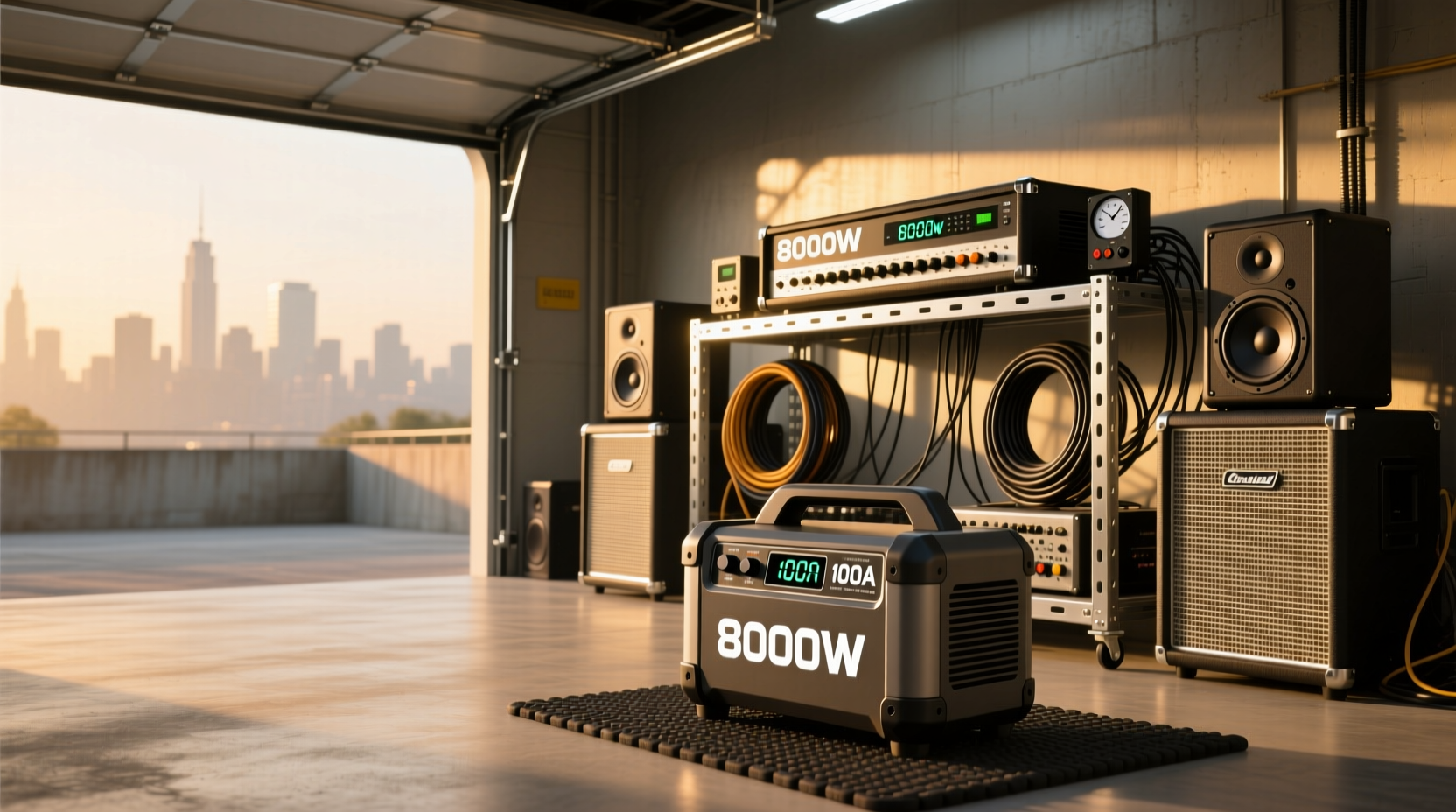
⚡ Short Introduction: What You Need to Know Right Away
When asking how many amps is a 8000 watt generator?, the answer depends on voltage and power factor. At 120V with a typical 0.8 power factor, it delivers about 83.3 amps; at 240V, around 41.7 amps. But real-world output is limited by outlet ratings—commonly 30A or 50A—not total wattage. If you're trying to choose an amplifier 8000w,How many amps is a 8000 watt generator? for home backup, RV use, or job sites, focus on receptacle types, continuous load capacity (80% of max), and dual-voltage circuits. Avoid models without 120/240V split-phase output if powering large appliances. Always check manufacturer specs—actual amperage per outlet varies by model.
🔍 Key Buying Insight: An 8000-watt generator doesn’t mean you can draw 83+ amps from a single outlet. The wiring, circuit breakers, and plug types cap safe current. A 30-amp 240V outlet maxes out at 7,200 watts—within the 8000W range but below peak. For whole-home backup or high-draw tools, prioritize a 50-amp 120/240V outlet.
About amplifier 8000w,How many amps is a 8000 watt generator?
The term amplifier 8000w appears to be a misstatement—likely intended as "8000-watt generator" rather than an audio amplifier. In electrical contexts, "amplifier" typically refers to audio signal boosting, not power generation. This guide focuses on 8000-watt portable generators, which are commonly used for emergency home backup, construction sites, RVs, and outdoor events.
An 8000-watt generator produces up to 8,000 watts of electrical power, enough to run multiple household circuits, HVAC units, well pumps, and power tools simultaneously. However, its usable amperage depends on voltage configuration and outlet design. Understanding the relationship between watts, volts, and amps is essential for matching the generator to your electrical needs.
Why amplifier 8000w,How many amps is a 8000 watt generator? is gaining popularity
High-capacity generators like the 8000-watt model are increasingly popular due to rising demand for reliable off-grid and backup power. With more frequent power outages, extreme weather events, and remote work setups, homeowners and contractors seek robust power solutions. These generators offer sufficient output to run refrigerators, sump pumps, lights, heating systems, and even small air conditioners—all at once.
Additionally, advancements in inverter technology and fuel efficiency have made larger generators quieter and more portable than before. Their ability to support both 120V and 240V devices makes them versatile for residential and commercial applications, further driving adoption.
Types and variants
8000-watt generators come in several configurations, each suited to different use cases:
- ⚙️Conventional Portable Generators: Use internal combustion engines (gasoline, diesel, or propane). Affordable and powerful, but noisy and less fuel-efficient.
- ✨Inverter Generators (High-Capacity): Produce cleaner power ideal for sensitive electronics. More expensive, but quieter and efficient. True 8000W inverters are rare; most combine parallel operation to reach that output.
- 🏭Dual-Fuel Models: Operate on gasoline and propane. Offer flexibility during fuel shortages and longer shelf life for propane.
- 🏠Home Standby Generators: Permanently installed, often natural gas-powered. Not portable, but automatically kick in during outages. Some models reach 8000W+ output.
Key Differences: Portability, noise level, fuel type, waveform quality, and startup surge capacity vary significantly. Conventional models dominate the 8000W category due to cost and availability.
Key features and specifications to evaluate
To properly choose amplifier 8000w,How many amps is a 8000 watt generator?, assess these critical specs:
- ⚡Rated vs. Surge Wattage: 8000W is usually the maximum (surge) power. Continuous output is typically 6,400–7,200W (80% load).
- 🔌Voltage Configuration: Look for 120/240V split-phase systems for full household compatibility.
- 📎Receptacle Types: Common outlets include 5-20R (20A/120V), L5-30R (30A/120V), L14-30R (30A/120-240V), and 14-50R (50A/120-240V).
- 📊Amperage per Outlet: A 30A 240V outlet delivers 7,200W; a 50A delivers up to 12,000W (but capped at 8,000W by the unit).
- ⛽Fuel Type & Runtime: Gasoline offers high energy density; propane burns cleaner. Check runtime at 50% load (typically 8–12 hours).
- 🧰Transfer Switch Compatibility: Essential for safe home backup. Requires proper interlock kit or manual transfer switch.
- 🔊Noise Level: Measured in dBA. Under 70 dBA is considered quiet for this class.
Pros and cons
✅ Pros
- Can power entire homes during outages
- Supports heavy-duty tools and appliances
- Dual-voltage output increases versatility
- Available with wheel kits for mobility
- Some models include CO detection and auto-shutdown
❌ Cons
- Bulky and heavy (200+ lbs)
- Loud without sound-dampening enclosures
- Requires regular maintenance (oil, filters)
- Not all models produce clean sine wave power
- Higher fuel consumption than smaller units
How to choose amplifier 8000w,How many amps is a 8000 watt generator?
Follow this step-by-step checklist when evaluating options:
- 📋Determine Your Load Needs: List all devices you plan to run. Add running watts; include startup surges (e.g., motors need 2–3x running wattage).
- 📍Check Voltage Requirements: Do you need 240V for well pumps, AC units, or electric ranges? Confirm split-phase capability.
- 🔌Match Receptacle to Application: For RVs or home transfer switches, a 14-50R (50A) or L14-30R (30A) is standard. Verify plug compatibility with your cords or panel.
- 🔋Calculate Real-World Amperage: Use the formula: Amps = Watts / (Volts × Power Factor). Assume PF ≈ 0.8 unless specified otherwise.
- 🚚Assess Portability: Units over 200 lbs may require a trailer or two people to move. Look for foldable handles and never-flat tires.
- 🔧Review Safety Features: Includes low-oil shutdown, overload protection, GFCI outlets, and carbon monoxide sensors.
- ❗Avoid These Red Flags:
- No clear distinction between rated and surge wattage
- Lack of 240V output on a claimed 8000W unit
- Missing UL or ETL certification
- Unrealistic runtime claims (e.g., 20+ hours on 5-gallon tank)
- No documentation of harmonic distortion or THD
If you’re using this generator for home backup systems, ensure it integrates with a transfer switch and meets local electrical codes. For job site use, prioritize rugged build and multiple 120V outlets.
Price & market insights
Prices for 8000-watt generators range from $900 to $2,000, depending on brand, fuel type, and features. Basic conventional models start around $900–$1,200. Dual-fuel or inverter-style units exceed $1,500. Standby systems cost significantly more due to installation requirements.
Value is best assessed by runtime per dollar, warranty length (3–5 years preferred), and service network availability. Chinese OEM brands offer lower prices but may lack long-term support. Established brands (e.g., Honda, Yamaha, Firman, Westinghouse) tend to have better reliability and parts access. Prices may vary by region and retailer—always compare after-freight costs for heavy units.
Top-seller & competitive analysis
Popular 8000-watt models include the Firman H08051, Westinghouse WGen9500DF, and Predator 9500. While actual output may exceed 8,000W surge, their continuous ratings align closely. Below is a comparison of key specs:
| Model | Rated Watts | Max Watts | Voltage | Receptacles | Fuel Type |
|---|---|---|---|---|---|
| Firman H08051 | 7,400W | 8,000W | 120/240V | 5-20R, L5-30R, L14-30R | Gasoline/Dual-Fuel |
| Westinghouse WGen9500DF | 7,500W | 9,500W | 120/240V | 5-20R, L5-30R, 14-50R | Gasoline/Propane |
| Predator 9500 | 7,500W | 9,500W | 120/240V | 5-20R, L5-30R, 14-50R | Gasoline |
Note: Actual performance may vary based on altitude, temperature, and maintenance. Always verify specs with the manufacturer.
Customer feedback synthesis
Based on aggregated user reviews, common themes emerge:
- 👍 Frequent Praise:
- Reliable power for whole-house backup
- Dual-fuel flexibility praised during emergencies
- Good value compared to premium brands
- Easy recoil and electric start functionality
- 👎 Common Complaints:
- Heavy and difficult to transport without assistance
- Noise levels above 70 dBA disturb neighbors
- Inconsistent voltage regulation under load
- Sometimes arrives with damaged packaging or missing parts
- Customer service responsiveness varies by brand
Sourcing & supplier tips
When purchasing, consider buying from authorized dealers or reputable online retailers (e.g., Home Depot, Northern Tool, Amazon). For bulk orders or resale, contact distributors directly. Ensure the supplier provides:
- Clear return policy (especially for heavy items)
- Warranty documentation
- Access to service centers
Maintenance, safety & legal considerations
Regular maintenance ensures longevity and safe operation. Change engine oil after the first 20 hours and every 100 hours thereafter. Replace air and fuel filters annually. Store fuel with stabilizer if keeping beyond 30 days.
Safety practices include:
- Never operate indoors or in enclosed spaces (risk of CO poisoning)
- Use heavy-duty extension cords rated for the load
- Ground the generator properly when connecting to a home panel
- Allow the engine to cool before refueling
Conclusion
If you need a powerful, versatile solution for whole-home backup, job sites, or RV use, an 8000-watt generator is a strong option. When figuring out how many amps is a 8000 watt generator?, remember it’s not just about total watts—it’s about voltage, outlet ratings, and continuous load handling. Prioritize models with 120/240V output and a 30A or 50A twist-lock receptacle. Avoid units without clear spec sheets or safety certifications. For sensitive electronics, consider inverter models or ensure low THD. Always size your generator based on actual load, not peak numbers alone.
FAQs
How many amps does an 8000-watt generator produce at 240 volts?
At 240V with a power factor of 0.8, an 8000-watt generator produces approximately 41.7 amps (8000 ÷ (240 × 0.8)). However, the actual available amperage depends on the outlet rating, typically 30A or 50A.
Can an 8000-watt generator run a house?
Yes, an 8000-watt generator can power most essential circuits in a mid-sized home, including lights, refrigerator, well pump, furnace, and a window AC unit. Use a transfer switch and calculate total load to avoid overloading.
What size breaker do I need for an 8000-watt generator?
For a 240V circuit, a 50-amp breaker is common for 8000-watt generators with a 14-50R outlet. For 30-amp outlets (L14-30R), use a 30-amp double-pole breaker. Always match the breaker to the outlet and wiring gauge.
Is 8000 watts enough for an RV?
Yes, 8000 watts is more than sufficient for most RVs, especially those with 50-amp service (12,000W capacity). It can run multiple AC units, kitchen appliances, and electronics simultaneously.
Do I need a transfer switch for an 8000-watt generator?
Yes, a transfer switch is highly recommended for safely connecting a generator to your home's electrical system. It prevents backfeeding into utility lines, which is dangerous and illegal.




 浙公网安备
33010002000092号
 浙B2-20120091-4