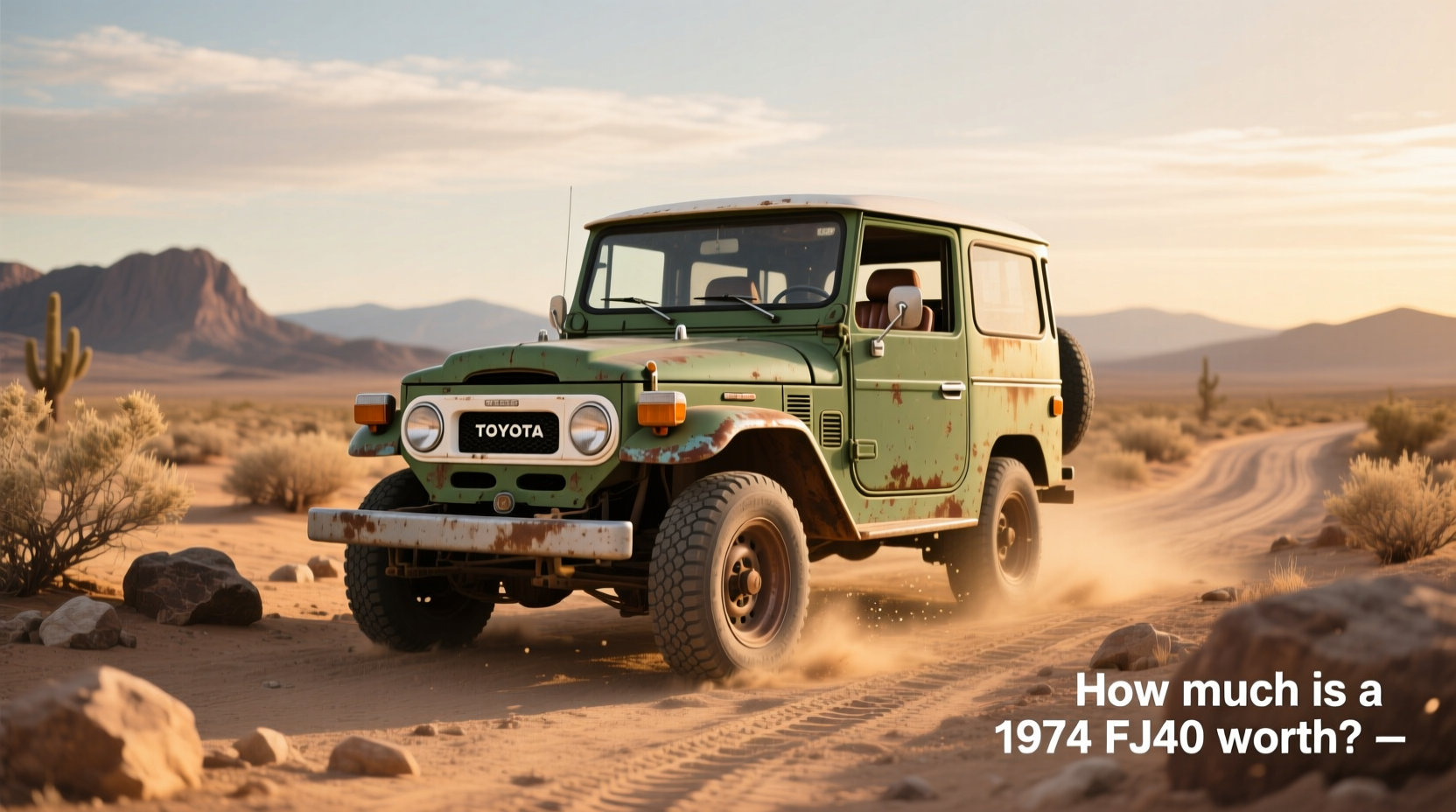
🔍 When evaluating a 1974 Toyota FJ40 for sale, the most critical factors are its condition, originality, engine type (1F), mileage, and location. Prices range from $5,500 for non-running examples to over $99,000 for pristine restorations. A median value of $27,500–$36,000 reflects typical well-maintained models. Knowing what to look for in a toyota fj40 for sale, how much is a 1974 FJ40 worth? scenario helps avoid overpaying or buying a project with hidden costs.
About the 1974 Toyota Land Cruiser FJ40
The 1974 Toyota Land Cruiser FJ40 is a legendary off-road vehicle known for its rugged durability, simple mechanical design, and timeless boxy styling. As part of the long-running 40 Series produced from 1960 to 1984, the FJ40 was built for utility—used globally by militaries, farmers, explorers, and adventurers in harsh environments 1. The 1974 model year sits just before a key transition: it features the 3.9L 1F inline-six engine, which lacks emissions controls found on later 2F engines introduced in 1975 2.
Today, the FJ40 is sought after as both a collector’s classic and a capable vintage 4x4. Buyers fall into three main categories: restoration enthusiasts, off-road adventurers seeking a durable rig, and investors betting on long-term appreciation. Most vehicles available today are either original survivors, partially restored, or fully rebuilt with modern upgrades.
Why the 1974 FJ40 Is Gaining Popularity
After a surge in classic SUV values during the early 2020s, the market for FJ40s has stabilized, making now a strategic time to buy 1. Several trends are driving interest:
- 📈 Rising demand for analog driving experiences: In an era of digital driver aids, buyers appreciate the FJ40’s raw, mechanical feel.
- 🌍 Global appeal and reliability reputation: Its worldwide service history builds trust in durability.
- 🧰 DIY-friendly mechanics: Simple systems allow owners to perform repairs with basic tools.
- ✨ Restoration potential: Many buyers enjoy the process of rebuilding a classic with personal touches.
However, rising popularity doesn’t mean all FJ40s are good investments—value depends heavily on authenticity and execution.
Types and Variants of the 1974 FJ40
The 1974 FJ40 came in several configurations, primarily differing by body style and drivetrain:
| Variety | Features | Pros | Cons |
|---|---|---|---|
| Soft Top (Canvas Roof) | Fold-down windshield, removable canvas top | Lighter weight, open-air experience, easier restoration | Less weather protection, lower resale than hardtops |
| Hard Top (Metal Roof) | Fixed steel roof, more sound insulation | Better security, higher perceived value, quieter ride | Heavier, prone to rust in roof seams |
| Long Wheelbase (FJ45) | Extended chassis, often with pickup bed | More cargo space, stable on-road | Less agile off-road, rarer in U.S. market |
While the FJ40 designation typically refers to the short-wheelbase soft or hardtop, some listings may blur lines with FJ45 variants. Always verify wheelbase and VIN when comparing values.
Key Features and Specifications to Evaluate
When researching a toyota fj40 for sale, how much is a 1974 FJ40 worth?, focus on these technical and cosmetic indicators:
- ⚙️ Engine (1F vs. Upgraded): The stock 1F engine is carbureted and pre-smog regulations. While authentic, it can be harder to register in states like California. Some sellers install V8 swaps (e.g., Chevrolet LS) for power, but this may reduce collector value 3.
- 📍 Location and Title Status: Vehicles from dry climates (Arizona, Nevada) often have less rust. Clean titles are essential—avoid salvage or flood-damaged units unless priced accordingly.
- 📊 Mileage: Low mileage (<20,000 miles) suggests limited use but verify if the odometer is original. High mileage isn’t always bad if maintenance records exist.
- 🔧 Drivetrain Condition: Check transfer case operation, differential noises, and transmission smoothness. These components are costly to rebuild.
- 🎨 Body and Frame Rust: Inspect rocker panels, firewall, and frame rails. Surface rust can be repaired; structural corrosion is a red flag.
- 📋 Documentation: Original manuals, service records, or matching numbers increase value and buyer confidence.
Pros and Cons of Buying a 1974 FJ40
✅ Pros
- Extremely durable mechanical components
- High resale among classic SUV collectors
- Strong global community and parts support
- Simple design allows owner maintenance
- Potential for customization without losing core identity
❌ Cons
- Primitive safety features (no airbags, weak brakes)
- Fuel economy averages 12–15 mpg
- Stiff ride and noisy cabin on highways
- Parts availability varies—some NOS items are expensive
- Registration challenges in strict emissions states
How to Choose a 1974 FJ40: Step-by-Step Buying Guide
Follow this checklist when evaluating a toyota fj40 for sale, how much is a 1974 FJ40 worth?:
- 🔍 Define your goal: Are you buying for restoration, daily driving, or investment? This determines budget and acceptable condition.
- 🛒 Set a realistic budget: Include $3,000–$10,000 for immediate repairs or recommissioning.
- 📌 Verify VIN and title: Confirm the vehicle matches the description and has no liens.
- 🚗 Inspect in person or hire a specialist: Don’t rely solely on photos. Test drive if possible.
- 🧼 Check for rust and frame integrity: Use a magnet to detect bondo; inspect undercarriage with a flashlight.
- 📎 Review maintenance history: Look for consistent oil changes, fluid replacements, and professional work.
- ❗ Avoid common pitfalls:
- Unverified engine swaps with poor wiring
- Non-original interiors masquerading as “restored”
- Vehicles stored outdoors for years without use
- Sellers who won’t allow third-party inspection
Price & Market Insights for 1974 FJ40s
The value of a 1974 FJ40 varies dramatically based on condition and modifications. Below is a summary of current pricing benchmarks:
| Condition | Price Range (USD) | Description |
|---|---|---|
| Perfect | $45,000 – $99,000 | Show-quality restoration, better than factory new |
| Excellent | $27,500 – $45,000 | Fully restored with high-quality parts |
| Good | $19,800 – $27,500 | Original, functional, minor flaws |
| Fair | $6,700 – $19,800 | Running but needs work |
| Project/Parts | $2,000 – $6,000 | Non-running, incomplete |
Recent auction data shows:
- 1974 FJ40 with 1,800 miles sold for $37,000 4
- Same year with 21,000 miles sold for $12,265 5
- Meticulously restored example listed at $45,495 6
Market benchmarks from Classic.com and The Classic Valuer place the median value around $35,000–$36,000 78. However, prices may vary by region—California buyers often pay premiums for smog-exempt models.
Top-Seller & Competitive Analysis
While no single “top seller” dominates, certain configurations attract more interest:
| Configuration | Demand Level | Resale Potential | Notes |
|---|---|---|---|
| Stock 1F Engine, Original Interior | High | ★★★★☆ | Purist preference; best for collectors |
| V8 Conversion (LS Swap) | Moderate | ★★★☆☆ | Popular with drivers, may deter traditionalists |
| Fully Restored Hard Top | Very High | ★★★★★ | Premium price point; turnkey appeal |
| Soft Top with Minimal Mods | High | ★★★★☆ | Favored for summer driving and shows |
Customer Feedback Synthesis
Based on forum discussions and auction reviews, here’s what buyers commonly praise or complain about:
- Positive Feedback:
- “Reliable even in remote areas with minimal tools.”
- “The build quality from the factory was exceptional.”
- “Community support makes finding parts easier than expected.”
- Common Complaints:
- “Hidden rust under floor mats destroyed the frame.”
- “Seller claimed ‘full restoration’ but used reproduction trim that faded quickly.”
- “Upgraded brake system failed within six months due to improper installation.”
Sourcing & Supplier Tips
You can find 1974 FJ40s through:
- 🌐 Online marketplaces: Bring a Trailer, ClassicCars.com, and Hemmings list curated examples.
- 👥 Specialty dealers: Reputable shops offer warranties but charge premium prices.
- 🤝 Private sellers: Often offer better deals but require more diligence.
- 🚚 Auctions: Both live and online (e.g., Barrett-Jackson) feature rare finds.
Always conduct a pre-purchase inspection by an independent mechanic familiar with vintage Toyotas. Verify shipping terms if buying remotely.
Maintenance, Safety & Legal Considerations
Maintaining a 1974 FJ40 requires regular attention:
- ⏱️ Oil changes every 3,000 miles using high-zinc oil to protect flat-tappet camshafts.
- 🔧 Brake system checks: Original drums are inadequate by modern standards; many upgrade to disc brakes.
- 🔋 Battery and electrical system: Upgrade to sealed battery and modern alternator for reliability.
- ⚖️ Legal compliance: Registration rules vary by state. In California, pre-1975 vehicles are exempt from smog testing 2. Elsewhere, check local DMV requirements.
Due to lack of seatbelts (in early models) and minimal crash protection, the FJ40 is not recommended for families or high-speed commuting.
Conclusion: Should You Buy a 1974 FJ40?
If you’re asking how much is a 1974 FJ40 worth? or looking at a toyota fj40 for sale, your decision should align with your goals. For collectors and enthusiasts, a well-documented, original or expertly restored FJ40 in excellent condition ($27,500–$45,000) offers strong long-term value. Budget buyers might consider a “fair” condition model for $10,000–$15,000, but factor in restoration costs. Avoid unverified modifications and structural rust. With proper research, the 1974 FJ40 remains one of the most rewarding classic 4x4s to own.
FAQs
How much is a 1974 FJ40 worth?
Values range from $5,500 for non-running examples to over $99,000 for show-quality restorations. Most well-maintained models sell between $27,500 and $36,000 depending on condition, mileage, and originality.
Does a V8 swap decrease FJ40 value?
It depends on the buyer. Enthusiasts who drive their FJ40s often prefer V8 power, but purists and collectors usually favor original 1F engines, which can make swapped models harder to resell at premium prices.
Can I register a 1974 FJ40 in California?
Yes. Vehicles manufactured before 1975 are exempt from California’s smog inspection program, making the 1974 FJ40 a practical choice for buyers in the state.
What should I inspect before buying an FJ40?
Focus on frame and body rust, engine noise, transmission and transfer case operation, title status, and documentation. A pre-purchase inspection by a specialist is highly recommended.
Are parts still available for the 1974 FJ40?
Yes. A strong global aftermarket supports the FJ40 with both OEM-reproduction and upgraded components. Online forums and specialty suppliers make sourcing parts manageable.




 浙公网安备
33010002000092号
 浙B2-20120091-4