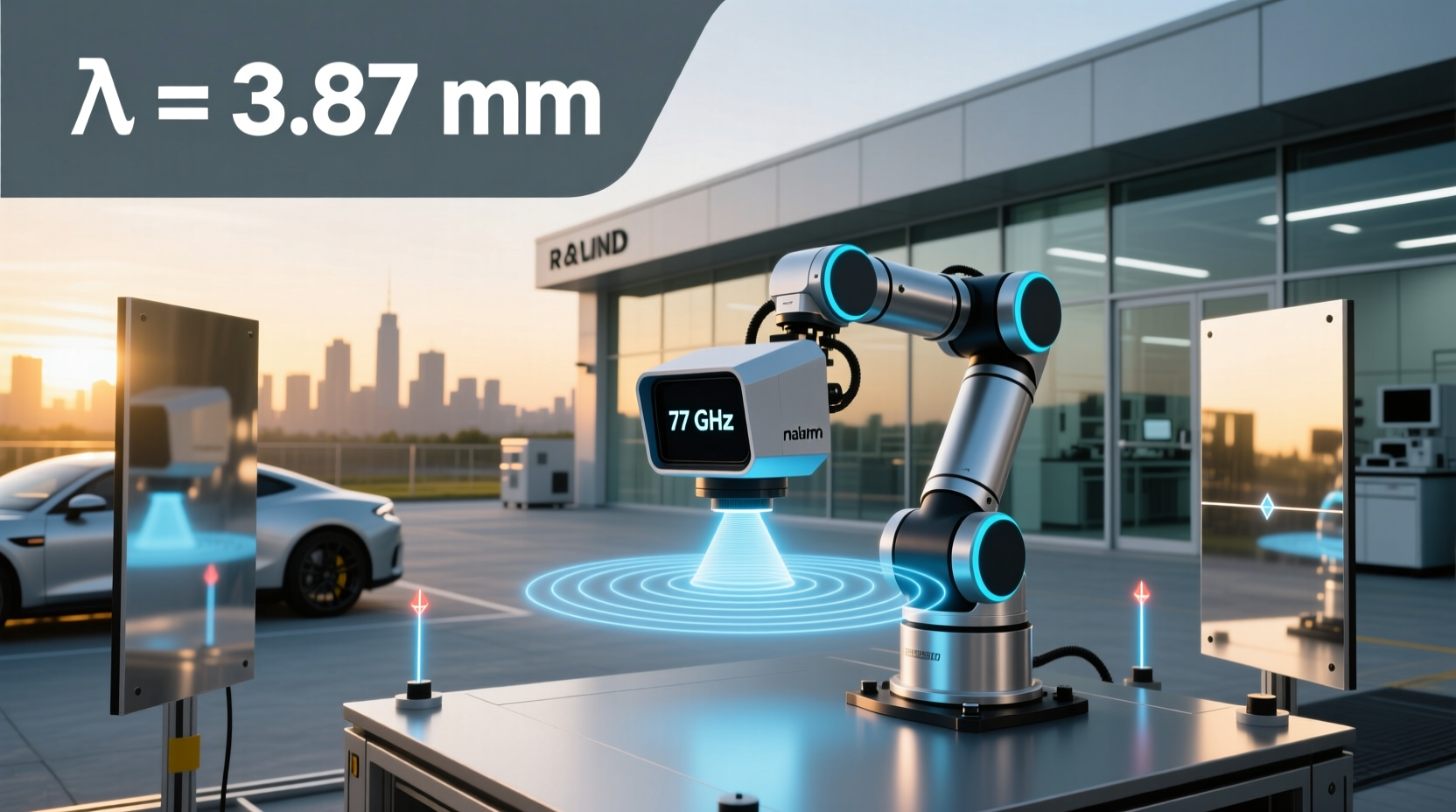
If you're wondering how to choose 77 GHz radar and what the wavelength of a 77 GHz signal means for your application, start here: the wavelength is approximately 3.89 mm, calculated using \\(\\lambda = c/f\\), where \\(c\\) is the speed of light and \\(f\\) is frequency 1. This short wavelength enables high-resolution detection, making 77 GHz radar ideal for automotive ADAS and traffic monitoring systems. When evaluating models, prioritize angular resolution, range accuracy, weather resilience, and integration flexibility. Avoid low-cost units lacking beamforming or Doppler processing if you need reliable object separation in dense environments.
📍 About 77 GHz Radar: What Is the Wavelength of 77 GHz?
The term 77 GHz radar refers to millimeter-wave radar systems operating near 77 billion cycles per second. Using the fundamental wave equation:
$$\\lambda = \\frac{c}{f}$$
where \\(\\lambda\\) is wavelength, \\(c \\approx 299,792,458\\) m/s is the speed of light, and \\(f = 77 \\times 10^9\\) Hz, we find:
$$\\lambda = \\frac{299,792,458}{77,000,000,000} \\approx 0.00389\\ \\text{m} = 3.89\\ \\text{mm}$$
This ~3.89 mm wavelength places 77 GHz in the E-band of the microwave spectrum, known for fine spatial resolution and compact antenna design 2.
Typical applications include:
- Automotive ADAS: Adaptive cruise control (ACC), automatic emergency braking (AEB), blind-spot detection
- Traffic Monitoring: Vehicle counting, speed enforcement, intersection safety
- Smart Infrastructure: Pedestrian detection at crosswalks, parking guidance, tunnel surveillance
📈 Why 77 GHz Radar Is Gaining Popularity
The global shift toward 77 GHz radar stems from its technical advantages over lower-frequency alternatives like 24 GHz:
- Higher Resolution: Shorter wavelengths allow finer angular and range discrimination, critical for detecting small or closely spaced objects.
- Better Performance in Adverse Weather: Unlike cameras or lidar, 77 GHz radar maintains functionality in fog, rain, and snow 3.
- Global Regulatory Alignment: Many countries have allocated 76–81 GHz bands for automotive use, encouraging standardization 4.
- Compact Antenna Size: Higher frequencies enable smaller antennas, facilitating integration into vehicle bumpers or roadside enclosures.
As autonomous driving and intelligent transportation systems evolve, demand for precise, all-weather sensing continues to drive adoption of 77 GHz solutions.
🔧 Types and Variants
77 GHz radar systems come in several configurations, each suited to different operational needs:
✅ Short-Range Radar (SRR)
Range: Up to 30 meters
Frequency Band: Typically 76–77 GHz
- Pros: Compact size, low cost, fast update rate
- Cons: Limited detection distance, lower velocity resolution
- Best For: Parking assistance, door-opening detection, blind-spot monitoring
✅ Medium-Range Radar (MRR)
Range: 30–80 meters
Frequency Band: 77 GHz
- Pros: Balanced field of view and range, moderate resolution
- Cons: Less effective in high-speed scenarios
- Best For: Lane change assist, rear cross-traffic alert
✅ Long-Range Radar (LRR)
Range: 80–250+ meters
Frequency Band: 77–81 GHz
- Pros: High directivity, excellent speed and distance measurement
- Cons: Narrower beam width, higher power consumption
- Best For: Adaptive cruise control, forward collision warning
✅ Imaging Radar / 4D Radar
Advanced systems with elevation and azimuth resolution, plus Doppler and RCS data.
- Pros: Object classification capability, elevation sensing, high point cloud density
- Cons: Significantly higher cost, complex data processing requirements
- Best For: L3+ autonomous vehicles, smart city intersections
⚙️ Key Features and Specifications to Evaluate
When comparing 77 GHz radar units, focus on these measurable parameters:
- Resolution: Look for angular resolution below 1° and range resolution under 10 cm.
- Doppler Velocity Accuracy: Should be ±0.1 m/s or better for reliable speed tracking.
- Field of View (FoV): Horizontal FoV typically ranges from 10° to 120° depending on application.
- Update Rate: Critical for dynamic environments; aim for ≥20 Hz in ADAS contexts.
- Beamforming Capability: Digital or hybrid beamforming improves target separation.
- Output Interface: Common options include CAN, Ethernet, or digital I/O; ensure compatibility with your system.
- Environmental Rating: IP67 or higher recommended for outdoor deployment.
- Power Consumption: Especially important for battery-powered or embedded systems.
Always verify specifications through independent test reports when possible, as manufacturer claims can vary.
📊 Pros and Cons
✨ Advantages
- High resolution due to short wavelength (~3.89 mm)
- Reliable operation in rain, fog, dust, and darkness
- Supports simultaneous multi-target tracking
- Enables compact sensor designs
- Aligned with international frequency regulations
❗ Limitations
- Shorter maximum range compared to lower-frequency radars (without amplification)
- Susceptible to signal attenuation from certain materials (e.g., metal mesh, thick walls)
- Higher component cost than 24 GHz systems
- Requires more sophisticated signal processing
- Potential interference in dense urban RF environments
📋 How to Choose 77 GHz Radar: A Step-by-Step Guide
Follow this checklist to make an informed selection:
- Define Your Use Case: Is it for vehicle safety, traffic monitoring, or industrial automation? This determines required range and FoV.
- Select Range Class: Match SRR, MRR, or LRR to your detection distance needs.
- Evaluate Resolution Needs: High-density environments require sub-degree angular resolution.
- Check Environmental Tolerance: Outdoor installations need robust sealing and temperature tolerance (-40°C to +85°C).
- Verify Integration Compatibility: Confirm interface support (CAN, Ethernet, etc.) and software SDK availability.
- Assess Processing Requirements: 4D radar may require external computing resources.
- Review Certification Status: Ensure compliance with local radio emission standards (e.g., FCC, ETSI).
Red Flags to Avoid:
- Units without published noise figure or sensitivity specs
- Missing documentation on clutter rejection or false alarm rates
- No firmware update path or security features
- Vague claims about "AI-powered detection" without explainable logic
- Unrealistic range promises (e.g., 300m with SRR)
💰 Price & Market Insights
Pricing varies significantly by type and capability:
- SRR Modules: $50–$150 (consumer-grade), up to $300 (industrial)
- MRR/LRR Sensors: $150–$500 depending on brand and performance tier
- Imaging Radar Systems: $800–$2,500+ due to advanced processing hardware
Prices may differ by region and supplier. Bulk purchases (100+ units) often reduce per-unit cost by 20–40%. Consider total cost of ownership, including integration, calibration, and maintenance. Entry-level modules may save money upfront but lack long-term support or scalability.
🏆 Top-Seller & Competitive Analysis
While specific brands aren't endorsed, leading 77 GHz radar products generally share these traits: proven reliability in automotive testing, open API access, and strong technical documentation.
| Type | Typical Range | Angular Resolution | Interface | Use Case Fit |
|---|---|---|---|---|
| Short-Range | ≤ 30 m | ≥ 5° | CAN, I/O | Parking, BSD |
| Medium-Range | 30–80 m | 2–5° | CAN FD, Ethernet | LCA, RCTA |
| Long-Range | 80–250 m | ≤ 1° | Ethernet, PCIe | ACC, FCW |
| 4D Imaging | 100–300 m | ≤ 0.5° | Ethernet, Optical | Autonomous Driving |
Compare not just price but also update frequency, developer community support, and availability of reference designs.
👥 Customer Feedback Synthesis
Based on aggregated user reviews and industry reports:
Frequent Praises:
- "Reliable performance in heavy rain where cameras failed"
- "Easy integration with existing CAN bus systems"
- "Precise object tracking even at highway speeds"
Common Complaints:
- "Difficult to configure without engineering expertise"
- "High false alarm rate near metallic structures"
- "Limited SDK documentation for custom applications"
These insights highlight the importance of technical support and clear documentation when selecting a vendor.
🏭 Sourcing & Supplier Tips
For procurement:
- Buy from authorized distributors to ensure authenticity and warranty coverage.
- Request evaluation kits before large orders to test real-world performance.
- Negotiate MOQs for bulk purchases; some suppliers offer discounts at 50+ units.
- Verify return policies and repair turnaround times.
- Ask for test reports showing actual vs. claimed range and resolution.
For OEMs or integrators, consider suppliers offering co-development support or customization options.
🧼 Maintenance, Safety & Legal Considerations
Radar systems require minimal maintenance but should be inspected periodically for:
- Physical damage or lens obstruction
- Mounting stability (vibration can affect alignment)
- Firmware updates for bug fixes or performance improvements
Safety-wise, 77 GHz radar emits non-ionizing radiation at low power (typically <1 dBm). It poses no health risk when installed correctly. However, always follow manufacturer handling guidelines.
Legally, confirm that your radar operates within permitted frequency bands in your country. Regulations vary—for example, the U.S. (FCC), EU (ETSI), and Japan (MIC) have slightly different rules. Check local requirements before deployment to avoid interference or compliance issues.
📌 Conclusion
Choosing the right 77 GHz radar depends on matching technical specs to your application. The wavelength of 77 GHz is ~3.89 mm, enabling high-resolution sensing ideal for ADAS and smart infrastructure. If you need long-range precision, opt for LRR with narrow beamwidth. For compact, cost-sensitive deployments, SRR may suffice. Advanced autonomy or complex urban monitoring benefits from 4D imaging radar despite higher costs. Always validate performance claims with real-world testing and ensure regulatory compliance in your region.
❓ FAQs
What is the wavelength of a 77 GHz radar signal?
The wavelength is approximately 3.89 millimeters, calculated using \\(\\lambda = c/f\\), where \\(c\\) is the speed of light and \\(f\\) is 77 billion Hz.
How does 77 GHz radar compare to 24 GHz?
77 GHz offers higher resolution and narrower beamwidth than 24 GHz, allowing better object separation. It also uses less spectrum space and aligns with newer global regulations, whereas 24 GHz is being phased out in many regions.
Can 77 GHz radar detect pedestrians and cyclists?
Yes, especially modern 4D radar systems can classify vulnerable road users (VRUs) using micro-Doppler signatures and high-resolution point clouds, provided the sensor is properly calibrated and positioned.
Is 77 GHz radar affected by weather conditions?
Unlike optical sensors, 77 GHz radar performs reliably in rain, fog, snow, and darkness. While heavy precipitation can cause minor signal attenuation, it rarely compromises core functionality.
Do I need special permits to operate 77 GHz radar?
In most cases, no. 77 GHz is designated for license-exempt use in automotive and ITS applications under international agreements. However, confirm compliance with local regulations (e.g., FCC, ETSI) before installation.




 浙公网安备
33010002000092号
 浙B2-20120091-4