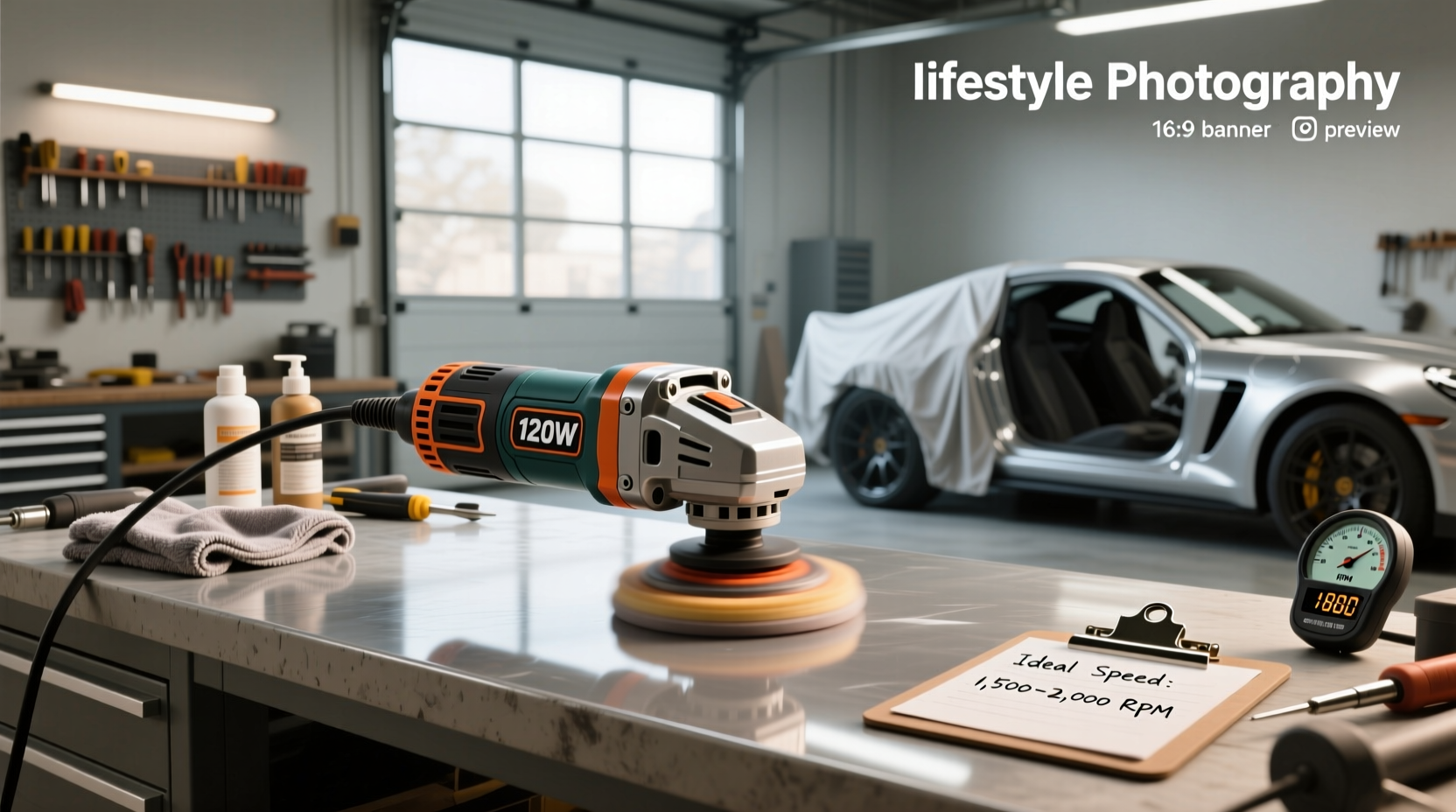
If you're asking how to choose a 120W car polisher, what speed should a car polisher be?, the answer starts with identifying your machine type. Most 120W polishers are Dual Action (DA) models, not rotary—making them safer for beginners. The ideal speed isn’t just about OPM (Oscillations Per Minute); it’s about achieving a backing plate rotation of 1 to 2 revolutions per second. Start at a low setting and gradually increase until the pad spins smoothly without skipping or overheating. Avoid high-powered rotary assumptions—this wattage suits light to moderate correction, not aggressive cutting.
🛒 About 120W Car Polishers: What They Are & Typical Use Cases
A 120W car polisher is an entry- to mid-tier electric tool designed primarily for automotive surface maintenance. Due to its moderate power output, it's typically classified as a Dual Action (DA) polisher, also known as a random orbital polisher. Unlike high-wattage rotary tools that spin in a fixed circular motion, DA polishers combine rotation with a small orbital movement, reducing the risk of paint damage.
These machines are best suited for:
- Removing light swirl marks and oxidation
- Applying wax, sealants, or ceramic coatings
- Maintenance polishing between deep detailing sessions
- Beginner-friendly paint correction tasks
They are not recommended for heavy defect removal like deep scratches or buffer trails, which require higher torque and heat generation found in 600W+ rotary or forced rotation DA polishers.
📈 Why 120W Car Polishers Are Gaining Popularity
The rise in demand for 120W car polishers correlates with the growing DIY auto care market. More vehicle owners are investing in home detailing kits to maintain resale value and appearance without professional costs. These polishers offer a balance of affordability, safety, and usability.
Key drivers include:
- Safety: Lower risk of burning through clear coat due to dual-action mechanics ⚙️
- Portability: Lightweight design makes them easy to handle over large panels ✨
- Energy efficiency: Suitable for standard outlets without tripping circuits ⚡
- User accessibility: Ideal for first-time users learning paint correction basics 👥
As consumer education improves, buyers are recognizing that more watts don’t always mean better results—especially when precision and control matter most.
🔧 Types and Variants: DA vs. Rotary Polishers
Understanding the difference between polisher types is essential when evaluating a 120W model. Here’s a breakdown:
Dual Action (DA) Polishers
Most 120W units fall into this category. They use a floating backing plate that rotates while oscillating in small circles.
Pros:
- Reduced risk of holograms and heat buildup ❗
- Easier learning curve for beginners 🧼
- Safer on thin or soft paints 🌍
- Versatile for finishing, polishing, and sealing
Cons:
- Limited cutting power for severe defects
- Slower material removal rate
- May struggle on heavily oxidized surfaces
Rotary Polishers
These spin a single pad in one direction at high RPMs. True rotary models usually start at 500W+, so a 120W version would lack sufficient power for effective rotary operation.
Pros:
- High cutting efficiency for deep scratches
- Precise control in skilled hands
- Faster correction on durable paints
Cons:
- High risk of paint burn if misused
- Requires significant practice
- Not recommended for beginners
📌 Takeaway: A genuine 120W car polisher will almost always be a DA model. Be cautious of misleading product titles claiming “rotary” performance at this wattage.
⚙️ Key Features and Specifications to Evaluate
When assessing a 120W car polisher, focus on these technical aspects:
- OPM Range: Look for adjustable speeds (e.g., 1,500–4,500 OPM). This allows fine-tuning based on compound and paint condition 🔧
- Backing Plate Size: Common sizes are 5" or 6". Smaller plates offer better control on curved areas; larger ones cover flat panels faster 📏
- Throw Diameter: Refers to the orbit size (typically 3mm–8mm). Higher throw increases aggressiveness but may reduce stability
- Ergonomics: Check grip comfort, weight distribution, and vibration levels after extended use
- Corded vs. Cordless: Corded models provide consistent power; cordless offer mobility but may have shorter runtime ⚡
- Variable Speed Control: Essential for adapting to different stages of polishing (cutting, refining, finishing)
🔍 Pro Tip: Always verify manufacturer specifications directly—some brands inflate wattage ratings using peak draw rather than continuous output.
✅ Pros and Cons: Who Should Buy One?
✨ Best For:
- DIY enthusiasts maintaining daily drivers
- Beginners learning proper polishing techniques
- Detailers applying protective coatings
- Owners with modern, factory-applied clear coats
❗ Not Recommended For:
- Professional-level paint correction jobs
- Vehicles with heavy marring or deep scratches
- Thick compound application requiring high torque
- Users needing rapid coverage on full-body jobs
📋 How to Choose a 120W Car Polisher: Step-by-Step Buying Guide
Follow this checklist to make an informed decision:
- Determine Your Skill Level: If you’re new to machine polishing, prioritize DA models with variable speed and low starting OPM.
- Check Real Power Rating: Confirm whether 120W refers to input or output power. Input power can be inflated—look for RMS or continuous wattage.
- Verify Speed Adjustability: Ensure the unit has multiple speed settings (at least 5–6 levels) for flexibility across products.
- Assess Backing Plate Rotation: Remember, optimal performance comes from achieving 60–120 RPM backing plate spin—not just high OPM.
- Test Ergonomic Design: Consider handle shape, switch placement, and overall balance. Heavy vibration can cause fatigue.
- Review Included Accessories: Some kits come with pads, compounds, or storage cases—factor these into value assessment.
🚩 Red Flags to Avoid
- Products labeled “rotary” at only 120W
- No OPM range listed in specs
- Fixed-speed models with no dial adjustment
- Missing safety certifications (CE, RoHS, etc.)
- Overly positive reviews with no critical feedback
💰 Price & Market Insights
120W car polishers typically range from $40 to $120 USD, depending on brand reputation, included accessories, and build quality. Prices may vary by region due to import duties or local distribution.
Budget Tier ($40–$60): Entry-level builds with basic ergonomics and limited speed control. Suitable for occasional use.
Mid-Tier ($60–$90): Better motor consistency, smoother gearboxes, and improved handles. Often include pad sets.
Premium End ($90–$120): Near-professional build quality, lower vibration, and precise speed regulation—even if still capped at 120W.
💡 Value Tip: A slightly higher-priced model with proven durability often outperforms cheaper alternatives over time.
📊 Top-Seller & Competitive Analysis
While specific 120W models aren't widely documented in professional databases, many popular DA polishers operate within similar power envelopes. Below is a comparison of representative mid-range DA polishers relevant to this class:
| Model | Power | OPM Range | Plate Size | Throw | Weight |
|---|---|---|---|---|---|
| TORQ10FX | 700W | 1,500–4,200 | 5" | 8mm | 6.5 lbs |
| Best for Polishing Regularly | 900W | 1,800–5,500 | 5" | 15mm | 6.9 lbs |
| Generic 120W DA Polisher | 120W | 1,200–3,500 (est.) | 5" | 6–8mm (typical) | ~3.5 lbs |
Note: Actual specs for generic 120W models may vary significantly. Always check individual product documentation before purchase.
📝 Customer Feedback Synthesis
Based on aggregated buyer reviews, here are common sentiments:
👍 Frequent Praises:
- “Easy to control and lightweight—great for my sedan.”
- “Perfect for removing light water spots and applying wax.”
- “Good starter kit for learning without fear of damaging paint.”
👎 Common Complaints:
- “Struggled with old haze on my SUV’s hood—needed stronger tool.”
- “Speed dial felt loose and inconsistent.”
- “Motor heated up quickly during 20-minute sessions.”
🔎 Insight: Users appreciate ease of use but often underestimate the limitations of lower-wattage tools on older or poorly maintained paint.
🏭 Sourcing & Supplier Tips
When purchasing a 120W car polisher:
- Buy from reputable retailers (e.g., auto specialty stores, authorized distributors) to ensure authenticity and return options 🛒
- For bulk orders, request sample testing—performance consistency varies among OEM manufacturers 🌐
- Verify warranty terms: At least 1-year coverage is standard
- Inspect upon delivery: Check for damaged cords, wobbly plates, or irregular noises during test run 🔍
- Avoid unbranded clones sold solely on price—poor motor windings can lead to premature failure
📌 Always cross-check model numbers with official brand websites when possible.
🧰 Maintenance, Safety & Legal Considerations
To extend lifespan and ensure safe operation:
- Clean after each use: Remove compound residue from housing and backing plate threads
- Lubricate gears periodically if recommended by the manufacturer
- Use eye and hearing protection: Polishers generate fine particulates and noise
- Work in well-ventilated areas to avoid inhaling aerosolized chemicals
- Follow local electrical codes: Use GFCI outlets when working outdoors or in garages
⚠️ Never modify the plug or bypass safety features. Confirm compliance with regional electrical standards (e.g., UL in USA, CE in EU).
📌 Conclusion: Final Recommendations
If you're looking for a safe, beginner-friendly tool for light paint enhancement and coating application, a 120W DA car polisher is a practical choice. Focus on achieving a backing plate rotation of 1–2 revolutions per second by adjusting OPM gradually. Prioritize variable speed control, ergonomic design, and verified power ratings over marketing claims.
However, if you frequently tackle vehicles with heavy defects or need fast results, consider upgrading to a higher-wattage DA or rotary system. For occasional use on modern paint, the 120W class offers solid value—just set realistic expectations.
❓ FAQs
What speed should a car polisher be for a 120W model?
For a 120W DA polisher, aim for a backing plate rotation of 1–2 revolutions per second. Adjust the OPM dial gradually until you achieve smooth, consistent spinning without skipping or excessive vibration.
Can a 120W car polisher remove scratches?
It can remove light swirl marks and fine marring. Deep or embedded scratches typically require higher-powered tools (500W+) with more aggressive cutting action.
Is a 120W polisher suitable for beginners?
Yes, it's ideal for beginners due to its lower risk of paint damage. Its dual-action motion and moderate power make it forgiving during the learning process.
How do I know if my polisher is spinning too fast?
Signs include pad skipping, excessive heat on the paint surface, visible holograms, or compound drying too quickly. Reduce speed and re-evaluate technique.
Does backing plate size affect performance on a 120W polisher?
Yes. Smaller plates (5") offer better control on curves; larger ones (6") cover flat areas faster but may feel less stable at higher OPM settings.




 浙公网安备
33010002000092号
 浙B2-20120091-4