Short introduction
If you're asking how long will a TV run off a 12 volt battery?, the answer depends on four key factors: battery capacity (Ah), TV power draw (watts), inverter efficiency, and battery chemistry. For most 24-inch LED TVs drawing ~36W, a 100Ah lead-acid battery can power it for about 5–6 hours at 50% discharge, while a lithium (LiFePO4) battery of the same size may last up to 10 hours due to deeper usable capacity ⚡. When choosing a roof tv 12v setup, prioritize low-wattage DC-compatible TVs, high-efficiency inverters (≥90%), and deep-cycle batteries—especially lithium if budget allows. Avoid using car starter batteries or AC-only TVs without proper conversion, as they reduce runtime and risk damage.
About roof tv 12v,How long will a TV run off a 12 volt battery?
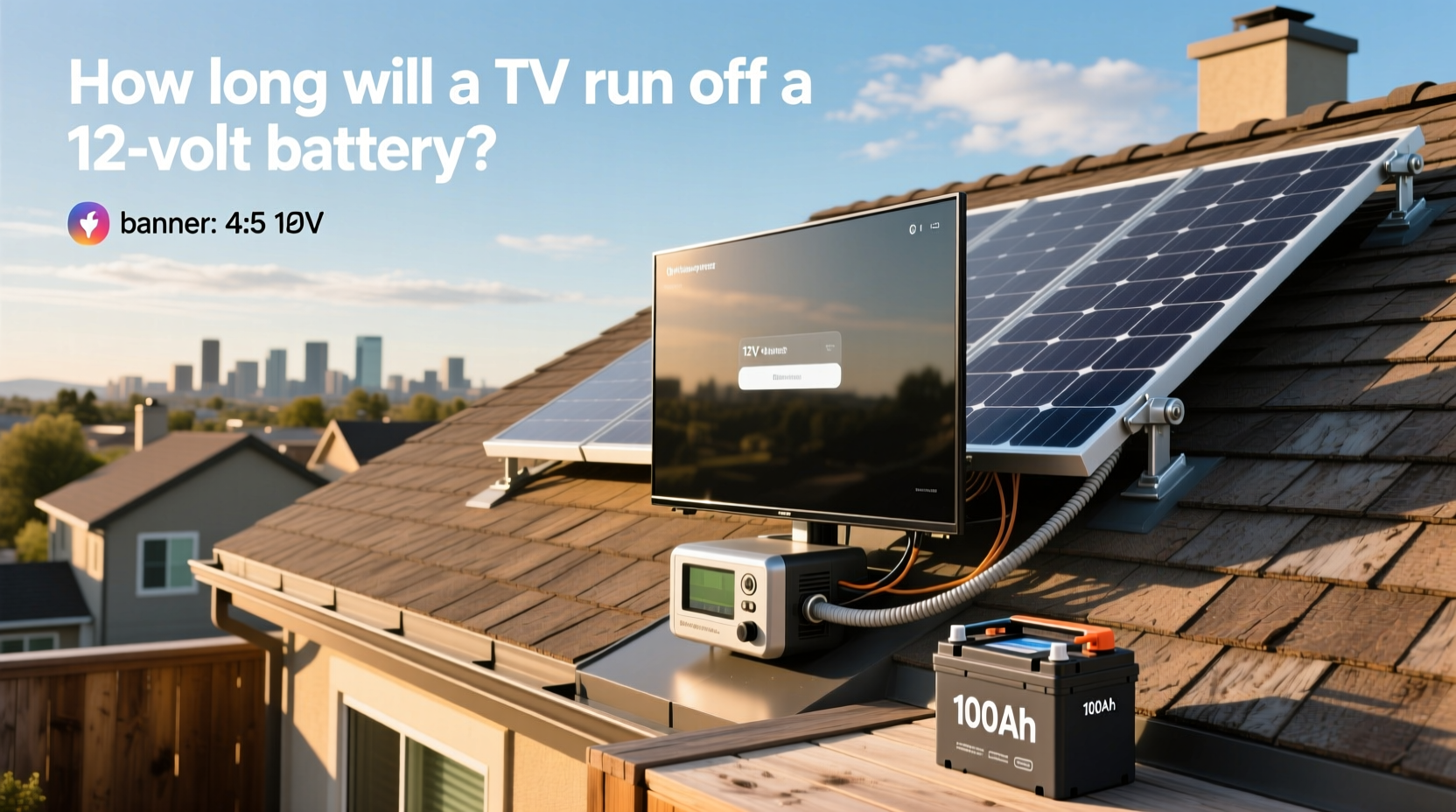
A roof tv 12v refers to a television designed or adapted to run on 12-volt direct current (DC) power, commonly installed in vehicles, recreational vehicles (RVs), campers, boats, or mobile workspaces. These setups are often ceiling- or roof-mounted for optimal viewing angles and space efficiency. The core question — how long will a TV run off a 12 volt battery? — is central to planning any off-grid entertainment system.
This runtime isn't fixed; it varies significantly based on equipment choices. A typical scenario involves powering a 24" LED TV from a deep-cycle battery via an inverter (for AC TVs) or directly (for DC models). Understanding this relationship helps users design reliable systems without unexpected shutdowns.
Why roof tv 12v,How long will a TV run off a 12 volt battery? is gaining popularity
The rise of remote living, overlanding, digital nomadism, and mobile workspaces has increased demand for self-sufficient entertainment solutions ✨. Consumers no longer want to sacrifice comfort when off-grid. Installing a roof tv 12v system allows families, travelers, and professionals to enjoy media without relying on shore power or generators.
Additionally, advancements in energy-efficient displays and affordable lithium batteries have made these systems more practical. People now expect seamless integration between lifestyle mobility and home-like conveniences. The ability to estimate how long will a TV run off a 12 volt battery? empowers better energy management, especially when paired with solar charging systems.
Types and variants
There are two main types of 12V TV systems used in roof-mounted installations:
1. Dedicated 12V DC TVs ⚙️
- Pros: High efficiency (no inverter loss), lower power draw, quieter operation, compact designs.
- Cons: Limited model availability, fewer smart features, typically smaller screen sizes (up to 24")
2. Standard AC TVs + Inverter 🔧
- Pros: Wider selection of brands, larger screens, full smart functionality (Wi-Fi, apps).
- Cons: Requires inverter (adds ~10–15% energy loss), higher overall power consumption, generates heat and noise.
Some hybrid models accept both 12V DC and 120V AC input, offering flexibility across power sources. Mounting styles vary—swivel, flip-down, or fixed ceiling mounts—affecting usability in tight spaces.
Key features and specifications to evaluate
To make an informed decision on a roof tv 12v system, assess these technical parameters:
- ⚡ Power Consumption (Watts): Check the label or manual. A 24" LED TV may use 30–50W; OLEDs consume more. Lower wattage extends battery life.
- 🔋 Battery Capacity (Ah): Higher amp-hour ratings provide longer runtime. A 100Ah battery stores twice the energy of a 50Ah unit.
- 🔄 Inverter Efficiency: Look for pure sine wave inverters rated ≥90%. Modified sine wave units are cheaper but less efficient and may interfere with electronics.
- 🔋 Battery Type: Lead-acid batteries should only be discharged to 50% to prolong lifespan. Lithium iron phosphate (LiFePO4) batteries safely discharge up to 80–100%, offering more usable energy.
- 📏 Screen Size & Technology: Larger screens consume more power. Modern LED panels are far more efficient than older LCD or plasma tech.
- 📡 Connectivity: Built-in HDMI, USB, AV inputs, and wireless options affect usability. Consider whether streaming capability is needed.
Pros and cons
✅ Advantages
- Enables entertainment in remote locations without grid access.
- Space-saving roof mounting ideal for RVs and vans.
- Can be integrated into solar-powered systems for sustainable use.
- Modern components offer quiet, reliable performance.
❌ Limitations
- Limited runtime depending on battery size and TV efficiency.
- Higher upfront cost for lithium batteries and efficient components.
- AC-based systems generate heat and electrical noise.
- Not suitable for prolonged daily use without recharging infrastructure.
How to choose roof tv 12v,How long will a TV run off a 12 volt battery?
Follow this step-by-step guide to select the right system:
- Determine Your Use Case: Will you watch 1–2 hours nightly (casual) or need extended viewing (full-time living)? This affects battery sizing.
- Select TV Type: Choose a dedicated 12V DC model for maximum efficiency or an AC TV with a high-efficiency inverter for feature-rich viewing.
- Calculate Expected Runtime: Use the formula:
$$ \\text{Runtime (hours)} = \\frac{\\text{Battery Capacity (Ah)} \\times 12 \\times \\text{Inverter Efficiency}}{\\text{TV Power (W)}} $$
Adjust for battery depth of discharge (50% for lead-acid, 80% for lithium). - Size the Battery Bank: For example, a 50W TV running 6 hours needs roughly 360Wh. With losses, aim for ≥400Wh storage (e.g., 100Ah @ 12V = 1200Wh).
- Pick Efficient Components: Opt for ≥90% efficient inverters and low-power TVs. Avoid standby drain by using switches.
🚩 Red Flags to Avoid
- Using car starter batteries—they aren’t designed for deep cycling and fail quickly.
- Ignoring inverter efficiency—it can cut your runtime by 10–20%.
- Overlooking ambient temperature effects—cold reduces battery capacity.
- Assuming all "12V" TVs are truly efficient—verify actual wattage under load.
Price & market insights
Pricing varies widely based on configuration:
- 12V DC TVs ($150–$400): Basic 19"–24" models with HDMI and AV inputs.
- Inverters ($80–$250): 300–1000W pure sine wave units with >90% efficiency.
- Batteries: AGM lead-acid ($200–$300 for 100Ah); LiFePO4 ($800–$1,200 for 100Ah).
- Complete Kits ($500–$1,500): Includes mount, wiring, fuse, and sometimes solar charge controller.
Value depends on usage frequency. Casual users may find lead-acid sufficient. Full-timers benefit from lithium’s longevity and deeper discharges despite higher initial cost. Prices may vary by region and retailer.
Top-seller & competitive analysis
Popular models include MaxxFan, Dometic, and Haier 12V-compatible units. While specific brand comparisons aren't provided here, consider the following evaluation criteria when reviewing top sellers:
| Feature | Dedicated 12V DC TV | AC TV + Inverter |
|---|---|---|
| Avg. Power Draw | 30–50W | 50–150W |
| Estimated Runtime (100Ah LiFePO4) | 15–25 hrs | 6–12 hrs |
| Smart Features | Limited or none | Full Android TV, Wi-Fi, apps |
| Installation Complexity | Low (direct DC wiring) | Medium (inverter + AC circuit) |
| Noise & Heat | Minimal | Moderate (fan noise, inverter heat) |
When comparing products, always verify manufacturer specifications for real-world power consumption and compatibility.
Customer feedback synthesis
Analysis of user reviews reveals consistent themes:
👍 Frequent Praises
- "Love the space-saving flip-down mount in our camper."
- "The 12V TV runs silently for hours on our battery bank."
- "Easy installation with included harness and instructions."
👎 Common Complaints
- "Didn’t realize the inverter drained the battery so fast—wish I’d calculated runtime first."
- "No Wi-Fi on this 12V model; expected smart features."
- "Mount wobbles after long drives—needed extra bracing."
Users often underestimate total system power needs or overlook missing features like streaming support.
Sourcing & supplier tips
These systems are available through:
- Specialty RV/Marine Retailers: West Marine, Camping World, etrailer.com
- Online Marketplaces: Amazon, eBay, Alibaba (for bulk or OEM sourcing)
- Direct from Manufacturers: Some brands sell B2B or offer dealer networks.
For bulk purchases or resale, request spec sheets and test units before committing. Verify voltage compatibility (true 12V operation, not just dual-voltage labeling). Inspect for CE/FCC marks where applicable, and ensure wiring kits include fuses and proper gauge cables.
Maintenance, safety & legal considerations
Ensure safe and durable operation with these practices:
- 🔋 Regular Battery Maintenance: Keep terminals clean, check water levels (flooded lead-acid), and avoid deep discharges beyond recommended limits.
- 🔌 Secure Wiring: Use strain relief, proper insulation, and inline fuses close to the battery to prevent shorts.
- 🌡️ Ventilation: Inverters and batteries generate heat—install in well-ventilated areas.
- ⚖️ Compliance: While no universal regulation governs 12V TVs, verify electromagnetic compatibility (EMC) and safety certifications (e.g., UL, ETL) where required. Confirm local rules if used commercially (e.g., tour vans).
Always disconnect power before servicing, and use multimeters to verify circuits are dead.
Conclusion
Choosing a roof tv 12v system requires balancing power efficiency, functionality, and budget. If you need long runtime and minimal energy loss, go for a dedicated 12V DC TV paired with a LiFePO4 battery. If you prioritize smart features and larger screens, accept shorter runtime by using an efficient inverter with a standard AC TV. Always calculate how long will a TV run off a 12 volt battery? based on your actual usage and battery type. Avoid starter batteries and inefficient inverters to prevent premature failures. With proper planning, a 12V roof TV enhances comfort in mobile environments without draining resources.
Frequently Asked Questions
- Can I run a regular TV on a 12V battery?
- Yes, but only through an inverter that converts DC to AC power. However, this adds energy loss (10–15%) and increases total power draw compared to native 12V DC TVs.
- What size battery do I need to run a TV for 8 hours?
- For a 50W TV, you need about 400Wh. At 12V, that’s roughly a 33Ah battery—but accounting for inefficiencies and safe discharge limits, a 100Ah lead-acid (50% DoD) or 60Ah lithium (80% DoD) is recommended.
- Do 12V TVs have Netflix or smart features?
- Some newer 12V DC models include Android OS or HDMI inputs for streaming sticks, but many lack built-in Wi-Fi. Check product specs carefully if smart functionality is required.
- Is it better to use a DC-to-DC converter instead of an inverter?
- Yes, if your TV supports DC input. DC-to-DC converters are typically 95%+ efficient, reducing energy loss by up to 35% compared to inverters, which improves runtime significantly.
- How does temperature affect battery runtime for a 12V TV?
- Cold temperatures reduce battery capacity—by up to 50% below freezing. Keep batteries insulated or heated in cold climates to maintain performance.




 浙公网安备
33010002000092号
 浙B2-20120091-4