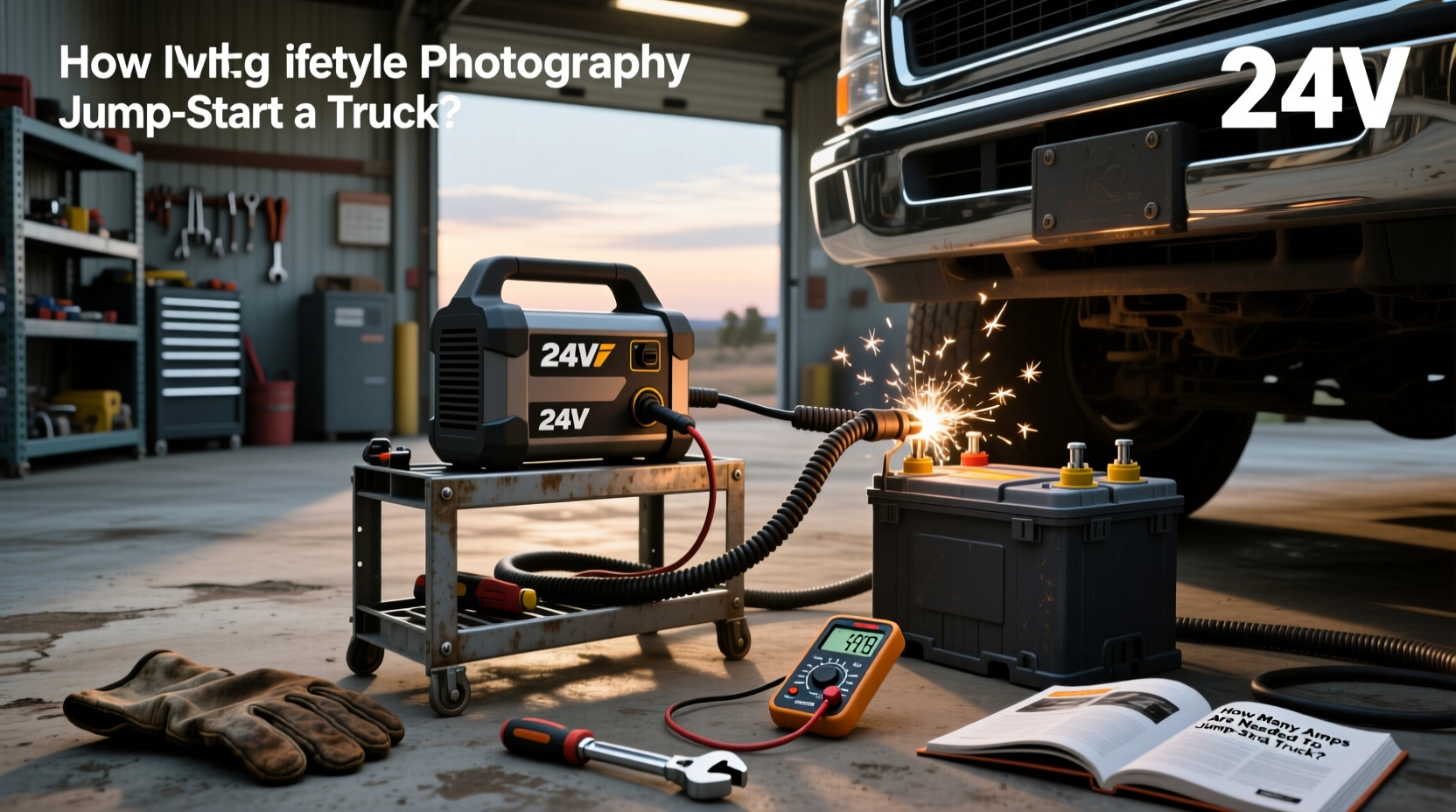
About 24V Jump Starters for Trucks and Amp Requirements
A 24V jump starter for truck is a specialized power device designed to deliver high current to start vehicles with 24-volt electrical systems—commonly found in medium to heavy-duty diesel trucks, commercial buses, and construction equipment 1. Unlike standard 12V jump starters used for passenger cars, these units must match the higher voltage of dual-battery setups wired in series.
The core question—how many amps are needed to jump-start a truck?—depends on engine type, displacement, ambient temperature, and battery condition. Diesel engines require significantly more cranking power due to high compression ratios. As a rule of thumb, small diesel pickups may need 2,000–3,000 peak amps, while large Class 8 trucks often demand 4,000A or higher 2.
Why 24V Jump Starters Are Gaining Popularity
Fleets, long-haul truckers, and mobile mechanics increasingly rely on portable 24V jump starters to reduce downtime. Traditional methods—like jumper cables from another vehicle—are impractical in remote locations or during emergencies. Modern 24V units offer instant access to starting power without requiring a second vehicle.
Advancements in lithium-ion technology have made these devices lighter, more compact, and capable of maintaining charge over extended periods. This portability supports preventative maintenance routines and roadside assistance operations, especially in cold climates where battery performance drops sharply.
Types and Variants of 24V Jump Starters
Different designs cater to varying usage scenarios. Understanding the trade-offs between types helps align your choice with operational needs.
🔧 Lithium-Ion Portable Units
- Pros: Lightweight (5–15 lbs), compact, fast recharge, long shelf life, often include USB ports for charging devices.
- Cons: Less effective below -10°C unless specifically rated; lower cycle life under heavy daily use.
- Best for: Personal truck owners, technicians, emergency responders needing mobility.
🏭 Sealed Lead-Acid (SLA) Industrial Models
- Pros: Durable, stable performance in extreme cold, higher surge capacity, longer lifespan with regular charging.
- Cons: Heavy (30–60 lbs), bulky, slower recharge, require periodic maintenance.
- Best for: Workshops, fleet depots, service trucks with stationary storage.
🔌 Dual-Voltage (12V/24V) Hybrid Systems
- Pros: Versatile—can start both car and truck batteries; ideal for mixed fleets.
- Cons: Slightly heavier than single-voltage Li-ion; premium pricing.
- Best for: Tow operators, multi-vehicle households, repair shops.
Key Features and Specifications to Evaluate
When evaluating a 24v jump starter for truck, How many amps are needed to jump-start a truck? is just one part of the equation. Consider these technical and practical factors:
⚡ Voltage Compatibility
Ensure the unit matches your truck’s system. Using a 12V starter on a 24V system will fail to crank the engine. Conversely, connecting a 24V starter to a 12V battery can damage electronics 3. Always verify your vehicle's voltage before purchasing.
📊 Peak Amps vs. Cold Cranking Amps (CCA)
Manufacturers often advertise "peak amps," which reflect short bursts of current. However, Cold Cranking Amps (CCA) indicate sustained output at 0°F (-18°C)—a better metric for reliability in winter. A good guideline: aim for a CCA rating of at least twice the engine’s cubic inch displacement 3.
🔋 Battery Chemistry
Lithium-ion dominates consumer models due to energy density and low self-discharge. SLA remains preferred in professional settings for its robustness under repeated cycling and wide operating temperatures.
✅ Safety Protections
Look for built-in safeguards:
- Reverse Polarity Protection: Prevents damage if clamps are reversed.
- Spark-Proof Technology: Eliminates ignition risk near flammable gases.
- Overload/Short Circuit Protection: Shuts down power during faults.
- Overcharge Protection: Preserves internal battery health.
🧰 Build Quality and Portability
Assess cable thickness, clamp durability, housing material, and handle design. For field use, rubberized casings and rugged connectors resist drops and moisture. Check weight: units over 20 lbs become cumbersome for frequent transport.
Pros and Cons of 24V Jump Starters for Trucks
👍 Advantages
- Enables independent restarts without external help
- Saves time and towing costs
- Compact modern versions fit in cab storage
- Multi-functional models charge phones/tablets
- Supports preventive maintenance checks
👎 Limitations
- High-capacity models can be expensive ($300–$800)
- Lithium units may underperform in extreme cold
- Improper use risks electrical damage
- Requires periodic recharging even when idle
- Not a substitute for failing alternators or deeply sulfated batteries
How to Choose a 24V Jump Starter for Your Truck: A Step-by-Step Guide
Follow this checklist to make an informed decision tailored to your needs:
- Confirm Vehicle Voltage: Most heavy-duty trucks use 24V systems via two 12V batteries in series. Check your owner’s manual or battery configuration.
- Determine Engine Type and Size: Diesel engines generally require 1,500+ peak amps. Use the table below as a reference.
- Evaluate Operating Environment: If working in sub-zero climates, prioritize units with high CCA ratings and cold-weather certifications.
- Select Battery Type: Choose lithium-ion for portability, SLA for durability.
- Verify Safety Features: Ensure reverse polarity, overload, and spark-proof protections are included.
- Check Additional Functions: Built-in air compressors, flashlights, or USB outputs add utility.
- Review Warranty and Support: Look for minimum 1-year warranty and accessible customer service.
- Units that don’t clearly state voltage output (12V/24V)
- No listed CCA or peak amp specifications
- Absence of safety certifications (e.g., CE, FCC, RoHS)
- Extremely low prices (<$100) for claimed 4,000A+ output—likely exaggerated
- Customer reviews reporting failure after first or second use
| Vehicle Type | Engine / Fuel | Recommended Peak Amps | Use Case |
|---|---|---|---|
| Diesel Cars / Light Pickups | 2.0L–3.0L Diesel | 2,000–3,000A | Personal use, rural areas |
| Heavy-Duty Pickups | 3.0L+ Diesel | 3,000–4,000A+ | Fleet operations, delivery |
| Commercial Buses / Trucks | High-Displacement Diesel | 4,000A+ | Service vehicles, depots |
| Construction Equipment | Large Diesel Engines | 4,000A+ | Mining, agriculture |
Price & Market Insights
Pricing varies widely based on capacity, chemistry, and brand reputation:
- $100–$250: Entry-level lithium units (up to 3,000A); suitable for light-duty diesel trucks.
- $250–$500: Mid-range dual-voltage or high-output Li-ion; ideal for most personal and small fleet uses.
- $500–$800+: Industrial SLA or advanced lithium systems with 4,000A+ output; built for daily professional use.
Value isn’t solely about price per amp. Consider total cost of ownership: cycle life, warranty length, and accessory integration. Higher-priced models often offer better longevity and support.
Top-Seller & Competitive Analysis
While specific model recommendations aren't provided, leading products in the 24v jump starter for truck category commonly share these traits:
- Dual-voltage capability (12V/24V)
- Peak current ≥ 3,000A with clear CCA ratings
- Integrated digital display showing battery level and voltage
- Robust safety circuitry and IP-rated enclosures
- Positive feedback on ease of use and reliability
| Feature | Lithium Model Example | SLA Model Example | Hybrid (12V/24V) |
|---|---|---|---|
| Peak Amps | 3,000A | 4,500A | 3,500A (24V mode) |
| Battery Type | Lithium-Polymer | Sealed Lead-Acid | Lithium-Ion |
| Weight | 8.5 lbs | 42 lbs | 14 lbs |
| Cold Rating | Operates to -4°F | Stable at -22°F | Operates to -20°F |
| Extra Features | USB, LED light | Air compressor | USB, voltmeter |
Customer Feedback Synthesis
Analyzing buyer reviews reveals consistent themes:
🌟 Frequent Praises
- “Started my semi in -15°C with no issues”
- “Lightweight compared to old lead units”
- “Saved me three tow calls last winter”
- “Dual voltage works for both truck and SUV”
❗ Common Complaints
- “Battery drained after two months in garage” (lack of maintenance charging)
- “Clamps felt flimsy after first use”
- “Noisy fan on high-end model”
- “Instructions unclear for 24V connection sequence”
Sourcing & Supplier Tips
For individuals, reputable online retailers and auto parts stores offer reliable options with return policies. For bulk purchases (fleet deployment), consider direct suppliers or distributors offering:
- Volume discounts
- Extended warranties
- Custom branding (optional)
- Technical training materials
Always verify product specifications against manufacturer datasheets—not retailer descriptions. Request sample units for field testing before large orders. Confirm compliance with regional electrical safety standards (e.g., UL, ETL).
Maintenance, Safety & Legal Considerations
To ensure long-term reliability:
- Recharge every 3–6 months, even if unused.
- Store in dry, temperature-controlled environments.
- Inspect cables and clamps regularly for wear.
- Follow correct connection order: connect positive first, then negative to engine block (not battery).
While no universal regulations govern jump starter use, employers may have OSHA-compliant safety protocols for roadside repairs. Always follow site-specific guidelines when operating on highways or job sites.
Conclusion: Matching Power to Your Needs
Choosing the right 24v jump starter for truck, How many amps are needed to jump-start a truck? depends on engine size, climate, and usage frequency. If you operate a personal diesel pickup, a dual-voltage lithium unit with 2,000–4,000A output offers balance and convenience. For commercial fleets or extreme conditions, invest in industrial SLA models with 4,000A+ capacity and proven cold-weather performance. Prioritize verified specs, safety features, and build quality over marketing claims.
Frequently Asked Questions
- Can I use a 12V jump starter on a 24V truck system? No. A 12V unit cannot provide enough voltage to engage the starter motor on a 24V system. Attempting this will not start the engine and may damage the jump starter.
- What is the difference between peak amps and CCA? Peak amps measure maximum short-burst current, while Cold Cranking Amps (CCA) measure sustained output at 0°F. CCA is a better indicator of real-world starting power in cold weather.
- How often should I recharge my 24V jump starter? Recharge every 3–6 months to maintain battery health. Lithium models hold charge longer than SLA, but all units self-discharge over time.
- Are lithium jump starters safe in hot climates? Yes, most modern units include thermal protection. However, avoid prolonged exposure to direct sunlight or temperatures above 140°F (60°C).
- Can a jump starter fully replace a truck battery? No. Jump starters are temporary solutions. A failing battery should be tested and replaced promptly to avoid recurring issues.




 浙公网安备
33010002000092号
 浙B2-20120091-4