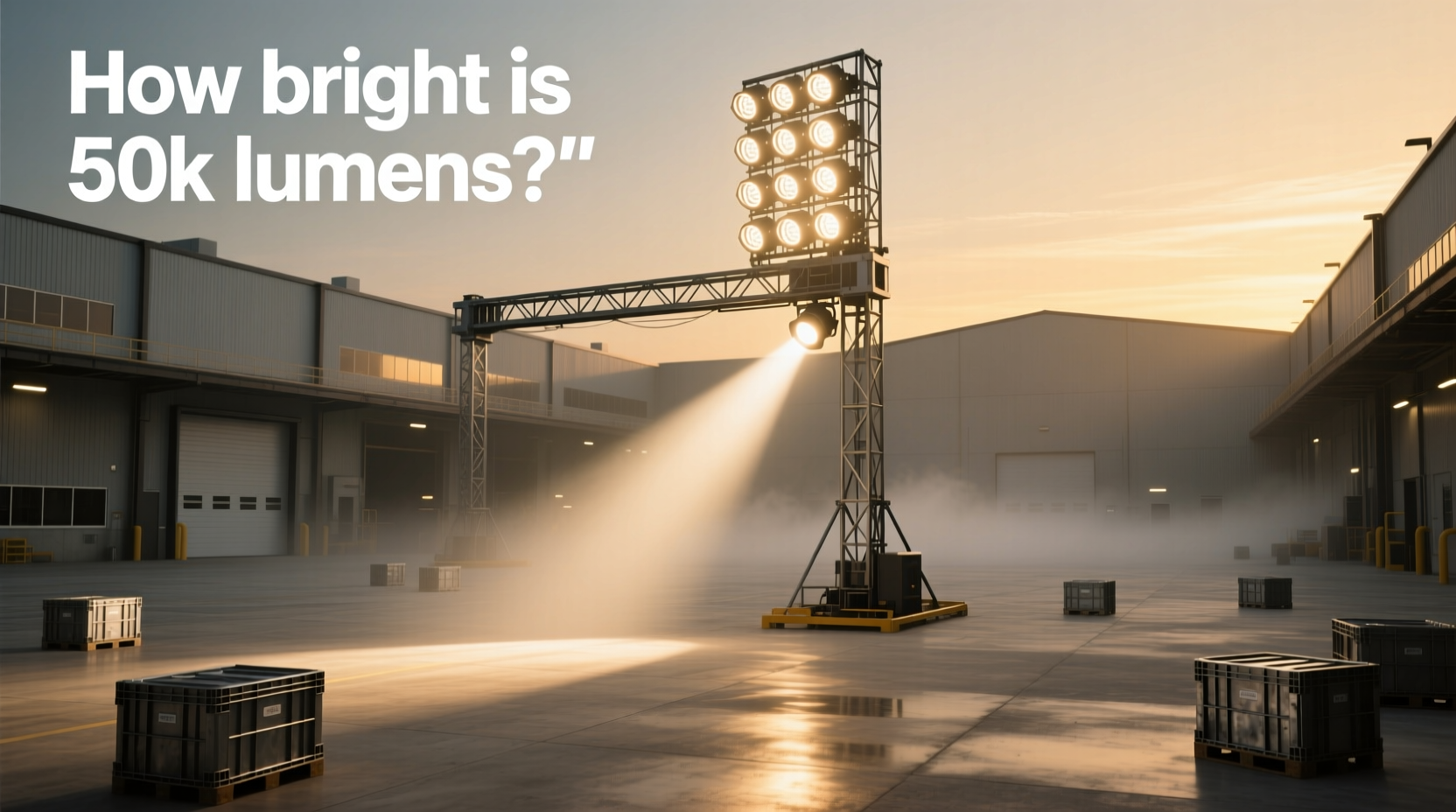
Short Introduction: What to Look for in LED 50,000 Lumens, How Bright Is 50K Lumens?
When considering how to choose LED 50000 lumens, how bright is 50k lumens?, start by recognizing that this level of brightness is not for everyday home use. A 50,000 lumen LED light delivers extreme illumination suitable for large industrial spaces, outdoor security areas, construction sites, or search and rescue operations ✅. Key factors include beam type (flood vs. spot), power draw (typically 300–400W), thermal management, and durability ratings like IP65 or higher 🌐. Avoid consumer-grade models claiming 50,000 lumens without verified output data ⚠️. For reliable performance, prioritize commercial or professional fixtures from reputable suppliers that provide clear photometric reports and realistic runtime estimates ⚙️.
About LED 50000 Lumens, How Bright Is 50K Lumens?
Lumens measure the total visible light emitted by a source, with higher values indicating greater brightness. At 50,000 lumens, an LED light produces an intense level of illumination far exceeding typical household bulbs 💡. For context, a standard 60-watt incandescent bulb emits about 800 lumens, while even high-output shop lights rarely exceed 5,000 lumens 1.
A 50,000-lumen fixture is comparable to multiple industrial-grade floodlights operating simultaneously. This intensity makes it ideal for environments requiring full visibility across expansive or poorly lit areas. Common applications include:
- 🏭 Large warehouses and manufacturing facilities
- 📍 Parking lots and perimeter security lighting
- 🔧 Construction zones and nighttime job sites
- 👥 Search and rescue missions using handheld spotlights
- ✨ Outdoor events needing temporary high-intensity lighting
The physical size and heat generation of such lights also increase significantly. Most units require active cooling systems, robust housings, and are designed for permanent mounting or specialized portable use.
Why LED 50000 Lumens, How Bright Is 50K Lumens? Is Gaining Popularity
Advancements in LED efficiency and thermal design have made ultra-high-lumen lighting more accessible and energy-efficient than traditional halogen or metal-halide alternatives ⚡. Users now seek powerful, long-lasting solutions that reduce maintenance frequency and operational costs over time.
Industries benefit from improved safety through better visibility, reduced accident rates, and enhanced surveillance capabilities when using 50,000-lumen floodlights. Additionally, emergency services and field operators value portable 50K lumen flashlights for their ability to illuminate distant objects—some models can project beams over 1,000 meters 2.
As prices for high-power LEDs decline and reliability improves, businesses and professionals are increasingly adopting these lights where mission-critical visibility matters most.
Types and Variants
Different form factors serve distinct purposes. Understanding the types helps match the right model to your needs.
🛒 LED Floodlights (Fixed Mount)
Ideal for permanent outdoor or ceiling installations.
Pros:- High durability (often IP68 rated)
- Wide beam coverage for area lighting
- Designed for continuous operation
- Long lifespan (50,000+ hours)
- Requires wiring and mounting hardware
- Limited portability
- Higher initial installation cost
🔋 High-Lumen Flashlights (Portable)
Battery-powered handheld devices reaching up to 50,000 lumens.
Pros:- Extremely bright for short bursts
- Mobility for field use
- Dual-beam options (spot + flood)
- Very short max-brightness runtime (~50 seconds)
- Heavy and bulky
- Premium pricing
🧰 Linear LED Light Packages
Modular strips or multi-fixture sets covering long spans (e.g., 32 feet).
Pros:- Uniform lighting across large interiors
- Often daisy-chainable
- Suitable for truck washes, barns, hangars
- Complex installation
- May require professional electrician
Key Features and Specifications to Evaluate
To make an informed decision on what to look for in LED 50000 lumens, how bright is 50k lumens?, assess the following technical aspects:
- ⚡ Actual Lumen Output: Verify manufacturer claims with independent testing or third-party lab reports. Some brands exaggerate peak outputs.
- 🔌 Power Consumption (Watts): Expect 300–400W for 50,000 lumens. Lower wattage with same output indicates higher efficiency.
- 🔦 Beam Angle & Type: Narrow spot beams reach farther; wide flood beams cover more ground. Dual-mode offers flexibility.
- 🌡️ Thermal Management: Look for aluminum heatsinks, fans, or passive cooling to prevent overheating and lumen depreciation.
- 🛡️ Ingress Protection (IP Rating): IP65 or higher recommended for outdoor/dusty environments.
- ⏳ Runtime (for portables): Check duration at various brightness levels. Turbo mode may last under a minute before throttling.
- 📏 Size and Weight: Impacts ease of transport and mounting requirements.
- 🔋 Battery Type (if applicable): Lithium-ion packs vary in capacity and replaceability.
Pros and Cons
✅ Advantages
- Unmatched brightness for large-scale visibility
- Energy-efficient compared to older technologies
- Long operational life reduces replacement frequency
- Versatile in industrial, security, and emergency contexts
❌ Limitations
- Overkill for residential or small-space use
- High power demand requires stable electrical supply
- Heat buildup necessitates proper ventilation
- Potential glare hazards if improperly aimed
How to Choose LED 50000 Lumens, How Bright Is 50K Lumens?
Follow this step-by-step checklist when evaluating products:
- Define Your Use Case: Are you lighting a warehouse, securing a compound, or conducting night searches? Match intensity and beam type accordingly.
- Check Verified Lumen Claims: Prefer products with published LM-79 photometric reports or third-party verification.
- Evaluate Beam Performance: Determine if you need long throw (spot) or wide coverage (flood). Some models offer both.
- Assess Power & Wiring Needs: Ensure your circuit can handle the load. Portable units should list battery life realistically.
- Review Durability Standards: Look for IK08 impact resistance and IP65/IP68 water/dust protection.
- Consider Heat Dissipation: Units without adequate cooling will dim prematurely or fail.
- Read Warranty Terms: Reputable brands offer 3–5 year warranties on commercial fixtures.
Red Flags to Avoid:
- ❌ No clear specifications or test data provided
- ❌ Claims of 50,000 lumens but only 200W power draw (physically implausible)
- ❌ Poor customer reviews regarding overheating or short lifespan
- ❌ Missing safety certifications (CE, RoHS, ETL where applicable)
Price & Market Insights
Pricing varies widely based on type, brand, and region:
- Fixed-mount floodlights: $200–$600 each
- Linear light packages (multi-unit): $800–$1,500
- High-end portable flashlights: $400–$900
Prices may differ depending on whether purchased individually or in bulk. Commercial suppliers often offer discounts for volume orders. Be cautious of extremely low-priced options online—these may misrepresent lumen output or use inferior components.
Value isn’t just about upfront cost. Consider total cost of ownership: energy efficiency, expected lifespan, and maintenance needs.
Top-Seller & Competitive Analysis
While specific models evolve, leading performers share common traits: transparent specs, solid build quality, and strong user feedback.
| Product Type | Power (W) | Lumens | Runtime | IP Rating | Key Feature |
|---|---|---|---|---|---|
| LED Floodlight | 350W | 50,000 | Continuous | IP68 | Weatherproof, wall-mountable |
| Linear Package (32ft) | 350W | 50,000 | Continuous | IP69K | Durable for wash bays |
| Handheld Flashlight | Battery-powered | 50,000 (turbo) | ~50 sec @ max | IP56 | Dual-beam, long throw |
When comparing top sellers, focus on real-world performance metrics rather than marketing headlines.
Customer Feedback Synthesis
Analysis of buyer reviews reveals consistent patterns:
👍 Frequent Praise Includes:- “Brighter than expected—completely transformed our loading dock visibility.”
- “Reliable in rain and dust—perfect for our outdoor storage yard.”
- “The dual beam on the flashlight saved us during a mountain rescue.”
- “Got hot quickly and shut down after two minutes at full power.”
- “Too bright for close work—caused glare in enclosed spaces.”
- “Battery pack died within six months despite moderate use.”
These insights highlight the importance of matching product capabilities to actual usage conditions.
Sourcing & Supplier Tips
For individuals or businesses sourcing 50,000-lumen lights:
- 🛒 Purchase Channels: Buy from established lighting suppliers, industrial equipment distributors, or authorized dealers to ensure authenticity.
- 📦 Bulk Orders: Inquire about volume pricing and lead times. Confirm compatibility across units if deploying multiple fixtures.
- 🔍 Verification Steps: Request datasheets, check for compliance marks, and verify return policies before ordering.
- 🧾 Inspection Upon Delivery: Test functionality immediately and inspect for shipping damage.
If importing internationally, confirm voltage compatibility and any required certifications in your country.
Maintenance, Safety & Legal Considerations
Proper handling ensures longevity and safe operation:
- 🛠️ Maintenance: Clean lenses regularly; inspect seals and mounts periodically. Replace batteries as needed in portable units.
- ⚠️ Safety: Avoid direct eye exposure. Mount lights securely to prevent falls. Use caution near flammable materials due to heat output.
- 📜 Compliance: Lighting used in public or commercial settings may be subject to local regulations regarding light pollution, directional aiming, or electrical codes. Always check manufacturer specs and confirm local requirements before installation.
Conclusion
If you need extreme brightness for industrial, outdoor security, or emergency response scenarios, a 50,000-lumen LED light can be a valuable investment. However, it’s essential to select the correct type—floodlight, linear array, or portable flashlight—based on your specific application. Prioritize verified performance data, durable construction, and appropriate beam characteristics. Avoid models lacking transparency in specifications or cooling design. By focusing on real-world usability and long-term reliability, you’ll make a smarter choice aligned with your operational demands.
FAQs
❓ How bright is 50,000 lumens in practical terms?
50,000 lumens is over 60 times brighter than a standard 60-watt incandescent bulb. It can fully illuminate a large parking lot or warehouse floor, making it suitable for commercial and industrial use.
❓ Can I use a 50,000-lumen light at home?
Generally not recommended. Such intense brightness is excessive for residential spaces and may cause discomfort or glare. These lights are designed for large-scale professional environments.
❓ Do 50,000-lumen flashlights stay at full brightness?
No. Due to heat buildup, most high-output flashlights automatically reduce brightness after a short turbo period—often around 50 seconds—to protect internal components.
❓ What power source do 50,000-lumen LED lights need?
Fixed units typically require hardwiring into a 120V/240V circuit capable of handling 300–400W. Portable versions use rechargeable lithium-ion battery packs.
❓ Are there safety risks with 50,000-lumen lights?
Yes. Risks include temporary vision impairment from direct exposure, fire hazard if installed near combustibles, and electrical overload if circuits are undersized. Proper installation and usage are critical.




 浙公网安备
33010002000092号
 浙B2-20120091-4