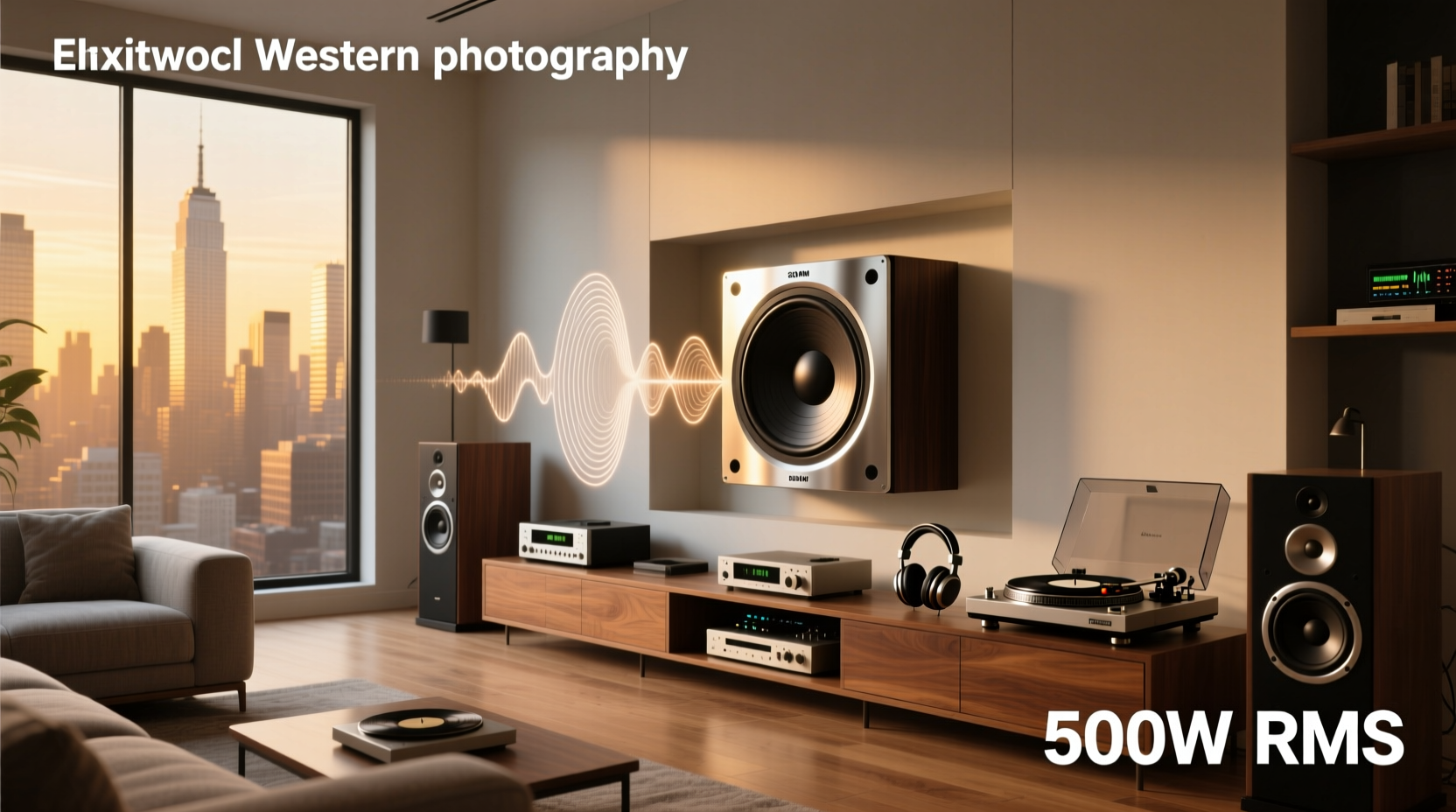
The term 500 watts RMS is central to selecting the right subwoofer for your audio system. Unlike peak power, which reflects short bursts, RMS (Root Mean Square) measures the continuous power a subwoofer can handle over time without overheating or distorting 1. This makes it the most reliable specification when building a balanced car or home audio setup. A 500W RMS subwoofer is designed to deliver deep, consistent bass when paired with a properly matched amplifier. Misunderstanding this rating can lead to underperformance or equipment failure—so knowing what to look for in a 500 rms subwoofer, what does 500 watts RMS mean? is essential before purchasing.
About 500 rms subwoofer, What does 500 watts RMS mean?
⚡A subwoofer rated at 500 watts RMS means it can continuously process 500 watts of power from an amplifier without sustaining damage or producing distorted sound 2. This number represents real-world performance rather than theoretical maximums. For example, during extended music playback or movie scenes with sustained low-frequency effects, the subwoofer operates within this safe power range.
RMS power differs significantly from peak power, which indicates momentary surges—like a sudden explosion in a film—that last only milliseconds. While some manufacturers highlight peak power in marketing materials, these figures are not sustainable and do not reflect daily usage conditions 3. Therefore, when evaluating a 500 rms subwoofer, always focus on its RMS handling capacity as the primary indicator of performance capability.
Why 500 rms subwoofer, What does 500 watts RMS mean? is gaining popularity
📈Subwoofers rated at 500 watts RMS have become increasingly popular due to their balance between output and efficiency. They offer strong bass response suitable for both car audio enthusiasts and home theater setups without requiring excessive electrical upgrades. In vehicles, a 500W RMS system often works well with standard alternators and battery systems, avoiding the need for additional capacitors or high-output charging components.
Additionally, many modern amplifiers are designed to deliver clean 500W output at stable impedances (2Ω or 4Ω), making integration straightforward. Users seeking immersive audio experiences—such as those enjoying EDM, action movies, or competitive car audio—find this power level sufficient for impactful low-end reproduction. The clarity and reliability associated with RMS-based matching also contribute to consumer trust in 500W-rated systems compared to higher peak-wattage models that may underperform in practice.
Types and variants
🔧Different types of 500W RMS subwoofers cater to various installation environments and sonic preferences:
- Single-Voice-Coil (SVC): Simple wiring, ideal for beginners. Offers one impedance option (e.g., 4Ω or 2Ω). Limited flexibility in multi-sub configurations.
- Double-Voice-Coil (DVC): Provides two voice coils per driver, allowing more wiring options (series or parallel). Enables better impedance matching with amplifiers but requires careful setup.
- Sealed Enclosures: Deliver tight, accurate bass. Best for musical accuracy and compact installations. Less efficient than ported designs.
- Ported (Bass Reflex) Enclosures: Produce louder, more resonant bass. Ideal for high-impact applications like movies or hip-hop. Larger size and potential for boomy sound if not tuned correctly.
- Bandpass Enclosures: Focused frequency output with high efficiency in a narrow band. Used in SPL competitions. Not suitable for general listening due to limited frequency response.
Key features and specifications to evaluate
🔍When assessing a 500 rms subwoofer, what does 500 watts RMS mean? goes beyond just power. Consider these critical factors:
- Sensitivity (dB): Measures how efficiently the sub converts power into sound. Higher sensitivity (≥85 dB) means louder output with less power.
- Frequency Response: Indicates the range of bass frequencies the sub can reproduce (e.g., 20–120 Hz). Lower starting points enable deeper bass.
- Impedance (Ohms): Must match your amplifier’s output capabilities. Common values: 2Ω, 4Ω, or dual 4Ω (for DVC).
- Excursion (Xmax): The distance the cone moves. Greater excursion allows deeper bass without distortion.
- Build Quality: Look for durable cones (polypropylene, carbon fiber), robust surrounds, and ventilated pole pieces for heat dissipation.
Always cross-check manufacturer specifications and avoid products lacking detailed technical data—a red flag for inconsistent quality control.
Pros and cons
✅ Pros
- Delivers powerful, consistent bass for most music genres and films
- Compatible with widely available Class D amplifiers
- Does not typically require upgraded vehicle electrical systems
- Offers good headroom when paired with 600W RMS amp (125% rule)
- Suitable for sealed or ported enclosures depending on preference
❗ Cons
- May struggle in large rooms or open spaces without multiple subs
- Requires precise impedance matching to avoid under/over-driving
- Limited output compared to 1000W+ systems used in SPL competitions
- Potential for distortion if amplifier clipping occurs
- Physical size may limit fitment in smaller vehicles
How to choose 500 rms subwoofer, What does 500 watts RMS mean? (Buying Guide)
🛒Follow this step-by-step checklist to make an informed decision:
- Confirm RMS Rating: Ensure the subwoofer specifies “500W RMS” clearly—not just “500W” or peak power.
- Match Impedance: Check whether your sub is 2Ω, 4Ω, or DVC. Select an amplifier that can deliver 500W RMS at that load.
- Select Amplifier Power: Aim for 500–625W RMS output (100–125% of sub’s rating) for optimal headroom 4.
- Verify Enclosure Type: Decide between pre-built or custom enclosures based on space and acoustic goals.
- Check Voice Coil Configuration: Use DVC models only if you plan to run multiple subs or need specific wiring flexibility.
- Avoid These Red Flags:
- No published RMS rating or incomplete specs
- Price too low for claimed performance (likely inflated peak ratings)
- Lack of thermal protection or venting features
- Incompatible impedance options for your setup
Test compatibility using online calculators or consult professional installers if unsure about wiring configurations.
Price & market insights
💰The price of a 500W RMS subwoofer varies based on brand, build quality, and region. Expect to pay:
- Budget Tier ($50–$100): Entry-level models with basic materials. May lack durability under continuous use.
- Mid-Range ($100–$200): Balanced performance with better cones, suspension, and heat management. Most recommended for everyday users.
- Premium Tier ($200+): High-excursion drivers, advanced motor structures, and superior longevity. Often used in competition builds.
Prices may differ across regions and retailers. Always compare total system cost—including amplifier and enclosure—rather than focusing solely on subwoofer price. Value is maximized when all components are properly matched.
Top-seller & competitive analysis
⭐Popular 500W RMS subwoofers vary by application. Below is a comparison of common types:
| Model Type | Impedance | Sensitivity | Best For | Considerations |
|---|---|---|---|---|
| SVC 12-inch | 4Ω | 86 dB | Compact cars, sealed boxes | Simple wiring, moderate output |
| DVC 12-inch | Dual 4Ω | 88 dB | Multi-sub setups, ported tuning | Flexible wiring, needs amp stability at 2Ω |
| 10-inch Sealed Unit | 2Ω | 84 dB | Tight bass, small trunks | Less volume, accurate response |
Note: Performance depends on enclosure design and amplifier pairing. Verify specs directly with manufacturers as ratings may vary by batch or region.
Customer feedback synthesis
👥Analysis of user reviews reveals recurring themes:
- Positive Feedback:
- “Clean, punchy bass with no distortion at high volumes”
- “Easy to integrate with my existing amplifier”
- “Well-built cone and surround lasted over three years with daily use”
- Common Complaints:
- “Received unit with torn surround—quality control issue”
- “Amplifier wasn’t delivering full power due to incorrect wiring”
- “Sound became muddy in ported box; needed retuning”
Issues often stem from improper installation or mismatched components rather than inherent product flaws. Reading verified purchase reviews helps identify consistent performers.
Sourcing & supplier tips
🌐When sourcing a 500W RMS subwoofer:
- Buy from authorized dealers or reputable online platforms to ensure authenticity.
- For bulk purchases (e.g., installation shops), contact distributors directly for wholesale pricing.
- Inspect packaging upon delivery—look for dents or moisture signs.
- Test functionality before final installation: check for free cone movement and listen for rattles.
- Verify return policies and warranty terms, especially when ordering internationally.
Be cautious of third-party sellers offering dramatically lower prices—these may be counterfeit or refurbished units labeled as new.
Maintenance, safety & legal considerations
🛠️To maintain performance and safety:
- Ensure proper ventilation around the subwoofer and amplifier to prevent overheating.
- Avoid prolonged operation at maximum volume to reduce wear on suspension components.
- Use fused power lines and secure wiring to prevent fire hazards.
- Check local noise ordinances if using high-output systems in public areas or residential zones.
- Periodically inspect connections for corrosion or looseness, especially in humid climates.
While no universal certification governs subwoofer use, compliance with vehicle electrical standards (where applicable) ensures long-term reliability.
Conclusion
If you're looking for a capable, reliable bass solution, a 500 rms subwoofer offers a smart balance of power and practicality. Understanding what does 500 watts RMS mean? ensures you select a model that matches your amplifier and usage needs. Focus on RMS—not peak—ratings, prioritize impedance compatibility, and invest in quality wiring and enclosures. Whether upgrading your car audio or enhancing a home theater, a properly matched 500W RMS system delivers satisfying low-end performance without unnecessary complexity.




 浙公网安备
33010002000092号
 浙B2-20120091-4