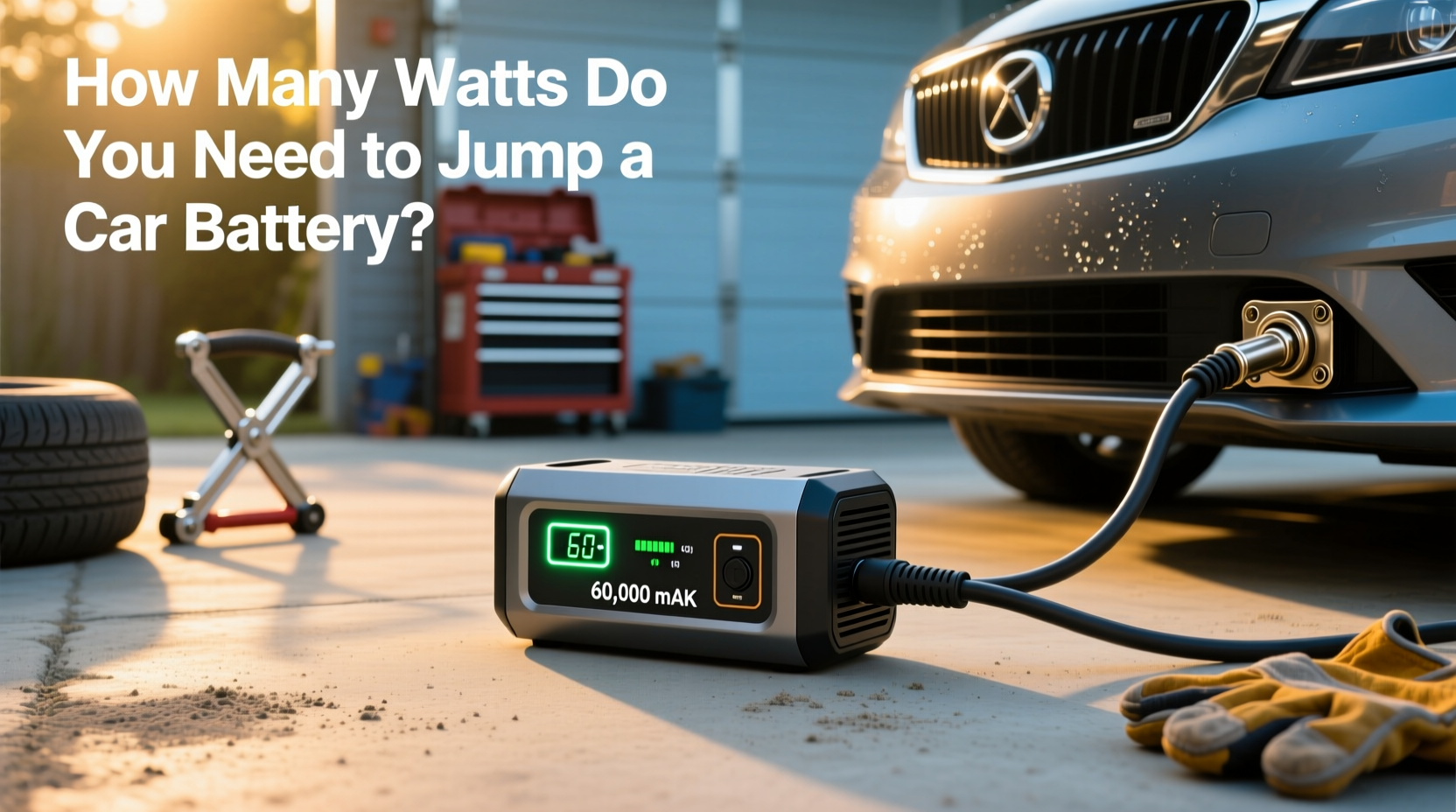
If you're asking how to choose a car jump starter 60000 mah,how many watts do you need to jump a car battery?, here's the core answer: The 60,000 mAh rating refers to battery capacity, not power output. What matters most is peak amps (PA) or cold cranking amps (CCA), not watts. For most gasoline cars, 800–2000 peak amps is sufficient. A 60,000 mAh unit offers high endurance for multiple jump attempts and device charging, but ensure it delivers at least 1000A PA for reliability, especially in cold climates 12. Avoid models that only list mAh without clear amp ratings.
About Car Jump Starter 60000 Mah, How Many Watts Do You Need to Jump a Car Battery?
⚡ A 60,000 mAh car jump starter is a portable lithium-powered device designed to deliver a surge of energy to start a vehicle with a dead battery. The "60,000 mAh" indicates its internal battery capacity—how much electrical charge it can store. This high capacity allows for multiple jump-starts on a single charge and doubles as a large power bank for phones, tablets, or laptops.
However, when answering how many watts do you need to jump a car battery?, the focus shifts from stored energy (mAh) to instantaneous power delivery. Watts are calculated as volts × amps. Most vehicles use 12V systems, so a jump starter delivering 1000A outputs 12,000W (12kW) during the crank 3. But manufacturers rarely advertise wattage; instead, they list peak amps (PA) or cold cranking amps (CCA), which are more practical indicators of starting power.
🛒 Typical use cases include emergency roadside starts, seasonal vehicle storage restarts, or supporting off-grid travel where access to another vehicle isn’t possible. These units are especially valuable for drivers in cold regions, older vehicles, or those with frequent short trips that don’t fully recharge the battery.
Why Car Jump Starter 60000 Mah, How Many Watts Do You Need to Jump a Car Battery? Is Gaining Popularity
🚗 Increasing vehicle electrification, aging car fleets, and extreme weather events have driven demand for reliable, self-contained jump starters. The 60,000 mAh models stand out because they offer extended usability beyond a single jump—ideal for families, fleet operators, or outdoor enthusiasts who need backup power for tools and devices.
🔍 Consumers are also becoming more informed about specs. Instead of guessing, buyers now research terms like CCA, PA, and mAh to avoid underpowered devices. This shift has led to clearer labeling and better product differentiation. Additionally, integration of features like USB-C PD, built-in flashlights, air compressors, and safety protections makes these units multifunctional tools rather than one-trick gadgets.
Types and Variants
🔧 Portable jump starters come in several configurations, each suited to different needs:
- 🔋 Compact Lithium Units (5,000–20,000 mAh)
Pros: Lightweight, pocketable, affordable.
Cons: Limited to small engines; may only support 1–2 jumps per charge. - ⚙️ Mid-Capacity Models (20,000–40,000 mAh)
Pros: Balanced size and power; suitable for sedans and small SUVs.
Cons: May struggle with diesel or very cold starts. - ⚡ High-Capacity Units (60,000 mAh+)
Pros: Multiple jump attempts, powers multiple devices, often includes advanced safety circuits.
Cons: Heavier (1.5–2.5 kg), bulkier, higher cost. - 🏭 Professional/Duty-Grade Starters
Pros: Designed for trucks, vans, and commercial fleets; often exceed 3000A PA.
Cons: Expensive, require regular maintenance, less portable.
Key Features and Specifications to Evaluate
📌 When evaluating a 60,000 mAh jump starter, consider these critical factors:
- Peak Amps (PA): The maximum current delivered in a short burst. Look for at least 1500A for gasoline SUVs and 2500A+ for diesel engines 4.
- Cold Cranking Amps (CCA): More reliable than PA, this measures sustained output at 0°F (-18°C). Aim for CCA ratings close to your vehicle’s OEM battery spec.
- mAh Capacity: 60,000 mAh provides ~72Wh of energy, enough for ~15–20 jump attempts theoretically, though real-world performance varies 3.
- Safety Protections: Must include reverse polarity, over-current, short-circuit, and overheating protection.
- Additional Functions: Built-in LED lights, USB ports (QC 3.0 / PD), air pumps, or AC inverters add utility.
- Clamp Quality: Thick cables and insulated clamps improve conductivity and user safety.
Pros and Cons
• Enables self-reliant jump-starting without another vehicle
• High-capacity models support multiple uses and device charging
• Compact compared to traditional jumper cables and donor cars
• Integrated safety features reduce risk of damage
• Not all 60,000 mAh models deliver sufficient peak power—verify amp ratings
• Performance drops in sub-freezing temperatures unless designed for cold weather
• Requires periodic recharging (every 3–6 months)
• May not start vehicles with severely damaged or shorted batteries
How to Choose Car Jump Starter 60000 Mah, How Many Watts Do You Need to Jump a Car Battery?
📋 Follow this step-by-step guide to make an informed decision:
- Identify Your Vehicle Type: Use the table below to estimate required amps.
- Add a Safety Margin: Increase recommended amps by 20–50% if you live in a cold climate or drive an older vehicle.
- Verify Both mAh and Amp Ratings: Don’t be misled by high mAh alone. Ensure the model lists PA or CCA clearly.
- Check Temperature Rating: Look for operation down to -20°C (-4°F) if used in winter.
- Evaluate Extra Features: Prioritize based on need—e.g., flashlight for night use, USB-C for modern devices.
- Review Warranty and Support: Reputable brands offer 1–2 year warranties.
| Vehicle Type | Engine Size / Fuel | Min CCA Recommended | Peak Amps Needed |
|---|---|---|---|
| Compact Cars | <2.0L Gasoline | 400–800A | 800–1000A |
| Mid/Large SUVs | 2.0–4.0L Gasoline | 800–1500A | 1200–2000A |
| Diesel Cars | 2.0–3.0L Diesel | 1000–2000A | 2000–3000A |
| Heavy-Duty Trucks | 3.0L+ Diesel | 1500–3000A | 3000–4000A+ |
🚫 Avoid if: The product only advertises mAh without amp specs, lacks safety certifications (CE, FCC, RoHS), or has overwhelmingly negative reviews about failed starts.
Price & Market Insights
💰 Prices for 60,000 mAh jump starters vary significantly:
- Budget Tier ($50–$80): Basic models with 1500–2000A PA; may lack robust build quality.
- Mid-Range ($80–$130): Better safety features, higher PA (2500A+), durable casing, and extra functions like air pumps.
- Premium ($130–$200+): Industrial-grade components, 3000A+ PA, wide temperature tolerance, fast-charging, and comprehensive warranties.
Value isn’t just about price per mAh. Consider total functionality, reliability, and longevity. A slightly more expensive model with verified cold-weather performance may save you in an emergency.
Top-Seller & Competitive Analysis
⭐ While specific brand recommendations aren't provided, top-selling 60,000 mAh models typically share these traits:
- Clear labeling of both mAh and peak/CCA amps
- Inclusion of USB-C input/output with PD charging
- Built-in LED work light with SOS mode
- Over 4-star average rating with consistent feedback on successful starts
- Comprehensive safety certifications listed
| Feature | Common in Top Models | Risk in Lower-Tier Units |
|---|---|---|
| Peak Amps | 2500A+ | Undisclosed or inflated claims |
| Charging Time | 3–5 hours (with QC/PD) | 6+ hours, no fast-charge support |
| Safety Protections | Full suite (6+ types) | Limited or unspecified |
| Temperature Range | -20°C to 60°C | 0°C minimum, poor cold starts |
Customer Feedback Synthesis
👥 Analyzing common buyer comments reveals recurring themes:
- Frequent Praise: Long-lasting charge, ability to jump-start multiple times, bright flashlight, ease of use without assistance.
- Common Complaints: Devices failing to start larger engines despite high mAh claims, slow recharge speed, plastic housing cracking after minor drops, unclear amp specifications.
- Surprise Issues: Some users report the unit works fine for phones but fails to crank engines in winter—often due to low CCA, not capacity.
Always cross-check reviews mentioning your vehicle type and climate conditions.
Sourcing & Supplier Tips
🌐 Whether buying retail or in bulk:
- Purchase from authorized dealers or reputable platforms to avoid counterfeits.
- For business/resale: Request product datasheets, safety certifications, and sample testing before ordering in volume.
- Inspect units upon arrival: Check for physical damage, verify included accessories, and test basic functions.
- Ensure return policies allow testing—some retailers classify electronics as final sale.
Maintenance, Safety & Legal Considerations
🔧 To ensure long-term reliability:
- Recharge every 3–4 months, even if unused.
- Store in a cool, dry place away from direct sunlight.
- Never attempt to jump-start a damaged, leaking, or frozen battery.
- Follow the manufacturer’s connection sequence strictly (usually red to positive, black to ground).
⚠️ Legality and compliance depend on local regulations. Verify that the device meets electromagnetic compatibility (EMC) and battery transport standards in your region. When in doubt, check with national consumer safety agencies or the seller.
Conclusion
If you drive a mid-sized SUV or live in a cold climate, a 60,000 mAh jump starter with at least 2000A peak amps offers reliable, repeatable performance. For diesel engines or heavy-duty vehicles, prioritize models with 3000A+ PA and verified cold-weather operation. Remember: capacity (mAh) enables multiple uses, but power (amps) determines whether the engine turns over. Always confirm both specs before purchasing to avoid being stranded with an underpowered device.
FAQs
Yes, if it has a 12V DC or AC inverter output, or USB-C Power Delivery. Check the output voltage and wattage compatibility with your laptop.
Theoretically up to 20 times for small engines, but real-world results vary based on engine size, temperature, and battery condition. Expect 5–10 reliable attempts for a typical sedan.
Not necessarily. While higher mAh means more stored energy, it doesn’t guarantee starting power. A 60,000 mAh unit with only 800A PA may fail where a 20,000 mAh unit with 3000A PA succeeds.
No, most are designed for consumer use with clear instructions and safety warnings. However, always follow the connection order and never touch the clamps together when powered.
Peak amps (PA) is the maximum short burst current. Cold cranking amps (CCA) measures sustained output at 0°F. CCA is a more reliable indicator of cold-weather performance.




 浙公网安备
33010002000092号
 浙B2-20120091-4