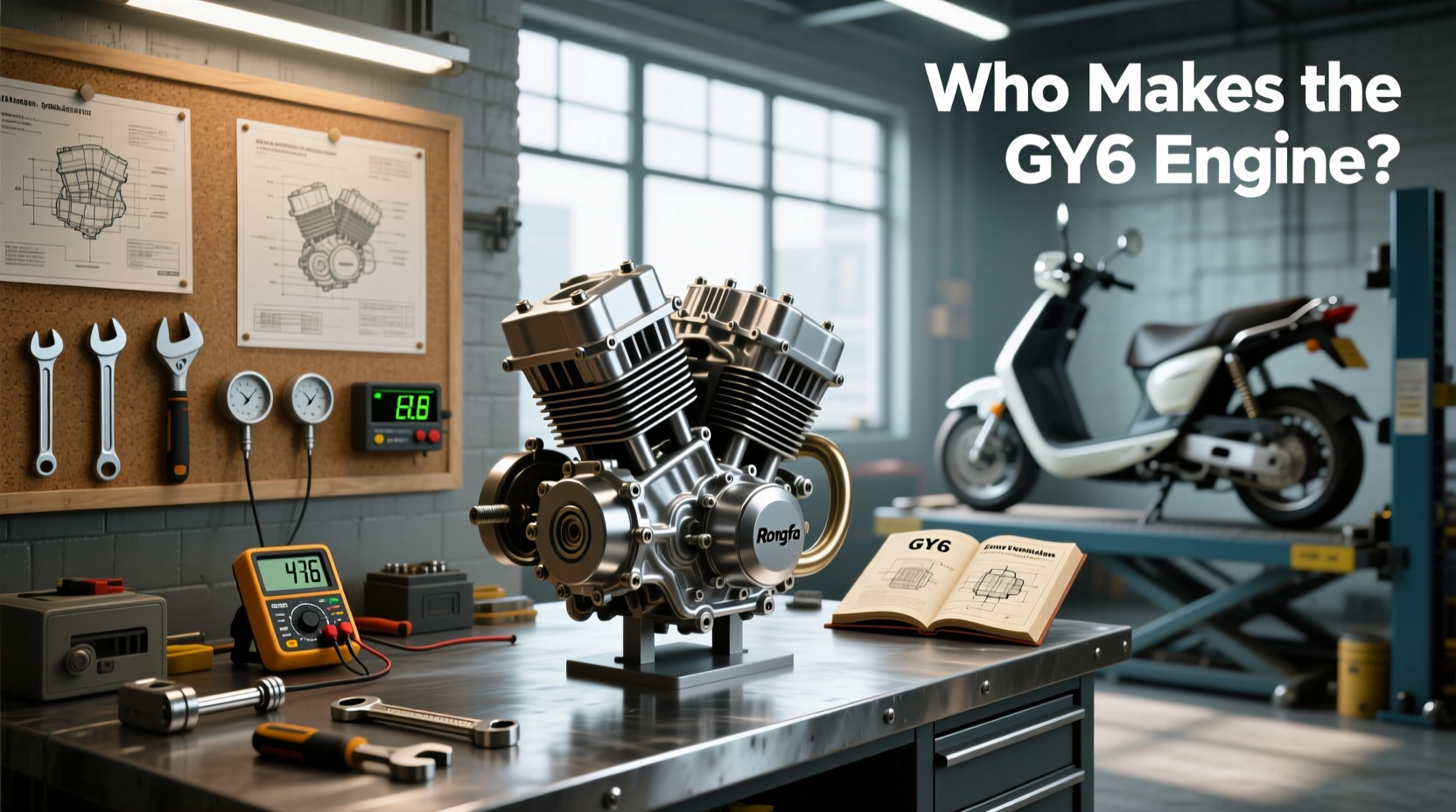
If you're asking how to choose rongfa engine gy6, who makes the GY6 engine?, start here: The GY6 is not made by one brand but is a widely cloned 150cc four-stroke engine design originally based on Honda’s Spacy platform and developed by KYMCO. Today, manufacturers across China produce compatible engines like the Rongfa 157QMJ. When choosing a GY6 engine, prioritize compatibility with your scooter model (long-case vs short-case), verify displacement (typically 150cc), check ignition type (CDI), and source from reputable suppliers offering clear warranty and return terms. Avoid generic listings without technical specs or verifiable origin.
About the GY6 Engine: Design Origins and Common Uses
The GY6 engine refers to a standardized four-stroke, single-cylinder powertrain design that has become a de facto industry platform for small scooters, particularly in Asia and increasingly in North America 1. Despite its name, the GY6 is not a product of a single manufacturer. Instead, it originated as a design collaboration between Honda and Taiwanese company Kwang Yang Motor Co., Ltd. (KYMCO), based on the Honda KCW125 “Spacy” model. KYMCO refined the architecture, leading to the GY6 designation, which was then widely replicated across manufacturing hubs in China and Southeast Asia.
Today, the term 'GY6' describes an entire ecosystem of interchangeable engines used in 50cc to 150cc scooters. Brands such as Roketa, Taotao, BMS, Coolster, and many others utilize variants of this engine. Engines branded as Rongfa 157QMJ are among the most common clones, designed to fit standard GY6 chassis configurations. These engines are typically air-cooled, equipped with overhead cam (OHC) valvetrains, and paired with continuously variable transmissions (CVT), making them ideal for urban commuting, last-mile delivery, and recreational use.
Why the GY6 Engine Is Gaining Popularity
The widespread adoption of the GY6 platform stems from several practical advantages. First, its modular design allows for high interchangeability—replacement engines and parts are readily available and often standardized across brands. This reduces repair costs and downtime. Second, the engine’s simplicity enhances reliability and ease of maintenance, appealing to both DIY mechanics and service centers. Third, mass production in low-cost regions keeps prices competitive, making GY6-powered scooters accessible to budget-conscious buyers.
Furthermore, the rise of e-commerce and global parts distribution has increased visibility and availability of GY6-compatible components. Enthusiasts also favor the platform for customization and go-kart conversions, further expanding its user base. As demand grows for affordable personal mobility solutions, the GY6 continues to be a go-to choice for entry-level and mid-range scooters.
Types and Variants of GY6 Engines
While all GY6 engines share core architectural traits, they come in distinct variants that affect compatibility and performance. Understanding these differences is essential when answering what to look for in rongfa engine gy6, who makes the GY6 engine?.
🔧 Short-Case vs. Long-Case Engines
- Short-Case: Compact design with integrated transmission. Ideal for smaller scooters with limited frame space. Offers easier installation but may have slightly reduced durability under heavy loads.
- Long-Case: Extended crankcase housing provides better oil circulation and cooling. Often found in higher-performance or heavier-duty models. Requires more precise alignment during installation.
⚙️ Displacement Options
- 50cc: Typically restricted for use in areas with moped licensing. Lower power output (~3–5 hp), suitable for flat terrain and light riders.
- 150cc: Most popular variant, delivering ~10–14 hp. Balances fuel efficiency and usable speed (up to 60 mph). Recommended for general-purpose riding.
⚡ Fuel System Types
- Carbureted (CVK-style): Most common. Uses a constant-velocity carburetor, often a Keihin clone. Cost-effective but sensitive to altitude and temperature changes.
- Fuel-Injected (FI): Emerging in newer models. Improves cold starts, fuel economy, and emissions. Slightly higher cost and complexity.
Key Features and Specifications to Evaluate
When conducting a rongfa engine gy6, who makes the GY6 engine? buying guide comparison, focus on measurable technical parameters:
- Displacement: Confirm actual cc (e.g., 149.6cc) matches your needs.
- Compression Ratio: Standard is 9.2:1; deviations may require fuel or tuning adjustments.
- Ignition System: CDI-based with magnetic trigger; ensure compatibility with your scooter’s electrical system.
- Power Output: Look for rated power (e.g., 5.9kW @ 7,000 rpm) and torque (≥9.0 Nm).
- Start Mechanism: Electric start preferred; kick-start serves as backup.
- Mounting Configuration: Verify bolt pattern, swingarm clearance, and exhaust routing.
Always cross-reference specifications with your original equipment manufacturer (OEM) manual or trusted aftermarket databases.
Pros and Cons of GY6 Engines
✅ Advantages
- High parts availability and interchangeability
- Low acquisition and maintenance costs
- Simple design enables easy repairs
- Proven reliability in varied conditions
- Widely supported by online communities and tutorials
❌ Limitations
- Performance ceiling limits high-speed or hilly terrain use
- Inconsistent quality control among Chinese manufacturers
- Carbureted versions may require frequent tuning
- Limited OEM support outside Asia
- Potential emissions compliance issues in regulated markets
How to Choose a Rongfa Engine GY6: Step-by-Step Buying Guide
Selecting the right GY6 engine involves more than just matching horsepower. Follow this checklist to avoid costly mistakes:
- Confirm Compatibility: Determine if your scooter uses a short-case or long-case engine. Measure existing mounts or consult service manuals.
- Verify Model Number: Match engine codes (e.g., 157QMJ) to ensure proper fitment.
- Check Electrical System: Ensure CDI unit, stator output, and wiring harness match your scooter.
- Evaluate Supplier Reputation: Prioritize sellers with clear contact info, return policies, and customer reviews.
- Inspect for Red Flags: Avoid listings with stock photos only, missing specs, or no warranty information.
- Review Shipping Terms: Confirm whether shipping includes handling fees, import duties, or insurance.
Ask potential suppliers for detailed photos of the actual engine, including casting marks and component labels. If possible, request batch or serial numbers to trace manufacturing origin.
Price & Market Insights
GY6 engine prices vary significantly by region, condition, and supplier. As of 2024:
- New 150cc Engine (Short-Case): $280–$380 USD
- New 150cc Engine (Long-Case): $320–$420 USD
- Rebuilt/Refurbished Units: $200–$280 USD (quality varies)
- Used Engines: $120–$200 USD (high risk of hidden wear)
Premium pricing may reflect added services like dyno testing, break-in procedures, or extended warranties. While lower-cost options exist on marketplaces like Alibaba or eBay, they may lack post-sale support. For critical replacements, investing in a mid-tier engine from a known distributor often delivers better long-term value.
Top-Seller & Competitive Analysis
Several suppliers dominate the Western market for GY6 engines. Below is a comparison of offerings from a well-established U.S.-based distributor:
| Specification | Red Fox Powersports (Long Case) | Red Fox Powersports (Short Case) |
|---|---|---|
| Engine Type | Single cylinder, 4-stroke, OHC | Single cylinder, 4-stroke, OHC |
| Displacement | 150cc (149.6CC) | 150cc (149.6CC) |
| Compression Ratio | 9.2:1 | 9.2:1 |
| Ignition | Electric or KICK start | Electric or KICK start |
| Maximum Power | 7.0 Kw DIN @ 7,500 rpm | 7.0 Kw DIN @ 7,500 rpm |
| Rated Power | 5.9Kw @ 7,000 rpm | 5.9Kw @ 7,000 rpm |
| Torque | At least 9.0Nm @ 6,000 rpm | At least 9.0Nm @ 6,000 rpm |
| Gears | CVT | CVT |
| Compatible Brands | Boom, Coolster, Cougar Cycle, Dongfang, Go Bowen, Roketa, TaoTao | Boom, Coolster, Cougar Cycle, Dongfang, Go Bowen, Roketa, TaoTao |
Note: Specifications may vary slightly between production batches. Always confirm details with the seller before purchase.
Customer Feedback Synthesis
Analysis of buyer reviews reveals consistent patterns in satisfaction and complaints:
👍 Frequent Positive Feedback
- “Engine arrived fully assembled and ready to install.”
- “Exact fit for my TaoTao Street Moto.”
- “Good throttle response and quiet operation after break-in.”
- “Seller responded quickly to questions.”
👎 Common Complaints
- “Missing gaskets or mounting bolts in package.”
- “Carburetor needed adjustment out of the box.”
- “Paint finish chipped during shipping.”
- “No instructions or wiring diagram included.”
These insights highlight the importance of inspecting deliveries upon arrival and preparing for minor setup tasks.
Sourcing & Supplier Tips
Most GY6 engines are manufactured in China but distributed globally. Direct factory sourcing (e.g., via Alibaba) can reduce costs but increases risk due to communication barriers and inconsistent QC. For individual buyers, purchasing through established U.S. or European distributors offers better protection.
When sourcing:
- Choose suppliers with physical addresses and responsive customer service.
- Request invoices and part numbers for warranty claims.
- For bulk orders, consider third-party inspection services.
- Verify return policies—some exclude opened or installed units.
Be cautious of counterfeit branding; genuine Rongfa engines typically include stamped model identifiers and consistent casting quality.
Maintenance, Safety & Legal Considerations
Regular maintenance extends engine life. Follow a schedule for oil changes (every 500–800 miles), air filter cleaning, and CVT belt inspection. Use 10W-40 or specified 4-stroke scooter oil.
Safety-wise, ensure all guards, wiring insulation, and exhaust shielding are intact. Test brakes and throttle return springs after installation.
Legally, verify that engine replacements comply with local emissions and noise regulations. In regions like California, EPA or CARB certification may be required for road use. Always check with local DMV or transport authorities before installing non-OEM engines.
Conclusion: Making the Right Choice
If you’re researching how to choose rongfa engine gy6, who makes the GY6 engine?, remember: the GY6 is a generic platform, not a brand. Your decision should center on compatibility, supplier reliability, and verified specifications. Opt for a new 150cc short- or long-case engine based on your scooter’s design. Prioritize sellers with transparent policies and strong customer feedback. While Rongfa and other Chinese manufacturers produce functional units, success depends on careful selection and verification—not brand names alone.
FAQs
❓ Who originally made the GY6 engine?
The GY6 engine design originated from a collaboration between Honda and Kwang Yang Motor Co., Ltd. (KYMCO) in Taiwan, based on the Honda Spacy 125 model. It was later cloned widely across Asia.
❓ Are all GY6 engines interchangeable?
Not universally. While many components are shared, short-case and long-case engines differ in dimensions and mounting points. Always verify physical and electrical compatibility before purchase.
❓ What does '157QMJ' mean in GY6 engines?
'157QMJ' is a Chinese engine code indicating a 150cc, four-stroke, forced-air-cooled, OHC scooter engine. It's the standard designation for GY6-compatible units produced by companies like Rongfa.
❓ Can I upgrade my scooter with a GY6 engine?
Yes, if your scooter’s frame, transmission, and electrical system support it. However, modifications may affect legality and safety. Consult a mechanic and verify local regulations first.
❓ How long do GY6 engines last?
With proper maintenance, a GY6 engine can last 20,000 to 30,000 miles. Lifespan depends on usage, oil quality, and operating conditions. Regular servicing significantly improves longevity.




 浙公网安备
33010002000092号
 浙B2-20120091-4