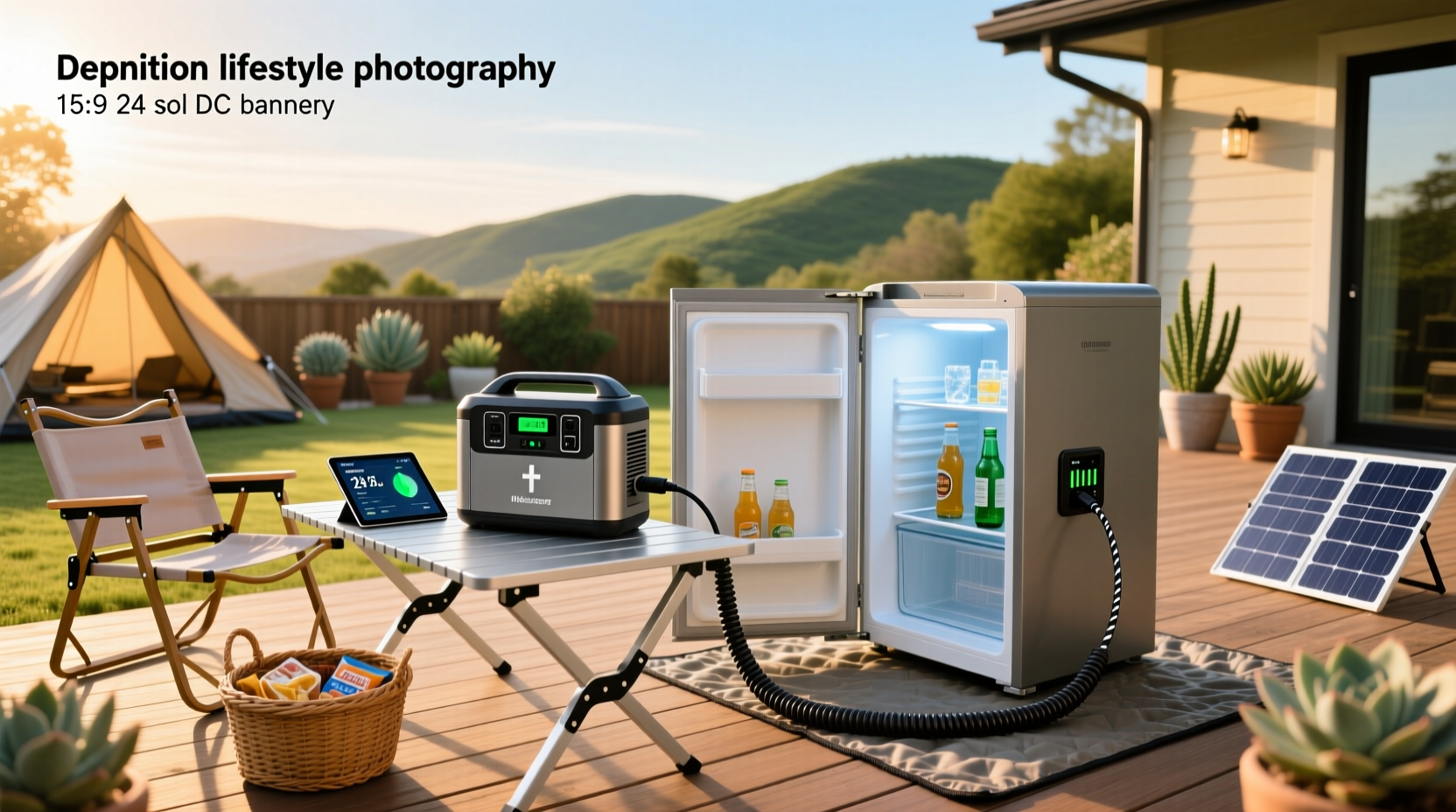
⚡ To run a 24 volt refrigerator off-grid, you need a portable power station with sufficient AC or DC output capacity and compatible voltage. For units without native 24V DC output, a reliable 24V to 12V converter may be required to match system voltages. When asking what portable power station can run a refrigerator?, focus first on the fridge’s wattage draw, cycle duration, and whether your power station supports sustained output without throttling. Key factors include battery capacity (Wh), surge tolerance, output type (pure sine wave), and efficiency in DC-to-DC conversion.
🛒 About 24 Volt Refrigerator & Compatible Power Stations
A 24-volt refrigerator is commonly used in RVs, marine environments, solar setups, and off-grid cabins where higher voltage systems reduce current draw and wiring losses over long distances. Unlike standard 12V models, these fridges require either a 24V power source or a step-down converter if running from lower-voltage batteries. Portable power stations capable of supporting such refrigeration units must deliver stable DC output at 24V or provide enough AC output to handle the fridge’s peak startup and running wattage through an inverter.
The question "What portable power station can run a refrigerator?" depends heavily on both the refrigerator's specifications and the power station’s sustained output capability. Most 24V refrigerators consume between 40–80 watts during operation but may spike up to 150W during compressor startup. Therefore, any viable power station should offer at least 200W continuous AC output or direct 24V DC output with adequate amperage (typically 5–10A).
📈 Why 24V Refrigeration + Power Stations Are Gaining Popularity
Off-grid living, overlanding, emergency preparedness, and mobile workspaces have driven demand for efficient, low-draw cooling solutions. The 24V system offers reduced electrical resistance compared to 12V, making it ideal for larger fridges or installations with extended cable runs. Combined with advancements in lithium-ion portable power stations, users now seek setups that maximize runtime while minimizing recharge frequency.
Additionally, many modern power stations integrate MPPT solar charging, app-based monitoring, and pure sine wave inverters—features that enhance compatibility with sensitive electronics like compressors in 24V refrigerators. As hybrid energy systems become more accessible, integrating a 24V fridge with a solar-charged power station offers a sustainable alternative to propane or grid-dependent appliances.
🔧 Types and Variants
🔋 24V Direct-Current (DC) Refrigerators
- Pros: High efficiency, minimal energy loss, quieter operation, compatible with solar charge controllers
- Cons: Requires dedicated 24V power supply; not plug-and-play with standard AC outlets
🔌 Dual-Voltage (12V/24V) Refrigerators
- Pros: Flexible input range; can operate across different vehicle or battery systems
- Cons: Slightly more complex internal regulation; may require manual voltage selection
🌀 AC-Powered Refrigerators Used with Inverters
- Pros: Wider model availability; easier to replace or upgrade
- Cons: Less efficient due to double conversion (DC → AC → DC); generates more heat and noise
⚡ Portable Power Station Types
- Battery Chemistry: LiFePO4 lasts longer and runs cooler than NMC, ideal for frequent cycling
- Output Options: Units with regulated 24V DC ports eliminate need for external converters
- Solar Input Support: Higher PV input (up to 500W+) enables faster recharging in sunlight
⚙️ Key Features and Specifications to Evaluate
🔋 Battery Capacity (Watt-hours, Wh)
This determines how long your refrigerator can run. A typical 24V fridge using 60W will consume about 60Wh per hour—but actual usage varies based on ambient temperature, insulation, and duty cycle. For example, a 500Wh power station could theoretically run a 60W fridge for ~8 hours (factoring 80% depth of discharge and inefficiencies). Always oversize by 30–50% for real-world conditions.
🔌 Output Type & Voltage Compatibility
Check if the power station has a dedicated 24V DC output port. If not, you'll likely need a 24V to 12V converter unless powering via AC inverter. However, some 24V fridges accept 12V input with reduced performance. Confirm compatibility through manufacturer specs before purchase.
⚡ Continuous & Surge Power Rating
The compressor surge can exceed running wattage by 2–3x. Ensure the power station supports at least 1.5x the fridge’s rated surge load. Look for pure sine wave AC inverters to avoid damaging motor components.
🔁 Efficiency & Conversion Losses
Using an AC inverter introduces ~10–15% energy loss. DC-to-DC conversion (via a 24V to 12V converter) also reduces efficiency (~85–90% typical). Prioritize direct DC coupling when possible to extend runtime.
☀️ Solar Recharge Capability
For extended off-grid use, verify maximum solar input voltage and wattage. MPPT controllers improve charging efficiency by 20–30% over PWM, especially in variable light conditions.
✅ Pros and Cons
✔️ Pros: Energy-efficient cooling, suitable for solar integration, longer cable runs without voltage drop, quiet operation, safer than propane alternatives.
✖️ Cons: Limited appliance options, potential need for converters, higher upfront cost, requires careful matching of power sources.
Best suited for: Overlanding rigs, sailboats, tiny homes, telecom shelters, remote monitoring stations.
Less ideal for: Occasional campers needing quick setup, users without basic electrical knowledge, budget-focused buyers seeking plug-and-play simplicity.
📋 How to Choose a 24V Refrigerator & Power Station Setup
- Determine Your Fridge’s Power Requirements: Check nameplate rating for running watts and estimated surge. Calculate daily consumption:
Watts × Hours Active Per Day = Daily Wh. - Match Voltage Output: Does your power station support 24V DC output? If not, assess whether a 24V to 12V converter is feasible and efficient for your use case.
- Select Adequate Capacity: Choose a power station with at least 1.5x your calculated daily fridge consumption to allow for other devices and partial recharges.
- Verify Output Waveform: Use only pure sine wave inverters for compressor-driven refrigerators to prevent overheating or premature failure.
- Assess Recharge Options: Consider solar, car charging, or wall outlet access. Faster recharge = greater flexibility.
- Test Runtime Estimates: Manufacturer claims often assume ideal conditions. Review independent tests or user logs for realistic performance data.
❗ Red Flags to Avoid
- Power stations advertising high surge ratings but lacking thermal management—these may throttle under load
- Fridges marketed as “24V” but requiring proprietary connectors or controllers
- Units without low-voltage disconnect protection, risking deep battery discharge
- Missing safety certifications (UL, CE, FCC)—verify compliance labels before purchase
💰 Price & Market Insights
Pricing varies significantly by chemistry, capacity, and feature set:
- Entry-level (300–500Wh, NMC): $200–$400 — Suitable for small 24V coolers or intermittent use
- Mid-tier (600–1000Wh, LiFePO4): $500–$900 — Balanced runtime and durability for regular off-grid use
- Premium (1000Wh+, LiFePO4, dual-phase solar): $1000–$2000+ — Ideal for full-time living or commercial applications
Prices may vary by region and retailer. Always compare total usable energy (not just advertised Wh) and warranty length (prefer 3+ years).
📊 Top-Seller & Competitive Analysis
| Model | Battery Type | Capacity (Wh) | Max AC Output | 24V DC Output? | Solar Input | Notes |
|---|---|---|---|---|---|---|
| Jackery Explorer 1000 | NMC | 1002 | 1000W | No | 200W max | Requires AC inverter; no native 24V support |
| EcoFlow Delta 2 | LFP | 1024 | 1800W | No | 500W max | High surge capacity; pair with 24V to 12V converter |
| Biolite PowerStation 200 | LFP | 200 | 200W | No | 120W solar | Too small for most 24V fridges; better for lighting |
| Titan Solar Products Yeti 1500X | LFP | 1512 | 2000W | Optional 24V module | Up to 1200W (dual panels) | Modular design allows 24V expansion |
Note: Availability and specs may differ by market. Always check manufacturer specs before assuming compatibility.
📌 Customer Feedback Synthesis
Based on aggregated reviews and forum discussions:
- Positive Feedback: Users appreciate long runtimes with LiFePO4 units, quiet operation of 24V compressors, and seamless solar integration. Many highlight reliability during blackouts or multi-day trips.
- Common Complaints: Unexpected shutdowns due to low-temp cutoffs, lack of true 24V output forcing reliance on inefficient AC conversion, and poor customer service from lesser-known brands.
- Surprise Issues: Some report incompatibility even with labeled “compatible” converters—always test under load before deployment.
🛍️ Sourcing & Supplier Tips
Purchase from authorized dealers or reputable online platforms (e.g., Renogy, Goal Zero, EcoFlow direct). For bulk orders or reselling:
- Request spec sheets and compliance documentation (CE, UL, UN38.3 for shipping)
- Confirm return policy and warranty terms—some exclude damage from improper voltage use
- Inspect units upon delivery for physical damage and verify included accessories
- For international buyers: ensure voltage/frequency compatibility and import regulations
🧼 Maintenance, Safety & Legal Considerations
To ensure longevity and safe operation:
- Store power stations in dry, temperate environments (avoid freezing or >40°C)
- Recharge every 3–6 months if unused; maintain 30–80% charge for long-term storage
- Use only matched cables and fuses—undersized wires pose fire risks
- Ensure ventilation around both fridge and power station to prevent overheating
- While no universal law bans 24V systems, always verify local electrical codes for permanent installations, especially in vehicles or marine vessels
✨ Conclusion
If you're asking "what portable power station can run a refrigerator?" in a 24V context, prioritize systems with high usable capacity, pure sine wave output, and ideally, native 24V DC support. For setups without direct 24V output, a quality 24V to 12V converter can bridge compatibility gaps—but expect some efficiency loss. Lithium iron phosphate (LiFePO4) power stations offer superior cycle life and safety for frequent use. Ultimately, match your choice to your usage pattern: occasional backup vs. daily off-grid living demands very different solutions.
❓ FAQs
Can I run a 24V refrigerator directly from a 12V power station?
Not directly unless the fridge supports dual voltage. You’ll need a boost converter (12V to 24V), which adds complexity and energy loss. More commonly, people use a 24V to 12V converter in reverse—which isn’t safe or effective. Best practice: use a power station with native 24V DC output or AC inverter matching the fridge’s requirements.
Do I really need a 24V to 12V converter for my setup?
Only if your 24V refrigerator accepts 12V input or you’re stepping down from a higher-voltage battery bank. Most 24V fridges don't run efficiently on 12V. Check the product manual. If your power station lacks 24V output, consider switching to an AC-powered fridge or upgrading to a compatible station.
How long will a 1000Wh power station run a 24V refrigerator?
Assuming a 60W fridge with a 50% duty cycle (runs 12 hours/day), it uses roughly 720Wh daily. A 1000Wh station at 80% discharge gives ~800Wh usable—enough for one full day under average conditions. Real-world results depend on ambient heat, door openings, and battery health.
Is it better to power a 24V fridge via AC or DC?
DC power is more efficient—especially direct 24V DC. Using an AC inverter adds conversion losses (10–15%). If your power station offers regulated 24V DC output, use it. Otherwise, AC is acceptable but reduces overall system efficiency.




 浙公网安备
33010002000092号
 浙B2-20120091-4