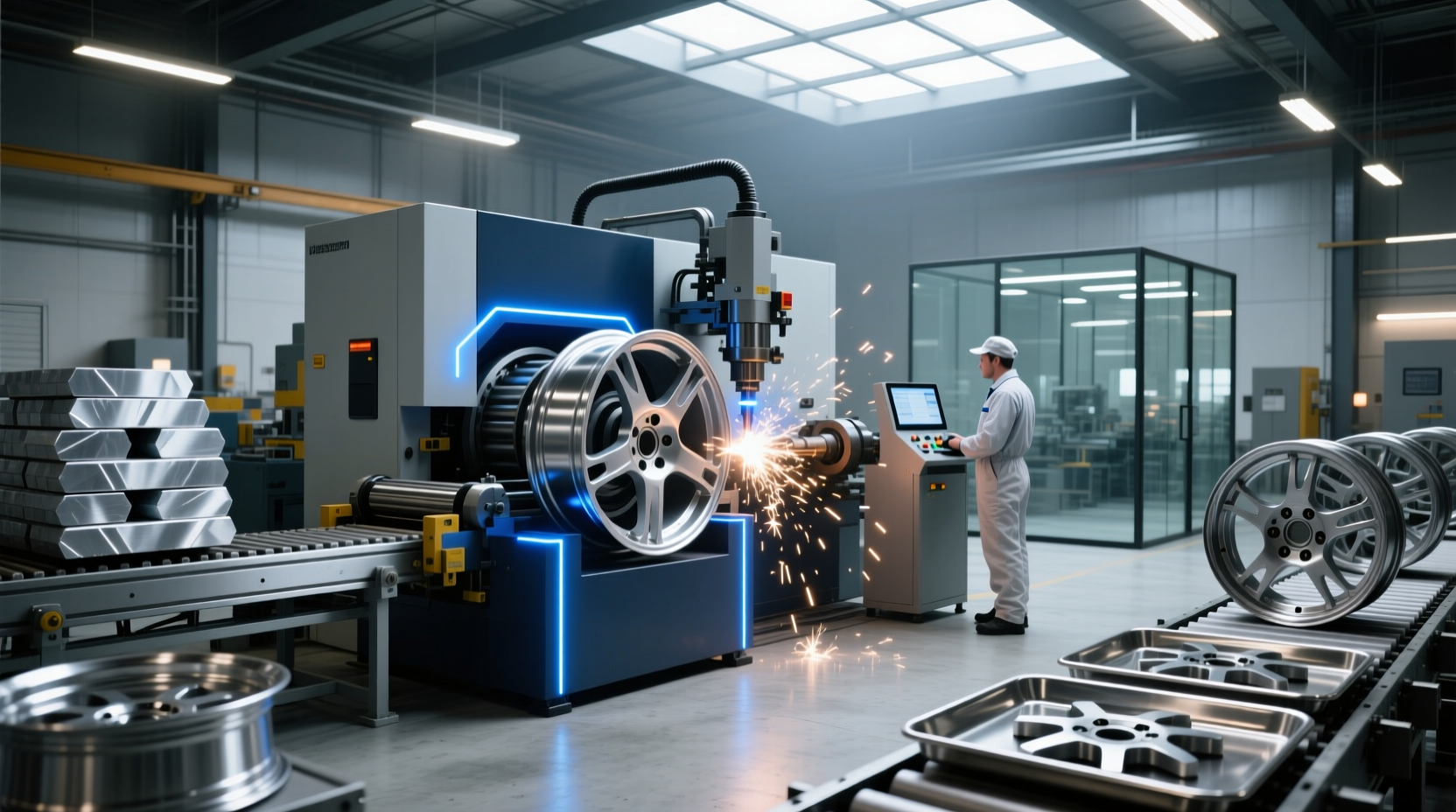
If you're evaluating a motorcycle wheel rim making machine, your decision should be guided by the intended production volume, desired rim type (spoke vs. cast), and target market—whether it's budget street bikes or high-performance racing models. Understanding what the manufacturing process of wheel rims entails is crucial: machines that support forging, flow forming, or low-pressure casting offer higher strength-to-weight ratios but come at increased cost and complexity. For small workshops, a gravity casting setup may suffice, while larger manufacturers benefit from CNC-integrated systems capable of precision machining and heat treatment automation. Key factors like material compatibility (aluminum, steel), mold change efficiency, and compliance with fatigue testing standards must be evaluated early to avoid costly mismatches.
🛒 About Motorcycle Wheel Rim Making Machines & the Rim Manufacturing Process
A motorcycle wheel rim making machine refers to industrial equipment used to produce wheel rims through various metallurgical and mechanical processes such as casting, forging, or flow forming. These machines range from semi-automated gravity casting units to fully automated production lines integrating CNC machining, heat treatment, and quality inspection stations.
The core function revolves around shaping raw materials—typically aluminum alloys like A356.2 or AA7075, or steel billets—into structurally sound rims that meet performance and safety requirements 1. The associated manufacturing process of wheel rims includes stages such as material preparation, mold design, casting/forging, machining, heat treatment, surface finishing, and rigorous testing for durability 2.
These systems are primarily used by OEMs, aftermarket suppliers, and custom fabrication shops aiming to enter or scale rim production. Depending on configuration, they can support spoke rims (common in off-road motorcycles) or one-piece alloy wheels found on modern sport and cruiser bikes.
📈 Why Motorcycle Wheel Rim Making Machines Are Gaining Popularity
Global demand for lightweight, durable motorcycle components has driven investment in localized rim manufacturing. As riders increasingly seek customized aesthetics and improved performance, businesses are turning to in-house production using dedicated motorcycle wheel rim making machines. This shift reduces reliance on overseas suppliers and allows faster response to market trends.
Additionally, advancements in automation and energy-efficient casting techniques have lowered entry barriers for mid-sized manufacturers. Flow forming technology, which combines casting with post-processing strengthening, is especially popular due to its balance of cost and performance—a trend reflected in rising machine sales across Asia and Eastern Europe.
🔧 Types and Variants of Rim Making Machines
Different rim types require distinct machinery setups. Below are the main categories:
1. Gravity Casting Machines
Uses molten metal poured into molds via gravity. Simple and low-cost, suitable for basic aluminum rims.
- ✅ Pros: Low initial cost, easy operation, minimal maintenance
- ❌ Cons: Heavier rims, lower structural integrity, limited to simple designs
2. Low-Pressure Casting (LPC) Systems
Molten metal is injected under controlled pressure into sealed molds, producing denser, stronger wheels.
- ✅ Pros: Better mechanical properties than gravity casting, widely used in OEMs
- ❌ Cons: Higher equipment cost, requires precise control systems
3. High-Pressure Die Casting (HPDC)
Used for high-volume production of complex alloy rims with tight tolerances.
- ✅ Pros: Fast cycle times, excellent dimensional accuracy
- ❌ Cons: Expensive tooling, risk of porosity if not managed properly
4. Forging Presses
Compresses solid aluminum billets under extreme force (up to thousands of tons), aligning grain structure for maximum strength.
- ✅ Pros: Produces strongest and lightest rims, ideal for racing applications
- ❌ Cons: Very high capital cost, limited shape flexibility, longer setup time
5. Flow Forming (Rotary Forging) Lines
Hybrid approach: starts with a cast blank, then spins and compresses the barrel section using rollers.
- ✅ Pros: Combines benefits of casting and forging—good strength, reduced weight, moderate cost
- ❌ Cons: Requires multi-stage integration, skilled operators needed
⚙️ Key Features and Specifications to Evaluate
When selecting a motorcycle wheel rim making machine, consider these technical and operational criteria:
- Material Compatibility: Ensure the machine supports your chosen alloy (e.g., A356.2, T6-6061) or steel grade.
- Production Capacity: Measured in units per hour/day; match output to business demand.
- Tolerance Precision: Look for ±0.1 mm or better in diameter and runout for reliable fitment.
- Automation Level: Semi-auto vs. full-auto lines affect labor costs and consistency.
- Energy Efficiency: Modern systems often include recuperative heating and closed-loop cooling.
- CNC Integration: Essential for machining spoke holes, valve stems, and final profiling.
- Heat Treatment Support: Built-in or compatible furnaces for T6 tempering improve strength 1.
- Safety Compliance: Check adherence to ISO 14122 (machine guarding), CE, or local industrial standards.
📊 Pros and Cons: Who Should Buy?
| Scenario | Recommended Type | Why Suitable |
|---|---|---|
| New small workshop | Gravity casting + CNC lathe | Low upfront cost, manageable learning curve |
| Aftermarket customization | Flow forming line | Balances performance and affordability |
| OEM-scale production | Low-pressure casting system | High repeatability, proven reliability |
| Racing component supplier | Forging press | Delivers optimal strength-to-weight ratio |
Not recommended for: Hobbyists without industrial space, companies lacking metallurgical QA staff, or those unable to invest in operator training.
📋 How to Choose a Motorcycle Wheel Rim Making Machine
Follow this step-by-step guide when assessing options:
- Define Your Output Goals: Estimate monthly unit targets and rim types (spoke, cast, dual-sport).
- Select the Right Method: Match manufacturing process (casting, forging, flow forming) to performance needs and budget.
- Evaluate Machine Scalability: Can it handle future upgrades (e.g., adding robotic arms or inline inspection)?
- Verify Mold Change Time: Quick-change systems reduce downtime between rim models.
- Review After-Sales Support: Availability of spare parts, technician training, and software updates.
- Assess Facility Requirements: Power supply (3-phase), floor load capacity, ventilation for fumes.
🚩 Red Flags to Avoid
- No documented compliance with international safety standards
- Lack of user manuals or English-language interface
- Vague claims about “high strength” without test data
- Suppliers unwilling to provide references or factory tours
- Poor customer service responsiveness during inquiry phase
💰 Price & Market Insights
Prices vary significantly based on automation level and origin:
- Basic Gravity Casting Setup: $15,000–$30,000
- Low-Pressure Casting Line: $80,000–$150,000
- Flow Forming System: $200,000–$400,000
- Fully Automated Forging Cell: $500,000+
Chinese and Turkish manufacturers offer competitive pricing but may require third-party inspection before shipment. European and Japanese systems typically cost more but come with tighter build quality and better documentation. Always request a detailed breakdown of costs—including shipping, installation, and training—before committing.
🏆 Top-Seller & Competitive Analysis
Leading suppliers include Oemer (Italy), Borghi (Italy), and Haitian (China). While no single model dominates globally, certain configurations stand out:
| Model | Method | Output/hr | Key Advantage | Ideal For |
|---|---|---|---|---|
| Oemer FLOW-3 | Flow Forming | 8–10 | Precision roller control | Performance aftermarket |
| Borghi LPC-200 | Low-Pressure Cast | 12–15 | Stable mold pressure regulation | OEM production |
| Haitian HMC-500 | Gravity Cast + CNC | 6–8 | Entry-level integration | Small workshops |
Note: Performance metrics may vary by region and configuration. Always check manufacturer specs before purchase.
📌 Customer Feedback Synthesis
Based on aggregated buyer reviews and industry reports:
- Frequent Praise: Machines with intuitive HMI interfaces, consistent casting density, and modular design for expansion.
- Common Complaints: Poor translation in manuals, delayed spare part delivery, inadequate cooling systems leading to thermal stress.
- Operator Notes: Training duration ranges from 2 weeks (gravity cast) to over 2 months (forging/flow forming).
🌐 Sourcing & Supplier Tips
Consider these strategies when procuring a motorcycle wheel rim making machine:
- Buy from Reputable Platforms: Alibaba, ThomasNet, or direct OEM contacts with verified certifications.
- Negotiate Bulk or Turnkey Deals: Include molds, CNC units, and QA equipment in the package.
- Request a Test Run Video: Ask suppliers to demonstrate actual rim production with material samples.
- Hire a Third-Party Inspector: Use services like SGS or Bureau Veritas pre-shipment to verify build quality.
- Check Export Documentation: Ensure compliance with import regulations in your country (e.g., CE, UL, RoHS where applicable).
🧼 Maintenance, Safety & Legal Considerations
Regular maintenance is critical for longevity and product consistency:
- Clean molds after each shift to prevent residue buildup.
- Lubricate moving parts weekly and calibrate sensors monthly.
- Train operators in emergency shutdown procedures and PPE usage (heat-resistant gloves, face shields).
- Confirm that produced rims undergo standardized fatigue testing (radial, torsional, impact) per ISO or JIS standards 2.
- While specific legal certification depends on your market (DOT in USA, ECE in Europe), always retain test records and material traceability logs.
✅ Conclusion
Choosing the right motorcycle wheel rim making machine hinges on aligning the manufacturing process of wheel rims with your production goals and financial capacity. If you need high-volume, cost-effective rims for commuter bikes, a low-pressure casting system offers reliability. For premium aftermarket products, flow forming delivers an ideal compromise. Only invest in forging if you serve high-performance or racing segments where ultimate strength justifies the expense. Always validate supplier credibility, inspect machine capabilities firsthand, and plan for ongoing training and maintenance to ensure long-term success.
❓ FAQs
Low-pressure casting is the most widely used method for mass-produced motorcycle rims due to its balance of strength, weight, and cost-efficiency compared to gravity casting or forging.
Generally, no. Spoke rims require welding and tensioning equipment, while cast rims need molding and machining systems. Some facilities use hybrid setups, but dedicated machines perform better for each type.
Heat treatment (like T6 tempering) enhances aluminum’s mechanical properties by dissolving alloying elements and rapidly quenching them, increasing tensile strength and resistance to deformation under load.
Forged rims are worth it for racing or heavy-duty applications where reduced weight and increased strength directly impact performance and safety, but they are often overkill for everyday street riding.
Inspect for physical damage, verify all components listed in the manual, test basic operations under supervision, and confirm software version and calibration status before full deployment.




 浙公网安备
33010002000092号
 浙B2-20120091-4