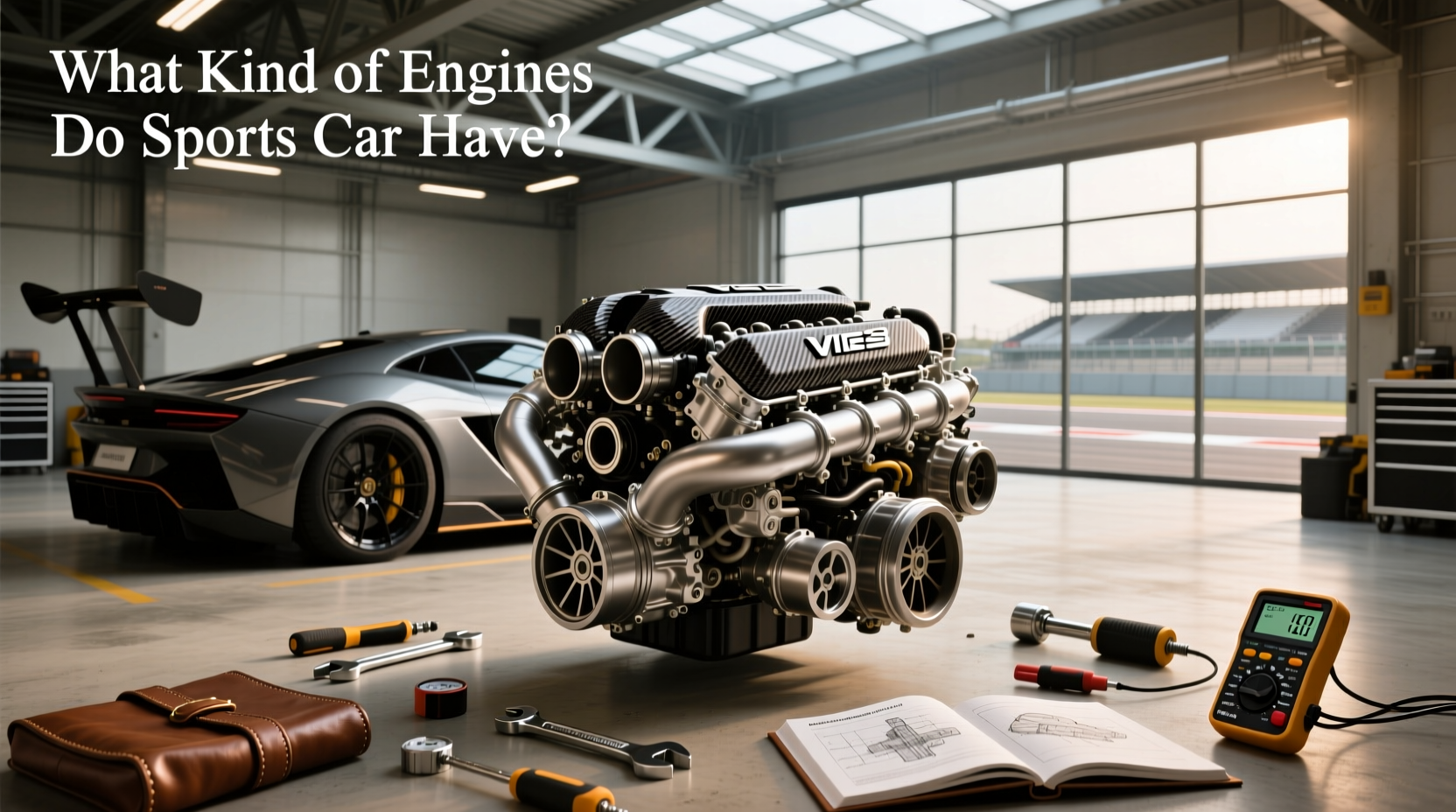
When choosing a sports car engine, focus on your primary use case: track performance, daily driving, or sustainability. V8s deliver raw power ideal for muscle cars ⚙️, while flat engines improve handling via low center of gravity—perfect for precision driving 📍. Turbocharged inline-six engines balance power and smoothness, as seen in the BMW M4 and Toyota GR Supra 1. For future-proofing, consider hybrid or electric powertrains like those in the Ferrari SF90 Stradale or Porsche Taycan, which combine high output with improved efficiency 2. Avoid rotary engines unless you accept higher maintenance costs and fuel consumption ❗. Understanding how engine layout affects weight distribution and responsiveness is key to making the right choice.
About Sports Car Engines: What Kinds Do They Have?
A sports car engine is specifically engineered to deliver high performance through superior power-to-weight ratios, rapid acceleration, and responsive throttle control. Unlike standard passenger vehicle engines, sports car powertrains prioritize dynamic capabilities over economy alone. These engines come in various configurations—V-type, inline, flat (boxer), rotary, and increasingly, hybrid or fully electric systems—each influencing the car’s character, balance, and driving experience 🔧.
Common applications include track days, spirited canyon runs, competitive autocross events, and high-speed highway cruising. Some models are designed for daily usability without sacrificing performance, such as the Honda Civic Type R with its turbocharged inline-four producing 306 horsepower 1. Others, like the Mercedes-AMG One, lean toward motorsport-derived extremes, using a Formula 1-based hybrid V6 to achieve 1,049 hp 3.
Why Sports Car Engines Are Evolving: Trends and Buyer Motivations
The demand for advanced sports car engines is rising due to technological innovation and shifting consumer priorities. Enthusiasts now seek not only speed but also sustainability, drivability, and long-term ownership value. Electric vehicles like the Rimac Nevera demonstrate that EVs can exceed 1,000 hp and accelerate from 0–60 mph in under 2 seconds—rivaling traditional supercars 2.
Hybridization allows manufacturers to boost performance while meeting emissions standards. The Ferrari SF90 Stradale combines a twin-turbo V8 with three electric motors for a total of 986 hp, offering all-wheel drive capability and limited zero-emission range 3. Buyers interested in cutting-edge engineering often explore these options, though they must weigh added complexity against gains in power and efficiency.
Types and Variants of Sports Car Engines
✅ V-Engines: Power and Compact Design
V-engines feature cylinders arranged in a 'V' shape around a shared crankshaft, allowing more cylinders in less space than inline layouts.
- V6 Engines: Offer balanced performance and moderate fuel use. Common in mid-tier sports coupes like certain Nissan Z models. Lighter than V8s, improving agility.
- V8 Engines: Deliver high horsepower and torque. Found in Chevrolet Corvette, Ford Mustang Shelby GT350. Ideal for straight-line speed and muscle car feel.
Pros: High power density, proven reliability, excellent for rear-wheel-drive platforms.
Cons: Heavier than flat or inline engines; wider footprint may affect steering geometry.
✅ Flat (Boxer) Engines: Low Center of Gravity
Used by Porsche and Subaru, flat engines have horizontally opposed pistons that reduce vibration and allow lower mounting.
- Improves cornering stability and chassis responsiveness.
Example: Porsche 718 Cayman GT4 RS uses a high-revving flat-four with ~400 hp 1.
Pros: Superior balance, reduced body roll, smoother idle.
Cons: Wider engine bay required; complex servicing access.
✅ Inline Engines: Simplicity and Smoothness
All cylinders aligned in one bank. Most common in European performance sedans and modern sports cars.
- Inline-Six: Known for linear power delivery and refinement. Powers BMW M3/M4 and Toyota GR Supra (382 hp turbo unit) 1.
Pros: Naturally balanced, compact lengthwise, strong mid-range torque.
Cons: Taller profile raises hood line; unsuitable for very high cylinder counts.
✅ Rotary (Wankel) Engines: Lightweight and High-Revving
Rotary engines use rotors instead of pistons, enabling small size and extreme RPMs (over 9,000 rpm).
- Famous in Mazda RX-7 and RX-8.
Delivers unique throttle response and compact packaging.
Pros: Exceptional power-to-weight ratio, minimal vibration.
Cons: Poor fuel economy, high oil consumption, rotor apex seal wear increases maintenance cost 4.
⚡ Electric and Hybrid Powertrains: The Future of Performance
Battery-electric and plug-in hybrid systems are redefining performance metrics.
- EVs: Instant torque, quiet operation, low maintenance. Examples: Porsche Taycan Turbo GT, Tesla Roadster (upcoming).
- Hybrids: Combine combustion engines with electric motors for peak power. See Aston Martin Valhalla (1,064 hp hybrid V6) 3.
Pros: Blistering acceleration, regenerative braking, partial zero-emissions driving.
Cons: Higher initial cost, battery degradation over time, charging infrastructure dependency.
Key Features and Specifications to Evaluate
When comparing sports car engines, assess these technical and experiential factors:
- Horsepower & Torque: Higher numbers mean faster acceleration, but real-world usability matters too.
- Engine Layout: Affects weight distribution and handling dynamics (e.g., front-mounted V8 vs mid-engine V6).
- Aspiration Type: Naturally aspirated engines offer linear response; turbocharged ones provide more power per liter.
- Redline and Power Band: High-revving NA engines (like Ford’s 5.2L V8) reward aggressive driving.
- Fuel Efficiency: Especially relevant for daily-driven sports cars.
- Weight and Balance: Lighter engines improve handling; low center of gravity enhances grip.
- Drivetrain Integration: How well the engine works with transmission, differential, and suspension tuning.
Pros and Cons: Who Should Consider Which Engine?
No single engine type suits all drivers. Your decision should reflect intended usage.
- Choose V8 if: You want maximum power, exhaust note, and straight-line performance.
- Opt for Flat-Four/Six if: Precision handling and balanced chassis behavior are priorities.
- Select Inline-Six if: You value smoothness, strong mid-range pull, and proven durability.
- Consider Hybrid/Electric if: You want cutting-edge tech, instant torque, and lower environmental impact.
- Avoid Rotary unless: You’re prepared for niche support, frequent rebuilds, and thirstier fuel use.
How to Choose a Sports Car Engine: Step-by-Step Guide
Follow this checklist when evaluating sports car engines:
- Define Your Use Case: Track-focused? Daily commuter? Weekend cruiser?
- Determine Budget: Include insurance, fuel, maintenance, and potential repairs.
- Test Drive Different Layouts: Feel how each engine responds to throttle inputs and cornering loads.
- Check Real-World Fuel Economy: Manufacturer claims may not reflect spirited driving.
- Research Reliability History: Look up common issues for specific engine families (e.g., older VR6 carbon buildup).
- Evaluate Resale Value: Certain engines (e.g., Porsche flat-six) hold value better.
- Verify Emissions Compliance: Some markets restrict older or non-certified engines.
Red Flags to Avoid:
- Unusually high oil consumption in turbocharged or rotary units.
- Lack of service history or undocumented modifications.
- Aftermarket tuning that voids warranty or stresses components.
- Engines known for timing chain/belt failures without recent replacement.
Price & Market Insights
Engine type significantly influences vehicle pricing:
- $30k–$60k: Turbo-four and base V6 engines (e.g., Civic Type R, Toyota GR86).
- $60k–$120k: Premium V8s, turbo inline-six, entry-level hybrids (e.g., BMW M4, Porsche 718).
- $120k+: High-output hybrids, supercars with F1-derived powertrains (e.g., Ferrari SF90, AMG One).
Prices vary by region, trim level, and availability. Always confirm local dealer pricing and incentives. Electric models may qualify for tax credits, altering effective cost.
Top Models & Competitive Analysis
| Sports Car Model | Engine Type | Horsepower | Key Strengths |
|---|---|---|---|
| 2025 Chevrolet Corvette ZR1 | Twin-turbo 5.5L V8 | 1,064 hp | Extreme power, mid-engine layout, high top speed |
| Toyota GR Supra | Turbo 3.0L Inline-Six | 382 hp | Balanced chassis, reliable B58 engine |
| Ferrari SF90 Stradale | Plug-in Hybrid V8 | 986 hp | All-wheel drive, electric-only mode, track-ready |
| Porsche 718 Cayman GT4 RS | Flat-Four (Naturally Aspirated) | ~400 hp | Sharp handling, lightweight, driver-focused |
| Honda Civic Type R | Turbo 2.0L Inline-Four | 306 hp | Front-wheel-drive agility, daily usability |
Data sourced from public manufacturer specifications and automotive databases 13.
Customer Feedback Synthesis
Analysis of owner reviews reveals consistent themes:
- Positive: Enthusiasts praise the sound and responsiveness of naturally aspirated V8s; inline-six engines lauded for smoothness; EV owners highlight instant torque and low running costs.
- Negative: Hybrid systems criticized for increased weight affecting handling; rotary engines frequently cited for poor fuel economy and repair expenses; some turbo-four engines lack engaging exhaust notes.
Sourcing & Supplier Tips
When purchasing a sports car—or engine separately (for restoration/modification):
- Buy from authorized dealers or certified pre-owned programs for warranty coverage.
- For used imports, verify compliance with local emissions and safety regulations.
- If sourcing individual engines (e.g., JDM swaps), ensure compatibility with transmission, ECU, and cooling systems.
- Inspect for accident history, maintenance logs, and software update status.
- Consider working with independent specialists familiar with high-performance powertrains.
Maintenance, Safety & Legal Considerations
High-performance engines require diligent upkeep:
- Follow manufacturer-recommended oil change intervals—especially critical for turbocharged and rotary engines.
- Use premium-grade fuels and lubricants to maintain performance and longevity.
- Monitor battery health in hybrid/electric models; replace coolant per schedule to avoid thermal system failure.
- Ensure proper ventilation when operating powerful engines in enclosed spaces.
- Modifications may affect road legality; always check local laws before installing aftermarket parts.
Always refer to official service manuals and consult qualified technicians for major work.
Conclusion: Matching Engine Type to Driver Needs
Selecting the right sports car engine depends on aligning technical characteristics with personal priorities. If you prioritize track precision and balanced handling, a flat engine like Porsche’s offers unmatched dynamics. For raw acceleration and classic muscle car appeal, a V8 remains king. Enthusiasts seeking refinement and reliability should consider turbocharged inline-six engines found in BMW and Toyota models. Those embracing innovation may prefer hybrid or electric powertrains, despite their complexity and cost. Ultimately, test driving multiple configurations provides the clearest insight into which engine best matches your expectations.
Frequently Asked Questions
What are the most reliable sports car engines?
Turbocharged inline-six engines like BMW’s B58 and naturally aspirated Lexus V8s are widely regarded for durability. Porsche flat-six engines also show strong long-term reliability with regular maintenance.
Do electric sports cars offer the same driving experience as gasoline models?
They deliver exceptional acceleration and smoothness but differ in sound and feedback. Many lack the emotional engagement of high-revving combustion engines, though brands like Porsche are bridging the gap with simulated sounds and mechanical feedback.
Are hybrid sports cars worth the extra cost?
They can be, if you value extreme performance and some fuel savings during city driving. However, added weight and system complexity may detract from pure driving enjoyment for purists.
How does engine placement affect performance?
Mid-engine layouts (engine behind cabin) improve weight balance and cornering grip. Front-engine designs often favor straight-line stability. Rear-engine setups, like in the Porsche 911, require skilled handling at limits due to inherent oversteer tendencies.
Can I modify a stock sports car engine safely?
Yes, within limits. Basic upgrades like intake, exhaust, and ECU tuning are common. However, forced induction on naturally aspirated engines or high-boost tuning requires expert knowledge to prevent damage.




 浙公网安备
33010002000092号
 浙B2-20120091-4