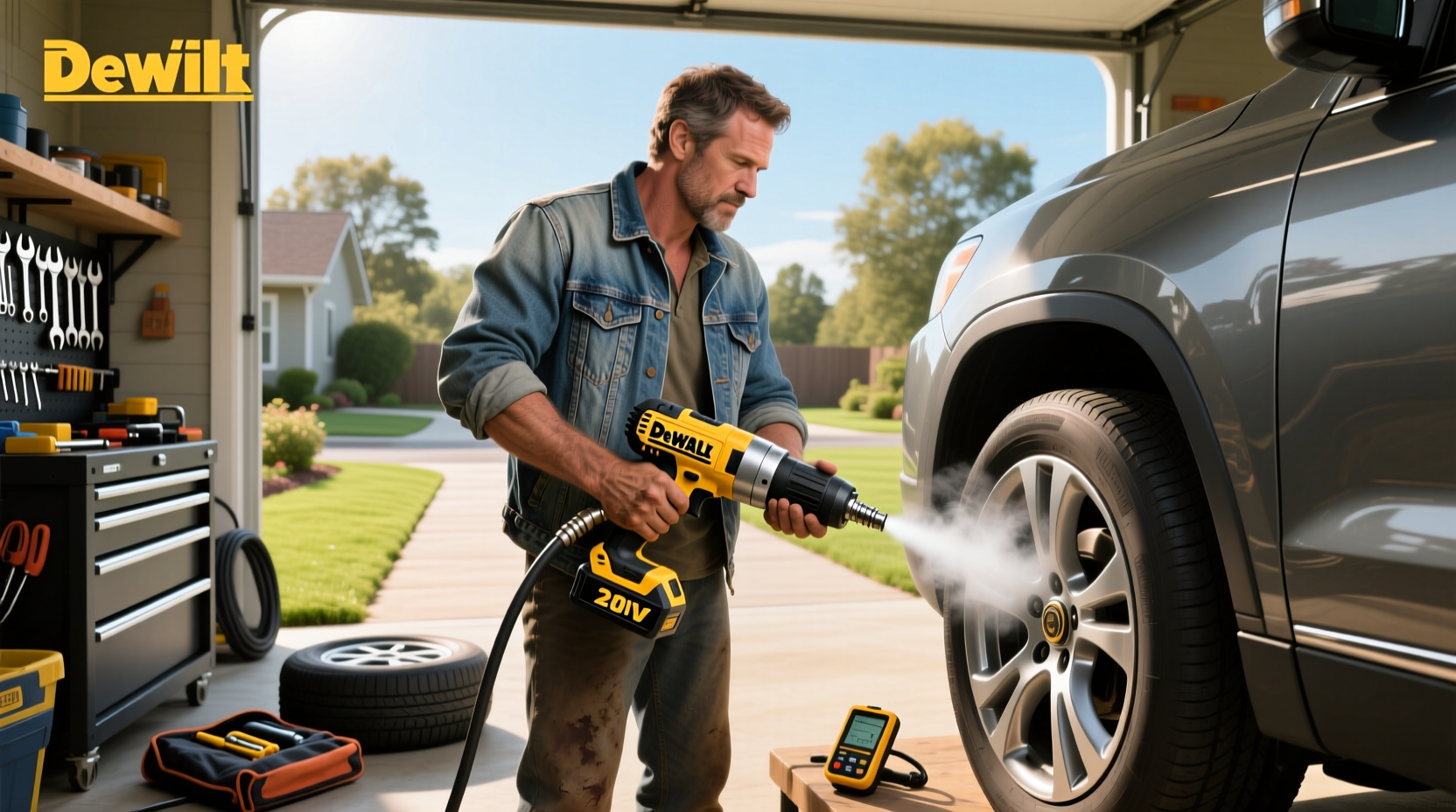
If you're asking which cordless tire inflator is best?, the answer depends on your use case. For professionals or those with large tires (SUVs, trucks), the DeWalt 20V MAX DCC020IB stands out due to its high inflation speed, rugged build, and triple power source (battery, car socket, wall outlet) ⚡. DIYers already using Ryobi tools should consider the Ryobi 18V ONE+ P747 for ecosystem compatibility and value 🛠️. Budget-focused users may prefer the AstroAI Cordless Tire Inflator, which balances performance and price ✅. When evaluating a dewalt 20v tire inflator,Which cordless tire inflator is best? comparison, prioritize inflation speed, PSI rating, battery integration, and durability based on your needs.
About dewalt 20v tire inflator,Which cordless tire inflator is best?
A cordless tire inflator is a portable device powered by a rechargeable battery, designed to inflate vehicle tires without relying on a wall outlet or car’s 12V socket. The DeWalt 20V MAX DCC020IB is one example of a high-performance model tailored for users invested in the DeWalt 20V/FLEXVOLT ecosystem. These tools are commonly used for routine tire maintenance, emergency inflation after punctures, and inflating bike tires, sports balls, or air mattresses using included nozzles 🌐.
The broader question — which cordless tire inflator is best? — reflects growing demand for reliable, on-the-go solutions. Unlike older 12V car adapters that stall engines or lack power, modern cordless models deliver consistent airflow and precise pressure control via digital gauges 🔍.
Why dewalt 20v tire inflator,Which cordless tire inflator is best? is gaining popularity
Cordless tire inflators are increasingly popular due to their convenience, portability, and improved performance. Drivers no longer need to search for gas stations or rely on underpowered car adapters. With advancements in lithium-ion batteries and motor efficiency, today’s models can fully inflate a flat passenger car tire in under three minutes ⏱️.
The rise of tool ecosystems like DeWalt 20V, Ryobi ONE+, and Milwaukee M12 has also driven adoption. Users prefer adding a single-purpose tool that runs on existing batteries rather than managing standalone chargers. This trend makes products like the dewalt 20v tire inflator appealing for contractors and homeowners alike who want seamless integration across their gear collection.
Types and variants
Cordless tire inflators come in several configurations, each suited to different user profiles:
🔧 Integrated Battery Models (e.g., AstroAI)
- Pros: Affordable, all-in-one design, often include flashlight and USB ports
- Cons: Limited runtime, slower recharge, not compatible with other tool systems
🔋 Tool-Ecosystem Compatible (e.g., DeWalt, Ryobi, Milwaukee)
- Pros: Share batteries with drills, saws, etc.; faster charging; higher durability
- Cons: Higher upfront cost if you don’t own compatible batteries
🔌 Multi-Power Source Units (e.g., DeWalt DCC020IB)
- Pros: Can run on battery, 12V DC (car), or 120V AC (wall); ideal for extended jobs
- Cons: Heavier, more complex wiring, typically pricier
🚚 Compact & Ultra-Portable (e.g., some Milwaukee M12 models)
- Pros: Easy to store in glove compartment, lightweight
- Cons: Lower max PSI or slower flow rate on larger tires
Choosing among these types requires assessing your primary use case: daily driver maintenance, off-road adventures, professional fleet service, or occasional home use.
Key features and specifications to evaluate
When researching how to choose dewalt 20v tire inflator,Which cordless tire inflator is best?, focus on measurable performance indicators:
- ⚡ Max Pressure (PSI): Aim for at least 150 PSI to handle most car, truck, and SUV tires. The DeWalt 20V MAX reaches 160 PSI, matching heavy-duty requirements.
- ⏱️ Inflation Speed: Measured in CFM (cubic feet per minute) or real-world time. Faster motors reduce wait time significantly — crucial for roadside emergencies.
- 🔋 Battery Compatibility: Check if it uses your existing platform (DeWalt 20V, Ryobi 18V, etc.). Swappable batteries increase utility.
- 📊 Pressure Accuracy: Digital gauges with ±1 PSI tolerance are preferred over analog dials. Auto-shutoff prevents overinflation.
- 🏭 Durability: Look for rubberized housings, metal fittings, and IP ratings for dust/water resistance — especially important for outdoor or job site use.
- ✨ Additional Features: Built-in LED lights, hose length (longer = easier access), secure chuck type (threaded vs. snap-on), and extra nozzles enhance usability.
Pros and cons
Understanding trade-offs helps avoid mismatched expectations.
✅ Advantages of Modern Cordless Inflators
- Portability: Fits in trunk or backpack
- No dependency on gas stations or running vehicles
- Precise digital control reduces risk of overinflation
- Fast inflation times with high-end models (under 3 minutes for standard tires)
- Multipurpose use with accessories (balls, inflatables)
❌ Limitations and Drawbacks
- Lower-end models may struggle with large truck tires or dual rear wheels
- Battery life varies — some can't inflate all four tires on one charge
- Tool-ecosystem models require investment in compatible batteries
- Digital components may fail in extreme temperatures
- Limited service support outside major brands
How to choose dewalt 20v tire inflator,Which cordless tire inflator is best?
Follow this step-by-step checklist when deciding what to look for in dewalt 20v tire inflator,Which cordless tire inflator is best?:
- Identify Your Primary Use Case: Are you maintaining a family sedan, servicing fleet vehicles, or prepping for off-roading? Professionals benefit from durability and speed; homeowners may prioritize affordability.
- Evaluate Battery Ecosystem: If you already own DeWalt, Ryobi, or Milwaukee tools, choose a model that shares batteries to save cost and space.
- Check Max PSI and Flow Rate: Ensure the unit supports your vehicle’s recommended tire pressure. Larger tires (LT, RV) need ≥150 PSI capability.
- Verify Real-World Performance: Look for independent tests measuring time to inflate a flat tire to 45 PSI. Avoid models taking over 5 minutes unless used infrequently.
- Assess Build Quality: Metal connectors, rubber overmolds, and secure hose attachments indicate better longevity.
- Review Power Options: Dual or triple-source units (like DeWalt’s) offer backup options during long jobs.
🚩 Red Flags to Avoid
- No auto-shutoff feature: Risk of damaging tires from overinflation.
- Analog gauge only: Less accurate than digital displays.
- Short hose (<20”): Difficult to reach valve stems on certain rims.
- No spare fuse or poor customer support: Indicates lower reliability.
- Vague runtime claims: Always cross-check with verified user reports.
Price & market insights
Prices vary widely depending on brand, battery inclusion, and compatibility:
- Budget ($40–$70): Standalone units like AstroAI or generic brands. Good for casual users.
- Mid-range ($70–$100): Milwaukee M12, some Ryobi kits. Offer balance of speed and ecosystem value.
- Premium ($130–$160): DeWalt 20V MAX DCC020IB (tool-only). Justified for pros needing speed and multi-power flexibility.
Note: Prices may differ by region and retailer. Bundled kits with carrying cases or extra batteries cost more but add convenience. Consider total ownership cost — including replacement batteries or chargers — before purchasing.
Top-seller & competitive analysis
Below is a comparison of leading models relevant to the dewalt 20v tire inflator,Which cordless tire inflator is best? discussion:
| Feature | DeWalt 20V MAX DCC020IB | Ryobi 18V ONE+ P747 | Milwaukee M12 | AstroAI |
|---|---|---|---|---|
| Max PSI | 160 | 150 | 120 | 160 |
| Inflation Speed | Excellent (large tires) | Good (slower on big tires) | Excellent (standard cars) | Good |
| Battery System | DeWalt 20V/FLEXVOLT | Ryobi 18V ONE+ | Milwaukee M12 | Built-in Li-ion |
| Power Sources | Battery, 12V, 120V | Battery only | Battery only | Battery, 12V |
| Key Features | Dual LCD, threaded chuck, LED light | Digital gauge, auto-shutoff | Backlit LCD, 26" hose | Flashlight, multiple nozzles |
| Best For | Professionals, large tires | DIYers, Ryobi owners | Speed on standard cars | Budget versatility |
Data sourced from performance reviews and field testing 12.
Customer feedback synthesis
Analysis of verified buyer reviews reveals common themes:
👍 Frequent Praises
- DeWalt: “Inflated my truck tire fast even in cold weather.” “Love that I can plug it into the wall when camping.”
- Milwaukee: “Super compact but powerful.” “The display is bright and easy to read at night.”
- AstroAI: “Great value for the price.” “Inflated all four car tires on one charge.”
👎 Common Complaints
- Ryobi: “Too slow for my SUV.” “Plastic body feels cheap after a few drops.”
- Generic Brands: “Gauge was off by 8 PSI.” “Stopped working after two months.”
- All Types: “Hose detached during use.” “Battery wouldn’t hold charge after six months.”
Reliability concerns often stem from inconsistent quality control in budget models, while premium brands receive praise for sustained performance.
Sourcing & supplier tips
When purchasing, consider:
- Authorized Retailers: Buy from Home Depot, Lowe’s, Amazon (sold by manufacturer), or direct from brand sites to ensure warranty validity.
- Return Policy: Verify at least a 30-day window to test performance under real conditions.
- Bulk Purchases: Contractors may qualify for fleet discounts through industrial suppliers like Grainger or Fastenal.
- Counterfeit Awareness: On third-party marketplaces, check seller ratings and packaging authenticity. Avoid deals that seem too good to be true.
- Verify Specs: Confirm voltage compatibility and included accessories match advertised listings.
Maintenance, safety & legal considerations
To extend lifespan and ensure safe operation:
- Storage: Keep in a dry place; remove battery if storing long-term.
- Cleaning: Wipe down after use, especially if exposed to mud or salt.
- Inspection: Regularly check hose integrity and chuck mechanism for wear.
- Safety: Never overinflate beyond tire manufacturer’s recommendation. Use protective eyewear during inflation.
- Compliance: While no universal regulation governs personal tire inflators, commercial users should follow OSHA guidelines where applicable. Always check local standards for equipment used in professional settings.
When in doubt about compliance, consult the manufacturer’s documentation or contact customer support for clarification.
Conclusion
The question which cordless tire inflator is best? doesn’t have a one-size-fits-all answer. However, understanding your priorities simplifies the decision:
- If you’re a professional or work with large tires, the DeWalt 20V MAX DCC020IB offers unmatched power, durability, and multi-source flexibility.
- If you’re a DIY homeowner already using Ryobi tools, the Ryobi 18V ONE+ P747 integrates seamlessly and offers solid value.
- If you want maximum speed for standard car tires, the Milwaukee M12 delivers excellent performance in a compact form.
- If you’re budget-conscious and want an all-in-one solution, the AstroAI provides strong features at a low entry point.
Ultimately, when exploring a dewalt 20v tire inflator,Which cordless tire inflator is best? comparison, focus on verified performance metrics, ecosystem compatibility, and real-world usability rather than marketing claims.
FAQs
❓ Can I use a DeWalt 20V tire inflator with any DeWalt battery?
Yes, the DeWalt DCC020IB is compatible with all DeWalt 20V MAX and FLEXVOLT batteries. However, higher-capacity batteries (5.0Ah+) will provide longer runtime.
❓ How accurate are digital tire pressure gauges on cordless inflators?
Most digital gauges are accurate within ±1 to ±3 PSI under normal conditions. For critical applications, verify readings with a calibrated handheld gauge periodically.
❓ Do cordless tire inflators work on truck tires?
High-end models like the DeWalt 20V MAX (160 PSI) can inflate light truck and SUV tires effectively. However, they may struggle with large commercial truck tires requiring very high volume.
❓ Why does my tire inflator shut off before reaching the set pressure?
This can happen due to overheating, low battery, or a faulty sensor. Allow the unit to cool, recharge the battery, and recalibrate if possible. Consult the manual for troubleshooting steps.




 浙公网安备
33010002000092号
 浙B2-20120091-4