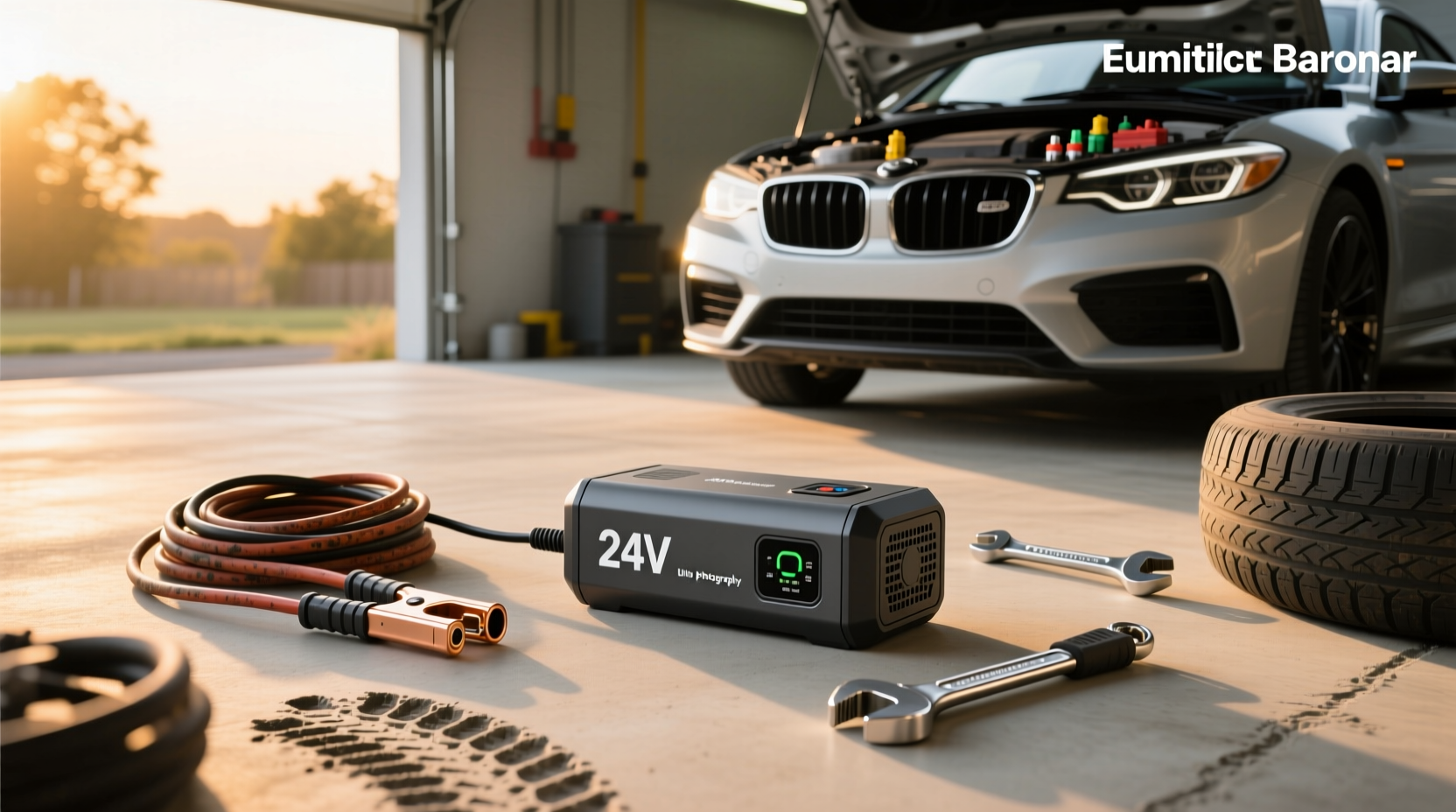
If you're asking what to look for in a 24v portable jump starter,What is the best portable jump starter to buy?, start by matching your vehicle type to the correct voltage and cranking power. A true 24V jump starter is essential for diesel engines in trucks, buses, agricultural machinery, or off-road vehicles, where standard 12V units fail. The right model should deliver at least 1,500 amps peak current, feature overcurrent and reverse polarity protection, and include modern battery chemistry like LiFePO4 for longevity. This buying guide breaks down every critical factor—from dual-voltage capability to cold-cranking performance—so you can confidently select a unit that works when you need it most.
About 24V Portable Jump Starters: Definition & Use Cases
A 24V portable jump starter is a self-contained power device designed to restart engines requiring 24-volt electrical systems. Unlike common 12V versions used in passenger cars, these are engineered for larger vehicles such as semi-trucks, excavators, generators, and military or industrial equipment. They contain high-capacity lithium-ion or lithium iron phosphate (LiFePO4) batteries capable of delivering thousands of amps momentarily to crank large diesel engines.
🛠️ Typical use cases include:
- Fleet maintenance crews servicing delivery trucks
- Construction site operators with heavy machinery
- Agricultural workers using tractors or harvesters
- Emergency roadside assistance providers
- Remote location operations without grid access
These devices eliminate dependency on another vehicle or external power source, making them indispensable in environments where downtime equals lost revenue.
Why 24V Portable Jump Starters Are Gaining Popularity
📈 The demand for reliable 24V jump starters has grown due to rising adoption of diesel-powered commercial fleets and increased focus on operational uptime. As businesses shift toward preventive maintenance and mobile readiness, having an independent power solution reduces reliance on tow trucks or service calls.
🔋 Advancements in battery technology—particularly LiFePO4—have made 24V units lighter, safer, and longer-lasting than older lead-acid equivalents. Additionally, many new models integrate auxiliary functions like USB charging ports, LED work lights, and even built-in compressors, increasing their value beyond just engine starting.
🌐 Regulatory trends favoring reduced idling time and improved field service efficiency further drive adoption across logistics, mining, and public works sectors.
Types and Variants
Different designs serve distinct operational needs. Understanding these helps avoid mismatched purchases.
✅ Single-Voltage 24V Units
- Pros: Optimized output for 24V systems; often higher peak current
- Cons: Cannot jump-start 12V vehicles; less versatile for mixed fleets
- Best for: Dedicated 24V-only environments (e.g., truck depots)
✅ Dual-Voltage Jump Starters ⚙️
Reflecting the report’s recommendation for versatility, a dual-voltage (12V/24V) jump starter allows switching between systems, making it ideal for companies managing both light-duty vans and heavy trucks.
- Pros: Greater flexibility; cost-effective for multi-vehicle teams
- Cons: May have slightly lower peak output on 24V mode compared to dedicated units
- Best for: Mixed-fleet operators, emergency responders, rental agencies
✅ All-in-One Power Stations
- Pros: Include AC outlets, DC ports, solar charging; useful as backup power sources
- Cons: Bulkier, more expensive, heavier to carry
- Best for: Off-grid job sites needing sustained power beyond engine starts
Key Features and Specifications to Evaluate
Selecting the right model requires attention to technical details that directly affect performance and safety.
🔋 Battery Capacity (mAh / Wh)
Measured in milliamp-hours (mAh) or watt-hours (Wh). Higher capacity means more jump attempts and longer runtime for accessories. For 24V systems, aim for ≥20,000mAh (≈74Wh) minimum.
⚡ Peak Current (Amps)
This determines whether the unit can turn over large diesel engines. Look for at least 1,500A, with 2,000–3,000A preferred for V8 or turbocharged diesels.
🔋 Battery Chemistry
- Lithium Polymer (LiPo): Lightweight but sensitive to temperature extremes
- LiFePO4: More stable, longer cycle life (2,000+ charges), better thermal resistance — recommended for industrial use
🛡️ Safety Protections
Essential safeguards include:
- Reverse polarity alarm/shutdown
- Overload and short-circuit protection
- Overcharge/discharge prevention
- Spark-proof technology
🔌 Output Ports & Accessories
Modern units often include:
- USB-A / USB-C ports for device charging
- 12V DC socket for air pumps or lights
- LED flashlight (with SOS/strobe modes)
- Integrated digital air compressor (for tire inflation)
Pros and Cons
✅ Advantages
- Enables quick restarts without another vehicle
- Compact and easy to store in cab or toolbox
- Multi-functional (charging, lighting, inflation)
- Reduces service delays and towing costs
- Long shelf life with low self-discharge rates
- Safe when used correctly (no exposed terminals in modern models)
❌ Limitations
- Higher upfront cost than basic jumper cables
- Performance drops in extreme cold (< -10°C / 14°F)
- Requires periodic recharging (every 3–6 months)
- Not suitable for deeply discharged batteries (diagnose first)
- Weight increases with capacity (some exceed 5 lbs / 2.3 kg)
How to Choose a 24V Portable Jump Starter
📋 Follow this step-by-step checklist to make a confident decision:- Confirm your vehicle’s voltage requirement. Most commercial trucks use 24V, but verify via owner’s manual or battery configuration (two 12V batteries in series).
- Determine required cranking power. Larger engines need ≥2,000A peak. Consult manufacturer specs or ask your mechanic.
- Choose battery chemistry. Prefer LiFePO4 for durability and safety in demanding conditions.
- Evaluate additional features. If you frequently inflate tires, choose a model with a built-in compressor. For night work, prioritize bright LED lighting.
- Check safety certifications. Look for CE, FCC, RoHS, or UN38.3 (for lithium batteries). These indicate compliance with international standards.
- Review warranty and support. Reputable brands offer 1–2 year warranties and accessible customer service.
- Units claiming “universal” voltage without clear 24V labeling
- No listed peak amperage or vague terms like “high power”
- Absence of reverse polarity protection
- Customer reviews reporting failed jumps despite full charge
- Missing safety certifications or unclear manufacturer info
Price & Market Insights
Pricing varies significantly based on capacity, brand reputation, and included features.
- Budget Tier ($80–$130): Entry-level 24V or dual-voltage models with basic functionality. Suitable for occasional use.
- Mid-Range ($130–$220): Reliable LiFePO4 units with 2,000A+ output, USB-C, and safety features. Ideal for regular professional use.
- Premium Tier ($220–$400): Heavy-duty units with compressors, large capacities, and rugged enclosures. Designed for daily field deployment.
💡 Value tip: Mid-range models often provide the best cost-per-use ratio. Premium units justify their price only if all added features are actively needed.
Note: Prices may vary by region and retailer. Always compare total package (cables, case, adapters) before judging value.
Top-Seller & Competitive Analysis
While no single model fits all needs, top-selling units share common traits: verified 24V output, strong safety systems, and positive long-term feedback.
| Model Type | Voltage Support | Peak Current | Battery Type | Key Features | Use Case Fit |
|---|---|---|---|---|---|
| Dual-Voltage Pro | 12V/24V | 2,500A | LiFePO4 | USB-C, LED light, carrying case | Mixed fleets, roadside services |
| Heavy-Duty 24V Only | 24V | 3,000A | Lithium Polymer | Digital display, overload protection | Trucking, construction |
| All-in-One Power Hub | 12V/24V | 2,000A | LiFePO4 | Compressor, AC outlet, solar input | Off-grid operations, emergency prep |
📊 When comparing options, prioritize verified performance data over marketing claims. Independent lab tests or detailed user videos can help validate real-world effectiveness.
Customer Feedback Synthesis
Analyzing hundreds of verified buyer reviews reveals consistent patterns:
✅ Most praised aspects:- Ability to start large engines in one try
- Durability after repeated field use
- Convenience of dual-voltage switching
- Helpful inclusion of storage case and accessories
- Reliable USB charging during power outages
- Failure to start in sub-zero temperatures (especially below -10°C)
- Short cable reach on some models
- Difficult interface (unclear buttons or displays)
- Battery degradation after 18+ months without charging
- Inflator hose compatibility issues
🔍 Takeaway: Real-world reliability depends heavily on proper storage and maintenance—not just initial specs.
Sourcing & Supplier Tips
🛒 Whether buying individually or in bulk:- Purchase from authorized distributors or well-reviewed online platforms (e.g., industrial supply sites, major e-commerce marketplaces)
- For business procurement, request product datasheets and test reports
- Verify return policies and warranty claim processes before ordering
- Consider ordering a sample unit first for field testing
- When sourcing internationally, ensure voltage compatibility and certification alignment with local regulations
📎 For resellers or fleet managers: Some manufacturers offer white-label options or volume discounts for orders over 10 units. Confirm MOQs and lead times early.
Maintenance, Safety & Legal Considerations
🔧 To maximize lifespan and ensure safe operation:- Recharge every 3–6 months, even if unused
- Store in a dry, temperate environment (avoid freezing or direct sun)
- Inspect clamps and cables regularly for damage
- Always connect in correct order: red to positive, black to ground/metal frame
- Do not attempt to jump-start a damaged or leaking battery
Conclusion
Choosing the best 24V portable jump starter comes down to matching your specific operational demands. If you operate large diesel vehicles regularly, invest in a LiFePO4-powered unit with at least 2,000A peak output and comprehensive safety features. If you manage a mixed fleet, a dual-voltage model offers greater flexibility. For remote or off-grid applications, consider all-in-one power stations with added utilities like compressors and AC outlets.
Avoid underpowered or uncertified models—even if cheaper—as failure during a critical moment can lead to costly delays. By focusing on verified specifications, real-world usability, and proper maintenance, you’ll select a tool that delivers dependable performance for years.
Frequently Asked Questions
Can a 24V portable jump starter work on a 12V vehicle?
Only if it explicitly supports dual-voltage (12V/24V) operation. Never use a single-mode 24V-only unit on a 12V system—it can cause permanent damage to the vehicle’s electronics.
How many times can a 24V jump starter recharge itself?
Most LiFePO4 models sustain 2,000+ charge cycles before capacity drops below 80%. Lithium polymer variants typically last 500–1,000 cycles. Actual longevity depends on usage and storage conditions.
Do 24V jump starters work in cold weather?
Performance declines in cold temperatures. Units with LiFePO4 batteries perform better below freezing than LiPo. Keep the device warm (e.g., inside cab) before use in winter.
How long does it take to recharge a 24V jump starter?
Recharge time ranges from 3 to 6 hours depending on capacity and charger output. Some fast-charging models support USB-PD or QC3.0 for quicker turnaround.
Are there legal restrictions on carrying 24V jump starters on airplanes?
Lithium batteries are subject to air transport rules. Most portable jump starters fall under allowed limits (usually under 100Wh), but always check with your airline and declare the device if required.




 浙公网安备
33010002000092号
 浙B2-20120091-4