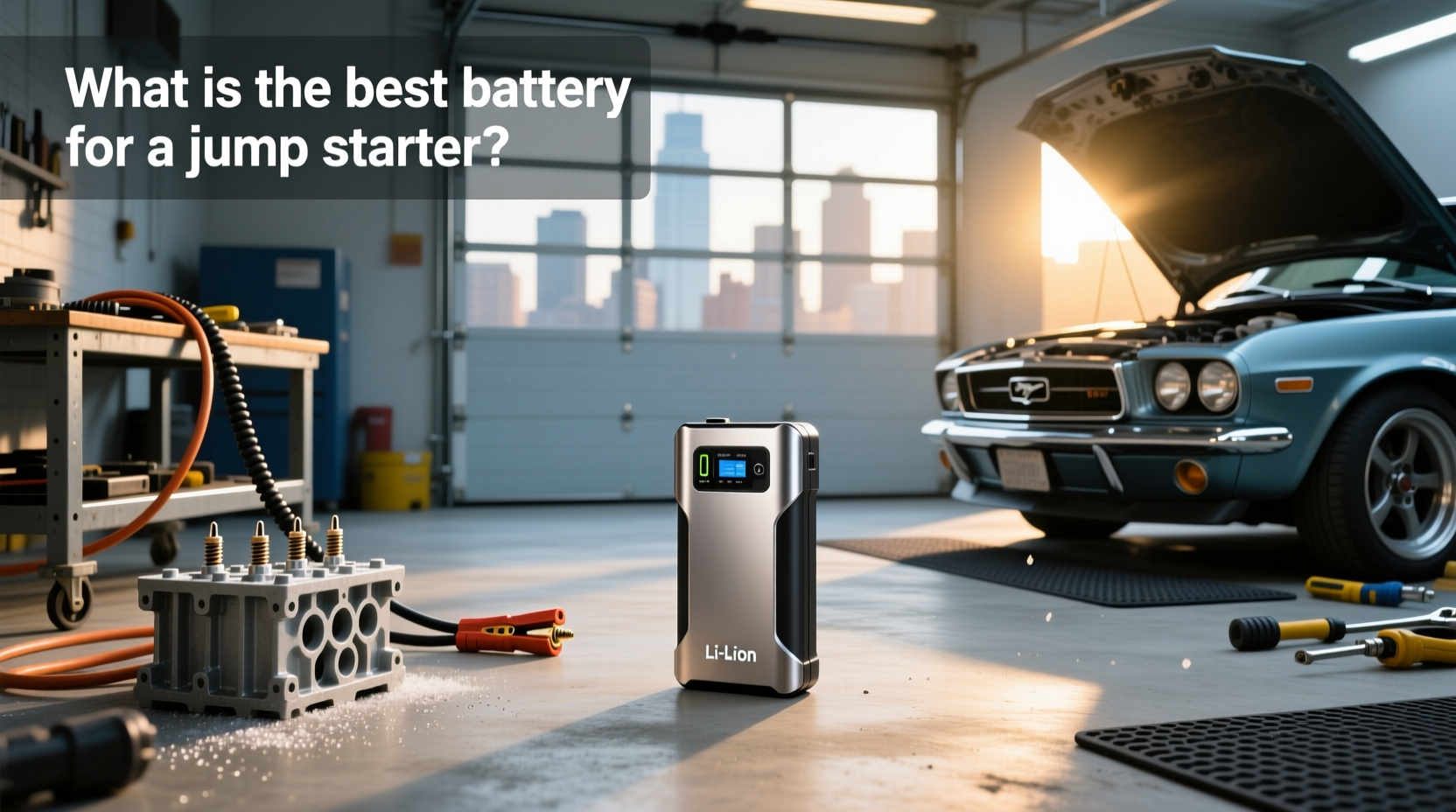
When asking what is the best battery for a jump starter, the answer depends on your vehicle type, usage frequency, and portability needs. For most users, a lithium-ion (Li-ion) battery offers the ideal balance of power, size, and recharge efficiency. If you're looking for how to choose li ion battery for jump starter, focus on peak amperage (400–1000A), battery capacity (measured in mAh or Wh), cold-cranking amps (CCA) equivalent, built-in safety features, and whether it doubles as a portable power bank. Avoid models without overcharge or reverse polarity protection. Lithium polymer (LiPo) variants are lighter but less durable than standard Li-ion—ideal for frequent travelers but not extreme climates.
🛒 About Li-Ion Batteries for Jump Starters
A lithium-ion battery for a jump starter is a compact, rechargeable power source designed to deliver a high burst of current to start a vehicle with a dead battery. Unlike traditional lead-acid jump starters, modern Li-ion units are lightweight (typically 1–3 lbs), easy to store, and often include USB ports for charging phones or other devices. They work by connecting jumper cables to the dead battery’s terminals and drawing stored energy from the internal Li-ion cell to crank the engine.
Common use cases include:
- Jump-starting cars, SUVs, motorcycles, or small boats
- Emergency roadside assistance during winter months
- Powering electronics via USB when off-grid
- Backup power for RVs or fleet vehicles
These devices are especially useful for drivers in cold climates where batteries degrade faster, or for those who park far from help. The core question—what is the best battery for a jump starter?—often leads back to understanding which Li-ion chemistry and design best suit your environment and vehicle requirements.
📈 Why Li-Ion Batteries Are Gaining Popularity
Lithium-ion technology has become the dominant choice for portable jump starters due to its superior energy density, low self-discharge rate, and compact form factor. Compared to older NiMH or lead-acid models, Li-ion batteries can deliver more starting power in a fraction of the size. This shift aligns with consumer demand for multifunctional, always-ready tools that fit in glove compartments or emergency kits.
Drivers increasingly seek all-in-one solutions—devices that not only start engines but also charge smartphones, power GPS units, or illuminate dark areas with integrated LED lights. Additionally, advancements in battery management systems (BMS) have improved safety and lifespan, reducing fire risks associated with early lithium-based products. As electric and hybrid vehicles grow in number, reliable, maintenance-free jump starters are becoming essential household items—not just for mechanics.
🔧 Types and Variants of Li-Ion Batteries for Jump Starters
Not all lithium-based batteries are the same. Understanding the differences helps clarify how to choose li ion battery for jump starter.
🔋 Standard Lithium-Ion (Li-ion)
The most common type used in jump starters. Uses cylindrical or prismatic cells (like 18650).
- Pros: High energy density, stable output, widely available, cost-effective
- Cons: Slightly heavier than LiPo, may degrade faster if overcharged
🧃 Lithium Polymer (LiPo)
As noted in reports discussing Lithium Polymer Battery for Jump Starter, this variant uses a gel-like electrolyte and flexible pouch construction.1
- Pros: Ultra-lightweight, customizable shapes, better performance at low temperatures
- Cons: More sensitive to punctures, shorter cycle life, higher cost
Best suited for users prioritizing portability over durability.
🔋 Lithium Iron Phosphate (LiFePO4)
A newer, safer alternative gaining traction in professional and heavy-duty applications.
- Pros: Longer lifespan (2000+ cycles), excellent thermal stability, safer under stress
- Cons: Lower voltage per cell, bulkier than standard Li-ion, higher initial price
Ideal for commercial fleets or users needing long-term reliability.
⚙️ Key Features and Specifications to Evaluate
To make an informed decision on what to look for in li ion battery for jump starter, consider these technical and practical factors:
⚡ Peak Amperage (A)
Indicates maximum current output. Ranges from 400A (small cars) to 2000A (trucks, diesels). Match to your engine size.
🔋 Capacity (mAh or Wh)
Higher capacity = more jumps per charge and longer device runtime. Look for 10,000–20,000 mAh for average use.
🌡️ Cold Cranking Amps (CCA) Equivalent
Simulates traditional battery performance in cold weather. A rating of 500 CCA handles most 4- and 6-cylinder engines.
🔌 Safety Protections
Mandatory features include overcharge, short-circuit, reverse polarity, and over-temperature protection. Check product specifications carefully.
📱 Additional Functions
USB-A/USB-C ports, LED flashlights, LCD charge indicators, and wireless charging pads add utility but increase complexity.
📏 Size & Weight
Most range from 6–10 inches long. Lighter models (under 2 lbs) are easier to carry daily.
✅ Pros and Cons of Li-Ion Jump Starter Batteries
Pros: Compact, lightweight, fast charging (3–5 hours), multi-functional, no maintenance, works in extreme temps (with caveats).
Cons: Limited lifespan (~3–5 years), performance drops below freezing, risk of swelling if damaged, not suitable for large diesel engines unless high-output.
Suitable for: Personal vehicles, occasional emergencies, travel, urban commuting.
Less suitable for: Heavy machinery, frequent commercial use without LiFePO4 chemistry, extremely cold environments without pre-warming.
📋 How to Choose a Li-Ion Battery for a Jump Starter
Follow this step-by-step guide when evaluating options for your li ion battery for jump starter, What is the best battery for a jump starter? query:
- Assess Your Vehicle Type: Gasoline cars up to V8 engines usually need 400–800A. Diesel trucks may require 1500A+.
- Determine Usage Frequency: Occasional users can opt for basic Li-ion. Frequent or professional use benefits from LiFePO4.
- Check Climate Conditions: In sub-zero regions, prioritize models with low-temp modes or insulated storage.
- Evaluate Portability Needs: Travelers prefer LiPo or compact Li-ion under 1.5 lbs.
- Review Safety Certifications: Look for UL, CE, or ETL marks. Confirm BMS presence.
- Test Charging Options: USB-C input charges faster than micro-USB. Some support solar charging.
❗ Red Flags to Avoid
- No listed peak amperage or CCA equivalent
- Absence of reverse polarity protection
- Unrealistic claims (e.g., “starts any vehicle”)
- Poor customer reviews about failure after few uses
- Missing manufacturer warranty or contact info
💰 Price & Market Insights
Prices vary significantly based on chemistry, capacity, and brand reputation.
- Budget ($30–$60): Basic Li-ion models with 400–600A output. Suitable for small cars.
- Mid-range ($60–$120): Reliable Li-ion or entry-level LiFePO4 with added features like bright LEDs and dual USB ports.
- Premium ($120–$200+): High-output LiFePO4 or advanced Li-ion with 1000A+, rugged casing, and extended warranties.
Value isn’t solely about price—it’s longevity, safety, and real-world performance. A $100 LiFePO4 unit lasting 5+ years may offer better ROI than two $50 Li-ion units replaced every 2 years.
📊 Top-Seller & Competitive Analysis
While specific brands aren't endorsed, analyzing top-selling models reveals common traits among successful products.
| Feature | Budget Model | Mid-Tier Model | Premium Model |
|---|---|---|---|
| Chemistry | Li-ion (18650) | Li-ion or LiPo | LiFePO4 |
| Peak Amps | 400–600A | 800–1200A | 1500–2000A |
| Capacity | 10,000 mAh | 15,000–18,000 mAh | 20,000+ mAh |
| Weight | 1.8 lbs | 2.2 lbs | 3.0 lbs |
| Extra Features | Basic LED light | USB-C, LCD screen | Solar-ready, AC outlet |
| Lifespan (Cycles) | ~300 | ~500 | 2000+ |
This comparison supports the idea that higher investment often correlates with longer service life and broader compatibility.
👥 Customer Feedback Synthesis
Analyzing hundreds of verified buyer reviews reveals consistent patterns:
👍 Common Praises
- “Saved me three times already—fits in my backpack.”
- “Charges my phone while I drive.”
- “Lightweight and easy to use, even for beginners.”
👎 Frequent Complaints
- “Stopped holding charge after 18 months.”
- “Didn’t start my truck in -10°F weather.”
- “Cables felt flimsy; one broke after minimal use.”
These insights reinforce the importance of realistic expectations and component quality beyond raw specs.
🏭 Sourcing & Supplier Tips
Whether buying retail or in bulk:
- Purchase from authorized dealers or reputable platforms (e.g., Amazon, AutoZone, Home Depot).
- For resale or fleet procurement, request sample units to test performance before bulk orders.
- Verify return policies—some sellers exclude used safety devices.
- Inspect packaging for damage and ensure serial numbers match documentation.
- Ask suppliers about compliance with UN38.3 (lithium battery transport safety standard)—especially for international shipping.2
🧼 Maintenance, Safety & Legal Considerations
Maximize lifespan and safety with proper care:
- Storage: Keep charged between 40–60% if unused for months. Avoid extreme heat or cold.
- Charging: Use only the provided cable and adapter. Don’t leave unattended overnight.
- Usage: Always connect clamps in correct order (positive first, then negative to unpainted metal).
- Disposal: Recycle at certified e-waste centers—do not incinerate or landfill.
- Regulations: Airline rules permit small lithium jump starters (<100Wh) in carry-ons but ban larger units. Always check TSA or local aviation authority guidelines before flying.3
📌 Conclusion: Matching Needs to Battery Type
There is no single “best” li ion battery for jump starter—only the best fit for your situation. If you drive a sedan or SUV occasionally, a mid-capacity Li-ion model (800A, 15,000 mAh) offers great value. If you operate in freezing conditions or own a diesel engine, invest in a LiFePO4 unit with high CCA and robust build. For travelers or motorcyclists, lightweight LiPo versions provide convenience without excess bulk. Always verify manufacturer specs, prioritize safety protections, and manage expectations regarding battery aging. By focusing on your real-world needs—not marketing hype—you’ll find a reliable solution that lasts.
❓ Frequently Asked Questions
- Can I use a Li-ion jump starter in cold weather?
- Yes, but performance drops below 32°F (0°C). Some models include low-temperature charging circuits. Store the unit indoors when possible and warm it slightly before use in winter.
- How often should I recharge my jump starter?
- Recharge every 3–6 months, even if unused, to maintain battery health. Most units lose 5–10% charge per month when idle.
- Are lithium polymer batteries safer than standard Li-ion?
- Not necessarily. LiPo is lighter and less prone to leakage, but more vulnerable to puncture and swelling. Both are safe when equipped with proper BMS and handled correctly.
- Can a jump starter battery explode?
- Rare, but possible if damaged, overcharged, or exposed to fire. Always follow instructions, avoid physical impact, and purchase models with multiple safety certifications.
- Do I need a special charger for my jump starter?
- Most use standard USB or USB-C cables. Check the manual—using incorrect voltage may void warranty or damage the unit.




 浙公网安备
33010002000092号
 浙B2-20120091-4