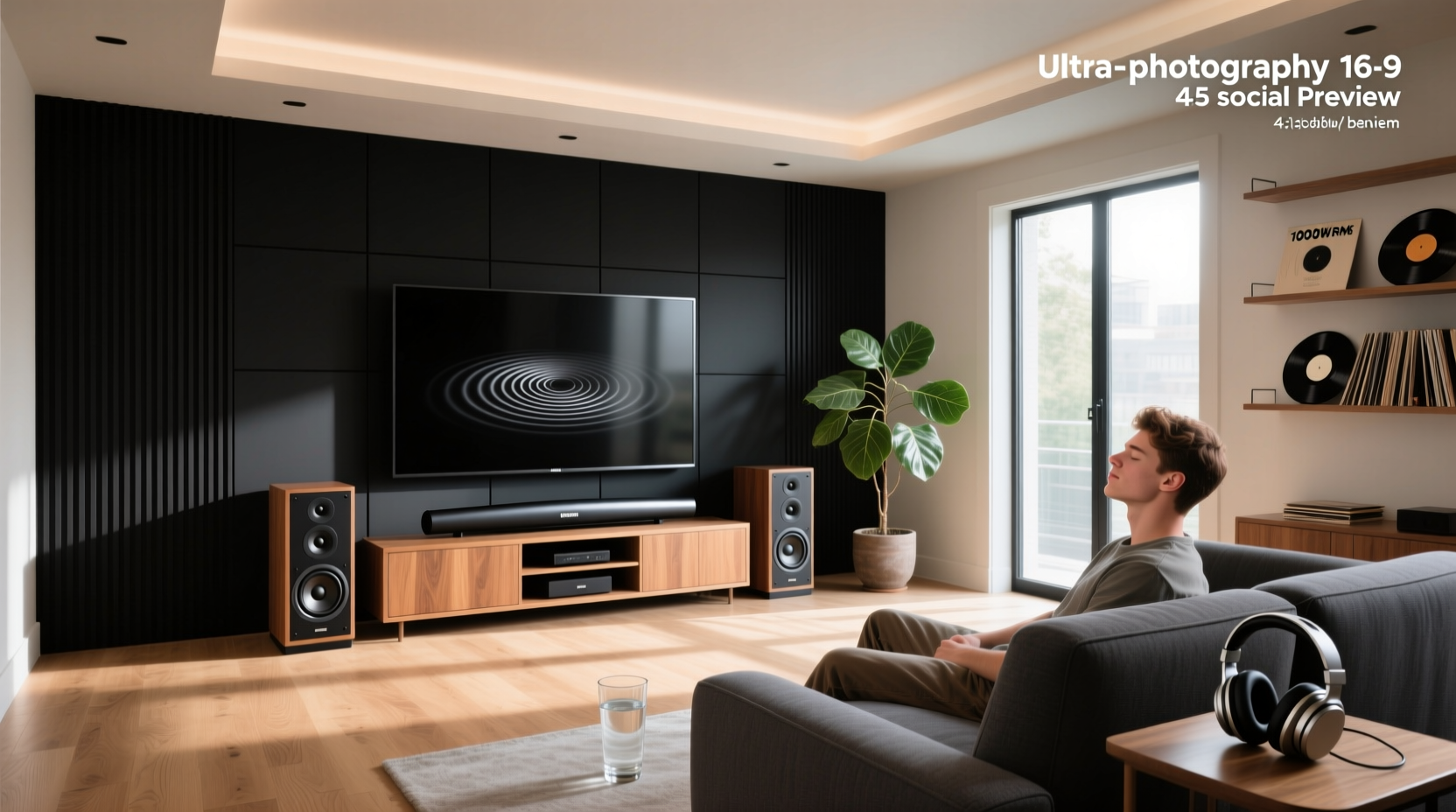
If you're asking how to choose a 1000W RMS subwoofer or wondering is a 1000 watt bass speaker good for home use?, the answer depends on your room size, listening habits, and system integration. A 1000W RMS subwoofer is powerful but not inherently better than lower-wattage models—performance hinges on driver sensitivity, cabinet design, and room acoustics 1. For small rooms, such high power may be excessive; for large or open spaces, it can deliver deep, immersive bass when properly matched. Avoid overvaluing wattage alone—focus instead on build quality, placement flexibility, and amplifier compatibility to make an informed decision.
🛒 About 1000W RMS Subwoofers: Definition & Typical Use Cases
A 1000W RMS (Root Mean Square) subwoofer is designed to handle continuous power of 1,000 watts without distortion or damage. Unlike peak power ratings, which reflect short bursts, RMS indicates sustained output capability—a more reliable metric for real-world performance 2.
These subwoofers are commonly used in:
- Home theaters: Delivering cinematic low-frequency effects (LFE) from action movies and surround soundtracks.
- Music listening rooms: Reproducing deep bass notes in genres like electronic, hip-hop, or orchestral music with accuracy.
- Large or open-plan living areas: Filling expansive spaces where smaller subs struggle due to poor bass distribution.
- Dedicated media rooms: Environments optimized for audio fidelity, often paired with AV receivers and multi-speaker setups.
It's important to note that a 1000W RMS rating does not mean the sub consumes 1000W constantly—it means it can safely handle that level of input power when driven by a capable amplifier.
✨ Why 1000W RMS Subwoofers Are Gaining Popularity
High-power subwoofers have become increasingly popular due to rising consumer expectations for immersive audio experiences. With the growth of 4K HDR content, Dolby Atmos, and high-resolution music streaming, users seek deeper, cleaner bass that enhances realism 1.
Key drivers include:
- Marketing influence: Wattage is often highlighted as a symbol of performance, leading buyers to associate higher numbers with superior sound.
- Improved amplifier efficiency: Modern Class D amplifiers deliver high power in compact form factors, making 1000W units more accessible.
- Room-filling demands: Open-concept homes require more acoustic energy to maintain even bass response across zones.
- DIY audio culture: Enthusiasts experiment with custom builds and multi-sub setups, increasing demand for powerful standalone units.
However, popularity doesn’t equate to universal suitability—context matters.
🔧 Types and Variants of 1000W RMS Subwoofers
Not all 1000W RMS subwoofers are created equal. Design variations significantly affect performance and application fit.
1. Sealed Enclosure
Features a tightly closed box that provides controlled, accurate bass.
- Pros: Tighter transient response, better for music; less prone to distortion.
- Cons: Lower efficiency—requires more power for same output; reduced maximum volume.
2. Ported (Bass Reflex) Enclosure
Includes a tuned port or vent to enhance low-frequency output.
- Pros: Higher efficiency and louder output; extends lower frequencies.
- Cons: Can sound boomy if not tuned correctly; larger physical footprint.
3. Bandpass Enclosure
Combines sealed and ported chambers to focus output within a narrow frequency band.
- Pros: Very loud within specific range; good for home theater impact.
- Cons: Narrow frequency response; less musical accuracy; bulky design.
4. Passive vs. Powered (Active)
Most 1000W RMS models are active (powered), meaning they include a built-in amplifier. Passive versions require external amplification.
- Active Pros: Easier setup, impedance-matched internally, compact design.
- Passive Pros: Greater flexibility in amp pairing; suitable for custom installations.
⚙️ Key Features and Specifications to Evaluate
When assessing a 1000W RMS subwoofer, go beyond wattage. Consider these critical specs:
- Driver Sensitivity (dB @ 1W/1m): Measures how efficiently the driver converts power to sound. A higher number (e.g., 88 dB vs. 84 dB) means more volume per watt 3.
- Frequency Response Range: Look for extended lows (e.g., 20–200 Hz). True sub-bass starts below 40 Hz.
- Cabinet Build Quality: MDF or HDF construction resists resonance better than plastic or particleboard.
- Amplifier Type: Class D offers high efficiency and cool operation—ideal for sustained use.
- Low-Pass Crossover & Phase Control: Allows integration with main speakers and time alignment.
- Connectivity Options: RCA inputs, LFE input, wireless receiver compatibility, mobile app control.
🔍 Pro Tip: Check whether the 1000W rating refers to the amplifier’s output or the driver’s handling capacity. Misalignment here can lead to underperformance or damage.
✅ Pros and Cons of 1000W RMS Subwoofers for Home Use
| Aspect | Pros | Cons |
|---|---|---|
| Power Headroom | Handles dynamic peaks without clipping; clean sound at high volumes | Overkill for small rooms; unnecessary energy draw |
| Bass Extension | Can reproduce very low frequencies with authority | Poorly designed models may lack true sub-bass despite high power |
| System Compatibility | Fits well with high-end AVRs and large speaker systems | May overwhelm bookshelf speakers or small monitors |
| Placement Flexibility | Strong output allows placement away from walls (with calibration) | Larger cabinets limit furniture integration options |
| Long-Term Durability | Quality models built with robust components last longer | Cheap high-wattage units often cut corners on materials |
📋 How to Choose a 1000W RMS Subwoofer: Step-by-Step Buying Guide
Follow this structured approach to ensure you select the right model:
- Assess Your Room Size:
In rooms under 300 sq ft, a 100–300W RMS sub is often sufficient. A 1000W unit excels in spaces over 500 sq ft or open layouts 1. - Evaluate Driver Sensitivity:
Compare sensitivity ratings. A 87 dB driver will outperform a 83 dB one even with less power. - Check Cabinet Design:
Sealed for accuracy, ported for output. Match to your primary use case (music vs. movies). - Verify Amplifier Matching:
Ensure the internal amp delivers stable power at the driver’s impedance (usually 4 or 8 ohms) 4. - Consider Placement Options:
Test virtual placement tools or use the “subwoofer crawl” method post-installation. - Avoid These Red Flags:
- Marketing-only “peak power” claims
- No published sensitivity or impedance data
- Lightweight cabinet (indicates thin materials)
- Lack of crossover or phase controls
💰 Price & Market Insights
Prices for 1000W RMS subwoofers vary widely based on brand, build quality, and technology:
- Budget Tier ($200–$400): Often feature basic components, plastic grilles, and generic amplifiers. Performance may not match wattage claims.
- Mid-Range ($400–$800): Balanced blend of power, sensitivity, and cabinet quality. Suitable for most home theaters.
- Premium ($800+): High-sensitivity drivers, advanced DSP, rugged enclosures, and refined tuning. Ideal for critical listeners.
Value isn't solely in price—compare cost per feature, warranty length, and user reviews. Be cautious of no-name brands claiming extreme specs without third-party validation.
📊 Top-Seller & Competitive Analysis
While specific models change frequently, leading brands like SVS, REL, KEF, and Monoprice offer competitive 1000W-class subs. Focus on verified performance metrics rather than popularity.
| Model Type | Sensitivity | Cabinet | Best For |
|---|---|---|---|
| High-Sensitivity Active | ≥87 dB | Sealed/MDF | Music lovers, accuracy-focused |
| Ported High-Output | 84–86 dB | Ported/MDF | Movie enthusiasts, large rooms |
| Budget High-Wattage | <83 dB | Plastic-thin | Risk of disappointment; avoid unless highly reviewed |
Look for models with user-replaceable parts, firmware updates, and room correction support.
👥 Customer Feedback Synthesis
Analysis of buyer reviews reveals consistent patterns:
- Common Praises:
- Deep, rumbling bass in large rooms
- Solid build quality in mid-to-high-tier models
- Smooth integration with modern AV receivers - Frequent Complaints:
- Underwhelming performance despite high wattage (often linked to low sensitivity)
- Oversized cabinets difficult to place aesthetically
- Overheating in poorly ventilated enclosures
- Inaccurate marketing of power ratings
Many satisfied users emphasize proper placement and room calibration as key to unlocking performance.
🏭 Sourcing & Supplier Tips
When purchasing:
- Buy from authorized dealers to ensure warranty validity and product authenticity.
- Check return policies—especially for large items with potential placement issues.
- For bulk or resale: Work with distributors offering demo units, B-stock, or volume discounts—but verify condition and origin.
- Inspect upon delivery: Look for shipping damage, test functionality early, and keep packaging until fully satisfied.
Online marketplaces may offer lower prices but carry risks of counterfeit or misrepresented products.
🧼 Maintenance, Safety & Legal Considerations
Maintenance: Keep vents clear, wipe down regularly, avoid placing near moisture sources.
Safety: Ensure adequate ventilation around the unit; do not cover amplifier sections. Use surge protectors to guard against voltage spikes.
Compliance: Confirm the device meets electrical safety standards in your region (e.g., UL in USA, CE in Europe). Noise levels should respect local ordinances—especially in apartments or shared walls.
Always refer to the manufacturer’s manual for model-specific care instructions.
📌 Conclusion: Is a 1000W RMS Subwoofer Good for Home Use?
A 1000W RMS subwoofer can be an excellent choice for home audio—but only when matched to your environment and expectations. If you have a large room, enjoy high-impact content, and prioritize deep bass extension, a well-designed 1000W model will meet your needs. However, if you’re in a small space or value musical accuracy over raw power, a lower-powered, higher-sensitivity sub may serve you better.
The key takeaway: wattage alone doesn’t define performance. Prioritize driver sensitivity, cabinet integrity, and system synergy over marketing numbers. Whether you're building a new setup or upgrading, focus on balanced integration—not just power.
❓ Frequently Asked Questions
- Can a 1000W subwoofer damage my AV receiver or main speakers?
- No, if properly configured. The sub receives a line-level signal and amplifies it independently. Just ensure crossover settings direct appropriate frequencies to each component.
- Do I need two subwoofers instead of one 1000W unit?
- In large or irregularly shaped rooms, yes. Multiple subs (e.g., two 500W units) often provide smoother bass distribution and reduce standing waves better than a single powerful sub 1.
- Is a 1000W RMS subwoofer overkill for normal listening?
- It can be, but not necessarily. You don’t have to run it at full power. A high-headroom sub operates cleaner at moderate volumes, reducing distortion.
- How do I verify a subwoofer’s true RMS rating?
- Check manufacturer datasheets, independent lab tests (e.g., Audioholics, Sound & Vision), and user reports. Reputable brands publish detailed technical specifications.
- Can I use a 1000W passive sub with my home theater receiver?
- Only if your receiver has pre-outs and you pair it with a compatible external amplifier. Most home theater receivers lack the power to drive passive subs directly.




 浙公网安备
33010002000092号
 浙B2-20120091-4