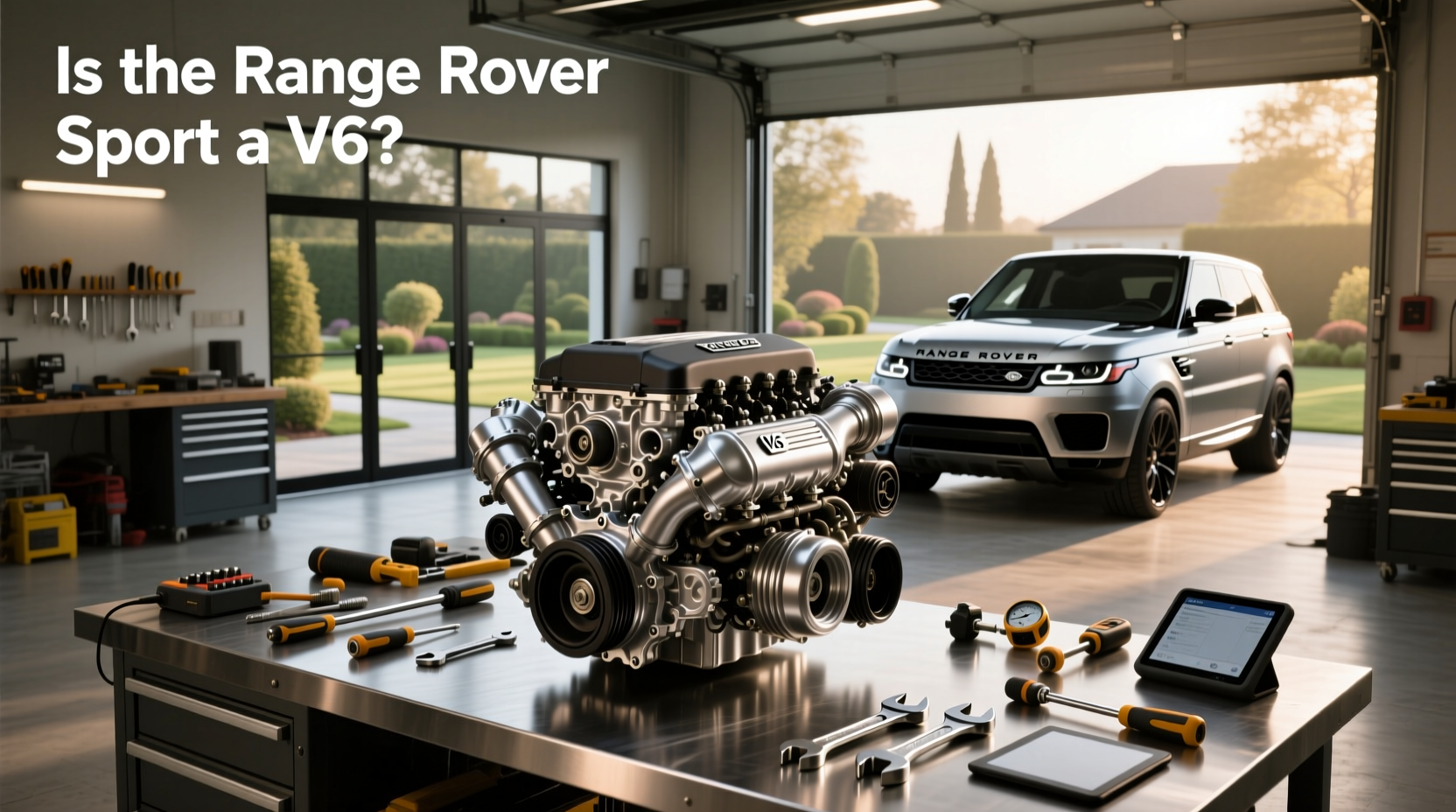
If you're asking how to choose a Range Rover Sport engine and wondering is the Range Rover Sport a V6?, the answer is no — not anymore. While earlier models (2013–2022) featured a supercharged 3.0L V6 petrol engine, the current 2024–2025 Range Rover Sport (L461) uses a modern 3.0L turbocharged inline-six (I-6) Ingenium engine across all non-V8 trims 12. When deciding what to look for in a Range Rover Sport engine, focus on whether you prioritize performance (V8), fuel efficiency (mild hybrid I-6), or electric range (plug-in hybrid). Avoid older V6 models if long-term parts availability or advanced tech are concerns.
About Range Rover Sport Engine: Is the Range Rover Sport a V6?
The question “Is the Range Rover Sport a V6?” stems from its historical use of V6 engines, particularly during the second generation (L494, 2013–2022). At that time, the 3.0L supercharged V6 was a core engine option, offering strong performance with 340 horsepower and smooth delivery 3. However, today’s model has transitioned entirely to inline-six (I-6) configurations under Land Rover’s Ingenium engine family.
The current engine lineup includes mild hybrid (MHEV) and plug-in hybrid (PHEV) versions of the 3.0L twin-turbo I-6, as well as twin-turbo V8 MHEV options. So while the term “V6” may still appear in used car listings or forums, new Range Rover Sports do not have V6 engines. Understanding this shift helps buyers avoid confusion when comparing trims and model years.
Why the Shift from V6 to I-6 Matters: Trends & Buyer Motivation
The evolution away from the V6 engine in the Range Rover Sport aligns with global automotive trends focused on sustainability, performance efficiency, and packaging optimization. Automakers are increasingly adopting straight-six (I-6) layouts because they offer inherent balance, smoother operation, and better integration with hybrid systems compared to traditional V6 designs.
Buyers today are not just looking for raw power — they want intelligent powertrains that deliver responsiveness without sacrificing fuel economy or environmental responsibility. The introduction of mild hybrid (MHEV) and plug-in hybrid (PHEV) variants of the I-6 engine allows drivers to reduce fuel consumption and CO₂ emissions while maintaining high performance levels. For example, the P550e PHEV produces 543 hp and can travel up to 48 miles on electric power alone 2.
This shift also supports Land Rover’s strategy to electrify its entire lineup by 2030. As such, understanding how to choose a Range Rover Sport engine now involves evaluating hybrid capability, electric range, charging infrastructure access, and long-term ownership costs — not just cylinder count.
Types and Variants: Current Engine Options Compared
The 2024–2025 Range Rover Sport offers six main engine configurations, none of which are V6. All gasoline engines are either inline-six (I-6) or V8, with hybrid technology integrated into every variant.
- \u27A1\uFE0F P360 (3.0L I-6 MHEV): 355 hp, 369 lb-ft torque. Best for daily driving and balanced performance. Mild hybrid system recovers energy during braking.
- Pros: Good fuel economy, lower purchase price, smooth ride
- Cons: Less powerful than higher trims, no electric-only mode
- \u27A1\uFE0F P400 (3.0L I-6 MHEV): 395 hp, 406 lb-ft torque. A step up in acceleration and responsiveness.
- Pros: Stronger performance, still efficient, standard on many trims
- Cons: Higher cost than P360, similar real-world MPG
- \u27A1\uFE0F P460e (3.0L I-6 PHEV): 454 hp, 487 lb-ft torque. Plug-in hybrid with ~39 miles electric range.
- Pros: Lower running costs for short commutes, reduced emissions
- Cons: Requires home charging setup, heavier due to battery
- \u27A1\uFE0F P550e (3.0L I-6 PHEV): 543 hp, 590 lb-ft torque. High-performance plug-in hybrid with ~48 miles EV range.
- Pros: Blends sporty performance with green credentials
- Cons: Most expensive I-6 option, complex maintenance
- \u27A1\uFE0F P530 (4.4L V8 MHEV): 523 hp, 553 lb-ft torque. Traditional high-performance choice.
- Pros: Powerful, refined, quick 0–60 mph (4.3 sec)
- Cons: Lower fuel economy, higher emissions, premium fuel required
- \u27A1\uFE0F P635 (4.4L V8 MHEV): 626 hp, 553 lb-ft torque. Top-tier performance trim.
- Pros: Supercar-like acceleration (0–60 in 3.6 sec)
- Cons: Highest price, highest fuel consumption, limited practicality
Key Features and Specifications to Evaluate
When assessing what to look for in a Range Rover Sport engine, consider these measurable criteria:
- \u27A1\uFE0F Power Output (hp) and Torque (lb-ft): Determines acceleration and towing capacity. Higher output suits performance seekers.
- \u27A1\uFE0F Hybrid Type (MHEV vs PHEV): Mild hybrids improve efficiency slightly but don’t drive on electricity alone. Plug-in hybrids require charging but offer real EV range.
- \u27A1\uFE0F Fuel Economy (MPG): Varies significantly between trims. PHEVs can achieve over 70 MPGe when charged regularly.
- \u27A1\uFE0F 0–60 mph Time: Ranges from 5.7 seconds (P360) to 3.6 seconds (P635). Important for sport-oriented drivers.
- \u27A1\uFE0F Towing Capacity: All engines support up to 7,716 lbs, so no difference here.
- \u27A1\uFE0F Engine Technology: The Ingenium I-6 features advanced thermal management, electric turbochargers (on some), and integrated starter-generator (ISG) for MHEV function.
Pros and Cons: Who Should (and Shouldn't) Buy Which Engine?
No single engine suits all buyers. Your ideal choice depends on usage patterns, budget, and priorities.
Who Should Consider the I-6 Engines (P360, P400, P460e, P550e)?
- Urban commuters who want lower fuel costs
- Environmentally conscious buyers seeking reduced emissions
- Drivers with access to home or workplace charging (for PHEVs)
- Budget-conscious shoppers avoiding V8 premiums
Who Should Consider the V8 Engines (P530, P635)?
- Performance enthusiasts wanting maximum power
- Frequent highway drivers less concerned about city MPG
- Luxury-focused buyers prioritizing refinement over efficiency
- Towing-heavy users who value consistent power delivery
Who Should Avoid These Models?
- Buyers expecting a traditional V6 engine — it’s no longer available
- Those without charging access considering a PHEV
- Owners in regions with strict emissions regulations and congestion charges
- People needing maximum cargo space — PHEV batteries reduce trunk volume slightly
How to Choose a Range Rover Sport Engine: Step-by-Step Buying Guide
Follow this checklist when deciding how to choose a Range Rover Sport engine:
- Determine your primary use case: Daily commute? Weekend adventures? Towing? Track days?
- Evaluate your driving habits: City vs highway ratio, average trip length, access to charging.
- Set a realistic budget: Include insurance, fuel/electricity, maintenance, and potential tax incentives for PHEVs.
- Test drive multiple trims: Feel the difference between MHEV and PHEV throttle response and noise levels.
- Review official specs: Confirm power, torque, 0–60 times, and fuel economy from manufacturer sources.
- Check local incentives: Some regions offer rebates for plug-in hybrids.
- Verify service network: Ensure there are qualified technicians nearby for hybrid/V8 systems.
Price & Market Insights: Value Tiers and Budget Planning
Pricing varies widely based on engine type and trim level. As of 2024–2025 model year estimates:
- P360: Starting around $75,000 – most affordable entry point
- P400: ~$78,000 – moderate premium for added power
- P460e: ~$82,000 – higher cost justified by hybrid savings over time
- P550e: ~$86,000 – premium for high-output PHEV
- P530 (V8): ~$95,000 – significant jump for performance
- P635: ~$105,000+ – top-tier luxury/performance price
Prices may vary by region, dealer fees, and optional packages. While the P360 offers the best value for general use, the P400 provides a sweet spot between cost and performance. PHEV models may qualify for federal or state tax credits (e.g., up to $7,500 in the U.S.), improving long-term value.
Top-Seller & Competitive Analysis
The P400 (I-6 MHEV) is among the most popular trims due to its balance of power, efficiency, and price. It outsells both base and high-end models in many markets.
| Model | Engine | HP | 0–60 mph | Fuel System |
|---|---|---|---|---|
| P360 | 3.0L I-6 MHEV | 355 | 5.7 sec | Mild Hybrid |
| P400 | 3.0L I-6 MHEV | 395 | 5.2 sec | Mild Hybrid |
| P530 | 4.4L V8 MHEV | 523 | 4.3 sec | Mild Hybrid |
| P635 | 4.4L V8 MHEV | 626 | 3.6 sec | Mild Hybrid |
Compared to rivals like the BMW X5 xDrive40i (I-6) or Mercedes GLE 450 (I-6 mild hybrid), the Range Rover Sport holds its ground in power and luxury, though it often commands a price premium.
Customer Feedback Synthesis
Based on aggregated owner reviews and expert analyses:
Common Praises:
- Silky-smooth power delivery from I-6 engines
- Impressive refinement and quiet cabin
- Plug-in hybrids deliver real-world fuel savings with regular charging
- V8 models praised for exhilarating acceleration
Common Complaints:
- PHEV battery reduces cargo space
- Complex hybrid systems may lead to costly repairs
- Real-world MPG lower than EPA estimates, especially for non-plugged PHEVs
- Higher trims feel overpriced relative to marginal performance gains
Sourcing & Supplier Tips
When purchasing a new or used Range Rover Sport:
- New vehicles: Order directly from authorized dealers. Verify engine code (e.g., P400, P550e) matches your preference.
- Used vehicles: Confirm whether it's a pre-2022 model with a V6 or post-2022 with I-6. Check service history for hybrid system health.
- Leasing: Consider leasing a PHEV to benefit from tax advantages without long-term battery concerns.
- Inspection: Have a certified technician inspect any used model, especially hybrid components and suspension systems.
Maintenance, Safety & Legal Considerations
All Range Rover Sport engines require scheduled maintenance per the manufacturer’s guide. Key points:
- I-6 and V8 engines need premium unleaded fuel (91 octane minimum).
- Hybrid systems (MHEV/PHEV) have sealed batteries not meant for user servicing.
- Brake wear may be reduced on PHEVs due to regenerative braking.
- Ensure software updates are current — critical for hybrid operation.
- Emissions compliance varies by region; verify eligibility for low-emission zones (e.g., London ULEZ).
Always consult official documentation and local regulations before purchase.
Conclusion: Matching Engine Choice to Your Needs
The Range Rover Sport is no longer a V6 vehicle. Since 2022, it has used a 3.0L turbocharged inline-six (I-6) Ingenium engine in various hybrid forms. If you’re asking how to choose a Range Rover Sport engine, start by clarifying your priorities. For balanced performance and efficiency, the P400 I-6 MHEV is ideal. For eco-friendly commuting with electric capability, consider the P550e PHEV. If raw power defines your needs, the P635 V8 delivers supercar-like speed. Avoid assuming engine types based on past knowledge — always verify the specific model year and engine code.
Frequently Asked Questions
- Is the Range Rover Sport still available with a V6 engine?
- No. The last V6-powered model was the 2022 second-generation (L494). The current 2024–2025 models use a 3.0L turbocharged inline-six (I-6), not a V6.
- What replaced the V6 engine in the Range Rover Sport?
- The supercharged V6 was replaced by a 3.0L twin-turbo inline-six (I-6) Ingenium engine with mild or plug-in hybrid technology, starting with the 2022 L461 model.
- Which Range Rover Sport engine is the most reliable?
- Long-term data is still emerging, but the P400 I-6 MHEV is considered a balanced choice with fewer complexity risks than PHEVs or V8s. Always check service records on used models.
- Can I charge a Range Rover Sport PHEV at home?
- Yes. You can use a standard 120V outlet (slower) or install a Level 2 (240V) charger for faster charging. Charging time varies by model and voltage.
- Does the I-6 engine perform as well as the old V6?
- Yes, and often better. The modern I-6 produces more power and torque than the previous supercharged V6, with improved fuel efficiency and smoother delivery thanks to turbocharging and hybrid tech.




 浙公网安备
33010002000092号
 浙B2-20120091-4