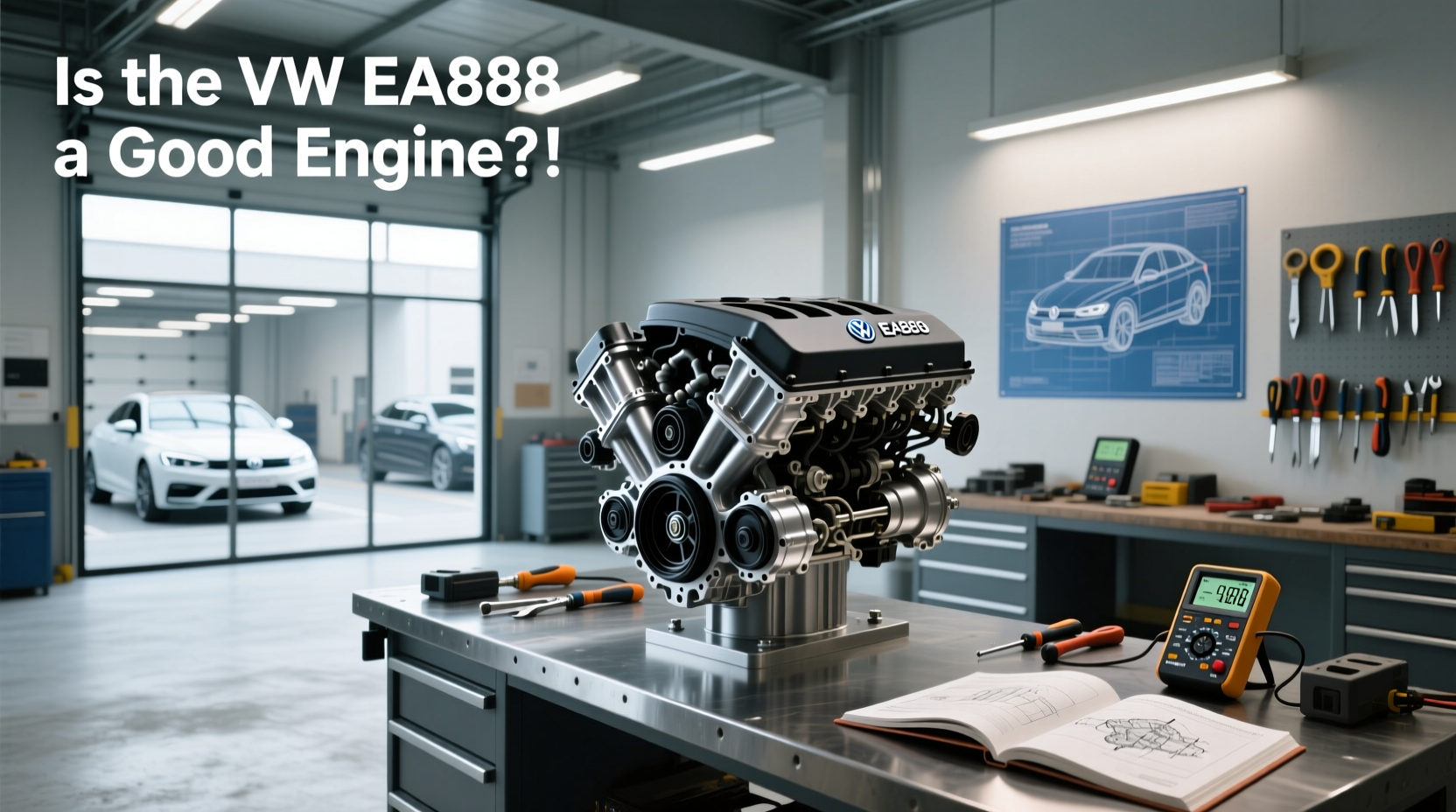
The Volkswagen EA888 engine is widely regarded as a solid choice for drivers seeking a balance of performance, efficiency, and tuning potential — but how to choose the right generation and configuration depends heavily on your priorities. If you're asking “Is the VW EA888 a good engine?”, the answer is generally yes for Gen 3 and Gen 4 models, especially if you prioritize modern turbocharged responsiveness and aftermarket support 1. However, earlier generations (Gen 1 and Gen 2) had notable reliability issues like oil consumption and carbon buildup, so buyers should avoid these unless budget-constrained and prepared for maintenance. For those considering a used or modified vehicle, what to look for in a VW EA888 engine includes service history, known weak points (like PCV valves and water pumps), and whether preventative upgrades have been made. This guide breaks down every factor that impacts real-world ownership, helping you make an informed decision.
About the VW EA888 Engine
The EA888 is a family of turbocharged inline-four gasoline engines developed by Volkswagen Group, used across multiple brands including Audi, Porsche, Škoda, and SEAT. Available in 1.8L and 2.0L displacements, it employs TSI (Turbo Stratified Injection) technology combining direct fuel injection and turbocharging to deliver strong power output with relatively low fuel consumption ⚙️. The engine has powered popular models such as the Volkswagen Golf GTI, Golf R, Passat, Tiguan, Audi A4, and TT, making it one of the most widespread performance-oriented four-cylinder platforms in Europe and North America.
Typical use cases include daily driving with occasional spirited performance, track-day preparation through tuning, and long-distance highway cruising. Its compact size allows flexible packaging in transverse and longitudinal layouts, while its modular design enables consistent manufacturing and updates across model years.
Why the EA888 Is Gaining Popularity
Enthusiasts and everyday drivers alike are increasingly focused on engines that offer both drivability and upgrade headroom. The EA888 stands out due to its strong factory output — particularly in hot hatches like the Golf R, where the 2.0L variant produces up to 315 horsepower and 295 lb-ft of torque — combined with excellent fuel economy, sometimes exceeding 40 mpg on highway cycles ✈️ 2.
Additionally, its open-source-friendly ECU tuning ecosystem makes it a favorite among modders. Whether someone wants mild performance gains or full race builds, the EA888 responds predictably to modifications. As emissions standards tighten globally, manufacturers are moving away from large naturally aspirated engines, increasing demand for efficient yet powerful turbo units like the EA888 🌍.
Types and Variants
The EA888 has evolved over four generations, each bringing improvements in reliability, efficiency, and performance:
- Gen 1 (2006–2009): Introduced the core TSI concept but suffered from lower refinement and limited tuning capability. Rare in today’s market and not recommended for purchase ❗.
- Gen 2 (2008–2015): Improved power delivery but plagued by excessive oil consumption due to flawed piston ring design. While some repairs exist, long-term reliability remains questionable 🔧 3.
- Gen 3 (2012–present): Major leap forward with stronger internals, better cooling, and revised turbo systems. Still susceptible to carbon buildup and oil leaks, but overall much more reliable with proper care ✅ 4.
- Gen 4 (2020–present): Latest iteration featuring updated turbochargers, improved software calibration, and enhanced durability. Early reports suggest fewer mechanical failures and better thermal management ⭐.
Each version comes in different states of tune — from economy-focused 150 hp variants to high-output 315+ hp versions in performance trims. Choosing between them depends on intended use, budget, and willingness to perform preventative maintenance.
Key Features and Specifications to Evaluate
When evaluating an EA888-powered vehicle, consider these technical aspects:
- Turbocharging System: Later models use more durable turbos; early Gen 3 units had IHI turbo issues, while Golf R models use the robust IS38 unit 🚀.
- Direct Fuel Injection + Port Injection (Gen 3+): Helps reduce carbon buildup compared to pure direct-injection setups.
- Variable Valve Timing (VVT): Improves torque curve and fuel economy across RPM range ⚙️.
- Cooling System Design: Plastic thermostat housings in Gen 3 can crack; metal replacements improve longevity 🔧.
- Oil System Integrity: Check for PCV valve condition, oil filter housing cracks, and rear main seal leaks — common failure points.
- ECU Tunability: Most models accept aftermarket tuning via OBD-II flash, supporting Stage 1–3 modifications.
Always verify the specific engine code (e.g., CAEB, CWCA, DKXA) as it indicates exact configuration and known issues.
Pros and Cons
- Strong power-to-weight ratio ideal for sporty compacts
- Fuel-efficient under normal driving conditions
- Excellent tuning headroom without major hardware changes
- Widely supported by aftermarket parts and tuning shops
- Used in many reliable chassis with good resale value
- Carbon buildup on intake valves requires periodic cleaning (especially Gen 2–3)
- Potential for costly oil leaks (cam cover, rear main seal)
- Timing chain stretch possible if oil changes are neglected
- Plastic coolant components prone to cracking over time
- Higher repair costs at dealerships vs independent specialists
This engine suits drivers who want engaging performance without sacrificing practicality. It's less ideal for those seeking zero-maintenance ownership or extreme off-road durability.
How to Choose a VW EA888 Engine
Follow this step-by-step checklist when selecting a vehicle with an EA888 engine:
- Determine Your Use Case: Daily commuter? Look for Gen 3 or 4 with documented service history. Performance enthusiast? Prioritize higher-horsepower trims suitable for tuning.
- Avoid Gen 1 and Early Gen 2 Models: These carry higher risk of oil consumption and internal wear. Only consider if priced significantly below market and fully inspected.
- Inspect Service Records: Regular oil changes using OEM-specified fluids (e.g., VW 502 00/505 00) are critical for timing chain and turbo longevity.
- Check for Known Issues:
- Carbon buildup symptoms (rough idle, misfires)?
- Oil leaks around cam bridge or rear main seal?
- Coolant leaks near thermostat housing?
- Check engine light related to PCV system?
- Look for Preventative Upgrades: Metal thermostat housing, oil catch can, upgraded intercooler, and auxiliary radiator indicate proactive ownership.
- Verify ECU Modifications: If tuned, ensure it was done professionally and logs are available. Unstable tunes can damage components.
- Get a Pre-Purchase Inspection (PPI): Have a specialist perform compression/leakdown tests, borescope inspection of intake valves, and scan for stored fault codes.
Red Flags to Avoid:
🚫 High mileage (>120k miles) with no records of timing chain or valve cleaning
🚫 Evidence of overheating or coolant mixing with oil
🚫 Repeated oil top-ups indicating consumption issues
🚫 Aftermarket tune without supporting hardware upgrades
Price & Market Insights
Prices vary widely based on vehicle model, trim, age, and region. As of 2024:
- Used Cars with EA888: $15,000–$35,000 depending on model (e.g., Jetta vs Golf R)
- Standalone Engines (Replacements): $3,000–$6,000 new; $1,500–$3,000 used
- Full Tune (Stage 1): $500–$900 at reputable shops
Gen 4 models command a premium due to improved reliability. In markets like the U.S. and UK, certified pre-owned programs often include extended warranties covering EA888 components. Independent repair shops typically offer 30–50% savings over dealership labor rates.
Top-Seller & Competitive Analysis
The 2.0T EA888 found in the Volkswagen Golf GTI and Audi S3 are among the most popular applications. Below is a comparison of key variants:
| Model | Horsepower | Torque (lb-ft) | Generation | Tuning Potential |
|---|---|---|---|---|
| Golf GTI (2015–2020) | 220 | 258 | Gen 3 | Up to 400 hp (Stage 2) |
| Golf R (2015–2020) | 315 | 295 | Gen 3 | Up to 500 hp reliably |
| Audi S3 (2020+) | 306 | 295 | Gen 4 | High (improved turbo & cooling) |
| Passat 2.0T | 174–220 | 207–258 | Gen 3 | Moderate (lower boost stock) |
While all share the same base architecture, factory tuning, cooling capacity, and turbo selection affect upgrade viability.
Customer Feedback Synthesis
Analysis of owner forums, reviews, and mechanic surveys reveals consistent patterns:
- Positive Feedback:
- “Responsive throttle and smooth power delivery”
- “Easy to tune — gained 60 hp with just a flash”
- “Gets 35+ mpg on road trips despite being quick”
- “Parts are readily available and community support is strong”
- Common Complaints:
- “Spent $1,200 fixing a cracked plastic coolant housing”
- “Intake valves clogged at 60k miles — had to do walnut blasting”
- “Rear main seal leak required transmission removal — very expensive”
- “Early turbo failed at 70k miles; replaced under extended warranty”
Satisfaction tends to correlate with maintenance diligence and awareness of known weaknesses.
Sourcing & Supplier Tips
For replacement engines or parts:
- Purchase from authorized remanufacturers or verified salvage yards with return policies.
- Confirm VIN compatibility — EA888 engines vary by year, emissions standard, and market.
- For tuning services, select shops with dyno validation and customer references.
- If buying in bulk (e.g., for repair business), compare core exchange options and warranty terms.
- Always inspect used engines for external damage, oil sludge, and missing components.
Online platforms like RockAuto, ECS Tuning, and FCP Euro offer competitive pricing, but verify fitment using OEM part numbers.
Maintenance, Safety & Legal Considerations
Regular maintenance is essential for longevity:
- Change oil every 5,000–7,500 miles using VW-approved 5W-40 or 0W-40 synthetic.
- Inspect PCV valve and hoses annually.
- Clean intake valves every 60,000–80,000 miles (via walnut blasting or chemical clean).
- Replace coolant every 4 years; consider metal thermostat housing upgrade.
Safety-wise, ensure any performance modifications don’t compromise braking, suspension, or traction control systems. Legally, check local regulations regarding modified emissions equipment — removing catalytic converters or disabling O2 sensors may violate environmental laws in many regions. Always retain original ECU maps for reversion if needed.
Conclusion
The VW EA888 engine is a capable and versatile powerplant, particularly in its Gen 3 and Gen 4 forms. If you need a responsive, efficient, and tunable engine for a sport compact or daily driver, the EA888 is a strong contender. However, if you expect completely maintenance-free operation, this engine may disappoint without proactive care. Focus on later-generation models, prioritize vehicles with full service history, and budget for known wear items. With proper selection and upkeep, the EA888 delivers a rewarding ownership experience that balances performance and practicality.
FAQs
❓ Is the EA888 engine reliable after 100,000 miles?
Yes, provided it received regular oil changes and preventative maintenance. Gen 3 and Gen 4 models are known to exceed 150,000 miles when properly cared for.
❓ Can I prevent carbon buildup on my EA888 engine?
You can reduce it significantly by using an oil catch can, performing regular short highway drives, and opting for Gen 3+ models with dual (port + direct) injection. Periodic walnut blasting is also effective.
❓ What is the most reliable EA888 generation?
Gen 4 is currently the most reliable, followed closely by late-model Gen 3 units. Both show marked improvement over earlier versions in durability and component quality.
❓ How much horsepower can the EA888 handle with modifications?
Stock internals can safely support up to 400–450 hp with proper cooling and fueling. Beyond that, forged pistons and rods are recommended for long-term reliability.
❓ Are EA888 engines expensive to repair?
Some repairs (like rear main seal or timing chain) are labor-intensive and costly at dealerships. Independent specialists often provide more affordable solutions, especially for recurring issues.




 浙公网安备
33010002000092号
 浙B2-20120091-4