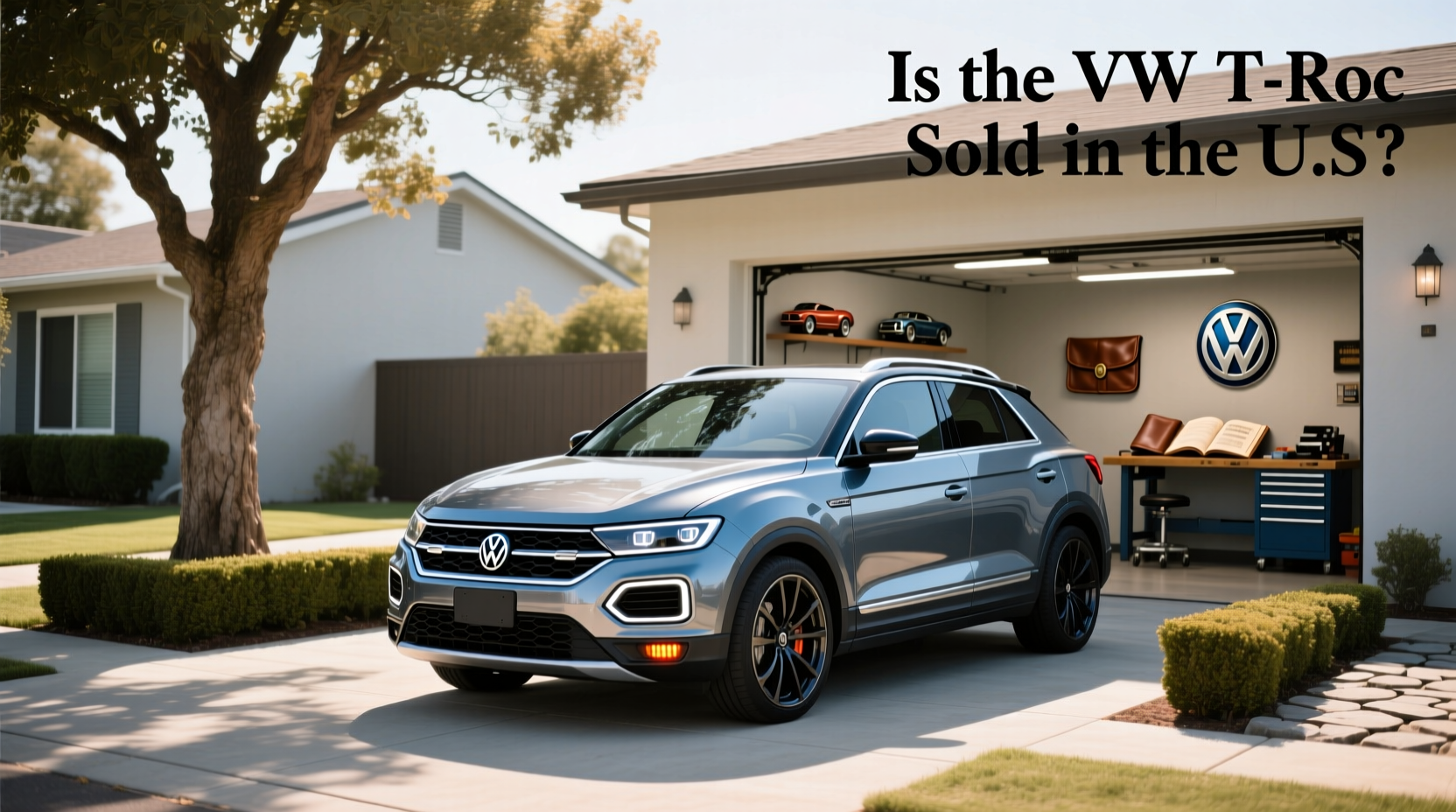
The Volkswagen T-Roc is a compact crossover SUV designed primarily for European and select global markets. Despite its popularity abroad, the T-Roc is not available for purchase in the United States. For American consumers seeking a similarly sized vehicle from Volkswagen, the brand offers the Taos as the smallest and most affordable SUV in its current U.S. lineup 1.
This absence reflects Volkswagen’s strategic positioning in North America, where consumer preferences favor slightly larger interiors, higher ground clearance, and value-focused feature packages. While the T-Roc boasts advanced tech and hybrid powertrains in Europe, these configurations are not offered stateside due to differing regulatory standards, fuel economy expectations, and competitive dynamics.
Why the VW T-Roc Isn’t Sold in the U.S.
Volkswagen has made a deliberate decision to exclude the T-Roc from the U.S. market. Understanding this choice helps clarify what types of vehicles succeed in North America and what alternatives may better suit local drivers.
- 📍 Strategic Market Focus: Volkswagen positions the Taos as its entry-point SUV in the U.S., directly competing with mainstream models like the Honda CR-V and Toyota RAV4. The Taos was engineered with American road conditions, family needs, and pricing sensitivity in mind.
- 👥 Consumer Demand Alignment: U.S. buyers often prioritize cargo space, ride comfort on highways, and standard all-wheel drive (AWD) availability. The T-Roc, while stylish and agile, offers less rear legroom and trunk capacity than many domestic competitors.
- 🏭 Production and Distribution Efficiency: Offering too many overlapping models can dilute marketing impact and complicate dealer inventories. By focusing on the Taos, Tiguan, ID.4, Atlas Cross Sport, and Atlas, VW streamlines its U.S. product strategy.
- 🌍 Regional Design Differences: European models like the T-Roc emphasize maneuverability in urban environments, diesel and mild-hybrid engines, and premium interior finishes. These attributes have less appeal in a market dominated by gasoline-powered, family-oriented crossovers.
Why the T-Roc Remains Popular Globally
Despite its absence in the U.S., the T-Roc has achieved strong sales across Europe, with over 2 million units sold worldwide since launch and nearly 300,000 delivered in 2023 alone 2. Key reasons for its international success include:
- ⚡ Hybrid Powertrain Options: The T-Roc offers both mild-hybrid (eTSI) and plug-in hybrid (GTE) variants, improving fuel efficiency without sacrificing performance. A 1.5L turbocharged engine produces up to 168 hp and 306 lb-ft of torque in hybrid form.
- ✨ Advanced Technology: Standard equipment includes a 12.9-inch infotainment touchscreen, digital cockpit, wireless smartphone integration, and optional head-up display.
- ✅ Safety & Driver Assistance: Features like Travel Assist (adaptive cruise + lane centering), Park Assist Pro, and Exit Warning enhance convenience and safety in dense city driving.
- 🔧 Stylish Customization: Two-tone roof options, ambient lighting, and multiple trim levels allow personalization uncommon in this segment.
Types and Variants of the Volkswagen T-Roc (Global)
While none of these are available in the U.S., knowing the range helps understand what’s missing and informs comparisons with available models.
1. T-Roc 1.5L TSI (Gasoline)
The base gasoline model delivers 150 hp and front-wheel drive (FWD), with optional AWD. It’s ideal for daily commuting and moderate climates.
- ✅ Pros: Reliable engine, smooth transmission, lower price point
- ❗ Cons: No hybrid option, average fuel economy compared to rivals
2. T-Roc eTSI (Mild Hybrid)
Combines a 1.5L turbo engine with a 48V electric system to reduce fuel consumption during stop-start driving.
- ✅ Pros: Improved city MPG, seamless start-stop function
- ❗ Cons: Limited electric-only range, minor real-world savings
3. T-Roc GTE (Plug-in Hybrid)
Offers ~35 miles of EV range and combined output of 242 hp. Suitable for eco-conscious drivers with access to charging.
- ✅ Pros: Low emissions, high efficiency, qualifies for incentives in some countries
- ❗ Cons: Higher initial cost, reduced cargo space due to battery placement
4. T-Roc R (Performance Version)
Features a 2.0L turbo engine with 300 hp, sport suspension, and AWD. Competes with hot hatches like the Golf R.
- ✅ Pros: Exciting acceleration, sharp handling
- ❗ Cons: Expensive, poor fuel economy, firm ride quality
Key Features and Specifications to Evaluate
When assessing whether a vehicle like the T-Roc—or its U.S. equivalent—is right for you, focus on measurable criteria that align with your lifestyle and priorities.
⚙️ Engine and Fuel Efficiency
In Europe, the T-Roc achieves up to 40 MPG on highway cycles with hybrid variants. In contrast, U.S. models like the Taos offer 36 MPG highway but lack electrified options beyond the ID.4 EV.
📊 Interior Space and Cargo Capacity
The T-Roc provides around 59 cu ft of max cargo space, whereas the Taos offers 65.9 cu ft—a significant difference for families or frequent travelers.
🛠️ Technology and Infotainment
The T-Roc’s 12.9-inch Discover Pro infotainment system surpasses the Taos’s 8-inch screen in size and functionality. However, Apple CarPlay and Android Auto are standard on both.
🛡️ Safety Systems
Both models come with forward collision warning and automatic emergency braking. The T-Roc adds more advanced features like exit warning (alerts passengers if a vehicle approaches when opening doors).
Pros and Cons of the T-Roc Concept for U.S. Buyers
👍 Advantages (if Available in the U.S.)
- More efficient hybrid engine options
- Larger infotainment screen and digital dashboard
- Better urban maneuverability due to shorter length
- Greater exterior customization (two-tone roofs, color accents)
- Higher perceived interior quality materials
👎 Limitations (Based on U.S. Market Realities)
- Smaller rear seat and trunk space
- Potential reliability concerns with complex hybrid systems under U.S. driving conditions
- Limited towing capacity compared to larger SUVs
- No proven track record in rugged weather or long-distance highway use
- Higher maintenance costs if imported privately
How to Choose a Suitable Alternative to the VW T-Roc in the U.S.
If you’re drawn to the T-Roc’s blend of style, efficiency, and tech but reside in the U.S., follow this step-by-step guide to make an informed decision.
- 📌 Determine Your Primary Use Case: Are you navigating city streets, commuting, or carrying passengers regularly? Urban drivers may prefer compact size; families need space.
- 🔍 Compare Available VW Models: The Taos ($25,495) is the closest match in size and price. The ID.4 ($45,095) offers full electrification and modern tech at a premium.
- 🛒 Test Drive Key Competitors: Consider the Honda HR-V, Mazda CX-30, and Subaru Crosstrek—they blend European-style driving dynamics with U.S. practicality.
- 💰 Evaluate Total Cost of Ownership: Include insurance, fuel, maintenance, and depreciation. Smaller engines save on gas but may lack resale appeal.
- 🚫 Avoid Importing Gray Market Vehicles: Privately importing a T-Roc into the U.S. risks non-compliance with NHTSA and EPA regulations, voided warranties, and costly modifications.
Price & Market Insights
U.S. pricing starts at $25,495 for the 2025 Taos FWD, rising to $39,310 for the seven-seat Atlas. The absence of the T-Roc keeps VW competitive in the value segment without cannibalizing its own sales.
Typical compact SUV prices in the U.S. range from $25,000–$35,000. Within this bracket, the Taos competes well on standard features and warranty coverage (limited: 4 years/50,000 miles; powertrain: 5 years/60,000 miles).
Top-Seller & Competitive Analysis
The Taos serves as Volkswagen’s answer to the T-Roc in North America. Below is a comparison of current VW SUVs available in the U.S.:
| Model | Starting MSRP | Engine | Drivetrain | MPG (City/Hwy/Combined) | Seating | Cargo (Max) |
|---|---|---|---|---|---|---|
| Taos | $25,495 | 1.5L Turbo 4-Cyl | FWD/AWD | 28 / 36 / 31 | 5 | 65.9 cu ft |
| ID.4 | $45,095 | All-electric (62/82 kWh) | RWD/AWD | Up to 291 mi | 5 | 64.2 cu ft |
| Tiguan | $30,245 | 2.0L Turbo 4-Cyl | FWD/AWD | 26 / 34 / 29 | 5 | 58.9 cu ft |
| Atlas Cross Sport | $38,300 | 2.0L Turbo 4-Cyl | FWD/AWD | 20 / 26 / 23 | 5 | 77.8 cu ft |
| Atlas | $39,310 | 2.0L Turbo 4-Cyl | FWD/AWD | 20 / 26 / 22 | 7 | 96.8 cu ft |
Customer Feedback Synthesis
Analysis of owner reviews reveals consistent themes across VW’s U.S. SUV lineup:
- ⭐ Positive Feedback: Smooth ride quality, intuitive infotainment, strong warranty, and confident handling in rain/snow (with AWD).
- ❗ Common Complaints: Rear seat space in the Tiguan, slow DC fast charging on ID.4, occasional software glitches in newer models, and higher-than-average repair costs post-warranty.
Sourcing & Supplier Tips
For U.S. buyers, the only authorized way to purchase a new Volkswagen SUV is through a certified dealership network. Avoid:
- ✈️ Importing a T-Roc from Canada or Europe—these vehicles may not meet U.S. crash or emissions standards.
- 🔗 Third-party brokers offering "parallel imports"—they typically don’t provide factory warranties or service support.
- 📝 Online auctions listing foreign-spec T-Rocs—registration may be denied by DMV.
Instead, work with local dealers to negotiate pricing, check inventory, and verify manufacturer incentives. Leasing or certified pre-owned programs can also improve affordability.
Maintenance, Safety & Legal Considerations
All U.S.-spec Volkswagens must comply with Federal Motor Vehicle Safety Standards (FMVSS) and EPA emissions rules. Owners should:
- 🧰 Follow scheduled maintenance using approved parts and fluids.
- 🌐 Register the vehicle with your state DMV and ensure it passes any required inspections.
- 🔍 Verify that software updates (especially for ADAS) are installed promptly.
- ❗ Note: Modifications (e.g., lift kits, aftermarket lights) may affect safety compliance and insurance eligibility.
Conclusion
The Volkswagen T-Roc is not sold in the United States, reflecting the automaker’s tailored approach to regional markets. If you're searching for a compact, efficient, and tech-forward SUV from VW, the Taos is your best option. It offers a balance of affordability, space, and standard features suited to American lifestyles. For those prioritizing electrification, the ID.4 fills a similar role with greater innovation. Ultimately, if you value hybrid efficiency and European styling, consider alternative brands available in the U.S.—but avoid unverified imports that could lead to legal or mechanical issues.
Frequently Asked Questions
- Q: Can I buy a Volkswagen T-Roc in the U.S.?
A: No, the T-Roc is not officially sold or imported by Volkswagen in the United States. Attempting to import one privately may result in compliance and warranty issues. - Q: How does the VW Taos compare to the T-Roc?
A: The Taos is slightly larger, offers more cargo space, and is priced lower than the T-Roc would likely be. However, it lacks hybrid powertrains and the larger infotainment screen found in the European model. - Q: Will Volkswagen ever bring the T-Roc to the U.S.?
A: There are no official plans to introduce the T-Roc to the U.S. market. VW continues to focus on the Taos, Tiguan, and ID.4 for its compact and midsize SUV segments. - Q: What are the main differences between European and U.S. Volkswagen models?
A: European models often include diesel engines, mild hybrids, smaller dimensions, and different safety calibrations. U.S. versions are adapted for longer drives, family use, and stricter regulatory requirements. - Q: Is the VW ID.4 a good alternative to the T-Roc?
A: Yes, especially if you want cutting-edge technology and zero-emission driving. The ID.4 is larger and more expensive, but shares the T-Roc’s modern design ethos and digital interface.




 浙公网安备
33010002000092号
 浙B2-20120091-4