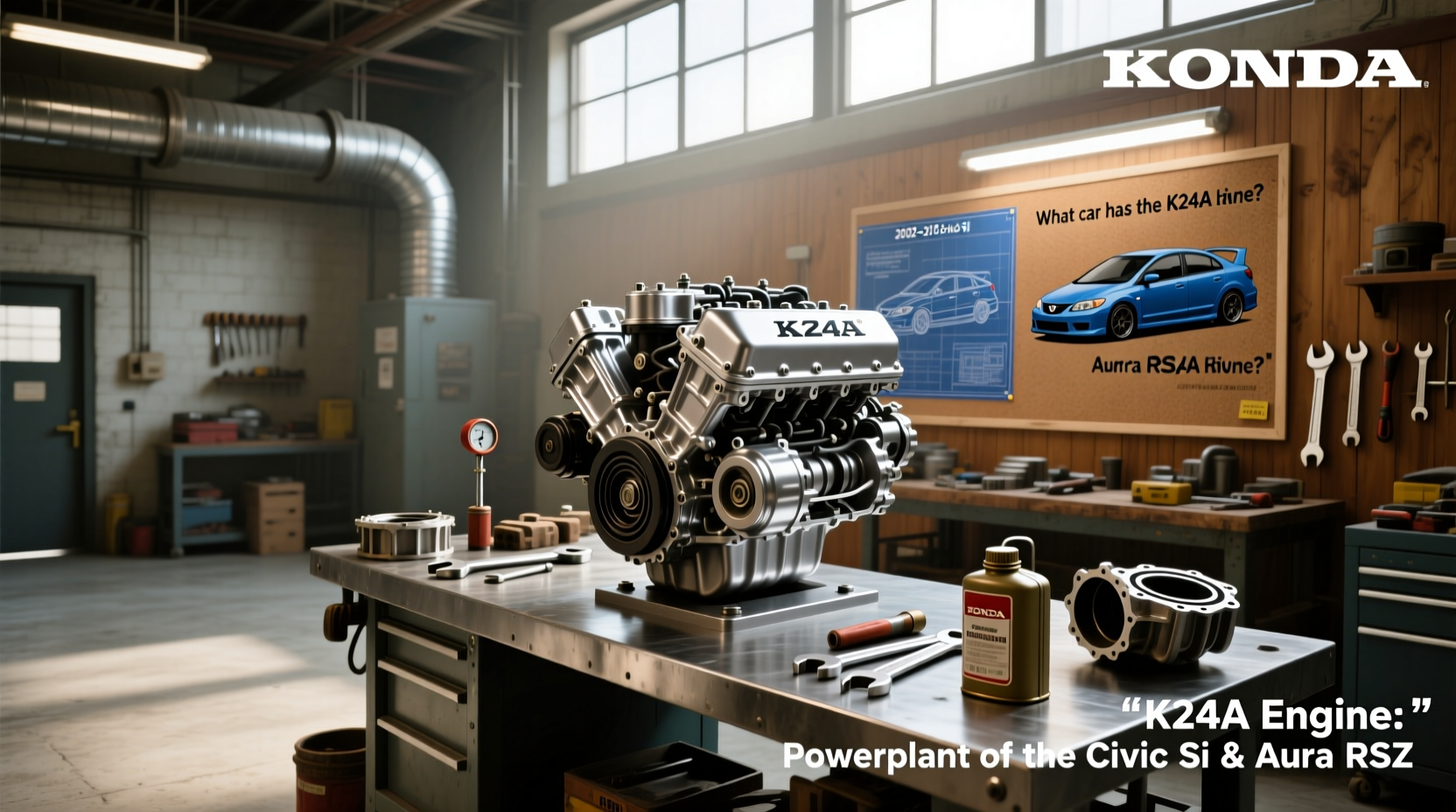
If you're asking how to choose a K24A engine or wondering what car has the K24A engine, your answer depends on your goal: OEM replacement, performance upgrade, or engine swap. The Honda K24A is a 2.4L inline-four from the renowned K-series, known for reliability, i-VTEC technology, and strong tuning potential 1. Key variants include the K24A1 (CR-V), K24A2 (TSX/Type-S), K24A4 (Accord/Element), and K24A8 (updated Accord/Element). For maximum performance, prioritize the K24A2; for daily use or swaps with modern electronics, consider the K24A8. Avoid engines without service history or with known oil consumption issues.
About the K24A Engine and Compatible Vehicles
The Honda K24A engine was introduced in 2001 as a larger-displacement evolution of the K20 series, designed to deliver more low-end torque while maintaining high-RPM responsiveness 2. It features a 2.4-liter displacement, aluminum block and head, and Honda’s i-VTEC system, which optimizes valve timing and lift for both efficiency and power. Unlike earlier VTEC systems, i-VTEC integrates variable timing on the intake cam, improving mid-range performance and fuel economy.
When researching what car has the K24A engine, focus on models produced between 2002 and 2011. The K24A powered several Honda and Acura vehicles globally, including the CR-V, Accord, Element, TSX, and Japan-market Odyssey Absolute. These applications vary significantly in tuning, output, and component quality. Understanding these differences is essential when deciding what to look for in a K24A engine based on your project needs—whether it’s OEM reliability, track use, or forced induction builds.
Why the K24A Engine Is Gaining Popularity
The K24A remains popular among enthusiasts due to its proven durability, widespread availability, and adaptability. In recent years, interest has grown in naturally aspirated high-revving engines as turbocharged platforms dominate new vehicle production. The K24A offers a balanced mix of 160–205 horsepower depending on variant, smooth power delivery, and a redline up to 7,200 RPM in high-output versions like the K24A2 3.
Additionally, the engine’s compatibility with aftermarket ECUs, turbo kits, and transmission swaps makes it ideal for DIY performance projects. Its use in the Acura TSX—a common donor car—means wiring harnesses, sensors, and accessories are readily available. This ecosystem supports both beginners and advanced builders, contributing to the K24A engine, what car has the K24A engine? search trend in forums and tuning communities.
Types and Variants of the K24A Engine
Understanding the differences between K24A variants is critical when deciding how to choose a K24A engine. Each version was tuned for specific markets and applications.
🔧 K24A1 – Honda CR-V (2002–2009)
Used in the second-generation North American CR-V, this variant prioritizes fuel efficiency and emissions compliance. Produces 156–160 hp.
- Pros: Reliable, widely available, good for daily drivers or mild swaps
- Cons: Lower compression ratio, conservative cam profile, limited tuning headroom
⚡ K24A2 – Acura TSX / Honda Accord Type-S (2002–2008)
Regarded as the most desirable K24A variant, used in the Acura TSX (North America) and Accord Type-S (Japan). Outputs 190–205 hp with a 10.5:1 compression ratio and aggressive cams.
- Pros: High redline (7,200 RPM), excellent airflow, ideal for performance builds
- Cons: More expensive, less common than base variants
⚙️ K24A3 – Honda Accord Euro (Australia/New Zealand, 2003–2005)
A sport-tuned version producing 188 hp. Found in the Accord Euro, which featured Recaro seats and stiffer suspension.
- Pros: Balanced performance and comfort, rare outside Oceania
- Cons: Limited parts availability internationally, fewer swap resources
🛒 K24A4 – Honda Accord & Element (2003–2006)
Designed for efficiency in the seventh-gen Accord and first-gen Element. Rated at 160 hp.
- Pros: Durable, common in junkyards, suitable for replacements
- Cons: Conservative tuning, lower output, older throttle cable system
🚚 K24A8 – Honda Accord & Element (2006–2011)
An updated K24A4 with drive-by-wire throttle, improved emissions, and slightly higher output (166–171 hp).
- Pros: Modern electronics, compatible with newer ECUs, smoother idle
- Cons: Slightly less robust than K24A2 for high-boost applications
Key Features and Specifications to Evaluate
When evaluating a K24A engine, inspect the following specifications to ensure it matches your intended use:
- Compression Ratio: Higher ratios (like 10.5:1 in the K24A2) indicate better efficiency and performance potential.
- Redline: Engines rated above 7,000 RPM (e.g., K24A2) are built for higher stress and respond better to tuning.
- Throttle System: Drive-by-wire (K24A8) simplifies integration with modern electronics but requires compatible ECUs.
- Cam Profile: Aggressive cams (found in K24A2) improve airflow and high-RPM power.
- Mileage and Maintenance History: Look for regular oil changes and absence of overheating or oil burning.
- Accessories Included: Intake manifold, alternator, ECU, and wiring harness affect installation complexity.
For swaps, verify compatibility with your chassis’ mounts, transmission, and cooling system.
✅ Pros and Cons of Choosing a K24A Engine
Advantages:
- Proven reliability with proper maintenance
- Strong aftermarket support for tuning and swaps
- Naturally aspirated design offers linear power delivery
- Versatile across multiple vehicle platforms
- i-VTEC provides broad torque curve
Limitations:
- Heavier than smaller K-series engines (K20)
- Some variants lack modern diagnostics or OBD-II readiness
- Drive-by-wire models require careful ECU matching
- Not originally designed for high-boost forced induction without internal upgrades
- Availability varies by region; some models are rare outside their home market
🛠️ How to Choose a K24A Engine: Step-by-Step Buying Guide
Follow this checklist to make an informed decision when searching for what car has the K24A engine and selecting the right one:
- Define Your Use Case: Replacement? Daily driver? Track build? Swap into a lightweight chassis?
- Select the Right Variant: Choose K24A2 for performance; K24A8 for modern compatibility; K24A1/A4 for budget replacements.
- Inspect Physical Condition: Check for oil leaks, coolant contamination, rust, and belt wear.
- Verify Service History: Ask for maintenance records. Engines with consistent oil changes last longer.
- Test Compression and Leakdown: Request test results or perform them yourself to assess internal health.
- Check ECU and Sensors: Ensure the ECU is included and sensors are intact, especially for drive-by-wire models.
- Confirm Compatibility: Match transmission type (manual/auto), motor mounts, and wiring harness to your project.
❗ What to Avoid When Buying a K24A Engine
- Engines with no documentation or unknown history
- Units showing signs of overheating (warped components, milky oil)
- High-mileage engines without compression tests
- Missing key components like ECU or intake manifold
- Purchase from sellers who won’t provide return options
💰 Price & Market Insights
K24A engine prices vary by variant, condition, and location. As of 2024:
- K24A1 / K24A4: $800–$1,500 (used, core-only)
- K24A2 (TSX donor): $1,500–$2,500 (complete long block with ECU)
- K24A8: $1,200–$2,000 (with wiring harness and accessories)
Prices may be lower at self-service junkyards or higher from certified rebuilders. Factor in shipping costs if purchasing online. Consider value: the K24A2 commands a premium due to performance potential, while K24A8 offers better integration with modern systems. Always compare complete packages—not just engine cost—when assessing value.
📊 Top-Seller & Competitive Analysis
The Acura TSX (2004–2008) is the most popular donor car for K24A engine swaps due to the inclusion of the high-output K24A2, complete wiring, and OEM reliability. Below is a comparison of top donor vehicles:
| Model | Engine Variant | HP | Key Advantages | Considerations |
|---|---|---|---|---|
| Acura TSX | K24A2 | 200–205 | High-performance engine, full harness, strong community support | Higher price, heavier sedan platform |
| Honda CR-V | K24A1 | 160 | Affordable, widely available, lighter SUV | Lower output, less aggressive tuning |
| Honda Element | K24A4/K24A8 | 160–166 | Durable, good for off-road or utility swaps | Bulkier body, limited aftermarket support |
📈 Customer Feedback Synthesis
Based on forum discussions and buyer reviews, common feedback includes:
- Positive: “The K24A2 pulls strong to redline,” “Reliable after 150k miles with regular oil changes,” “Perfect swap into my EG Civic.”
- Complaints: “Found a K24A4 with spun bearing—no history provided,” “Drive-by-wire harness didn’t match my standalone ECU,” “Shipping damaged the oil pan.”
Buyers consistently praise the K24A2’s performance and the K24A8’s modern features, while criticizing incomplete listings and poor seller communication. Always insist on detailed photos and testing data before purchase.
🔧 Sourcing & Supplier Tips
K24A engines can be sourced from:
- Junkyards: Local self-service yards offer low-cost cores; verify condition before removal.
- Online Marketplaces: eBay Motors, Facebook Marketplace, and specialized forums (e.g., K20Club) list complete engines.
- Rebuilders: Companies offering remanufactured K24As with warranties (typically 12–24 months).
For bulk or resale, contact salvage yard networks or importers. When ordering, request high-resolution images of all sides, the oil cap (for sludge check), and the VIN-linked service history if possible. Confirm return policies and shipping protection.
🧼 Maintenance, Safety & Legal Considerations
To maximize longevity, change oil every 5,000 miles with high-quality synthetic, replace timing components at 100k miles, and monitor for VTC actuator failure (common in cold climates). Use OEM-spec fluids and avoid prolonged idling.
Safety-wise, secure the engine properly during installation using correct mounts and fasteners. Test cooling system integrity before first start. For swaps, ensure exhaust routing doesn’t compromise ground clearance or cabin sealing.
Legally, verify that engine swaps comply with local emissions regulations. Some regions require the new engine to meet or exceed the original’s emissions standards. Always check with your DMV or transport authority before registering modified vehicles.
📌 Conclusion: Which K24A Engine Should You Choose?
If you need a reliable daily driver engine, the K24A1 or K24A8 from a CR-V or Element is cost-effective and durable. If you’re planning a performance build or swap, the K24A2 from an Acura TSX offers the best balance of power, tuning headroom, and component quality. When asking what car has the K24A engine, prioritize vehicles with documented maintenance and complete accessory packages. Always test or verify engine health before purchase to avoid costly repairs down the line.
❓ FAQs
What cars have the K24A engine?
The K24A engine was used in the Honda CR-V (2002–2009), Accord (2003–2007), Element (2003–2011), Acura TSX (2004–2008), and Japan-market Odyssey Absolute. Specific variants include K24A1, K24A2, K24A4, and K24A8.
Which K24A variant is best for performance?
The K24A2, found in the Acura TSX and Japanese Accord Type-S, is considered the best for performance due to its higher compression ratio (10.5:1), aggressive cam profiles, and 7,200 RPM redline.
Can the K24A handle turbocharging?
Yes, the K24A can handle forced induction, especially the K24A2 and K24A8 variants. However, sustained high boost may require forged internals, upgraded pistons, and proper tuning to prevent damage.
Is the K24A2 compatible with OBD2 systems?
Yes, the K24A2 is OBD2-compliant and uses standard diagnostic protocols. It integrates well with OEM and aftermarket ECUs designed for 2004–2008 Acura TSX models.
How much does a K24A engine swap cost?
Total swap costs range from $3,000 to $7,000+, including engine ($1,500–$2,500), transmission, mounts, harness, ECU, and labor. DIY projects reduce labor costs significantly.




 浙公网安备
33010002000092号
 浙B2-20120091-4